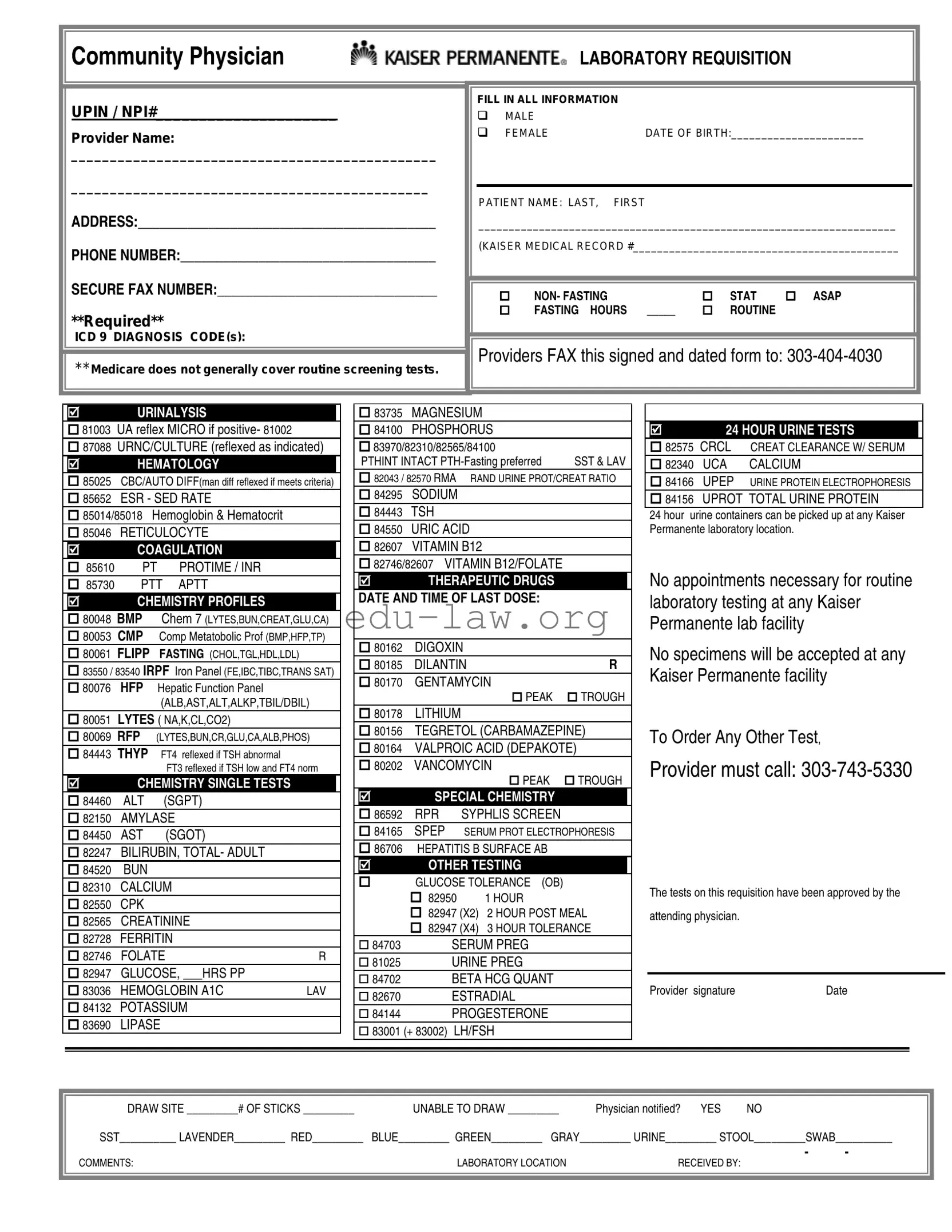
The Lab Requisition form is an essential document that streamlines the process of ordering laboratory tests. It includes critical information about the patient, such as their name, date of birth, and gender, ensuring that the right tests are performed for the right individual. Healthcare providers fill out their details, including their name, address, and contact information, which helps in maintaining clear communication. The form also requires specific diagnosis codes, which are vital for insurance purposes, particularly when it comes to Medicare coverage. Various tests can be requested, ranging from routine urinalysis to specialized chemistry profiles, allowing for a comprehensive assessment of the patient's health. Additionally, the form indicates whether the tests are to be performed on a fasting or non-fasting basis, and it provides options for urgent requests. With clear instructions for submitting the form via secure fax, the Lab Requisition form plays a crucial role in ensuring timely and accurate laboratory testing.
Community Physician |
LABORATORY REQUISITION |
|
|
UPIN / NPI#_____________________
Provider Name:
_______________________________________________
______________________________________________
ADDRESS:__________________________________________
PHONE NUMBER:____________________________________
SECURE FAX NUMBER:_______________________________
**Required**
ICD 9 DIAGNOSIS CODE(s):
**Medicare does not generally cover routine screening tests.
FILL IN ALL INFORMATION
ノ |
MALE |
|
ノ |
FEMALE |
DATE OF BIRTH:______________________ |
|
|
|
PATIENT NAME: LAST, |
FIRST |
|
_____________________________________________________________________
(KAISER MEDICAL RECORD #____________________________________________
ニ NON- FASTING |
ニ STAT |
ニ ASAP |
ニFASTING HOURS _____ ニ ROUTINE
Providers FAX this signed and dated form to:
|
[ |
URINALYSIS |
|
|
ニ 81003 |
UA reflex MICRO if positive- 81002 |
|
ニ 87088 URNC/CULTURE (reflexed as indicated)
[ HEMATOLOGY
ニ 85025 CBC/AUTO DIFF(man diff reflexed if meets criteria)
ニ 85652 ESR - SED RATE
ニ 85014/85018 Hemoglobin & Hematocrit
|
ニ 85046 |
RETICULOCYTE |
|
|
||
|
[ |
COAGULATION LB/SP1 L |
|
|
||
|
ニ 85610 |
PT |
PROTIME / INR |
|
|
|
|
ニ 85730 |
PTT |
APTT |
|
|
|
|
[ |
CHEMISTRY PROFILES |
|
|
||
|
ニ 80048 BMP |
Chem 7 (LYTES,BUN,CREAT,GLU,CA) |
|
|||
|
ニ 80053 |
CMP Comp Metatobolic Prof (BMP,HFP,TP) |
|
|||
|
ニ 80061 FLIPP |
FASTING (CHOL,TGL,HDL,LDL) |
|
|
||
|
ニ 83550 / 83540 IRPF Iron Panel (FE,IBC,TIBC,TRANS SAT) |
|
||||
|
ニ 80076 |
HFP |
Hepatic Function Panel |
|
|
|
|
|
|
(ALB,AST,ALT,ALKP,TBIL/DBIL) |
|
||
|
ニ 80051 |
LYTES ( NA,K,CL,CO2) |
|
|
||
|
ニ 80069 RFP |
(LYTES,BUN,CR,GLU,CA,ALB,PHOS) |
|
|||
|
ニ 84443 |
THYP |
FT4 |
reflexed if TSH abnormal |
|
|
|
|
|
FT3 reflexed if TSH low and FT4 norm |
|
||
|
[ |
CHEMISTRY SINGLE TESTS |
|
|
||
|
ニ 84460 |
ALT |
(SGPT) |
|
|
|
|
ニ 82150 |
AMYLASE |
|
|
|
|
|
ニ 84450 |
AST |
(SGOT) |
|
|
|
|
ニ 82247 BILIRUBIN, TOTAL- ADULT |
|
|
|||
|
ニ 84520 |
BUN |
|
|
|
|
|
ニ 82310 |
CALCIUM |
|
|
|
|
|
ニ 82550 |
CPK |
|
|
|
|
|
ニ 82565 |
CREATININE |
|
|
||
|
ニ 82728 |
FERRITIN |
|
|
|
|
|
ニ 82746 |
FOLATE |
|
R |
|
|
|
ニ 82947 GLUCOSE, ___HRS PP |
|
|
|||
|
ニ 83036 |
HEMOGLOBIN A1C |
LAV |
|
||
|
ニ 84132 |
POTASSIUM |
|
|
||
|
ニ 83690 |
LIPASE |
|
|
|
|
|
ニ 83735 |
MAGNESIUM |
|
|
|
|
|
ニ 84100 |
PHOSPHORUS |
|
|
||
|
ニ 83970/82310/82565/84100 |
|
|
|||
|
PTHINT INTACT |
SST & LAV |
||||
|
ニ 82043 / 82570 RMA |
RAND URINE PROT/CREAT RATIO |
||||
|
ニ 84295 |
SODIUM |
|
|
|
|
|
ニ 84443 |
TSH |
|
|
|
|
|
ニ 84550 |
URIC ACID |
|
|
|
|
|
ニ 82607 |
VITAMIN B12 |
|
|
|
|
|
ニ 82746/82607 VITAMIN B12/FOLATE |
|
|
|||
|
[ |
THERAPEUTIC DRUGS |
|
|
||
|
DATE AND TIME OF LAST DOSE: |
|
|
|||
|
|
|
|
|
|
|
|
ニ 80162 |
DIGOXIN |
|
|
|
|
|
ニ 80185 |
DILANTIN |
|
R |
||
|
ニ 80170 |
GENTAMYCIN |
|
|
||
|
|
|
|
ニ PEAK |
ニ TROUGH |
|
|
ニ 80178 |
LITHIUM |
|
|
|
|
|
ニ 80156 |
TEGRETOL (CARBAMAZEPINE) |
||||
|
ニ 80164 VALPROIC ACID (DEPAKOTE) |
|||||
|
ニ 80202 |
VANCOMYCIN |
|
|
||
|
|
|
|
ニ PEAK |
ニ TROUGH |
|
|
[ |
SPECIAL CHEMISTRY |
|
|
||
|
ニ 86592 |
RPR |
SYPHLIS SCREEN |
|
|
|
|
ニ 84165 |
SPEP |
SERUM PROT ELECTROPHORESIS |
|||
|
ニ 86706 HEPATITIS B SURFACE AB |
|
|
|||
|
[ |
OTHER TESTING |
|
|
||
|
ニ |
GLUCOSE TOLERANCE (OB) |
|
|
||
|
|
ニ 82950 |
|
1 HOUR |
|
|
|
|
ニ 82947 (X2) |
2 HOUR POST MEAL |
|||
|
|
ニ 82947 (X4) |
3 HOUR TOLERANCE |
|||
|
ニ 84703 |
SERUM PREG |
|
|
||
|
ニ 81025 |
URINE PREG |
|
|
||
|
ニ 84702 |
BETA HCG QUANT |
|
|
||
|
ニ 82670 |
ESTRADIAL |
|
|
||
|
ニ 84144 |
PROGESTERONE |
|
|
||
ニ 83001 (+ 83002) LH/FSH
|
|
|
|
|
|
[ |
24 HOUR URINE TESTS |
|
|
|
ニ 82575 CRCL |
CREAT CLEARANCE W/ SERUM |
|
|
|
ニ 82340 |
UCA |
CALCIUM |
|
|
ニ 84166 |
UPEP |
URINE PROTEIN ELECTROPHORESIS |
|
|
ニ 84156 |
UPROT TOTAL URINE PROTEIN |
|
|
24 hour urine containers can be picked up at any Kaiser Permanente laboratory location.
No appointments necessary for routine laboratory testing at any Kaiser Permanente lab facility
No specimens will be accepted at any Kaiser Permanente facility
To Order Any Other Test,
Provider must call:
The tests on this requisition have been approved by the attending physician.
Provider signature |
Date |
DRAW SITE _________# OF STICKS _________ |
UNABLE TO DRAW _________ |
Physician notified? |
YES |
NO |
|
SST__________ LAVENDER_________ RED_________ |
BLUE_________ GREEN_________ GRAY_________ URINE_________ STOOL_________SWAB__________ |
||||
For questions regarding tube types or other specimen collection issues, call the Laboratory Client Services Dept. at |
|||||
COMMENTS: |
|
LABORATORY LOCATION |
RECEIVED BY: |
|
|
Reorder form # 00254730 Kaiser Permanente form updated on 6/07 |
|
|
|
|
|
| Fact Name | Description |
|---|---|
| Purpose | The Lab Requisition form is used by healthcare providers to order laboratory tests for patients. |
| Required Information | Providers must fill out patient demographics, diagnosis codes, and specific tests requested on the form. |
| ICD Codes | ICD 9 Diagnosis Codes are required, as Medicare does not generally cover routine screening tests. |
| Submission Method | The completed form must be faxed to the designated laboratory number, 303-404-4030. |
| State-Specific Law | In Colorado, the use of lab requisition forms is governed by state health regulations and Medicare guidelines. |
| Patient Identification | Each form requires the patient's name, date of birth, and gender to ensure accurate testing and record-keeping. |
Completing the Lab Requisition form is a straightforward process that requires accurate information to ensure proper testing and diagnosis. Once the form is filled out, it should be submitted to the designated laboratory. Below are the steps to effectively complete the form.
What is a Lab Requisition form?
A Lab Requisition form is a document used by healthcare providers to request specific laboratory tests for their patients. This form contains essential information such as the patient's details, the tests required, and the provider's information. It ensures that the laboratory has all the necessary data to perform the tests accurately and efficiently.
Why is the ICD 9 Diagnosis Code required?
The ICD 9 Diagnosis Code is crucial because it helps the laboratory understand the medical reason for the tests being ordered. It also plays a significant role in insurance billing. Without this code, there may be delays in processing or issues with coverage, especially for patients on Medicare, which often does not cover routine screening tests.
What should I do if I need to order additional tests not listed on the form?
If you need to order tests that are not included on the Lab Requisition form, it is essential to call the designated number at 303-743-5330. The laboratory staff will guide you through the process and ensure that the additional tests are properly requested and documented.
How do I submit the Lab Requisition form?
Once the Lab Requisition form is completed and signed, it should be faxed to the laboratory at 303-404-4030. Ensure that all sections are filled out accurately to avoid any delays in processing the tests. Timely submission is vital for receiving results quickly.
What information is needed for the patient section of the form?
The patient section of the Lab Requisition form requires the patient's full name (last and first), date of birth, and gender. This information is essential for identifying the patient correctly and ensuring that the test results are accurately attributed to the right individual.
What if a patient is unable to draw blood?
If a patient is unable to draw blood, this should be indicated on the form in the designated area. It is also important to notify the physician about this situation. The laboratory staff may need to take alternative steps or schedule a follow-up to ensure that the necessary tests are completed.
Where can I pick up 24-hour urine test containers?
24-hour urine test containers can be picked up at any Kaiser Permanente laboratory location. No appointment is necessary for this process. Simply visit the lab facility, and the staff will provide you with the containers you need for your test.
Incomplete Provider Information: Failing to fill out the provider's name, address, or contact details can lead to delays in processing the requisition.
Missing Diagnosis Code: Not including the required ICD-9 diagnosis code can result in the rejection of the test request, especially for Medicare patients.
Incorrect Patient Details: Errors in the patient's name or date of birth can cause confusion and misidentification of test results.
Not Indicating Test Urgency: Failing to mark whether the test is routine, STAT, or ASAP may lead to inappropriate prioritization of the tests.
Omitting Fasting Status: Not indicating if the patient is fasting or non-fasting can affect the accuracy of certain test results.
Not Specifying the Draw Site: Leaving the draw site blank can lead to confusion during specimen collection, impacting efficiency.
Missing Signature: A requisition form without a provider's signature is invalid and will not be processed.
Failing to Indicate Number of Sticks: Not providing the number of sticks attempted can hinder the laboratory's understanding of the collection process.
Ignoring Comments Section: Neglecting to use the comments section for special instructions or notes may lead to misunderstandings about the patient's condition or needs.
The Lab Requisition form is a crucial document in the medical field, often accompanied by various other forms and documents that facilitate patient care and laboratory testing. Understanding these additional forms can enhance communication between healthcare providers and ensure accurate and timely testing. Below is a list of common documents used alongside the Lab Requisition form.
These forms and documents work together to create a streamlined process for laboratory testing and patient care. By understanding their purposes, healthcare providers can enhance the quality of care and ensure that patients receive the best possible service.
The Lab Requisition form shares similarities with a Prescription form, which is a document used by healthcare providers to authorize medications for patients. Both forms require essential patient information, including name, date of birth, and specific details about the requested services or medications. Just as a Lab Requisition outlines necessary tests, a Prescription specifies the medications and dosages required for treatment. Both documents must be signed by a licensed provider, ensuring that the patient's care is directed by a qualified professional.
Another document akin to the Lab Requisition is the Referral form. This form is used when a healthcare provider recommends that a patient see a specialist for further evaluation or treatment. Like the Lab Requisition, it includes patient information and the reason for the referral. Both documents facilitate communication between healthcare providers, ensuring that patients receive comprehensive care tailored to their needs.
A Patient Registration form is also similar to the Lab Requisition. This form collects essential information about a patient, such as contact details, insurance information, and medical history. While the Lab Requisition focuses on specific laboratory tests, the Patient Registration form serves a broader purpose in establishing a patient's identity and ensuring that their medical records are accurate and up to date.
The Consent form bears resemblance to the Lab Requisition as well. This document is used to obtain a patient's permission for various medical procedures or treatments. Both forms require clear communication about what the patient is consenting to, whether it be laboratory testing or a medical procedure. Each document ensures that patients are informed and involved in their healthcare decisions.
In addition, the Medical History form shares common ground with the Lab Requisition. This document gathers comprehensive information about a patient's past medical conditions, surgeries, and family health history. Similar to the Lab Requisition, it helps healthcare providers understand the patient's health background, which can influence the selection of appropriate tests and treatments.
The Insurance Authorization form is another document that parallels the Lab Requisition. This form is used to obtain approval from an insurance company for specific medical services or tests. Just as the Lab Requisition outlines the necessary tests, the Insurance Authorization form details the services being requested to ensure coverage. Both documents are essential for navigating the complexities of healthcare and insurance.
A Treatment Plan is also similar to the Lab Requisition in that it outlines the specific interventions a patient will receive. This document typically includes diagnostic tests, medications, and other therapeutic measures. Like the Lab Requisition, a Treatment Plan is developed by a healthcare provider and is tailored to meet the individual needs of the patient.
The Discharge Summary document shares similarities with the Lab Requisition as well. This summary is provided when a patient is released from a healthcare facility and includes important information about the patient's treatment and follow-up care. Both documents serve to communicate critical information about a patient's health status and the next steps in their care journey.
Another related document is the Laboratory Test Results form. This form presents the findings from laboratory tests and is typically generated after a Lab Requisition has been processed. While the Lab Requisition requests specific tests, the Test Results form provides the outcomes, allowing healthcare providers to make informed decisions about further treatment or intervention.
Finally, the Follow-Up Appointment form is similar to the Lab Requisition in that it is used to schedule additional care after initial tests or treatments. Both documents are essential for ensuring continuity of care and keeping patients engaged in their healthcare journey. The Follow-Up Appointment form may reference the results of the tests requested on the Lab Requisition, further linking these two important documents in the healthcare process.
When filling out the Lab Requisition form, attention to detail is crucial. Here’s a list of six important dos and don’ts to ensure the process goes smoothly.
Following these guidelines can help avoid unnecessary complications and ensure that the lab receives all the information needed for efficient processing. Clear communication is essential in healthcare, and your attention to detail makes a significant difference.
Many people believe that the lab requisition form is solely for blood tests. In reality, it covers a wide range of tests, including urine tests, cultures, and special chemistry tests.
While it is common for physicians to complete the form, other qualified healthcare providers can also fill it out. This includes nurse practitioners and physician assistants.
Some individuals think that they can skip sections of the form. However, filling in all required information is crucial for accurate testing and billing. Missing details can lead to delays or errors.
This form is not limited to routine tests. It is also essential for specialized tests and diagnostics, making it a vital part of patient care.
Patients often assume their providers have all their medical history. However, informing providers about previous tests can help ensure appropriate testing and avoid unnecessary procedures.
Each laboratory may have its own specific requisition form. It is important to use the correct form for the laboratory where the tests will be performed.
Some believe that once the form is submitted, they will automatically receive results. Following up with the laboratory or provider can help ensure that tests are completed and results are communicated effectively.
When filling out the Lab Requisition form, keep the following key points in mind:
By following these guidelines, the process of filling out and using the Lab Requisition form will be smoother and more efficient.