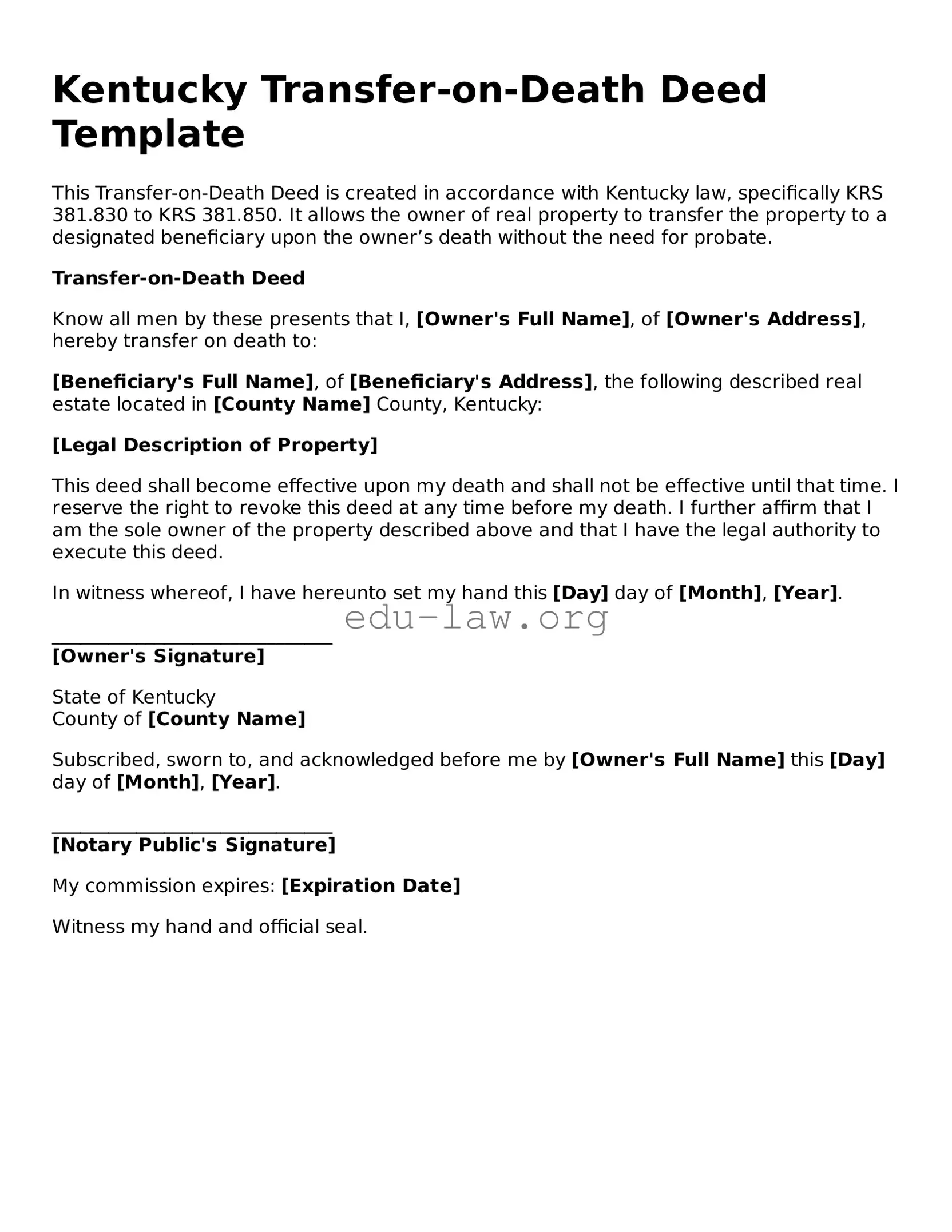
The Kentucky Transfer-on-Death Deed (TOD) form serves as a crucial tool for property owners seeking to simplify the transfer of real estate upon their death. This legal instrument allows individuals to designate one or more beneficiaries who will automatically receive ownership of the property without the need for probate proceedings. The form must be properly executed and recorded to ensure its effectiveness, and it can be revoked or modified at any time during the property owner's lifetime. Importantly, the TOD deed does not affect the owner's rights to use or sell the property while they are alive. This mechanism provides a straightforward way to pass on real estate, potentially reducing the emotional and financial burdens often associated with estate planning. Understanding the requirements and implications of the TOD deed is essential for anyone considering this option in Kentucky, as it can significantly impact how assets are managed and distributed after death.
Kentucky Transfer-on-Death Deed Template
This Transfer-on-Death Deed is created in accordance with Kentucky law, specifically KRS 381.830 to KRS 381.850. It allows the owner of real property to transfer the property to a designated beneficiary upon the owner’s death without the need for probate.
Transfer-on-Death Deed
Know all men by these presents that I, [Owner's Full Name], of [Owner's Address], hereby transfer on death to:
[Beneficiary's Full Name], of [Beneficiary's Address], the following described real estate located in [County Name] County, Kentucky:
[Legal Description of Property]
This deed shall become effective upon my death and shall not be effective until that time. I reserve the right to revoke this deed at any time before my death. I further affirm that I am the sole owner of the property described above and that I have the legal authority to execute this deed.
In witness whereof, I have hereunto set my hand this [Day] day of [Month], [Year].
______________________________
[Owner's Signature]
State of Kentucky
County of [County Name]
Subscribed, sworn to, and acknowledged before me by [Owner's Full Name] this [Day] day of [Month], [Year].
______________________________
[Notary Public's Signature]
My commission expires: [Expiration Date]
Witness my hand and official seal.
| Fact Name | Description |
|---|---|
| Definition | A Transfer-on-Death (TOD) deed allows property owners in Kentucky to transfer real estate to a beneficiary upon their death, without going through probate. |
| Governing Law | The TOD deed is governed by Kentucky Revised Statutes, specifically KRS 382.850 to 382.860. |
| Eligibility | Any individual who owns real property in Kentucky can create a TOD deed. |
| Beneficiary Designation | Property owners can name one or more beneficiaries in the TOD deed. |
| Revocation | The property owner can revoke the TOD deed at any time before their death, using a written document. |
| Execution Requirements | The deed must be signed by the property owner and notarized to be valid. |
| Recording | To be effective, the TOD deed must be recorded in the county where the property is located. |
| Impact on Creditors | Transfer-on-Death deeds do not shield property from creditors; debts may still need to be settled from the estate. |
| Tax Implications | Beneficiaries may face tax implications when they inherit property through a TOD deed. |
| Limitations | Not all types of property can be transferred via a TOD deed, such as personal property or property held in joint tenancy. |
Filling out the Kentucky Transfer-on-Death Deed form is a crucial step in ensuring that your property is transferred according to your wishes upon your passing. After completing the form, it must be signed and notarized before being recorded with the county clerk's office. Follow these steps carefully to ensure accuracy and compliance.
What is a Transfer-on-Death Deed in Kentucky?
A Transfer-on-Death Deed (TODD) is a legal document that allows a property owner to designate one or more beneficiaries to receive their real estate upon their death. This deed enables the transfer of property without going through probate, simplifying the process for heirs. The owner retains full control of the property during their lifetime and can change the beneficiaries or revoke the deed if necessary.
Who can create a Transfer-on-Death Deed in Kentucky?
In Kentucky, any individual who owns real estate can create a Transfer-on-Death Deed. This includes homeowners, landowners, and those with a vested interest in the property. It is important for the property owner to be of sound mind and to understand the implications of designating beneficiaries.
How do I fill out a Transfer-on-Death Deed form?
To complete a Transfer-on-Death Deed form, the property owner must provide specific information, including their name, the legal description of the property, and the names of the designated beneficiaries. It is essential to ensure that the information is accurate and complete. Once filled out, the deed must be signed and notarized to be legally valid.
Do I need to file the Transfer-on-Death Deed with the county?
Yes, after completing the Transfer-on-Death Deed, it must be filed with the county clerk's office where the property is located. This filing ensures that the deed is part of the public record, making it enforceable upon the property owner's death. There may be a filing fee associated with this process.
Can I change or revoke a Transfer-on-Death Deed after it is created?
Yes, property owners have the right to change or revoke a Transfer-on-Death Deed at any time during their lifetime. To do this, the owner must create a new deed or a formal revocation document and file it with the county clerk. It is advisable to inform the beneficiaries of any changes to avoid confusion later on.
What happens if a beneficiary predeceases the property owner?
If a designated beneficiary passes away before the property owner, their share typically does not transfer to that beneficiary's heirs unless specified otherwise in the deed. Instead, the share may be distributed among the remaining beneficiaries or according to the property owner's wishes if no alternate beneficiaries are named.
Are there any tax implications associated with a Transfer-on-Death Deed?
Generally, a Transfer-on-Death Deed does not trigger immediate tax consequences for the property owner. However, beneficiaries may be subject to estate taxes or other tax considerations upon the owner's death. It is wise for property owners and beneficiaries to consult with a tax professional to understand any potential implications.
Not including all required information. Each section of the form must be filled out completely. Missing details can lead to delays or issues with the deed.
Using incorrect names. Ensure that the names of all parties involved are spelled correctly and match official documents. This helps avoid confusion later.
Failing to sign the form. The deed must be signed by the property owner. Without a signature, the document is not valid.
Not having the deed notarized. A notary public must witness the signing of the deed. This step is essential for the deed to be legally recognized.
Overlooking property description details. The property must be clearly identified, including its address and any relevant legal descriptions. Ambiguities can create problems.
Not understanding the implications of the deed. It’s important to know that this deed transfers ownership upon death. Individuals should fully understand their choices before proceeding.
When considering a Transfer-on-Death Deed in Kentucky, it's essential to understand that several other documents may also be involved in the estate planning process. Each of these documents serves a specific purpose and can help ensure that your wishes are carried out effectively. Below is a list of commonly used forms and documents that often accompany the Transfer-on-Death Deed.
Understanding these documents can greatly enhance your estate planning strategy. By ensuring that each form is correctly completed and in place, you can provide clarity and peace of mind for yourself and your loved ones.
The Kentucky Transfer-on-Death Deed (TOD) form is similar to a Will in that both documents facilitate the transfer of property upon the death of the owner. A Will outlines how a person's assets should be distributed after their passing. However, unlike a Will, which goes through probate, a TOD deed allows for the direct transfer of property without the need for probate court involvement. This can save time and reduce costs for the beneficiaries, making the TOD deed an attractive option for property owners who wish to simplify the transfer process.
An Affidavit of Heirship shares similarities with the TOD deed as both documents address the transfer of property after an individual's death. The Affidavit of Heirship is used to establish the rightful heirs of a deceased person's property, often in situations where no Will exists. While the TOD deed specifies the beneficiaries during the owner's lifetime, the Affidavit serves to confirm who those beneficiaries are after the owner's death. Both documents aim to clarify ownership and facilitate a smoother transition of property rights.
The Joint Tenancy with Right of Survivorship is another document that shares characteristics with the TOD deed. In a joint tenancy, two or more individuals hold title to a property together, and when one owner dies, their share automatically passes to the surviving owner(s). This mechanism is similar to the TOD deed, which allows for the direct transfer of property upon death. Both arrangements provide a straightforward way to ensure that property ownership is transferred without the need for probate, promoting efficiency in estate planning.
A Revocable Living Trust is akin to the TOD deed in that both are used to manage and transfer property outside of probate. A Revocable Living Trust allows the creator to retain control over their assets during their lifetime while designating beneficiaries for those assets after death. Similar to the TOD deed, the trust can help streamline the transfer process and maintain privacy, as it does not become a public record. Both documents offer flexibility and ease of transfer, making them popular choices for estate planning.
Finally, a Beneficiary Designation form is similar to the TOD deed in that it allows individuals to name beneficiaries for certain assets, such as bank accounts or retirement plans. Both documents serve the purpose of directing how property will be transferred upon death. The key difference lies in the types of assets they cover; the TOD deed specifically addresses real property, while Beneficiary Designation forms can apply to various financial accounts. Each method simplifies the transfer process, ensuring that the intended recipients receive the assets without unnecessary delays.
When filling out the Kentucky Transfer-on-Death Deed form, it's essential to approach the process with care. This deed allows property owners to designate beneficiaries who will receive their property upon their passing. Here are ten important do's and don'ts to consider.
By following these guidelines, you can ensure that the Transfer-on-Death Deed is completed correctly and serves its intended purpose effectively.
The Kentucky Transfer-on-Death Deed (TODD) form is often misunderstood. Here are seven common misconceptions about this legal tool, along with clarifications to help individuals navigate its use effectively.
This is incorrect. While the TODD form primarily applies to real estate, it can also be used to transfer other assets, depending on state laws. However, it is essential to verify what can be included in the transfer.
This is a misconception. While a TODD can help bypass probate for the property it covers, other assets not included in the TODD may still be subject to probate. Therefore, it does not eliminate probate entirely.
It is true that the TODD deed must be executed and recorded during the owner's lifetime. However, some individuals believe they can wait until they are seriously ill to complete this process, which can lead to complications.
This is misleading. The TODD deed designates specific beneficiaries, which means that only those named in the deed will inherit the property. Other heirs may not have any claim unless they are included in the deed.
This is not accurate. A TODD deed can be revoked or changed by the original owner at any time before their death. This can be done through a new deed or by explicitly stating the revocation in writing.
This is a common belief, but it is not entirely true. While the transfer itself may not incur immediate taxes, beneficiaries may face tax implications upon the sale of the property or if the estate exceeds certain thresholds.
While it is possible to create a TODD deed without legal help, this can lead to errors or misunderstandings. Seeking guidance from a legal professional ensures that the deed is executed correctly and aligns with the owner’s intentions.
Understanding these misconceptions can empower individuals to make informed decisions regarding property transfer in Kentucky. Properly utilizing the TODD form can simplify estate planning and help ensure that one's wishes are honored after passing.
Understanding the Kentucky Transfer-on-Death Deed form is essential for effective estate planning. Here are some key takeaways to keep in mind: