Navigating the complexities of estate administration can often be overwhelming, particularly when dealing with the loss of a loved one. In Kentucky, the Small Estate Affidavit provides a streamlined process for settling the affairs of a deceased individual whose estate falls below a certain value threshold. This form allows eligible heirs to bypass the lengthy probate process, enabling them to claim assets more swiftly and efficiently. Generally applicable to estates valued at $30,000 or less, the affidavit must be completed and signed by the heirs, affirming their relationship to the deceased and their entitlement to the estate's assets. Essential details, such as the decedent's date of death and the list of assets, must be included to ensure compliance with state regulations. Moreover, the form requires notarization, adding a layer of authenticity to the claims made by the heirs. By understanding the Small Estate Affidavit, individuals can facilitate the transfer of assets while minimizing potential disputes and delays, ultimately honoring the wishes of the deceased with respect and efficiency.
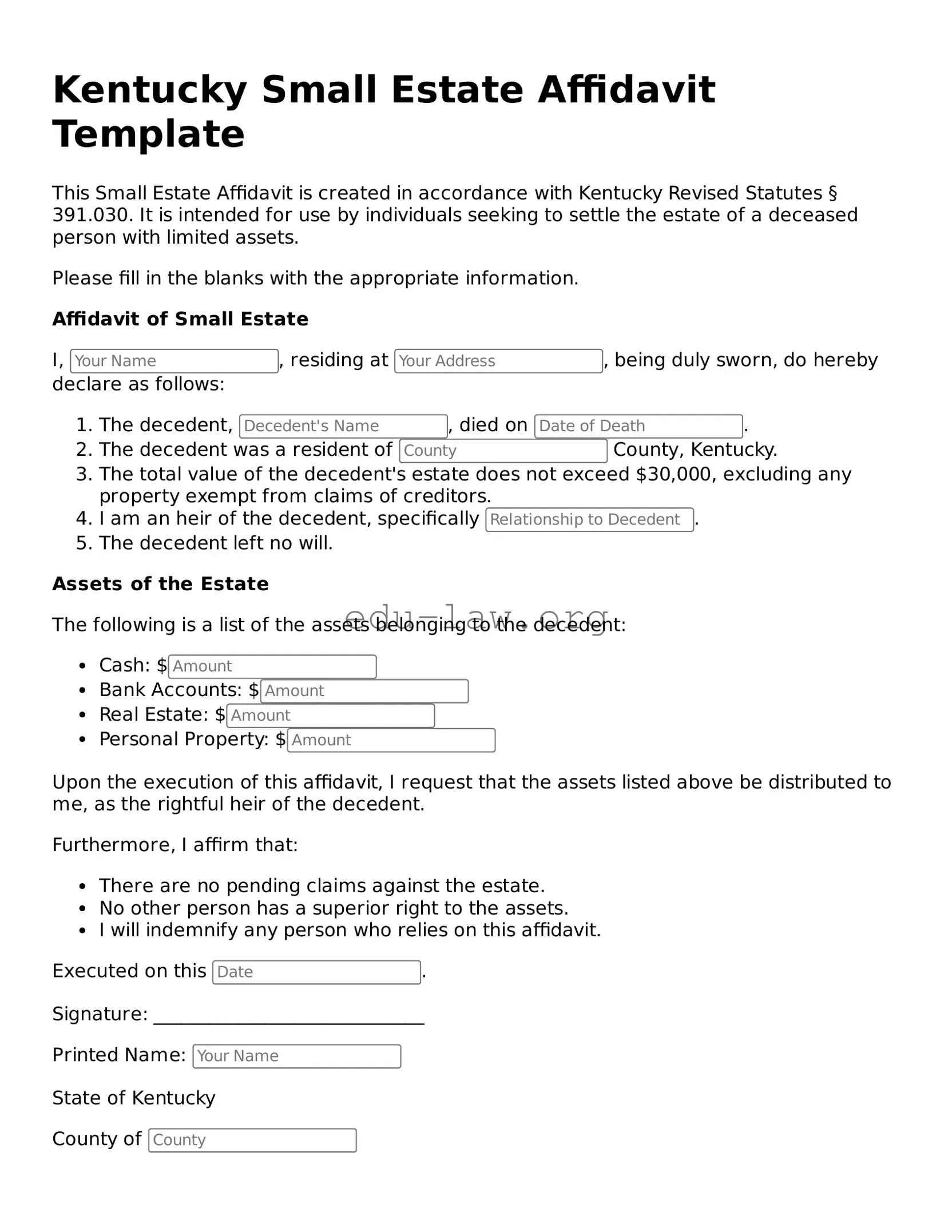
Kentucky Small Estate Affidavit Template
This Small Estate Affidavit is created in accordance with Kentucky Revised Statutes § 391.030. It is intended for use by individuals seeking to settle the estate of a deceased person with limited assets.
Please fill in the blanks with the appropriate information.
Affidavit of Small Estate
I, , residing at , being duly sworn, do hereby declare as follows:
Assets of the Estate
The following is a list of the assets belonging to the decedent:
Upon the execution of this affidavit, I request that the assets listed above be distributed to me, as the rightful heir of the decedent.
Furthermore, I affirm that:
Executed on this .
Signature: _____________________________
Printed Name:
State of Kentucky
County of
Subscribed and sworn to before me this .
Notary Public: _____________________________
My commission expires:
| Fact Name | Description |
|---|---|
| Purpose | The Kentucky Small Estate Affidavit allows heirs to claim property of a deceased person without going through formal probate, simplifying the process for small estates. |
| Eligibility | This form is applicable when the total value of the estate is less than $30,000, excluding certain types of property, such as real estate. |
| Governing Law | The use of the Small Estate Affidavit in Kentucky is governed by KRS 391.030, which outlines the requirements and procedures for small estate claims. |
| Filing Requirements | The affidavit must be signed by all heirs and filed with the county clerk where the deceased resided at the time of death. |
| Required Information | The form requires details such as the deceased's name, date of death, and a list of assets and their estimated values. |
| Limitations | While the affidavit streamlines the process, it cannot be used for estates that include real property or for estates that exceed the value limit. |
After gathering the necessary information and documentation, you are ready to complete the Kentucky Small Estate Affidavit form. This form will facilitate the transfer of assets from a deceased person's estate without the need for formal probate proceedings. Follow the steps outlined below to accurately fill out the form.
What is a Kentucky Small Estate Affidavit?
The Kentucky Small Estate Affidavit is a legal document that allows individuals to settle the estate of a deceased person without going through the full probate process. This simplified procedure is designed for estates that fall below a certain value threshold, making it easier and quicker for heirs to access the deceased's assets. Typically, the estate must be valued at less than $30,000 for individuals or $60,000 for married couples. By using this affidavit, heirs can claim property, bank accounts, and other assets directly.
Who can use the Small Estate Affidavit in Kentucky?
In Kentucky, the Small Estate Affidavit can be utilized by the surviving spouse, children, or other heirs of the deceased. To qualify, the person filing the affidavit must be entitled to inherit under Kentucky law. It's important to ensure that the estate meets the value limit and that all debts and taxes of the deceased have been settled before proceeding with this option. If there are disputes among heirs or if the estate is more complicated, it might be wise to consider formal probate proceedings instead.
How do I complete the Small Estate Affidavit?
Completing the Kentucky Small Estate Affidavit involves several steps. First, you will need to gather relevant information about the deceased, including their full name, date of death, and details about their assets and liabilities. Next, fill out the affidavit form, ensuring all required sections are completed accurately. You must also include a statement that confirms the total value of the estate does not exceed the limits set by Kentucky law. Finally, the affidavit needs to be signed in front of a notary public to validate it before submission to the appropriate entities, such as banks or property title offices.
What happens after I file the Small Estate Affidavit?
After filing the Small Estate Affidavit, the heirs can begin to claim the assets of the deceased. Institutions such as banks and title companies will typically require a copy of the notarized affidavit to release funds or transfer property. It’s essential to keep copies of all documents for your records. If any issues arise, such as challenges from other potential heirs or creditors, it may be necessary to consult with a legal professional to navigate those complexities. Generally, the process allows for a smoother transition of assets without the lengthy probate process.
Failing to list all eligible heirs. It is important to include every person entitled to inherit under Kentucky law. Omitting an heir can lead to complications or disputes later.
Not providing accurate information about the deceased. Ensure that the name, date of birth, and date of death are correct. Errors in this information can cause delays in processing the affidavit.
Neglecting to sign the affidavit in front of a notary. A signature without notarization can render the document invalid. Make sure to complete this step to ensure the affidavit is legally binding.
Overlooking the requirement for a complete list of assets. All assets owned by the deceased must be accounted for. This includes bank accounts, real estate, and personal property. Missing any asset can complicate the distribution process.
Submitting the affidavit without the necessary supporting documents. Required documents may include a death certificate and proof of the relationship to the deceased. Failing to include these can delay the process.
When dealing with the Kentucky Small Estate Affidavit, several other forms and documents may be necessary to ensure a smooth process in settling a deceased person's estate. Each of these documents plays a crucial role in providing clarity and legal backing to the estate's administration.
Understanding these accompanying documents is vital for anyone navigating the small estate process in Kentucky. Each form contributes to a clearer picture of the estate and ensures that the wishes of the deceased are honored appropriately.
The Kentucky Small Estate Affidavit is similar to the Affidavit of Heirship, which is often used in probate cases. This document helps establish the rightful heirs of a deceased person's estate when no will exists. Like the Small Estate Affidavit, the Affidavit of Heirship allows heirs to claim property without going through the lengthy probate process. Both documents aim to streamline the transfer of assets and reduce the burden on families during a difficult time.
Another comparable document is the Petition for Summary Administration. This form is utilized in situations where an estate is small and can be settled without the full probate process. Similar to the Small Estate Affidavit, the Petition for Summary Administration allows for a quicker resolution, enabling heirs to access the deceased's assets with minimal court involvement. Both documents serve to simplify the legal process surrounding the distribution of an estate.
The Will itself can also be seen as a related document. While the Small Estate Affidavit is used when there is no will, a Will outlines how a deceased person's assets should be distributed. Both documents are integral to the estate planning process. A Will requires probate, whereas the Small Estate Affidavit bypasses that requirement, allowing heirs to claim property directly.
The Affidavit of Collection is another document that shares similarities with the Small Estate Affidavit. This form allows individuals to collect personal property from a deceased person's estate without the need for probate. Like the Small Estate Affidavit, it provides a straightforward way for heirs to gain access to assets, thus minimizing delays and legal complexities.
The Renunciation of Right to Administer is also relevant. This document is used when an individual who is eligible to serve as an executor or administrator of an estate chooses not to take on that responsibility. While it does not directly facilitate the transfer of assets like the Small Estate Affidavit, it plays a role in the overall estate administration process. Both documents help streamline the handling of an estate, ensuring that the wishes of the deceased are honored efficiently.
Lastly, the Affidavit of Small Estate Value is another similar document. This affidavit is used to declare the total value of an estate, typically when it is below a certain threshold. Like the Small Estate Affidavit, it allows for the expedited transfer of assets without the need for full probate proceedings. Both documents aim to ease the process for families dealing with the loss of a loved one, providing a means to settle affairs with minimal legal intervention.
When filling out the Kentucky Small Estate Affidavit form, it is essential to approach the process with care. This form allows individuals to settle the estate of a deceased person without going through a lengthy probate process. Below is a list of ten important dos and don’ts to consider.
By following these guidelines, individuals can navigate the Kentucky Small Estate Affidavit process more smoothly and ensure that they comply with the necessary legal requirements.
Understanding the Kentucky Small Estate Affidavit form can be challenging. Here are five common misconceptions about this form:
This is not true. The Small Estate Affidavit is available for estates with a total value below a certain threshold, which is accessible to many individuals, regardless of their financial status.
Not all assets qualify for the Small Estate Affidavit. Some assets, such as real estate or jointly owned property, may require different legal processes.
This is a misconception. While it is beneficial to have consensus among heirs, the affidavit can still be filed even if not all parties agree, provided the form is filled out correctly.
While the affidavit simplifies the process, it does not completely eliminate the need for probate in all cases. Some situations may still require formal probate proceedings.
Filling out and using the Kentucky Small Estate Affidavit form can be a straightforward process, but it’s essential to understand the key elements involved. Here are some important takeaways to keep in mind:
Understanding these key points can simplify the process of using the Kentucky Small Estate Affidavit form and help ensure that you navigate it successfully.