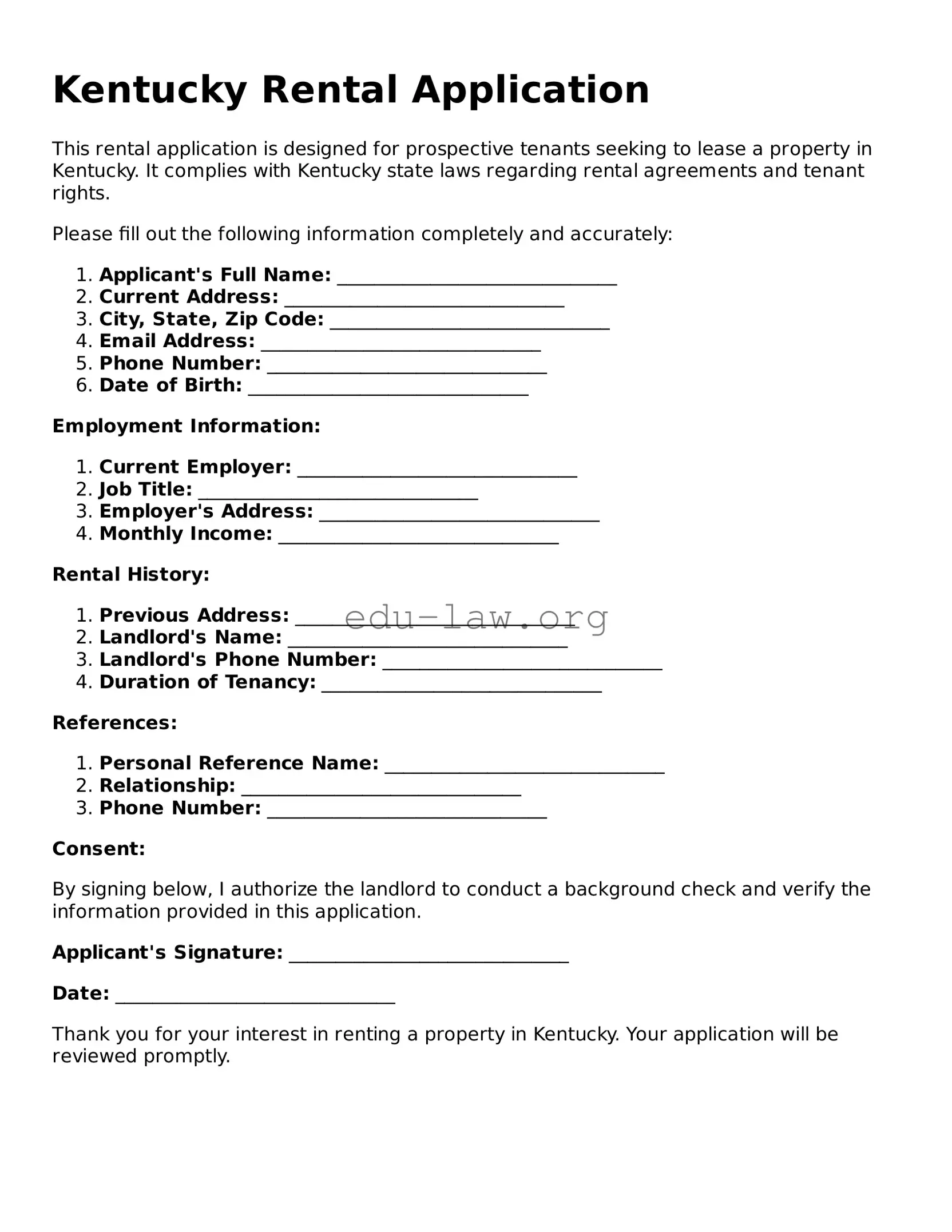
When seeking a new rental property in Kentucky, prospective tenants often encounter the Kentucky Rental Application form, a crucial document that helps landlords assess potential renters. This form typically requires a range of personal information, including the applicant's name, contact details, and social security number, which are essential for conducting background checks. Additionally, applicants must provide employment history and income verification to demonstrate their financial stability. References from previous landlords or personal contacts may also be requested, offering insight into the applicant's reliability as a tenant. Furthermore, the form often includes questions about pets, smoking preferences, and any special accommodations needed, allowing landlords to make informed decisions that align with their property policies. Understanding the components of this application is vital for both renters and landlords, as it lays the groundwork for a successful rental relationship.
Kentucky Rental Application
This rental application is designed for prospective tenants seeking to lease a property in Kentucky. It complies with Kentucky state laws regarding rental agreements and tenant rights.
Please fill out the following information completely and accurately:
Employment Information:
Rental History:
References:
Consent:
By signing below, I authorize the landlord to conduct a background check and verify the information provided in this application.
Applicant's Signature: ______________________________
Date: ______________________________
Thank you for your interest in renting a property in Kentucky. Your application will be reviewed promptly.
| Fact Name | Description |
|---|---|
| Purpose | The Kentucky Rental Application form is used by landlords to screen potential tenants. It helps gather necessary information for evaluating an applicant's suitability for renting a property. |
| Required Information | Applicants typically need to provide personal details, rental history, employment information, and references. This information assists landlords in making informed decisions. |
| Governing Laws | The use of rental applications in Kentucky is governed by state laws, including the Kentucky Residential Tenant Act. This ensures that both landlords and tenants are protected during the rental process. |
| Application Fees | Landlords in Kentucky may charge an application fee. However, this fee must be reasonable and should be disclosed upfront to the applicant. |
After obtaining the Kentucky Rental Application form, you will need to provide various personal and financial details to complete it. Ensure that you have all necessary information at hand before starting to fill out the form. Follow these steps carefully to ensure accuracy.
Once you have completed the form, review all entries for accuracy. Make sure to submit the application according to the instructions provided by the landlord or property manager.
What is a Kentucky Rental Application form?
The Kentucky Rental Application form is a document used by landlords to collect information from potential tenants. It typically includes personal details, rental history, employment information, and references. This form helps landlords assess the suitability of applicants for renting their property.
Why do I need to fill out a rental application?
Filling out a rental application is essential for landlords to determine if you meet their criteria for renting a property. It allows them to verify your income, rental history, and creditworthiness. This process helps ensure a smooth rental experience for both parties.
What information is typically required on the application?
A standard Kentucky Rental Application will usually ask for your full name, contact information, social security number, employment details, income, rental history, and references. Some applications may also request permission to run a background or credit check.
Is there a fee for submitting a rental application?
Many landlords charge a non-refundable application fee to cover the costs of processing your application, including background and credit checks. The fee amount can vary, so it’s important to ask the landlord or property manager about their specific policy.
How long does it take to process a rental application?
The processing time for a rental application can vary depending on the landlord or property management company. Typically, it may take anywhere from a few hours to several days. It’s a good idea to follow up if you haven’t heard back within a reasonable timeframe.
Can I be denied after filling out the application?
Yes, you can be denied after submitting your application. Common reasons for denial include poor credit history, insufficient income, or negative rental history. Landlords are required to inform you of the reasons for denial, especially if they are based on information obtained from a credit report.
Do I need to provide references?
Most rental applications will ask for references, typically from previous landlords or employers. Providing reliable references can strengthen your application and demonstrate your responsibility as a tenant.
Can I edit my application after submission?
Once you submit your rental application, it is generally considered final. If you realize you made an error or need to update information, contact the landlord or property manager as soon as possible. They may allow you to correct certain details, but this is at their discretion.
What happens after my application is approved?
If your application is approved, the landlord will typically contact you to discuss the next steps. This may include signing a lease agreement, paying the security deposit, and arranging for move-in details. Be prepared to finalize these arrangements promptly to secure the rental.
Failing to provide complete personal information. Applicants often overlook filling in their full name, current address, or contact details. This can lead to delays in processing the application.
Neglecting to include employment history. It is crucial to detail current and previous employment, including job titles and duration. Incomplete information may raise concerns for potential landlords.
Omitting references. Many applicants forget to list personal or professional references. Providing this information can enhance credibility and trustworthiness.
Not disclosing rental history. Previous rental experiences should be accurately documented. Failing to include this can lead to misunderstandings about an applicant's rental behavior.
Incorrectly reporting income. It is vital to provide accurate income details. Misrepresentation, even if unintentional, can result in disqualification from the rental process.
Overlooking the application fee. Some applicants forget to include the required fee or payment method. This oversight can delay the review of the application.
Not reading the terms and conditions. Applicants should carefully review all terms before signing. Ignoring this can lead to unexpected obligations or misunderstandings later.
When applying for a rental property in Kentucky, several forms and documents often accompany the rental application. These documents help landlords assess potential tenants and ensure a smooth rental process. Here’s a list of commonly used forms that you might encounter.
Having these documents ready can streamline the application process and make it easier for both tenants and landlords. Being prepared with the necessary paperwork demonstrates responsibility and can help secure the desired rental property.
The Kentucky Rental Application form shares similarities with the standard lease agreement. Both documents are essential in the rental process, as they establish the terms and conditions of the rental relationship. While the rental application focuses on gathering the applicant's personal information, rental history, and financial background, the lease agreement formalizes the arrangement between the landlord and tenant. It outlines the rights and responsibilities of both parties, including rent payment details, maintenance obligations, and rules regarding property use. Together, they ensure that both landlords and tenants have a clear understanding of their commitments.
Another document that resembles the Kentucky Rental Application is the tenant screening report. This report is often generated after a landlord reviews a rental application. It includes a thorough background check, which may cover credit history, criminal records, and eviction history. While the rental application collects initial information from the applicant, the tenant screening report provides a deeper dive into the applicant's past, helping landlords make informed decisions about potential tenants. Both documents aim to protect the interests of landlords while also ensuring that tenants are aware of the screening process.
Lastly, the Kentucky Rental Application can be compared to the roommate agreement. This document is especially relevant when multiple individuals share a rental space. Like the rental application, a roommate agreement outlines the expectations and responsibilities of each person living in the property. It covers issues such as rent payment, utility responsibilities, and house rules. While the rental application is primarily focused on securing a lease, the roommate agreement fosters a harmonious living environment by clarifying each roommate's role, thus preventing potential conflicts down the line.
When filling out the Kentucky Rental Application form, it's important to approach the process carefully. Here are five things to keep in mind:
Following these guidelines can enhance your chances of securing a rental property in Kentucky.
When it comes to the Kentucky Rental Application form, many people have misunderstandings that can lead to confusion during the rental process. Here are nine common misconceptions:
Many believe that rental applications are uniform across the board. However, each landlord or property management company may have their own specific requirements and forms.
Some applicants think that landlords do not require credit checks. In reality, most landlords will conduct a credit check to assess the financial reliability of potential tenants.
Some individuals believe that minor inaccuracies on their application won’t matter. However, providing false information can lead to immediate disqualification or even legal consequences.
While income is a crucial factor, landlords also consider rental history, credit scores, and background checks when evaluating applications.
Many applicants assume that application fees will be returned if they are not approved. Typically, these fees are non-refundable, regardless of the outcome.
Some believe that personal references are off-limits. However, many landlords request references to gain insight into an applicant's character and reliability.
It’s a common misconception that applications are set in stone. In many cases, applicants can update or correct information before the landlord makes a decision.
People often think that processing times are uniform. In reality, the time it takes to process an application can vary based on the landlord's workload and the thoroughness of background checks.
Some may think that a denied application leads to immediate eviction. However, eviction processes involve specific legal steps and cannot occur without proper notice.
Understanding these misconceptions can help applicants navigate the rental process more effectively and avoid potential pitfalls.
When filling out and using the Kentucky Rental Application form, it is essential to understand the following key points:
By keeping these points in mind, you can enhance your chances of securing a rental property in Kentucky.