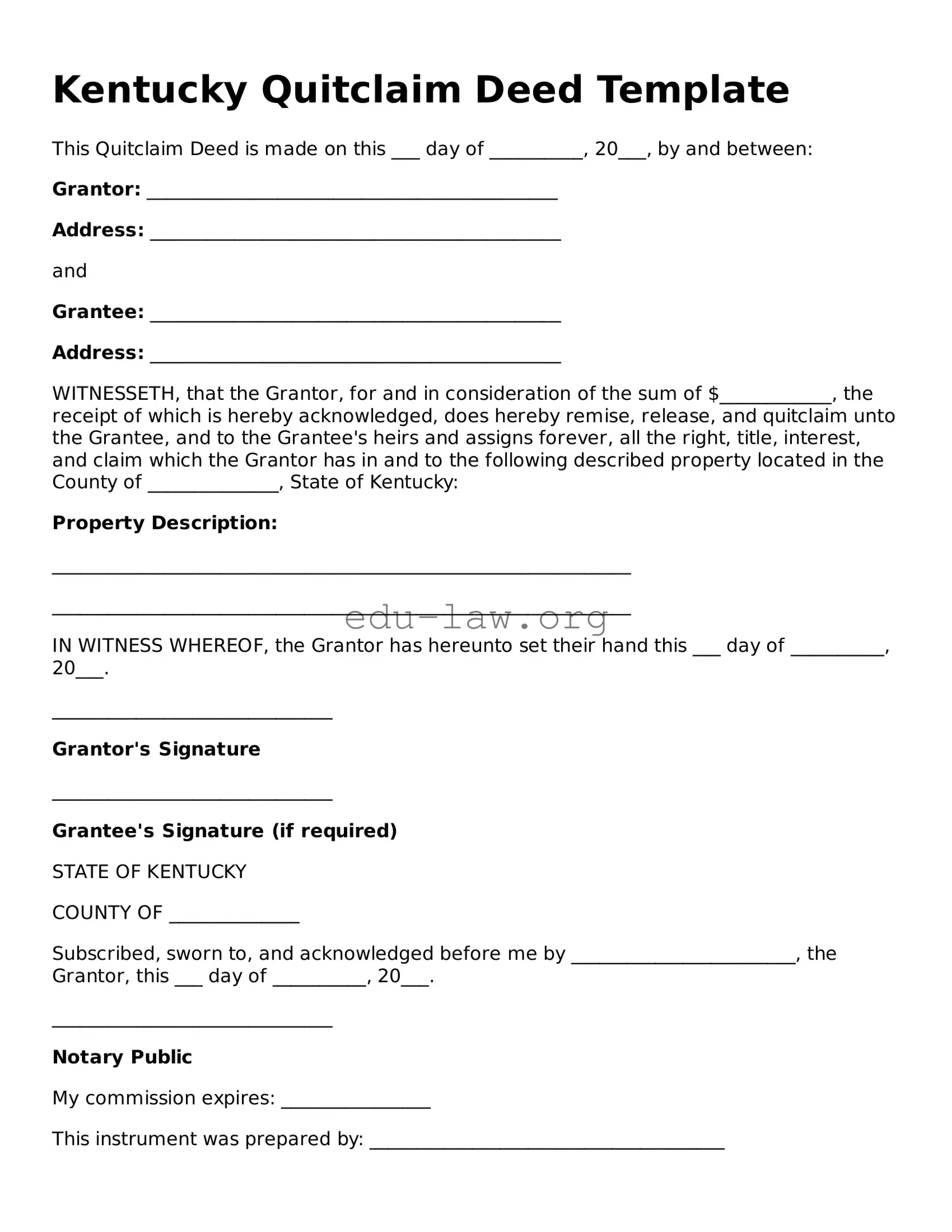
The Kentucky Quitclaim Deed form serves as a vital tool for property transfers in the state of Kentucky. This form allows an individual, known as the grantor, to convey their interest in a property to another party, referred to as the grantee, without making any guarantees about the title's validity. It is particularly useful in situations where the grantor may not have complete ownership or wishes to transfer property quickly and efficiently, such as in family transfers or between acquaintances. The form typically includes essential details such as the names of both parties, a description of the property, and the date of the transfer. Unlike warranty deeds, quitclaim deeds do not provide the same level of protection to the grantee, as they do not ensure that the title is free of liens or other claims. Understanding the implications of using a quitclaim deed is crucial for both parties involved, as it can significantly impact their rights and responsibilities regarding the property. Overall, the Kentucky Quitclaim Deed form is a straightforward yet powerful instrument for real estate transactions, enabling individuals to navigate property transfers with relative ease.
Kentucky Quitclaim Deed Template
This Quitclaim Deed is made on this ___ day of __________, 20___, by and between:
Grantor: ____________________________________________
Address: ____________________________________________
and
Grantee: ____________________________________________
Address: ____________________________________________
WITNESSETH, that the Grantor, for and in consideration of the sum of $____________, the receipt of which is hereby acknowledged, does hereby remise, release, and quitclaim unto the Grantee, and to the Grantee's heirs and assigns forever, all the right, title, interest, and claim which the Grantor has in and to the following described property located in the County of ______________, State of Kentucky:
Property Description:
______________________________________________________________
______________________________________________________________
IN WITNESS WHEREOF, the Grantor has hereunto set their hand this ___ day of __________, 20___.
______________________________
Grantor's Signature
______________________________
Grantee's Signature (if required)
STATE OF KENTUCKY
COUNTY OF ______________
Subscribed, sworn to, and acknowledged before me by ________________________, the Grantor, this ___ day of __________, 20___.
______________________________
Notary Public
My commission expires: ________________
This instrument was prepared by: ______________________________________
Address: ____________________________________________
| Fact Name | Description |
|---|---|
| Definition | A quitclaim deed is a legal document that allows a property owner to transfer their interest in a property to another party without making any guarantees about the title. |
| Governing Law | In Kentucky, the use of quitclaim deeds is governed by the Kentucky Revised Statutes, specifically KRS 382.130. |
| Use Cases | Quitclaim deeds are often used in situations such as transferring property between family members, settling divorce agreements, or clearing up title issues. |
| Limitations | Unlike warranty deeds, quitclaim deeds do not provide any warranties or guarantees regarding the ownership or condition of the property being transferred. |
Once you have the Kentucky Quitclaim Deed form, you can begin filling it out. Ensure that all information is accurate to avoid any potential issues later. After completing the form, you will need to sign it in the presence of a notary public and then file it with the appropriate county clerk's office.
What is a Kentucky Quitclaim Deed?
A Kentucky Quitclaim Deed is a legal document used to transfer ownership of real estate from one person to another. Unlike a warranty deed, a quitclaim deed does not guarantee that the property title is clear or free from liens. Instead, it simply conveys whatever interest the seller has in the property, if any. This type of deed is often used among family members or in situations where the parties know each other well and trust that there are no hidden issues with the property title.
When should I use a Quitclaim Deed in Kentucky?
There are several scenarios where a quitclaim deed might be appropriate. Common situations include transferring property between family members, adding or removing someone from the title, or transferring property as part of a divorce settlement. It is particularly useful when the parties involved are familiar with each other and the property, as it simplifies the process without the need for extensive title searches or warranties.
What information is required on a Kentucky Quitclaim Deed?
To complete a Kentucky Quitclaim Deed, certain information is essential. This includes the names and addresses of both the grantor (the person transferring the property) and the grantee (the person receiving the property). A legal description of the property must be included, along with the date of the transfer. Additionally, the deed should be signed by the grantor in the presence of a notary public to make it legally binding.
How do I file a Quitclaim Deed in Kentucky?
Filing a quitclaim deed in Kentucky involves a few straightforward steps. After completing the deed, the next step is to have it notarized. Once notarized, the deed should be filed with the county clerk’s office in the county where the property is located. There may be a small filing fee, and it’s important to ensure that the deed is recorded promptly to protect the new owner’s rights.
Are there any risks associated with using a Quitclaim Deed?
Yes, there are some risks to consider when using a quitclaim deed. The primary risk is that the grantor does not guarantee the title’s validity. If there are any existing liens, debts, or claims against the property, the grantee may inherit those issues. Therefore, it’s advisable for the grantee to conduct a title search or obtain title insurance before accepting the property. This can help mitigate potential future disputes or financial liabilities.
Not including the full legal names of all parties involved. It’s essential to use the names as they appear on legal documents to avoid confusion.
Failing to provide a complete property description. The property should be described in detail, including the address and any relevant identifiers, to ensure clarity.
Omitting the date of execution. Every deed needs to have a date when it was signed to establish when the transfer of ownership took place.
Not having the signature of the grantor. The person transferring the property must sign the deed. Without this signature, the deed is not valid.
Forgetting to include a witness or notary signature. In Kentucky, having a notary public or witness can help validate the deed and make it legally binding.
Using the wrong type of deed. A quitclaim deed is not the same as a warranty deed. Understanding the differences is crucial for ensuring the right document is used.
Neglecting to check for outstanding liens or encumbrances. Before transferring property, it’s important to ensure there are no legal claims against it.
Not filing the deed with the county clerk’s office. Once completed, the quitclaim deed should be recorded to make the transfer official and public.
Failing to keep a copy of the deed. Always retain a copy for personal records. This can be helpful for future reference or disputes.
Overlooking tax implications. Transferring property can have tax consequences. Consulting a tax professional before completing the deed can help avoid surprises.
When dealing with property transfers in Kentucky, the Quitclaim Deed is a common document. However, it is often accompanied by other forms and documents that help clarify ownership, establish rights, or fulfill legal requirements. Here’s a list of ten documents that are frequently used alongside the Kentucky Quitclaim Deed.
These documents, when used in conjunction with the Kentucky Quitclaim Deed, help ensure a smoother property transfer process. Each one serves a specific purpose, contributing to a comprehensive understanding of the transaction and protecting the interests of all parties involved.
A warranty deed is similar to a quitclaim deed in that both are used to transfer ownership of property. However, a warranty deed provides a guarantee that the seller holds clear title to the property and has the right to sell it. This means that if any issues arise regarding ownership, the seller is responsible for resolving them. In contrast, a quitclaim deed does not offer such guarantees, making it a quicker and less formal option for transferring property rights.
A bargain and sale deed is another document that shares similarities with a quitclaim deed. Like a quitclaim deed, a bargain and sale deed transfers ownership without warranties. However, it implies that the seller has some interest in the property. This type of deed is often used in transactions involving foreclosures or tax sales, where the seller may not be able to provide a warranty on the title.
A special warranty deed is also comparable to a quitclaim deed. This document transfers property ownership but only guarantees that the seller has not caused any title issues during their ownership. Unlike a quitclaim deed, which offers no guarantees, a special warranty deed provides some level of assurance to the buyer regarding the time the seller owned the property.
A general warranty deed is similar in that it transfers property ownership, but it provides the most protection for the buyer. It guarantees that the seller holds clear title and will defend against any claims. This document offers a higher level of security compared to a quitclaim deed, making it a preferred option for many buyers.
A deed of trust is another document that may be confused with a quitclaim deed. While a quitclaim deed transfers ownership, a deed of trust is used in financing arrangements. It involves three parties: the borrower, the lender, and a trustee. The borrower conveys the property to the trustee as security for a loan. If the borrower defaults, the trustee can sell the property to repay the lender.
An easement deed is somewhat similar as it involves property rights, but it serves a different purpose. An easement allows one party to use another party's property for a specific purpose, such as accessing a road. While a quitclaim deed transfers ownership, an easement deed grants a right to use the property without transferring ownership.
Lastly, a lease agreement can be seen as related to a quitclaim deed in that it involves property rights. However, a lease does not transfer ownership. Instead, it allows one party to use another's property for a specified period in exchange for rent. While a quitclaim deed is a permanent transfer, a lease is temporary and subject to the terms agreed upon by both parties.
When filling out the Kentucky Quitclaim Deed form, it is essential to follow certain guidelines to ensure accuracy and compliance. Below is a list of things you should and shouldn't do during this process.
Things You Should Do:
Things You Shouldn't Do:
The Kentucky Quitclaim Deed form is often misunderstood. Here are six common misconceptions about this legal document:
This is not entirely accurate. A quitclaim deed transfers whatever interest the grantor has in the property, but it does not guarantee that the grantor actually has any interest to transfer. If there are no ownership rights, the deed offers no protection to the grantee.
While they are commonly used in divorce settlements to transfer property between spouses, quitclaim deeds can also be used in various situations, such as transferring property to family members or in estate planning.
This misconception overlooks a key difference. A warranty deed provides a guarantee that the grantor holds clear title to the property and has the right to sell it. In contrast, a quitclaim deed offers no such guarantees.
While it is advisable to have a quitclaim deed notarized for it to be legally effective, Kentucky law does not strictly require notarization for the deed to be valid. However, notarization does help in preventing future disputes.
This is misleading. Once a quitclaim deed is executed and delivered, it cannot be undone by the grantor unilaterally. However, the grantee can choose to return the property through another deed if both parties agree.
Many people believe that the process is overly complex. In reality, the filing process can be straightforward. Completing the form and submitting it to the appropriate county office is often all that is required.
When filling out and using the Kentucky Quitclaim Deed form, keep these key takeaways in mind: