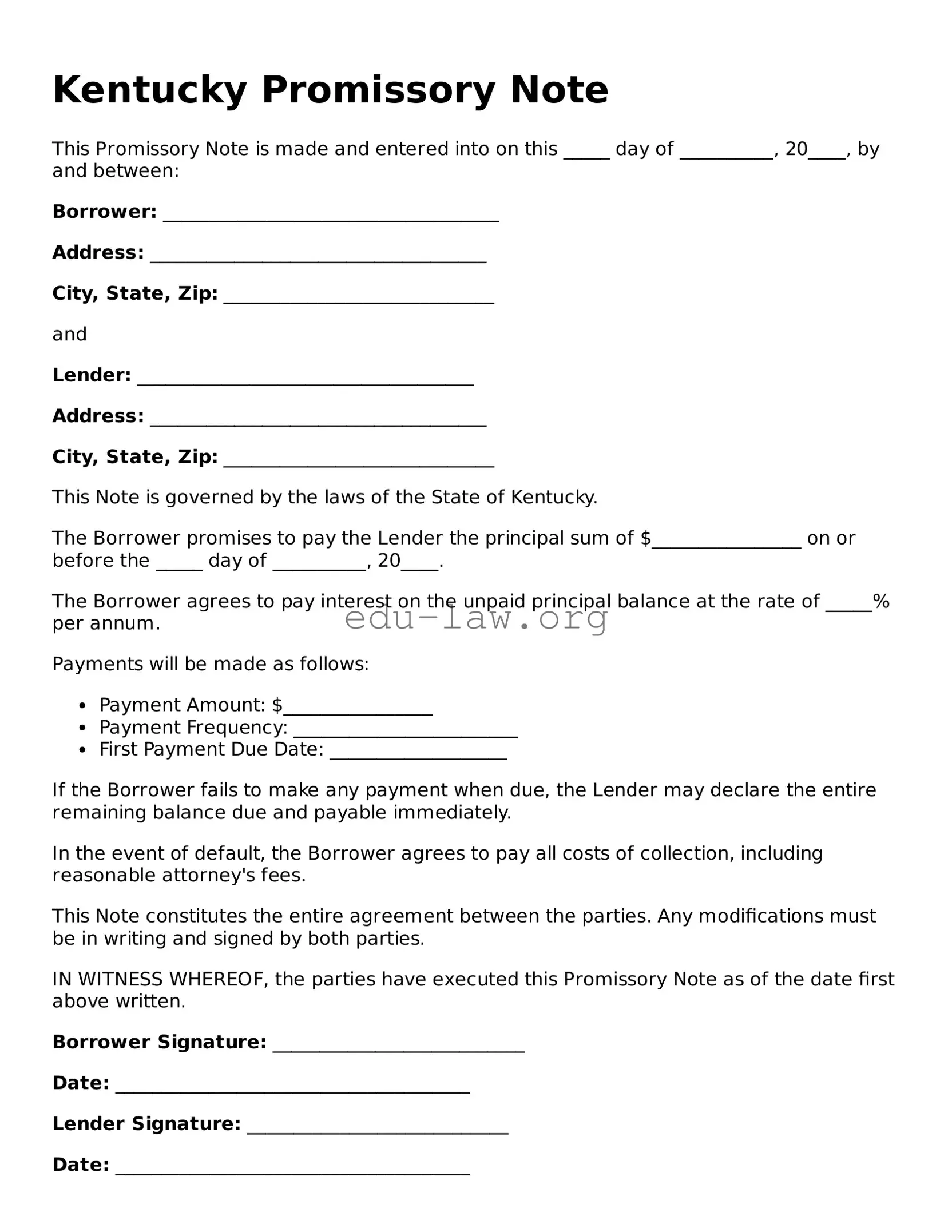
The Kentucky Promissory Note form serves as a vital financial instrument for individuals and businesses alike, facilitating the borrowing and lending process across the state. This legally binding document outlines the terms of a loan, including the principal amount, interest rate, repayment schedule, and any applicable fees. By clearly stating the obligations of both the borrower and lender, the form helps prevent misunderstandings and disputes. It is essential for ensuring that all parties are aware of their rights and responsibilities. Additionally, the Kentucky Promissory Note can be tailored to suit specific needs, accommodating various situations such as personal loans, business financing, or real estate transactions. Understanding the key components of this form is crucial for anyone involved in a lending agreement in Kentucky, as it lays the groundwork for a successful financial relationship.
Kentucky Promissory Note
This Promissory Note is made and entered into on this _____ day of __________, 20____, by and between:
Borrower: ____________________________________
Address: ____________________________________
City, State, Zip: _____________________________
and
Lender: ____________________________________
Address: ____________________________________
City, State, Zip: _____________________________
This Note is governed by the laws of the State of Kentucky.
The Borrower promises to pay the Lender the principal sum of $________________ on or before the _____ day of __________, 20____.
The Borrower agrees to pay interest on the unpaid principal balance at the rate of _____% per annum.
Payments will be made as follows:
If the Borrower fails to make any payment when due, the Lender may declare the entire remaining balance due and payable immediately.
In the event of default, the Borrower agrees to pay all costs of collection, including reasonable attorney's fees.
This Note constitutes the entire agreement between the parties. Any modifications must be in writing and signed by both parties.
IN WITNESS WHEREOF, the parties have executed this Promissory Note as of the date first above written.
Borrower Signature: ___________________________
Date: ______________________________________
Lender Signature: ____________________________
Date: ______________________________________
| Fact Name | Details |
|---|---|
| Definition | A Kentucky Promissory Note is a written promise to pay a specified amount of money to a designated person or entity at a specified time. |
| Governing Law | The Kentucky Revised Statutes, specifically KRS Chapter 371, govern promissory notes in Kentucky. |
| Requirements | The note must include the amount to be paid, the interest rate (if any), and the payment terms. |
| Signature | The borrower’s signature is required for the note to be enforceable. |
| Enforceability | If properly executed, a promissory note is legally enforceable in a court of law. |
After obtaining the Kentucky Promissory Note form, you will need to complete it carefully. This form will require specific information about the loan agreement between the borrower and the lender. Ensure that all details are accurate to avoid any potential issues in the future.
Once you have filled out the form, review it for any errors or missing information. After ensuring everything is correct, both parties should keep a copy for their records.
What is a Kentucky Promissory Note?
A Kentucky Promissory Note is a written promise to pay a specified amount of money to a lender or a third party. It outlines the terms of the loan, including the principal amount, interest rate, repayment schedule, and any other conditions agreed upon by both parties. This document serves as a legal record of the debt and the borrower's commitment to repay it.
Who can create a Promissory Note in Kentucky?
Any individual or business entity can create a Promissory Note in Kentucky. Both the borrower and the lender must be capable of entering into a legal agreement. It is essential that both parties understand the terms and implications of the note before signing.
What information should be included in a Kentucky Promissory Note?
A well-drafted Kentucky Promissory Note should include the following information: the names and addresses of the borrower and lender, the principal amount of the loan, the interest rate, the repayment schedule, any late fees or penalties, and the signatures of both parties. Additionally, including a date and any relevant terms regarding collateral can be beneficial.
Is a Promissory Note legally binding in Kentucky?
Yes, a Promissory Note is legally binding in Kentucky as long as it meets the necessary legal requirements. Both parties must agree to the terms, and the document must be signed. In the event of a dispute, the Promissory Note can be enforced in court, provided it is clear and unambiguous.
Do I need a lawyer to draft a Kentucky Promissory Note?
While it is not mandatory to hire a lawyer to draft a Promissory Note, it is advisable to seek legal counsel, especially for larger loans or complex agreements. A legal professional can ensure that the document complies with Kentucky law and adequately protects your interests.
Can a Promissory Note be modified after it is signed?
Yes, a Promissory Note can be modified after it is signed, but both parties must agree to the changes. It is important to document any modifications in writing and have both parties sign the amended note to avoid future disputes.
What happens if the borrower defaults on the Promissory Note?
If the borrower defaults, the lender has the right to pursue legal action to recover the owed amount. This may involve filing a lawsuit or seeking a judgment against the borrower. The specific remedies available will depend on the terms outlined in the Promissory Note and applicable Kentucky law.
Are there any specific laws governing Promissory Notes in Kentucky?
Yes, Promissory Notes in Kentucky are governed by both state law and the Uniform Commercial Code (UCC). These laws outline the requirements for creating, enforcing, and modifying Promissory Notes. Familiarity with these laws can help both parties understand their rights and obligations.
Can a Promissory Note be secured or unsecured?
A Promissory Note can be either secured or unsecured. A secured note is backed by collateral, such as property or assets, which the lender can claim if the borrower defaults. An unsecured note does not have collateral backing it, making it riskier for the lender. The choice between secured and unsecured will depend on the relationship between the parties and the level of trust involved.
Is it necessary to notarize a Kentucky Promissory Note?
Notarization is not required for a Promissory Note to be legally binding in Kentucky. However, having the document notarized can provide an additional layer of protection and may help in proving the authenticity of the signatures if a dispute arises in the future.
Incorrect Borrower Information: One common mistake is failing to provide accurate details about the borrower. This includes the full name, address, and any other identifying information. Incomplete or incorrect information can lead to confusion and potential legal issues down the line.
Missing Lender Details: Just as it's crucial to have the correct borrower information, the lender’s details must also be precise. Omitting the lender's name or address can result in challenges when enforcing the note.
Unclear Loan Amount: The loan amount must be clearly stated. Some people write it in words but forget to include the numerical value, or vice versa. This inconsistency can create misunderstandings about the actual amount borrowed.
Omitting Interest Rate: If the loan includes an interest rate, it should be explicitly mentioned. Neglecting to include this information can lead to disputes over how much the borrower actually owes over time.
Vague Repayment Terms: The repayment terms should be specific. Some individuals fail to outline the schedule for payments, leading to uncertainty about when payments are due. Clear terms help both parties understand their obligations.
Not Signing the Document: Finally, one of the simplest yet most critical mistakes is forgetting to sign the promissory note. Without a signature, the document may not be legally binding, leaving the lender without recourse if the borrower defaults.
When dealing with a Kentucky Promissory Note, there are several other documents that may be used to support the agreement or provide additional information. Here’s a list of some common forms and documents that often accompany a promissory note.
These documents work together to create a clear understanding between the parties involved in the loan. Having them in place can help protect both the lender and borrower, ensuring a smoother transaction.
A loan agreement is a document that outlines the terms and conditions of a loan between a lender and a borrower. Like a promissory note, it specifies the amount borrowed, the interest rate, and the repayment schedule. However, a loan agreement often includes more detailed provisions, such as collateral requirements and default consequences, making it a more comprehensive document. Both documents serve to formalize the borrowing process and protect the interests of both parties.
A mortgage agreement is similar to a promissory note in that it is a legal document used in the context of borrowing money. In this case, the borrower takes out a loan to purchase real estate. The mortgage agreement secures the loan with the property itself, meaning that if the borrower fails to repay, the lender can take possession of the property. While a promissory note focuses on the borrower's promise to repay, a mortgage agreement includes the additional layer of security provided by the property.
An installment agreement is another document that shares similarities with a promissory note. It outlines the terms under which a borrower agrees to pay back a loan in regular installments over time. Like a promissory note, it specifies the total amount owed, the interest rate, and the payment schedule. However, installment agreements often apply to larger purchases, such as vehicles or appliances, and may include additional terms regarding warranties or service agreements.
A personal guarantee is a document that can accompany a promissory note, especially in business transactions. It is a promise made by an individual to repay a loan if the primary borrower defaults. This document provides additional security to the lender, similar to how a promissory note assures the lender of the borrower's intent to repay. Both documents serve to mitigate risk for the lender, though a personal guarantee places the financial responsibility on an individual rather than a business entity.
A credit agreement is another document that resembles a promissory note. This document outlines the terms of a credit facility provided by a lender to a borrower. It specifies the credit limit, interest rates, and repayment terms, much like a promissory note. However, a credit agreement typically covers a broader range of borrowing scenarios and may allow for multiple withdrawals and repayments over time, unlike a single loan represented by a promissory note.
A lease agreement shares some characteristics with a promissory note, particularly in the context of personal property rentals. A lease outlines the terms under which one party agrees to rent property from another. While it does not typically involve a loan, it may require the lessee to make regular payments over time. Both documents establish a formal understanding between parties regarding financial obligations and timelines for payment.
A security agreement is a document that often accompanies a promissory note in transactions involving collateral. It outlines the terms under which the borrower pledges specific assets to secure the loan. While a promissory note focuses on the borrower's promise to repay, a security agreement details the rights of the lender to the collateral in case of default. Both documents work together to protect the lender's interests.
A forbearance agreement is similar to a promissory note in that it addresses the repayment of a loan but under specific circumstances. This document is used when a borrower is unable to make regular payments and seeks temporary relief from the lender. It outlines the terms of the forbearance, including any adjustments to the repayment schedule. Both agreements aim to provide clarity and understanding between the borrower and lender regarding payment expectations.
A debt settlement agreement is a document that may resemble a promissory note in that it involves the repayment of a debt. However, it typically occurs when a borrower negotiates with a creditor to settle a debt for less than the full amount owed. This agreement specifies the terms of the settlement and the payment plan. Both documents serve to formalize the financial obligations between parties, although a debt settlement agreement often reflects a compromise rather than a straightforward repayment plan.
A business loan agreement is another document similar to a promissory note, specifically for business financing. It outlines the terms of a loan provided to a business, including the loan amount, interest rate, and repayment schedule. Like a promissory note, it serves to formalize the borrowing process. However, a business loan agreement may include additional terms related to the business's operations, financial reporting, and covenants that the business must adhere to during the loan term.
When filling out the Kentucky Promissory Note form, it is essential to follow specific guidelines to ensure accuracy and legal validity. Below are six important do's and don'ts to consider.
Following these guidelines can help prevent misunderstandings and potential disputes in the future. It is crucial to approach this process with care and attention to detail.
Understanding the Kentucky Promissory Note form is crucial for anyone involved in lending or borrowing money. However, several misconceptions can lead to confusion. Here are seven common misconceptions:
Many believe that a promissory note requires notarization. In Kentucky, notarization is not a requirement for the note to be legally binding, although it can add an extra layer of authenticity.
This is not true. Individuals and businesses can create promissory notes as well. Anyone can lend money and outline the terms in a promissory note.
While there are standard components that should be included, there is no strict format mandated by law. Flexibility exists in how you draft the document.
Each promissory note can vary significantly based on the terms agreed upon by the parties involved. Interest rates, repayment schedules, and conditions can differ widely.
This is a misconception. Promissory notes can be sold or assigned to another party, allowing the new holder to collect the debt.
While defaulting can lead to legal action, it is not always immediate. Lenders often attempt to resolve the issue amicably before pursuing legal remedies.
Kentucky law does impose limits on the interest rates that can be charged. It's important to comply with these regulations to avoid legal complications.
Awareness of these misconceptions can help ensure that both lenders and borrowers are better prepared and protected in their financial agreements.
When preparing to fill out and utilize the Kentucky Promissory Note form, it is essential to understand several key aspects to ensure accuracy and legal compliance. Below are important takeaways to consider:
By following these guidelines, you can create a clear and effective promissory note that protects the interests of both the borrower and the lender.