When considering marriage, many couples focus on the joy of their union, but it’s equally important to think about the practicalities of financial matters. A Kentucky Prenuptial Agreement can serve as a vital tool in this process, allowing partners to openly discuss and outline their financial rights and responsibilities before tying the knot. This legally binding document addresses key aspects such as the division of property, spousal support, and debt allocation, providing clarity and security for both parties. By establishing terms that reflect each partner's wishes, the agreement can help prevent misunderstandings and disputes in the future. Additionally, it can protect individual assets acquired prior to marriage and outline how future earnings will be handled. Understanding the components of this form is essential for anyone considering marriage in Kentucky, as it not only promotes transparency but also fosters a sense of trust and cooperation between partners.
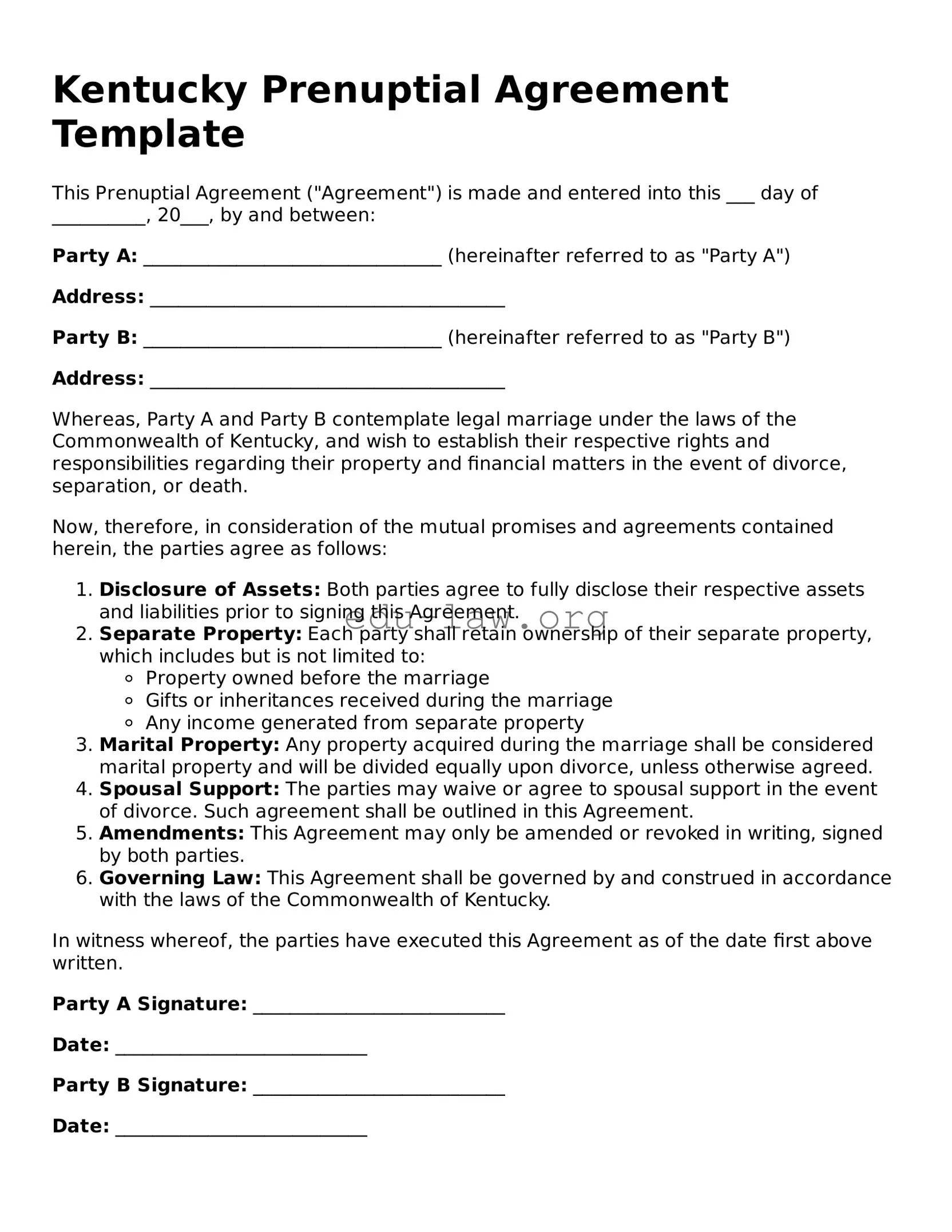
Kentucky Prenuptial Agreement Template
This Prenuptial Agreement ("Agreement") is made and entered into this ___ day of __________, 20___, by and between:
Party A: ________________________________ (hereinafter referred to as "Party A")
Address: ______________________________________
Party B: ________________________________ (hereinafter referred to as "Party B")
Address: ______________________________________
Whereas, Party A and Party B contemplate legal marriage under the laws of the Commonwealth of Kentucky, and wish to establish their respective rights and responsibilities regarding their property and financial matters in the event of divorce, separation, or death.
Now, therefore, in consideration of the mutual promises and agreements contained herein, the parties agree as follows:
In witness whereof, the parties have executed this Agreement as of the date first above written.
Party A Signature: ___________________________
Date: ___________________________
Party B Signature: ___________________________
Date: ___________________________
Both parties acknowledge that they have had the opportunity to seek independent legal advice regarding this Agreement.
| Fact Name | Details |
|---|---|
| Definition | A prenuptial agreement in Kentucky is a contract between two individuals before marriage that outlines the distribution of assets and responsibilities in the event of divorce or separation. |
| Governing Law | Kentucky Revised Statutes, Chapter 403, governs prenuptial agreements in the state. |
| Enforceability | For a prenuptial agreement to be enforceable, it must be in writing and signed by both parties. Full disclosure of assets is also required. |
| Modification | Parties can modify or revoke a prenuptial agreement at any time, but this must also be done in writing and signed by both parties. |
| Legal Advice | It is highly recommended that both parties seek independent legal counsel before signing a prenuptial agreement to ensure fairness and understanding. |
Filling out the Kentucky Prenuptial Agreement form is a straightforward process that requires careful attention to detail. This document will help you outline the terms of your financial arrangements before marriage. Once completed, both parties will need to review the agreement together, ensuring that all terms are clear and mutually understood.
After completing the form, keep a copy for your records. It is advisable to consult with a legal professional to ensure that the agreement meets all necessary requirements and protects both parties adequately.
What is a prenuptial agreement in Kentucky?
A prenuptial agreement, often called a prenup, is a legal contract entered into by two individuals before marriage. In Kentucky, this agreement outlines how assets and debts will be divided in the event of a divorce or separation. It can also address other matters, such as spousal support. Having a prenup can provide clarity and protect both parties' interests during a marriage and in the case of its dissolution.
What should be included in a Kentucky prenuptial agreement?
In Kentucky, a prenuptial agreement can cover a variety of topics. Commonly included items are the division of property, management of debts, and provisions for spousal support. It may also address how future income or property acquired during the marriage will be treated. To ensure the agreement is comprehensive, both parties should disclose their assets and liabilities fully.
Are there any legal requirements for a prenuptial agreement in Kentucky?
Yes, to be enforceable, a prenuptial agreement in Kentucky must meet certain legal requirements. Both parties should enter the agreement voluntarily, without coercion. It must be in writing and signed by both individuals. Additionally, it is advisable for each party to have independent legal counsel to ensure that their rights are protected and that they fully understand the implications of the agreement.
Can a prenuptial agreement be modified or revoked in Kentucky?
Yes, a prenuptial agreement can be modified or revoked in Kentucky. Both parties must agree to any changes, and these modifications should be made in writing and signed by both individuals. If either party wishes to revoke the agreement entirely, that too must be documented in writing. It's essential to keep all changes clear and legally binding to avoid future disputes.
What happens if a prenuptial agreement is challenged in court?
If a prenuptial agreement is challenged in court, the judge will evaluate its validity based on several factors. The court will consider whether the agreement was entered into voluntarily, whether both parties had full disclosure of assets, and if the terms are fair and reasonable. If the court finds the agreement to be valid, it will enforce the terms as outlined. If not, the court may set it aside, leading to a division of assets according to state law.
Failing to fully disclose assets and liabilities. Both parties should provide complete and honest information about their financial situations.
Not considering future income. It is important to address how future earnings will be handled in the agreement.
Using vague language. Clear and specific terms help prevent misunderstandings in the future.
Not including provisions for changes in circumstances. Life events, such as the birth of children or changes in employment, should be anticipated.
Neglecting to review state laws. Each state has different requirements and regulations regarding prenuptial agreements.
Forgetting to have the agreement notarized. A notarized signature can add an extra layer of authenticity and validity.
Not allowing sufficient time for review. Rushing through the process can lead to errors and misunderstandings.
Failing to seek legal advice. Consulting with an attorney can help ensure that the agreement is fair and legally sound.
Overlooking the need for both parties to sign. Both individuals must agree to the terms for the agreement to be enforceable.
Not discussing the agreement openly. Communication about the terms can foster trust and understanding between partners.
When couples decide to enter into a prenuptial agreement in Kentucky, they often find it beneficial to consider additional forms and documents that can complement their agreement. These documents can help clarify expectations, protect assets, and ensure a smoother transition into marriage. Below is a list of commonly used forms and documents that may accompany a prenuptial agreement.
These forms and documents serve various purposes, from financial transparency to estate planning. Couples should consider their unique circumstances and consult with legal professionals to determine which documents best suit their needs. By doing so, they can create a solid foundation for their marriage and future together.
A Cohabitation Agreement is similar to a prenuptial agreement in that it outlines the rights and responsibilities of two individuals living together. This document is particularly useful for unmarried couples who wish to clarify financial arrangements and property ownership. It can address issues such as shared expenses, asset division, and what happens if the relationship ends. Both agreements aim to protect individual interests and provide a clear framework for the relationship.
A Postnuptial Agreement serves a similar purpose to a prenuptial agreement but is executed after marriage. Like a prenuptial agreement, it can define how assets and debts will be handled during the marriage and in the event of a divorce. Couples may choose to create a postnuptial agreement to address changes in their financial situation or to clarify terms that were not covered before marriage.
A Separation Agreement is another document that shares similarities with a prenuptial agreement. It is used when a couple decides to live apart but still wants to address issues such as property division, child custody, and support obligations. This agreement can help prevent disputes during the separation process and provides a clear outline of each party's rights and responsibilities.
A Marital Settlement Agreement is created during divorce proceedings and outlines how assets, debts, and child-related issues will be resolved. While a prenuptial agreement is created before marriage, a marital settlement agreement is a response to the dissolution of that marriage. Both documents aim to provide clarity and fairness in the division of assets and responsibilities.
A Living Together Agreement is similar to a cohabitation agreement and is designed for couples who are not married but share a household. This document details the rights and obligations of each partner regarding finances, property, and other shared responsibilities. It helps establish expectations and can prevent misunderstandings, much like a prenuptial agreement does for married couples.
A Trust Agreement can also be compared to a prenuptial agreement in terms of asset protection. A trust allows individuals to manage their assets and determine how they will be distributed upon death or incapacitation. Both documents serve to protect individual interests and ensure that assets are handled according to the individual's wishes.
A Will is another important legal document that, like a prenuptial agreement, addresses the distribution of assets. While a prenuptial agreement focuses on asset division during marriage or divorce, a will specifies how assets will be divided after death. Both documents are crucial for ensuring that individual wishes are respected and followed.
A Business Partnership Agreement shares similarities with a prenuptial agreement in that it outlines the terms of a partnership between two or more parties. This document defines each partner's roles, responsibilities, and how profits and losses will be shared. Both agreements aim to prevent disputes and provide a clear framework for collaboration.
A Financial Power of Attorney grants someone the authority to manage financial matters on behalf of another person. While a prenuptial agreement addresses asset division and financial responsibilities in a marriage, a financial power of attorney allows for the delegation of financial decisions, particularly in situations where one partner may be unable to act on their own behalf.
An Estate Plan encompasses various documents, including wills, trusts, and powers of attorney. Like a prenuptial agreement, an estate plan is designed to protect individual interests and ensure that assets are distributed according to one's wishes. Both documents require careful consideration and planning to address potential future scenarios.
When filling out the Kentucky Prenuptial Agreement form, there are important steps to follow. Here’s a list of what you should and shouldn’t do:
When it comes to prenuptial agreements in Kentucky, many people hold misconceptions that can lead to confusion or even legal issues down the line. Here are eight common misunderstandings about the Kentucky Prenuptial Agreement form, along with clarifications to help you navigate this important legal document.
Understanding these misconceptions can help you approach the topic of prenuptial agreements with a clearer perspective. By doing so, you can make informed decisions that best suit your relationship and financial future.
When considering a prenuptial agreement in Kentucky, it is essential to understand the key aspects involved in filling out and using the agreement form. Here are ten important takeaways:
By understanding these key points, individuals can better navigate the process of creating and utilizing a prenuptial agreement in Kentucky.