In the state of Kentucky, the Power of Attorney (POA) form serves as a crucial legal document that allows individuals to designate someone else to make decisions on their behalf. This form can be particularly important in situations where a person may become incapacitated or unable to manage their affairs due to illness or other reasons. The designated individual, often referred to as the agent or attorney-in-fact, can handle a variety of matters, including financial transactions, medical decisions, and property management. Importantly, the Kentucky Power of Attorney form can be tailored to meet specific needs, allowing for general powers or limited powers that focus on particular tasks. Additionally, it is essential to understand the requirements for executing this form, such as the need for signatures and witnesses, to ensure its validity. By taking the time to establish a Power of Attorney, individuals can gain peace of mind knowing that their interests will be safeguarded and managed by a trusted person if the need arises.
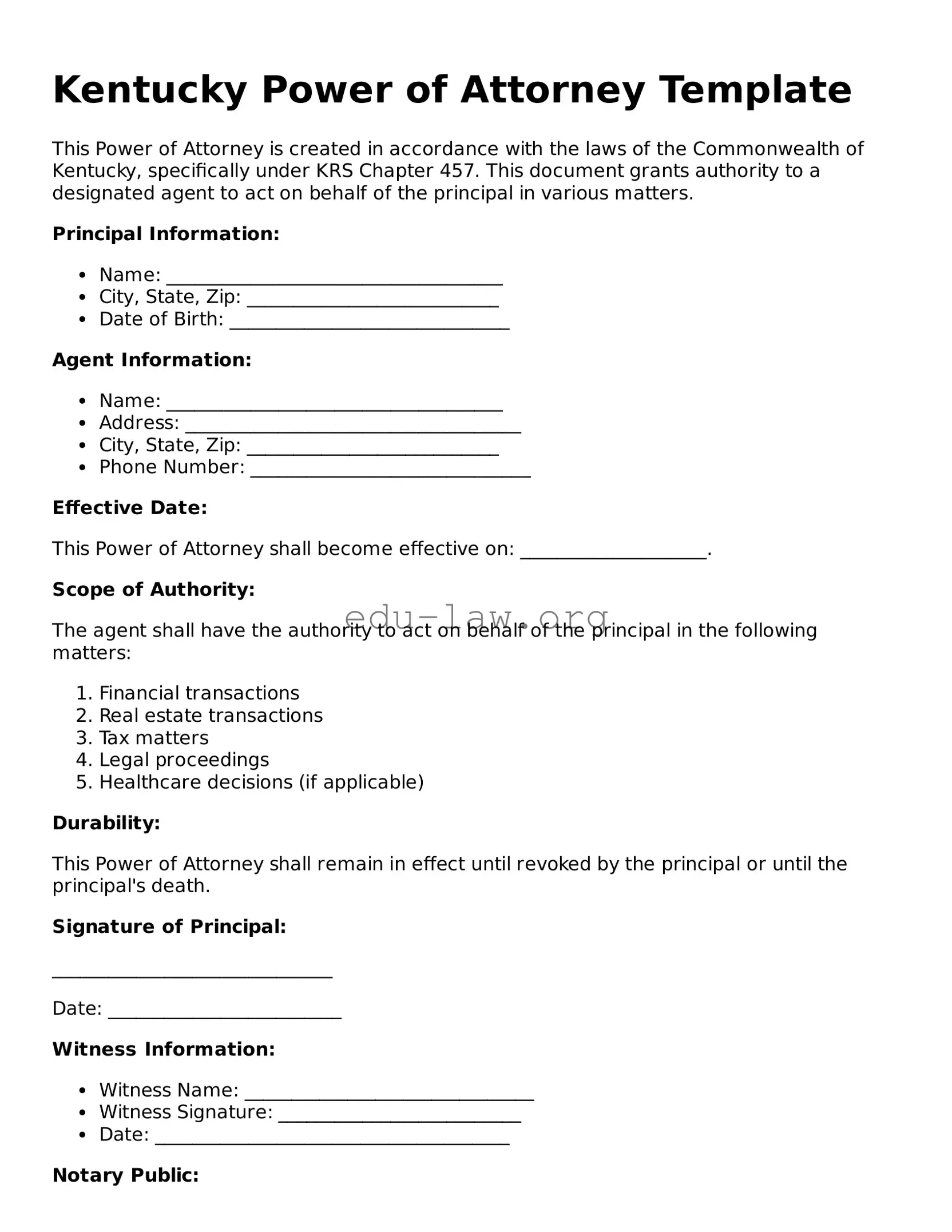
Kentucky Power of Attorney Template
This Power of Attorney is created in accordance with the laws of the Commonwealth of Kentucky, specifically under KRS Chapter 457. This document grants authority to a designated agent to act on behalf of the principal in various matters.
Principal Information:
Agent Information:
Effective Date:
This Power of Attorney shall become effective on: ____________________.
Scope of Authority:
The agent shall have the authority to act on behalf of the principal in the following matters:
Durability:
This Power of Attorney shall remain in effect until revoked by the principal or until the principal's death.
Signature of Principal:
______________________________
Date: _________________________
Witness Information:
Notary Public:
State of Kentucky
County of ___________________________
Subscribed and sworn to before me this ____ day of __________, 20__.
______________________________
Notary Public Signature
My Commission Expires: ____________________
| Fact Name | Description |
|---|---|
| Definition | A Power of Attorney (POA) in Kentucky is a legal document that allows one person to act on behalf of another in legal or financial matters. |
| Governing Law | The Kentucky Power of Attorney is governed by KRS Chapter 457, which outlines the requirements and limitations of such documents. |
| Types of POA | In Kentucky, there are several types of POAs, including durable, non-durable, and medical powers of attorney, each serving different purposes. |
| Durability | A durable power of attorney remains effective even if the principal becomes incapacitated, ensuring that the agent can continue to act on their behalf. |
| Signing Requirements | The form must be signed by the principal in the presence of a notary public or two witnesses to be legally valid. |
| Revocation | The principal can revoke a Power of Attorney at any time, provided they are mentally competent, by notifying the agent and any relevant third parties. |
Filling out a Power of Attorney form in Kentucky is a straightforward process that allows you to designate someone to make decisions on your behalf. Once you complete the form, you will need to have it signed and notarized to ensure its validity. Here are the steps to help you navigate the process:
After completing these steps, your Power of Attorney will be ready for use. Ensure that you keep a copy for your records and communicate with your agent about your wishes and expectations.
What is a Power of Attorney in Kentucky?
A Power of Attorney (POA) in Kentucky is a legal document that allows one person, known as the principal, to appoint another person, called the agent or attorney-in-fact, to make decisions on their behalf. This can include financial matters, healthcare decisions, or other personal affairs. The principal can specify the extent of the agent's authority, making it a flexible tool for managing various aspects of life.
What types of Power of Attorney are available in Kentucky?
In Kentucky, there are several types of Power of Attorney. The most common include: 1. General Power of Attorney: This grants broad authority to the agent to handle a wide range of matters. 2. Limited Power of Attorney: This allows the agent to act only in specific situations, such as selling a property or managing a bank account. 3. Durable Power of Attorney: This remains effective even if the principal becomes incapacitated, ensuring that the agent can continue to act on their behalf. 4. Medical Power of Attorney: This specifically allows the agent to make healthcare decisions for the principal if they are unable to do so themselves.
How do I create a Power of Attorney in Kentucky?
To create a Power of Attorney in Kentucky, you must complete a form that outlines the powers you wish to grant to your agent. The form should include your name, the agent's name, and a detailed description of the powers being granted. It is important to sign the document in the presence of a notary public to ensure its validity. You may also want to provide copies to relevant parties, such as banks or healthcare providers, to ensure they recognize the agent’s authority.
Can I revoke a Power of Attorney in Kentucky?
Yes, you can revoke a Power of Attorney in Kentucky at any time, as long as you are mentally competent. To do this, you should create a written revocation notice that states your intention to cancel the POA. It is advisable to notify your agent and any institutions or individuals who were relying on the original document. This helps prevent any confusion regarding your decisions moving forward.
What happens if my agent cannot serve or is unavailable?
If your agent is unable to serve or is unavailable, it is important to have a backup plan. You can name an alternate agent in your Power of Attorney document. If you did not name an alternate, the Power of Attorney may become ineffective, and you may need to create a new one or seek legal assistance to appoint someone else.
Is it necessary to have a lawyer to create a Power of Attorney in Kentucky?
While it is not legally required to have a lawyer to create a Power of Attorney in Kentucky, consulting one can be beneficial. A lawyer can help ensure that the document meets all legal requirements and accurately reflects your wishes. They can also provide guidance on the implications of granting certain powers and assist in addressing any specific concerns you may have.
Not Specifying Powers Clearly: One common mistake is failing to clearly outline the specific powers granted to the agent. It is essential to be precise about what decisions the agent can make on your behalf.
Omitting Dates: Some individuals forget to include the effective date of the Power of Attorney. This date indicates when the document becomes valid and is crucial for clarity.
Not Signing in the Presence of a Notary: A valid Power of Attorney typically requires notarization. Failing to have the document notarized can lead to complications or invalidate the form.
Choosing the Wrong Agent: Selecting someone who may not have the best interests in mind or lacks the ability to handle financial or medical decisions can lead to serious issues. It is vital to choose a trustworthy and capable agent.
Ignoring State-Specific Requirements: Each state has its own rules regarding Power of Attorney forms. Neglecting to follow Kentucky's specific requirements can render the document ineffective.
Not Reviewing the Document Regularly: Life circumstances change, and so do relationships. Failing to review and update the Power of Attorney regularly can lead to outdated or inappropriate designations.
When creating a Power of Attorney in Kentucky, it's important to consider additional forms and documents that may complement or support your primary document. These forms can help clarify intentions, provide necessary information, and ensure that all parties understand their roles and responsibilities. Below is a list of commonly used documents.
These documents play vital roles in ensuring that your wishes are respected and that your affairs are managed according to your preferences. Always consult with a legal professional to ensure that you select the appropriate forms for your specific needs.
The Kentucky Power of Attorney form shares similarities with the Durable Power of Attorney. Both documents allow an individual, known as the principal, to appoint another person, referred to as the agent, to manage their financial or legal affairs. The key difference lies in the durability; a Durable Power of Attorney remains effective even if the principal becomes incapacitated, whereas a standard Power of Attorney may not. This characteristic makes the Durable Power of Attorney particularly useful for long-term planning.
Another document comparable to the Kentucky Power of Attorney is the Medical Power of Attorney. This form specifically designates an agent to make healthcare decisions on behalf of the principal if they are unable to do so themselves. While the Kentucky Power of Attorney primarily addresses financial matters, the Medical Power of Attorney focuses on medical choices, emphasizing the importance of appointing trusted individuals for both financial and health-related decisions.
The Living Will is also similar to the Kentucky Power of Attorney in that it expresses an individual's wishes regarding medical treatment in the event of terminal illness or incapacitation. Unlike the Power of Attorney, which appoints an agent, a Living Will directly communicates the principal's preferences to healthcare providers. This document ensures that the principal's desires are honored when they cannot voice them.
The Revocable Trust shares features with the Kentucky Power of Attorney in terms of estate planning. Both documents allow individuals to manage their assets and provide for the distribution of their estate. However, a Revocable Trust can help avoid probate, while a Power of Attorney typically ceases to be effective upon the principal’s death. This distinction highlights the complementary nature of these documents in comprehensive estate planning.
The Advance Directive is another document akin to the Kentucky Power of Attorney. It combines elements of a Living Will and a Medical Power of Attorney, allowing individuals to outline their healthcare preferences and designate an agent. This document serves as a comprehensive guide for medical decisions, ensuring that the principal's wishes are respected in various scenarios.
The Guardianship Petition is similar to the Kentucky Power of Attorney in that both can address the needs of individuals who are unable to manage their affairs. A Guardianship Petition is filed in court to appoint a guardian for someone deemed incapacitated, whereas a Power of Attorney allows the principal to choose their agent without court intervention. Both serve to protect the interests of individuals who may need assistance.
The Special Power of Attorney is another related document. This form allows the principal to grant specific powers to the agent for a limited purpose or time frame. While the Kentucky Power of Attorney can provide broad authority, a Special Power of Attorney limits the agent's powers to particular tasks. This specificity can be beneficial in situations requiring targeted authority.
The Business Power of Attorney is similar in function to the Kentucky Power of Attorney but is tailored for business-related matters. This document allows an individual to designate an agent to handle business transactions and make decisions on behalf of a business entity. It emphasizes the importance of having a trusted individual manage business affairs, similar to personal financial matters covered by the Kentucky Power of Attorney.
Finally, the Financial Power of Attorney is closely related to the Kentucky Power of Attorney, as both documents allow an agent to manage the principal's financial affairs. However, the Financial Power of Attorney may focus exclusively on financial matters, whereas the Kentucky version can encompass a broader range of responsibilities. This distinction can help individuals choose the appropriate document based on their specific needs.
When filling out the Kentucky Power of Attorney form, it is essential to approach the process with care. Below are four important guidelines to follow, as well as common pitfalls to avoid.
Understanding the Kentucky Power of Attorney form is crucial for anyone considering its use. However, several misconceptions can lead to confusion. Here are seven common misunderstandings:
Being informed about these misconceptions can help individuals make better decisions regarding the use of a Power of Attorney in Kentucky.
Filling out and using a Power of Attorney form in Kentucky is an important step in ensuring that your financial and medical decisions can be managed by someone you trust when you are unable to do so yourself. Here are some key takeaways to consider:
By keeping these points in mind, you can navigate the process of creating and using a Power of Attorney in Kentucky with confidence and clarity.