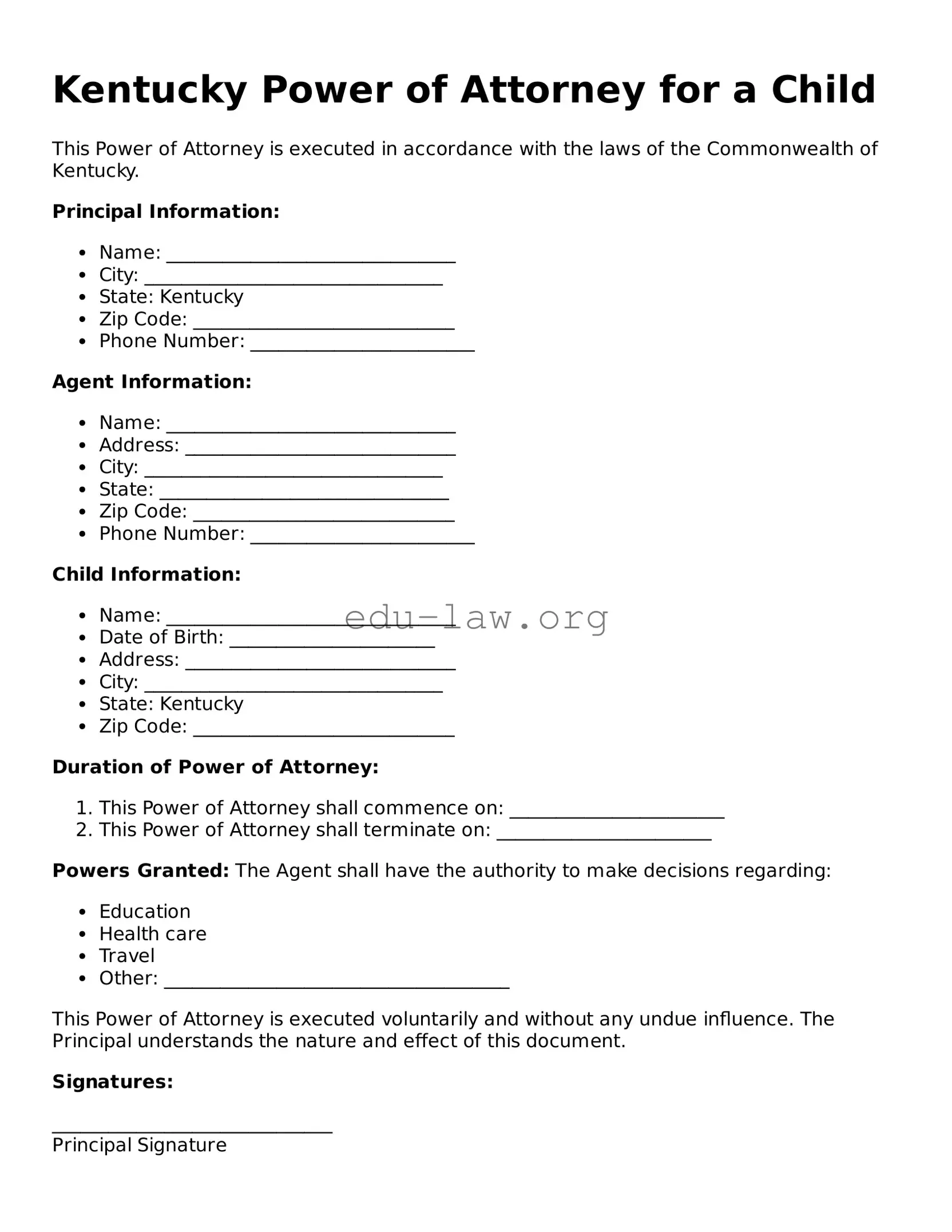
When it comes to ensuring the well-being and care of a child, the Kentucky Power of Attorney for a Child form serves as a vital tool for parents and guardians. This legal document allows a parent or legal guardian to grant another trusted adult the authority to make decisions on behalf of their child, particularly in situations where the parent may be temporarily unavailable. Key aspects of the form include the specification of the powers being granted, which can range from making medical decisions to handling educational matters. Additionally, the form requires the identification of both the child and the designated agent, ensuring clarity in who is responsible for the child's welfare. It is essential to understand that this power can be limited to a specific time frame or circumstance, providing flexibility for families. By utilizing this form, parents can have peace of mind, knowing that their child will be cared for by someone they trust during their absence.
Kentucky Power of Attorney for a Child
This Power of Attorney is executed in accordance with the laws of the Commonwealth of Kentucky.
Principal Information:
Agent Information:
Child Information:
Duration of Power of Attorney:
Powers Granted: The Agent shall have the authority to make decisions regarding:
This Power of Attorney is executed voluntarily and without any undue influence. The Principal understands the nature and effect of this document.
Signatures:
______________________________
Principal Signature
Date: ________________________
______________________________
Agent Signature
Date: ________________________
Witnesses:
Notary Public:
State of Kentucky
County of ______________________
Subscribed and sworn to before me on this _____ day of ____________, 20__.
______________________________
Notary Public Signature
My Commission Expires: ________________________
| Fact Name | Description |
|---|---|
| Definition | The Kentucky Power of Attorney for a Child form allows a parent or guardian to designate another individual to make decisions on behalf of their child. |
| Governing Law | This form is governed by Kentucky Revised Statutes, specifically KRS 403.270 and KRS 403.320. |
| Purpose | The primary purpose is to ensure that a child has a responsible adult available to make decisions in the absence of the parent or guardian. |
| Duration | The authority granted through this power of attorney can be limited to a specific time frame or event, as specified by the parent or guardian. |
| Revocation | A parent or guardian can revoke the power of attorney at any time, as long as the revocation is documented in writing. |
| Eligibility | Any adult can be designated as an agent, but it is recommended that the chosen individual is trustworthy and capable of making decisions for the child. |
| Signature Requirements | The form must be signed by the parent or guardian, and it is advisable to have the signature notarized for added legal protection. |
| Limitations | The power of attorney does not grant the agent the authority to make medical decisions unless specifically stated in the document. |
| Notification | It is best practice for the parent or guardian to inform the child and the designated agent about the power of attorney arrangement. |
| Use Cases | This form is particularly useful for parents who travel frequently or for those who need temporary assistance in caring for their child. |
Filling out the Kentucky Power of Attorney for a Child form is an important step in ensuring that a trusted individual can make decisions on behalf of your child when you are unable to do so. This process requires careful attention to detail to ensure that all necessary information is accurately provided. Below are the steps to guide you through the completion of this form.
After you have completed the form, it is important to communicate with the appointed attorney-in-fact about their responsibilities and the scope of authority granted. This will help ensure that everyone is on the same page regarding the care and decisions for your child.
What is a Power of Attorney for a Child in Kentucky?
A Power of Attorney for a Child in Kentucky is a legal document that allows a parent or guardian to designate another individual to make decisions on behalf of their child. This can include decisions related to education, healthcare, and general welfare. It is often used when parents are temporarily unable to care for their child due to travel, illness, or other circumstances.
Who can be designated as an agent in the Power of Attorney for a Child?
The agent, or attorney-in-fact, can be any responsible adult that the parent or guardian trusts. This may include relatives, family friends, or neighbors. It is important to choose someone who is willing and able to take on the responsibilities outlined in the document.
How long is the Power of Attorney for a Child valid?
The Power of Attorney for a Child remains valid until the specified expiration date, if one is provided. If no expiration date is mentioned, it generally remains in effect until the parent or guardian revokes it or until the child reaches the age of majority, which is 18 years old in Kentucky.
Do I need to have the Power of Attorney for a Child form notarized?
Yes, in Kentucky, the Power of Attorney for a Child form must be signed in the presence of a notary public. This helps to ensure that the document is legally binding and that the identities of the parties involved are verified.
Can a Power of Attorney for a Child be revoked?
Yes, a parent or guardian can revoke the Power of Attorney at any time. To do this, a written notice of revocation should be provided to the agent and any relevant parties. It is advisable to keep a copy of the revocation for personal records.
What decisions can the agent make on behalf of the child?
The agent can make various decisions regarding the child’s care, including educational decisions, medical treatment, and day-to-day living arrangements. However, the specific powers granted should be clearly outlined in the Power of Attorney document to avoid any confusion.
Is a Power of Attorney for a Child the same as guardianship?
No, a Power of Attorney for a Child is not the same as guardianship. Guardianship is a legal process that grants a person permanent authority over a child's welfare. In contrast, a Power of Attorney is typically temporary and does not require court approval.
Can I use a Power of Attorney for a Child form from another state?
While some states may have similar forms, it is recommended to use the Kentucky-specific Power of Attorney for a Child form. This ensures compliance with state laws and regulations, minimizing the risk of complications.
What should I do if I have questions about the Power of Attorney for a Child?
If you have questions or need assistance with the Power of Attorney for a Child, it is advisable to consult a legal professional who specializes in family law. They can provide guidance tailored to your specific situation and help ensure that all legal requirements are met.
Where can I obtain the Power of Attorney for a Child form?
The Power of Attorney for a Child form can typically be obtained from legal stationery stores, online legal resources, or through family law attorneys in Kentucky. Make sure to use the most current version to ensure compliance with state laws.
Not specifying the child’s full name: It’s crucial to include the complete legal name of the child. Omitting this detail can lead to confusion and potential legal issues.
Failing to identify the agent: The person designated to act on behalf of the child must be clearly named. Vague references can render the document ineffective.
Not including the duration of authority: Specify how long the Power of Attorney will remain in effect. Without a clear timeframe, the authority may be questioned.
Ignoring witness requirements: Kentucky law may require the signature of witnesses. Skipping this step can invalidate the form.
Not signing the document: All parties involved must sign the form. A missing signature can lead to disputes about the validity of the Power of Attorney.
Neglecting to date the form: The date of signing is important. Without it, the timeline of authority can become unclear.
Using outdated forms: Ensure that you are using the most current version of the Power of Attorney form. Outdated forms may not comply with current laws.
Failing to provide necessary documentation: If there are specific requirements for supporting documents, be sure to include them. This could include identification or proof of relationship.
Not reviewing the completed form: Before submitting, double-check for any errors or omissions. A thorough review can prevent complications down the line.
When setting up a Power of Attorney for a Child in Kentucky, there are several other documents that may be helpful. These documents can provide additional clarity and support for the arrangements you are making. Below are some commonly used forms that complement the Power of Attorney for a Child.
Having these documents ready can make the process smoother and provide peace of mind. It's always a good idea to consult with a professional if you have questions or need assistance with these forms.
The Kentucky Power of Attorney for a Child form shares similarities with the General Power of Attorney. Both documents grant authority to an individual to act on behalf of another person. In the case of the General Power of Attorney, the scope is broader and can cover various financial and legal matters, while the Power of Attorney for a Child specifically focuses on decisions related to the care and custody of a minor. This ensures that the appointed individual can make necessary decisions for the child’s welfare in the absence of the parent or legal guardian.
Another similar document is the Medical Power of Attorney. This form allows an individual to make healthcare decisions on behalf of another person. Like the Power of Attorney for a Child, it is focused on specific aspects of a person's life—in this case, medical care. The Medical Power of Attorney is crucial when a person is unable to make their own healthcare decisions due to illness or incapacity, ensuring that their medical needs are addressed according to their wishes.
The Temporary Guardianship Agreement also resembles the Power of Attorney for a Child. This document allows a parent to designate someone to care for their child for a limited time. While the Power of Attorney for a Child can be more permanent, the Temporary Guardianship Agreement is often used in situations where a parent is temporarily unavailable. Both documents ensure that a child’s needs are met and that someone is legally empowered to make decisions on their behalf.
The Child Custody Agreement is another related document. This legal arrangement outlines the rights and responsibilities of parents or guardians regarding the care of a child. While the Power of Attorney for a Child allows for decision-making authority, the Child Custody Agreement establishes the framework for where the child will live and how parenting time will be divided. Both documents aim to protect the child's best interests but serve different functions in the legal landscape.
The Authorization for Release of Medical Records is similar in that it involves the management of a child's healthcare. This document allows parents or guardians to grant permission for healthcare providers to share medical information with designated individuals. While the Power of Attorney for a Child enables someone to make healthcare decisions, the Authorization for Release of Medical Records focuses specifically on the sharing of medical information, ensuring that the appointed person can access necessary health records.
The Consent to Travel form also shares some commonality with the Power of Attorney for a Child. This document allows a parent or guardian to grant permission for a child to travel with another adult. While the Power of Attorney for a Child can cover broader decision-making authority, the Consent to Travel is specifically focused on travel-related permissions. Both documents help facilitate situations where a child may be under the care of someone other than their legal guardian.
Lastly, the School Authorization form is relevant in this context. This document allows a parent or guardian to grant permission for another individual to make educational decisions on behalf of a child, such as enrolling them in school or attending parent-teacher meetings. Similar to the Power of Attorney for a Child, the School Authorization ensures that the child’s educational needs are met when the parent or guardian is unavailable to make those decisions.
When filling out the Kentucky Power of Attorney for a Child form, it is essential to approach the process with care and attention. Below is a list of important dos and don'ts to consider.
By following these guidelines, you can help ensure that the Power of Attorney for a Child form is completed correctly and serves its intended purpose effectively.
Understanding the Kentucky Power of Attorney for a Child form can be challenging, and several misconceptions often arise. Here are five common misunderstandings, along with clarifications to help clear the air.
While the Power of Attorney for a Child can grant authority for medical decisions, it is not limited to that. It can also cover educational and financial matters, allowing the designated agent to make various decisions on behalf of the child.
Notarization is not always a requirement for the Power of Attorney for a Child in Kentucky. However, having the document notarized can enhance its validity and acceptance, especially in different institutions.
This is a common misconception. The Power of Attorney for a Child can be revoked at any time by the parent or guardian, as long as they provide proper notice to the agent and any relevant parties.
While parents typically initiate this process, legal guardians and other custodians can also establish a Power of Attorney for a Child, provided they have the legal authority to do so.
This form does not grant guardianship rights. It allows someone to act on behalf of a child in specific areas, but it does not transfer legal custody or guardianship from the parent or guardian.
By understanding these misconceptions, individuals can better navigate the process of creating a Power of Attorney for a Child in Kentucky, ensuring that they make informed decisions that best serve the child's needs.
Filling out and using the Kentucky Power of Attorney for a Child form is an important step for parents or guardians who need to delegate authority temporarily. Here are some key takeaways to consider:
Understanding these key points can help ensure that the process is smooth and that the child's needs are met during the period of delegation.