In the world of business formation, particularly for limited liability companies (LLCs), the Kentucky Operating Agreement plays a crucial role in outlining the internal workings of the entity. This document serves as a roadmap for how the LLC will operate, detailing the rights and responsibilities of its members, the distribution of profits and losses, and the procedures for decision-making. It also addresses important aspects such as the management structure, voting rights, and the process for adding or removing members. By establishing clear guidelines, the Operating Agreement helps prevent misunderstandings and disputes among members, ensuring that everyone is on the same page. While Kentucky does not legally require an Operating Agreement for LLCs, having one is highly advisable as it provides legal protection and adds a layer of professionalism to the business. Understanding the key components of this form can empower business owners to create a solid foundation for their LLC, fostering a collaborative and efficient working environment.
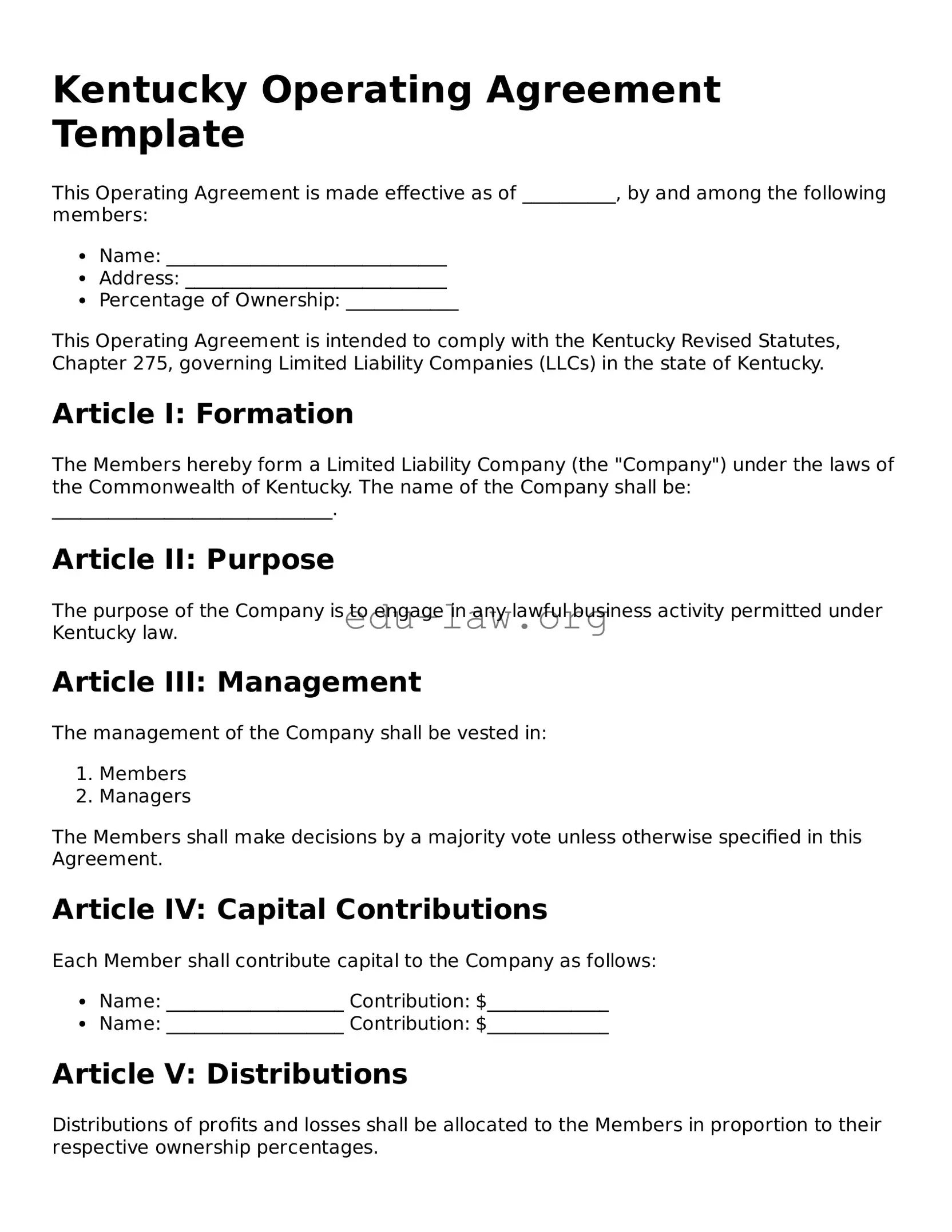
Kentucky Operating Agreement Template
This Operating Agreement is made effective as of __________, by and among the following members:
This Operating Agreement is intended to comply with the Kentucky Revised Statutes, Chapter 275, governing Limited Liability Companies (LLCs) in the state of Kentucky.
Article I: Formation
The Members hereby form a Limited Liability Company (the "Company") under the laws of the Commonwealth of Kentucky. The name of the Company shall be: ______________________________.
Article II: Purpose
The purpose of the Company is to engage in any lawful business activity permitted under Kentucky law.
Article III: Management
The management of the Company shall be vested in:
The Members shall make decisions by a majority vote unless otherwise specified in this Agreement.
Article IV: Capital Contributions
Each Member shall contribute capital to the Company as follows:
Article V: Distributions
Distributions of profits and losses shall be allocated to the Members in proportion to their respective ownership percentages.
Article VI: Indemnification
The Company shall indemnify any Member or Manager against any and all expenses and liabilities incurred in connection with the Company, to the fullest extent permitted by Kentucky law.
Article VII: Amendments
This Agreement may be amended only by a written agreement signed by all Members.
Article VIII: Governing Law
This Agreement shall be governed by and construed in accordance with the laws of the Commonwealth of Kentucky.
Signatures
IN WITNESS WHEREOF, the Members have executed this Operating Agreement as of the date first above written.
Date: _______________
| Fact Name | Description |
|---|---|
| Purpose | The Kentucky Operating Agreement outlines the management structure and operating procedures of a limited liability company (LLC). |
| Governing Law | The agreement is governed by Kentucky Revised Statutes, specifically KRS Chapter 275. |
| Members' Rights | It details the rights and responsibilities of the members, including profit distribution and decision-making processes. |
| Flexibility | The Operating Agreement allows for customization to fit the specific needs of the LLC and its members. |
| Legal Requirement | While not required by state law, having an Operating Agreement is highly recommended for LLCs in Kentucky. |
| Amendments | Members can amend the Operating Agreement as needed, provided all members agree to the changes. |
| Dispute Resolution | The agreement often includes provisions for resolving disputes among members, promoting smoother operations. |
Once you have the Kentucky Operating Agreement form in hand, you will need to carefully fill it out to ensure that all necessary information is included. This document is essential for outlining the structure and operations of your business. Follow the steps below to complete the form accurately.
After completing the form, review it carefully for any errors or omissions. Once confirmed, you can proceed with filing it according to Kentucky regulations.
What is a Kentucky Operating Agreement?
A Kentucky Operating Agreement is a legal document that outlines the management structure and operating procedures of a limited liability company (LLC) in Kentucky. This agreement is essential for defining the roles and responsibilities of the members and managers, as well as the financial arrangements within the LLC. Although it is not required by law, having an Operating Agreement can help prevent disputes and provide clarity in operations.
Why should I create an Operating Agreement for my LLC?
Creating an Operating Agreement is beneficial for several reasons. First, it helps establish clear guidelines for how the business will be run. Second, it protects the limited liability status of the members by demonstrating that the LLC is a separate entity. Third, it can help resolve potential conflicts among members by providing a framework for decision-making and profit distribution. Overall, it adds a layer of professionalism and structure to your business.
Who should be involved in drafting the Operating Agreement?
All members of the LLC should be involved in drafting the Operating Agreement. This ensures that everyone's interests and expectations are considered. It may also be helpful to consult with a legal professional who can provide guidance on specific legal requirements and best practices. Collaboration among members can lead to a more comprehensive and effective agreement.
What key elements should be included in the Operating Agreement?
An effective Operating Agreement should include several key elements. These typically cover the organization of the LLC, member contributions, profit and loss distribution, management structure, and procedures for adding or removing members. Additionally, it should outline how disputes will be resolved and specify the process for amending the agreement in the future. Each of these components plays a crucial role in the operation of the LLC.
Is an Operating Agreement required in Kentucky?
No, an Operating Agreement is not legally required in Kentucky. However, it is highly recommended. Having an Operating Agreement can help protect your business and its members by providing a clear set of rules and expectations. In the absence of this document, state laws will govern the LLC, which may not align with the members' intentions.
How can I change or amend the Operating Agreement later?
Amending the Operating Agreement is generally a straightforward process, but it should be done carefully. Most agreements will specify the procedure for making changes, which usually requires a majority vote from the members. Once the amendments are agreed upon, they should be documented in writing and signed by all members to ensure clarity and enforceability. Keeping an updated version of the Operating Agreement is important for the ongoing management of the LLC.
Failing to include the names of all members. Every individual or entity involved should be listed clearly to avoid future disputes.
Not specifying the ownership percentages. Each member's share must be clearly defined to establish rights and responsibilities.
Omitting the management structure. It's essential to outline whether the business will be managed by members or designated managers.
Using vague language. Clarity is crucial. Ensure that terms and conditions are specific to prevent misunderstandings.
Neglecting to include dispute resolution procedures. Having a plan in place for resolving conflicts can save time and money later.
Not updating the agreement as needed. As the business evolves, so should the Operating Agreement. Regular reviews are important.
When forming a limited liability company (LLC) in Kentucky, the Operating Agreement is a crucial document that outlines the management structure and operational procedures of the business. However, it is not the only document you'll need to ensure your LLC operates smoothly. Here are several other important forms and documents that are commonly used alongside the Kentucky Operating Agreement.
Having these documents in place not only enhances the professionalism of your LLC but also helps in avoiding potential disputes and misunderstandings among members. Each document plays a unique role in ensuring that your business is legally compliant and operates effectively. As you navigate the formation and operation of your LLC, consider how these documents can support your goals and streamline your processes.
The Kentucky Operating Agreement form is similar to the Articles of Incorporation, which is a foundational document for corporations. Both documents outline essential details about the business structure. The Articles of Incorporation typically include the business name, purpose, and registered agent, while the Operating Agreement focuses on the management structure and operating procedures of a limited liability company (LLC). Together, they establish the legal framework for the business entity.
Another similar document is the Partnership Agreement. This agreement is used when two or more individuals decide to run a business together. Like the Operating Agreement, it outlines the roles and responsibilities of each partner. It also details profit-sharing arrangements and procedures for resolving disputes. Both documents aim to provide clarity and prevent misunderstandings among business owners.
The Bylaws of a corporation also share similarities with the Operating Agreement. Bylaws govern the internal management of a corporation, specifying how meetings are conducted and how decisions are made. In contrast, the Operating Agreement does this for an LLC. Both documents serve to ensure smooth operations and provide a clear structure for decision-making processes.
The Shareholders Agreement is another related document, particularly for corporations. This agreement outlines the rights and obligations of shareholders, including how shares can be transferred and how decisions are made. The Operating Agreement serves a similar purpose for LLC members, detailing their rights and responsibilities. Both documents aim to protect the interests of the owners and provide a framework for governance.
A Non-Disclosure Agreement (NDA) can also be compared to the Operating Agreement. While the NDA protects sensitive information shared between parties, the Operating Agreement protects the interests and operations of the LLC. Both documents help maintain confidentiality and establish trust among business partners, ensuring that proprietary information is safeguarded.
The Employment Agreement is another document that shares some characteristics with the Operating Agreement. An Employment Agreement outlines the terms of employment for individuals working for the business. Similarly, the Operating Agreement defines the roles of members in an LLC. Both documents clarify expectations and responsibilities, promoting a productive working relationship.
The Membership Certificate is relevant as well. This document is issued to members of an LLC, confirming their ownership interest. While the Operating Agreement details the rights and responsibilities of members, the Membership Certificate serves as proof of ownership. Both documents are essential for establishing the legal standing of members within the company.
Lastly, the Business Plan can be seen as similar to the Operating Agreement in its purpose. A Business Plan outlines the goals and strategies for a business, while the Operating Agreement focuses on the operational aspects of an LLC. Both documents are vital for guiding the business toward success, providing a roadmap for growth and development.
When completing the Kentucky Operating Agreement form, it is essential to approach the task with care and attention to detail. Below is a list of important do's and don'ts to consider during this process.
By following these guidelines, you can help ensure that your Kentucky Operating Agreement is completed correctly and effectively. Taking the time to do it right can save you from potential issues in the future.
Understanding the Kentucky Operating Agreement form is essential for anyone involved in business formation in the state. However, several misconceptions can lead to confusion. Here are four common misconceptions:
While it is true that Kentucky does not require LLCs to have an Operating Agreement, having one is highly recommended. This document outlines the management structure and operating procedures, helping to prevent disputes among members.
The Operating Agreement is an internal document and does not need to be filed with the Kentucky Secretary of State. However, it is crucial for the members to keep it accessible for reference and legal purposes.
There is no mandated format for an Operating Agreement in Kentucky. Each agreement can be tailored to fit the specific needs and preferences of the LLC members, allowing for flexibility in its provisions.
It is important to regularly review and update the Operating Agreement as the business evolves. Changes in membership, management, or business direction may necessitate amendments to ensure the agreement remains relevant and effective.
When filling out and utilizing the Kentucky Operating Agreement form, it is essential to keep several key points in mind to ensure clarity and compliance. Here are some important takeaways: