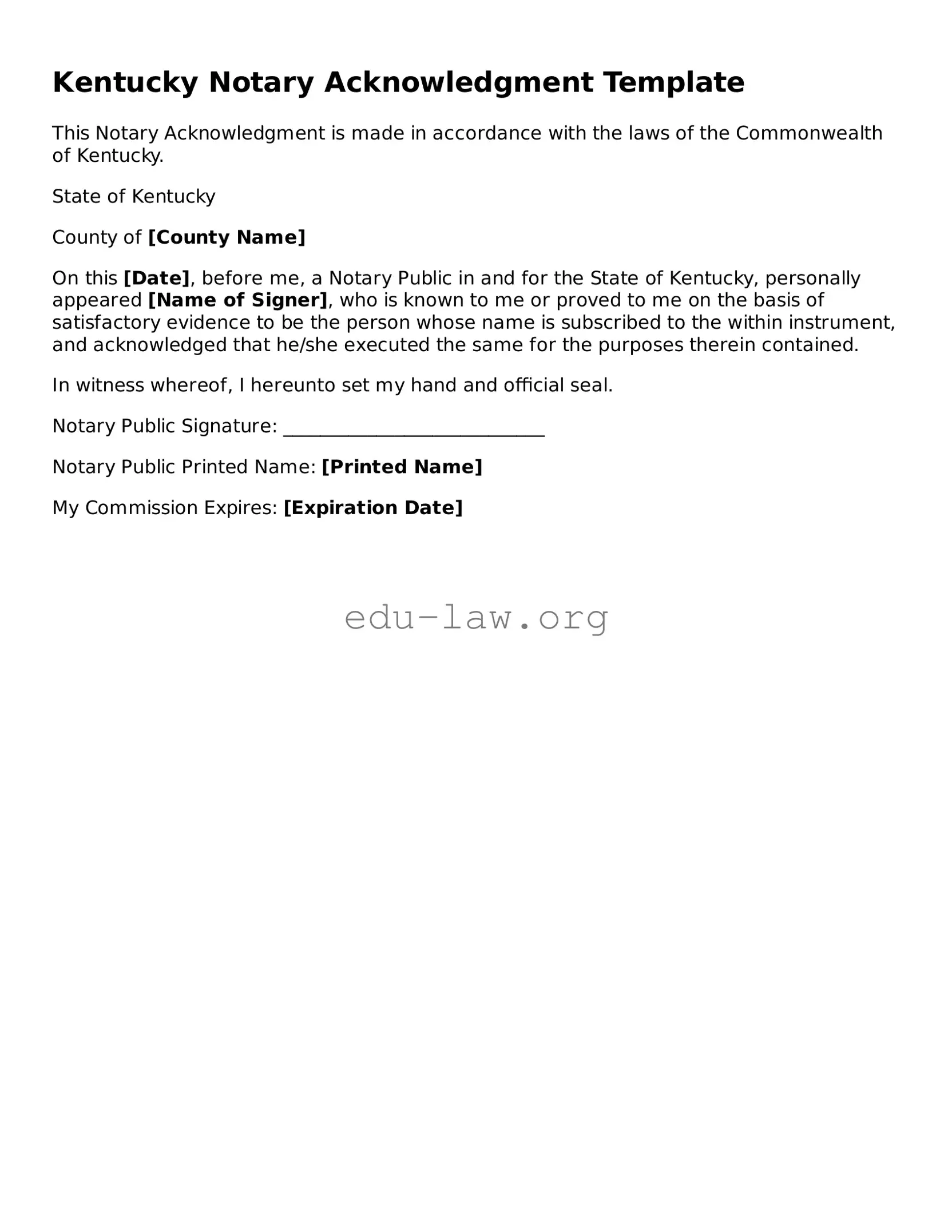
The Kentucky Notary Acknowledgment form plays a vital role in the realm of legal documentation, ensuring that signatures on various documents are verified and authentic. This form is essential for individuals looking to formalize agreements, contracts, or other important papers requiring notarization. By using this form, signers affirm that they willingly and knowingly signed the document in the presence of a notary public. The notary's role is to confirm the identity of the signer, thereby preventing fraud and ensuring that all parties involved understand the implications of their actions. Additionally, the Kentucky Notary Acknowledgment form typically includes specific information such as the date of the acknowledgment, the name of the signer, and the notary's signature and seal. Understanding the intricacies of this form is crucial for anyone involved in legal transactions in Kentucky, as it provides a layer of protection and legitimacy to the documents being executed.
Kentucky Notary Acknowledgment Template
This Notary Acknowledgment is made in accordance with the laws of the Commonwealth of Kentucky.
State of Kentucky
County of [County Name]
On this [Date], before me, a Notary Public in and for the State of Kentucky, personally appeared [Name of Signer], who is known to me or proved to me on the basis of satisfactory evidence to be the person whose name is subscribed to the within instrument, and acknowledged that he/she executed the same for the purposes therein contained.
In witness whereof, I hereunto set my hand and official seal.
Notary Public Signature: ____________________________
Notary Public Printed Name: [Printed Name]
My Commission Expires: [Expiration Date]
| Fact Name | Description |
|---|---|
| Purpose | The Kentucky Notary Acknowledgment form is used to confirm that a signer has willingly signed a document in the presence of a notary public. |
| Governing Law | This form is governed by Kentucky Revised Statutes (KRS) § 423.130, which outlines the requirements for notarial acts. |
| Signature Requirement | For the acknowledgment to be valid, the signer must personally appear before the notary and provide identification. |
| Record Keeping | Notaries are required to keep a record of the acknowledgment in their notary journal, including details of the transaction and the signer's identification. |
After obtaining the Kentucky Notary Acknowledgement form, it is essential to complete it accurately. This ensures that the document serves its intended purpose effectively. Follow the steps below to fill out the form correctly.
What is a Kentucky Notary Acknowledgement form?
The Kentucky Notary Acknowledgement form is a legal document used to verify the identity of a signer and confirm that they willingly signed a document. This form is essential for ensuring that the signing process is legitimate and that the signer understands the contents of the document they are signing.
Who can act as a notary in Kentucky?
In Kentucky, a notary public must be at least 18 years old, a resident of the state, and possess the ability to read and write in English. Additionally, they must complete the necessary training and obtain a notary commission from the state. This ensures that notaries are qualified to perform their duties effectively and ethically.
When is a Notary Acknowledgement required?
A Notary Acknowledgement is typically required when a document needs to be recorded or filed with a government agency. Common documents include deeds, mortgages, and powers of attorney. If you want to ensure the document's validity and enforceability, having it notarized is crucial.
How do I complete a Kentucky Notary Acknowledgement form?
To complete the form, the signer must appear before the notary and provide valid identification. The notary will then fill out the form, including details such as the date, the signer's name, and the notary's signature and seal. It’s important to ensure that all information is accurate and that the signer understands what they are signing.
Is there a fee for notarization in Kentucky?
Yes, Kentucky law allows notaries to charge a fee for their services. The maximum fee is set by the state, and it can vary depending on the type of service provided. Always check with your notary beforehand to understand the costs involved, as this can help avoid any surprises.
What happens if I lose my Notary Acknowledgement form?
If you lose your Notary Acknowledgement form, it’s essential to act quickly. You may need to obtain a new acknowledgment by having the document re-signed in front of a notary. Depending on the importance of the document, consider consulting with a legal professional to understand your options and the best course of action.
Can I use a Kentucky Notary Acknowledgement form for documents from other states?
While a Kentucky Notary Acknowledgement form is designed for use within Kentucky, it may be accepted for documents from other states if they comply with that state's laws. However, it’s advisable to check with the relevant authorities in the other state to ensure that the form meets their requirements. This can prevent potential issues down the line.
When completing the Kentucky Notary Acknowledgement form, it is essential to be meticulous. Errors can lead to delays or complications in the notarization process. Here are nine common mistakes to avoid:
Inaccurate Names: Ensure that the names of all parties involved are spelled correctly. A simple typo can invalidate the document.
Missing Signatures: All required signatures must be present. Omitting a signature can render the acknowledgment incomplete.
Incorrect Date: The date on which the document is signed should match the date of the acknowledgment. An inconsistency can raise questions about the validity.
Failure to Include the Notary's Seal: The notary's seal is crucial for the acknowledgment. Without it, the document may not be recognized.
Not Identifying the Signer: The notary must verify the identity of the signer. Failing to do so can lead to issues regarding the legitimacy of the document.
Inadequate Witnesses: If witnesses are required, ensure they are present and sign where necessary. Missing witnesses can invalidate the document.
Using Incorrect Notary Language: The acknowledgment must include specific language as required by Kentucky law. Using incorrect wording can cause problems.
Not Following Proper Procedure: Each step in the notarization process must be followed carefully. Skipping steps can lead to complications.
Neglecting to Keep Records: Notaries should maintain a record of all acknowledgments. Failing to do so can hinder future verification.
Being aware of these potential pitfalls can help ensure that the Kentucky Notary Acknowledgement form is filled out correctly. Taking the time to review each detail will contribute to a smoother notarization process.
The Kentucky Notary Acknowledgement form is a vital document used to verify the identity of individuals signing a legal document. It serves as proof that the signer has willingly provided their signature in the presence of a notary. Several other forms and documents often accompany this acknowledgment to ensure proper legal processes are followed. Below is a list of some commonly used documents.
Each of these documents plays a significant role in various legal processes. They often require notarization to ensure authenticity and protect the interests of all parties involved. Understanding their functions can aid in navigating legal matters more effectively.
The Kentucky Notary Acknowledgment form is similar to the Affidavit. Both documents serve as formal declarations made under oath. An affidavit is a written statement confirmed by the oath of the party making it, often used as evidence in court. Just like a notary acknowledgment, an affidavit requires a notary public to witness the signing and verify the identity of the signer. This ensures that the information contained within the affidavit is credible and can be relied upon by courts and other entities.
Another document akin to the Kentucky Notary Acknowledgment is the Power of Attorney. A Power of Attorney allows one person to act on behalf of another in legal matters. Similar to a notary acknowledgment, it requires notarization to confirm the identity of the principal and ensure that the document is executed voluntarily. This verification process protects against fraud and ensures that the authority granted is legitimate and legally binding.
Lastly, the Certificate of Acknowledgment shares similarities with the Kentucky Notary Acknowledgment form. This document is used to certify that a person has appeared before a notary public and has acknowledged their signature on a specific document. Like the notary acknowledgment, it serves to validate the authenticity of the signing process. Both documents provide a safeguard against disputes regarding the validity of signatures, ensuring that transactions are carried out smoothly and legally.
When completing the Kentucky Notary Acknowledgement form, it is essential to follow specific guidelines to ensure accuracy and compliance. Below are five key points to consider:
Understanding the Kentucky Notary Acknowledgement form is essential for anyone needing notary services. However, several misconceptions often arise. Here are five common misunderstandings:
Clarifying these misconceptions can help ensure that individuals understand the purpose and limitations of the Kentucky Notary Acknowledgement form.
The Kentucky Notary Acknowledgement form is used to verify the identity of a signer and their willingness to sign a document.
Ensure that the form is filled out completely before presenting it to a notary public.
Both the signer and the notary must be present at the time of signing to complete the acknowledgment.
The form requires the notary to include their official seal, which is essential for the acknowledgment to be valid.
It is important to provide the notary with proper identification to confirm the identity of the signer.
The notary will record the details of the transaction in their notary journal, if applicable.
Each notary acknowledgment must be specific to the document being signed; using a generic acknowledgment may not be sufficient.
Check for any state-specific requirements that may apply to the use of the acknowledgment form.
The completed acknowledgment form should be attached to the original document to maintain a clear record.
Keep a copy of the signed acknowledgment form for personal records, as it may be needed for future reference.