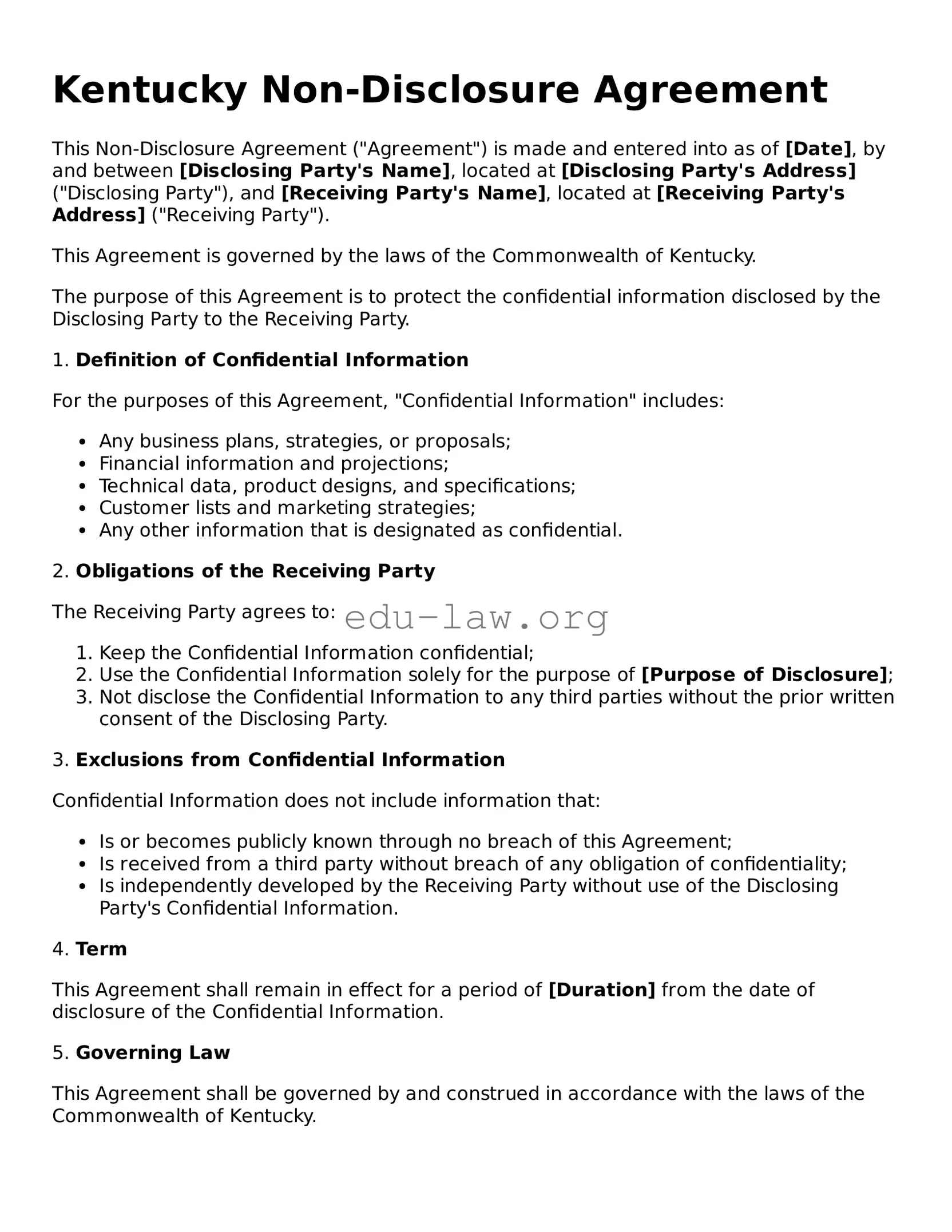
The Kentucky Non-Disclosure Agreement (NDA) form serves as a crucial legal document designed to protect sensitive information shared between parties during business transactions or collaborations. By establishing clear terms, the NDA helps prevent unauthorized disclosure of proprietary data, trade secrets, and confidential communications. This form typically outlines the definition of confidential information, the obligations of the parties involved, and the duration of confidentiality. Additionally, it may specify exceptions to the confidentiality obligations, such as information that becomes public knowledge or is independently developed. By signing this agreement, parties can foster trust and encourage open communication while safeguarding their valuable intellectual property and business interests.
Kentucky Non-Disclosure Agreement
This Non-Disclosure Agreement ("Agreement") is made and entered into as of [Date], by and between [Disclosing Party's Name], located at [Disclosing Party's Address] ("Disclosing Party"), and [Receiving Party's Name], located at [Receiving Party's Address] ("Receiving Party").
This Agreement is governed by the laws of the Commonwealth of Kentucky.
The purpose of this Agreement is to protect the confidential information disclosed by the Disclosing Party to the Receiving Party.
1. Definition of Confidential Information
For the purposes of this Agreement, "Confidential Information" includes:
2. Obligations of the Receiving Party
The Receiving Party agrees to:
3. Exclusions from Confidential Information
Confidential Information does not include information that:
4. Term
This Agreement shall remain in effect for a period of [Duration] from the date of disclosure of the Confidential Information.
5. Governing Law
This Agreement shall be governed by and construed in accordance with the laws of the Commonwealth of Kentucky.
IN WITNESS WHEREOF, the parties hereto have executed this Non-Disclosure Agreement as of the date first above written.
Disclosing Party:
Signature: ___________________________
Name: [Disclosing Party's Name]
Date: _________________________________
Receiving Party:
Signature: ___________________________
Name: [Receiving Party's Name]
Date: _________________________________
| Fact Name | Description |
|---|---|
| Purpose | The Kentucky Non-disclosure Agreement (NDA) is designed to protect confidential information shared between parties. |
| Governing Law | The NDA is governed by the laws of the Commonwealth of Kentucky, ensuring that any disputes are handled according to state regulations. |
| Parties Involved | Typically, the agreement involves at least two parties: the disclosing party and the receiving party. |
| Duration | The duration of confidentiality obligations can vary, but it is commonly set for a specific period, often ranging from 1 to 5 years. |
| Enforceability | In Kentucky, NDAs are generally enforceable as long as they are reasonable in scope and duration, and do not violate public policy. |
Once you have the Kentucky Non-disclosure Agreement form, you can begin filling it out. This process involves providing specific information that will ensure the agreement is complete and legally binding.
What is a Kentucky Non-disclosure Agreement (NDA)?
A Kentucky Non-disclosure Agreement is a legal document designed to protect confidential information shared between parties. This agreement ensures that sensitive information, such as trade secrets, business plans, or proprietary data, remains private and is not disclosed to unauthorized individuals or entities. It creates a formal understanding of the expectations surrounding confidentiality between the parties involved.
Who typically uses a Non-disclosure Agreement in Kentucky?
NDAs are commonly used by businesses, entrepreneurs, and individuals who wish to share sensitive information with potential partners, employees, or investors. For example, a startup may require an NDA from a potential investor to safeguard its business ideas. Similarly, employers might ask employees to sign an NDA to protect company secrets during their employment and after they leave the company.
What information can be protected under a Kentucky NDA?
The types of information that can be protected by a Kentucky NDA include, but are not limited to, trade secrets, customer lists, marketing strategies, financial data, and product designs. Essentially, any information that is not publicly available and provides a competitive advantage can be covered under this agreement. It is important to clearly define what constitutes confidential information within the NDA.
How long does the confidentiality obligation last?
The duration of the confidentiality obligation can vary and should be specified in the NDA. Typically, the obligation lasts for a set period, such as one to five years, but it can also be indefinite in certain cases, especially for trade secrets. Parties should negotiate and agree upon a timeframe that suits their specific needs while considering the nature of the information being protected.
What happens if someone breaches the NDA?
If a party breaches the NDA, the injured party may seek legal remedies. This can include monetary damages for any losses incurred due to the breach, as well as injunctive relief to prevent further disclosure of the confidential information. The NDA may also outline specific consequences or penalties for breach, which can help deter violations and provide clarity on the repercussions.
Is it necessary to have a lawyer draft a Kentucky NDA?
While it is not legally required to have a lawyer draft a Non-disclosure Agreement, it is highly recommended. A legal professional can ensure that the NDA is comprehensive, tailored to the specific situation, and compliant with Kentucky laws. This can help prevent misunderstandings and strengthen the enforceability of the agreement should a dispute arise in the future.
Incomplete Information: Failing to provide all required details, such as names, addresses, or dates, can lead to delays or invalidation of the agreement.
Incorrect Names: Using incorrect legal names for the parties involved can create confusion and may render the agreement unenforceable.
Missing Signatures: Omitting signatures from one or more parties is a common oversight that can nullify the agreement.
Not Dating the Agreement: Failing to include the date of signing can lead to disputes regarding the timeline of the agreement.
Ambiguous Terms: Using vague language or failing to clearly define confidential information can lead to misunderstandings.
Ignoring State-Specific Requirements: Not adhering to Kentucky-specific laws or guidelines may affect the validity of the agreement.
Inadequate Duration: Setting an unreasonable duration for confidentiality can create issues if information needs protection for a longer period.
Failure to Include Exceptions: Not specifying exceptions to confidentiality, such as information already in the public domain, can lead to complications.
Not Consulting Legal Advice: Attempting to draft or fill out the form without professional guidance can result in critical mistakes.
Neglecting to Keep Copies: Not retaining a signed copy of the agreement for personal records can lead to difficulties in enforcement or reference later.
When entering into a Non-disclosure Agreement (NDA) in Kentucky, several other forms and documents may be necessary to ensure comprehensive protection of confidential information. Here’s a list of commonly used documents that complement an NDA.
Utilizing these documents alongside a Kentucky Non-disclosure Agreement can significantly enhance your legal protections. Each document plays a unique role in safeguarding confidential information and ensuring that all parties understand their obligations.
A Non-Disclosure Agreement (NDA) is similar to a Confidentiality Agreement. Both documents serve the primary purpose of protecting sensitive information from being disclosed to unauthorized parties. While NDAs are often used in business contexts, Confidentiality Agreements can also apply to personal matters, such as sharing private information between friends or family members. The key difference lies in the scope and specific terms, but the fundamental goal of both is to maintain privacy and confidentiality.
Another document that shares similarities with an NDA is a Non-Circumvention Agreement. This type of agreement is designed to prevent one party from bypassing the other to engage directly with a third party, especially in business dealings. Like an NDA, it seeks to protect the interests of the parties involved. Both documents emphasize trust and the importance of maintaining established relationships while safeguarding sensitive information.
A Proprietary Information Agreement (PIA) is also akin to an NDA. A PIA specifically focuses on protecting proprietary information, which is often a subset of confidential information. While NDAs can cover a broader range of sensitive data, PIAs are more targeted. Both agreements aim to ensure that the receiving party does not disclose or misuse the information provided.
A Mutual Non-Disclosure Agreement is another document that resembles a standard NDA. In this case, both parties agree to protect each other's confidential information. This mutuality fosters a balanced relationship and encourages open communication. The structure and intent are similar to a traditional NDA, but the mutual aspect ensures that both parties are equally accountable for maintaining confidentiality.
An Employment Confidentiality Agreement is similar to an NDA, particularly when it comes to protecting sensitive information shared within an employment context. Employees often have access to confidential company data, and these agreements ensure that they do not disclose such information during or after their employment. The focus is on safeguarding the employer's interests while outlining the employee's obligations regarding confidentiality.
A Non-Disclosure Agreement for Startups is another document that aligns closely with a standard NDA. Startups often share proprietary information with investors, partners, and employees, making it crucial to protect that information. This specialized NDA addresses the unique needs of startups, ensuring that sensitive business ideas, strategies, and plans remain confidential, similar to traditional NDAs.
A Data Protection Agreement (DPA) shares similarities with an NDA, particularly in the context of data privacy. DPAs are commonly used in situations where personal data is shared between parties. Both documents aim to protect sensitive information, but DPAs focus specifically on compliance with data protection laws and regulations. This ensures that personal data is handled responsibly and securely.
A Licensing Agreement can also be compared to an NDA. While licensing agreements primarily deal with the rights to use intellectual property, they often include confidentiality clauses to protect sensitive information shared during the licensing process. Both documents emphasize the importance of confidentiality, particularly when proprietary information is involved in business transactions.
A Service Agreement may also bear similarities to an NDA, especially when it involves the exchange of confidential information between a service provider and a client. These agreements often include confidentiality clauses to protect sensitive data shared during the course of service delivery. Both documents aim to establish clear expectations regarding the handling of confidential information.
Finally, a Partnership Agreement can resemble an NDA, particularly in the context of protecting shared business information between partners. This agreement outlines the responsibilities and obligations of each partner, including confidentiality provisions. Both documents emphasize trust and the importance of safeguarding sensitive information for the benefit of all parties involved.
When filling out the Kentucky Non-disclosure Agreement form, it’s essential to approach the task with care. Here’s a guide on what to do and what to avoid:
Non-disclosure agreements (NDAs) are often misunderstood. In Kentucky, like elsewhere, these agreements serve important purposes. Here are five common misconceptions about the Kentucky Non-disclosure Agreement form.
Understanding these misconceptions can help individuals and businesses make informed decisions about using NDAs in Kentucky. Properly utilizing these agreements can safeguard valuable information and foster trust in professional relationships.
When considering the Kentucky Non-disclosure Agreement (NDA) form, it is essential to understand its purpose and implications. Below are key takeaways that can guide individuals and businesses in filling out and utilizing this important legal document.
Understanding these key aspects can significantly enhance the effectiveness of a Non-disclosure Agreement in Kentucky, ensuring that sensitive information remains protected and that all parties are aware of their rights and obligations.