In the competitive landscape of Kentucky's job market, businesses often seek to protect their interests through non-compete agreements. These legally binding documents serve as a safeguard against unfair competition by restricting employees from working with rivals or starting similar ventures within a specified time frame and geographic area after leaving a company. Key components of the Kentucky Non-compete Agreement form include the duration of the restrictions, the geographic scope, and the specific activities that are prohibited. Employers must ensure that these terms are reasonable and not overly broad to be enforceable. Additionally, the agreement must be supported by adequate consideration, meaning that the employee receives something of value in exchange for signing. Understanding these elements is crucial for both employers and employees to navigate the implications of such agreements effectively.
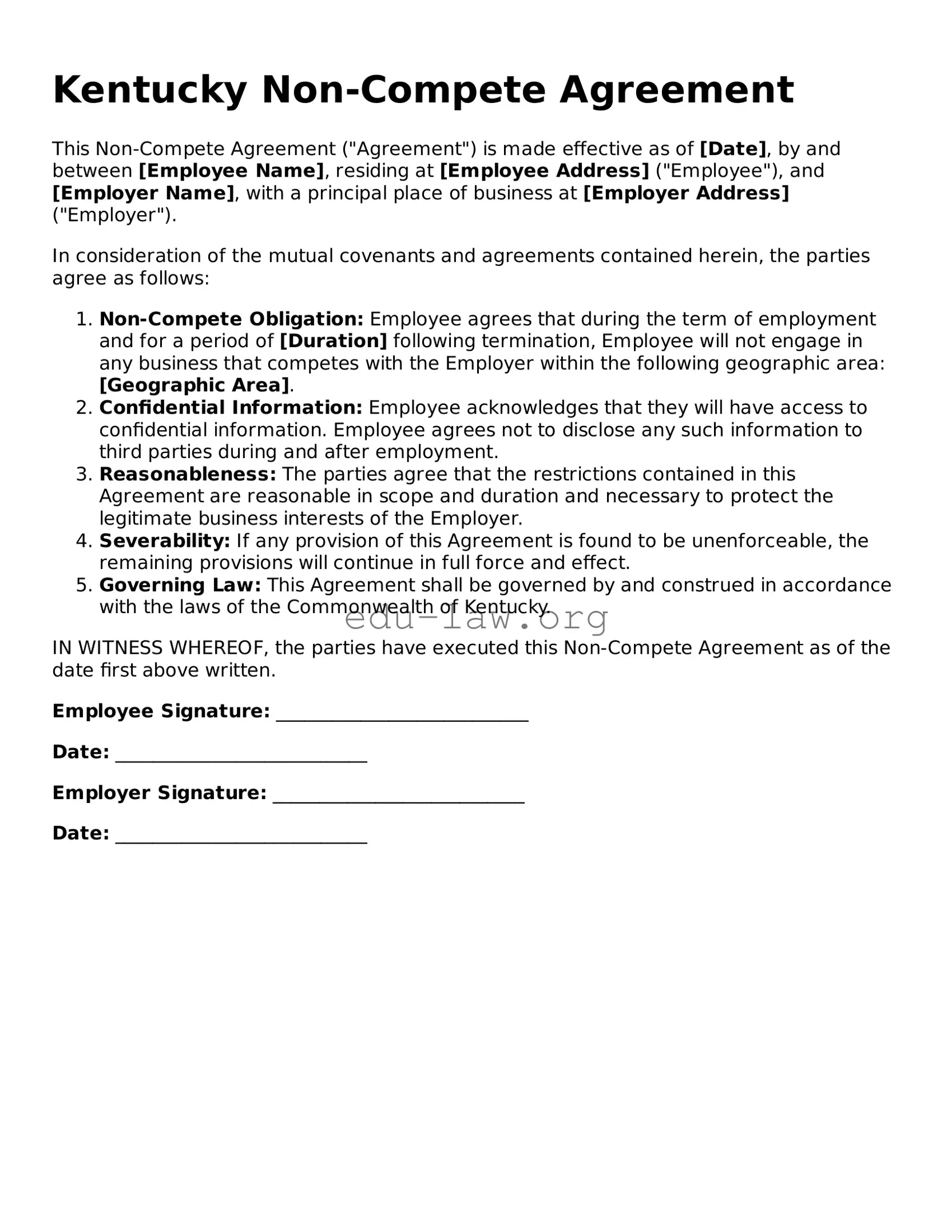
Kentucky Non-Compete Agreement
This Non-Compete Agreement ("Agreement") is made effective as of [Date], by and between [Employee Name], residing at [Employee Address] ("Employee"), and [Employer Name], with a principal place of business at [Employer Address] ("Employer").
In consideration of the mutual covenants and agreements contained herein, the parties agree as follows:
IN WITNESS WHEREOF, the parties have executed this Non-Compete Agreement as of the date first above written.
Employee Signature: ___________________________
Date: ___________________________
Employer Signature: ___________________________
Date: ___________________________
| Fact Name | Details |
|---|---|
| Governing Law | The Kentucky Non-compete Agreement is governed by Kentucky state law. |
| Enforceability | Non-compete agreements in Kentucky are enforceable if they are reasonable in scope, duration, and geographic area. |
| Consideration Requirement | For a non-compete agreement to be valid, there must be adequate consideration, such as employment or access to confidential information. |
| Duration Limitations | Kentucky courts generally favor non-compete agreements with a duration of one to two years. |
| Geographic Scope | The geographic area covered by a non-compete must be reasonable and not overly broad. |
| Public Policy | Kentucky courts may invalidate non-compete agreements that are deemed to restrain trade excessively. |
| Employee Rights | Employees have the right to challenge non-compete agreements in court if they believe the terms are unfair. |
| Exceptions | Certain professions, such as medical practitioners, may face different standards regarding non-compete agreements. |
After you have gathered all necessary information, you can begin filling out the Kentucky Non-compete Agreement form. This document is essential for establishing terms between parties regarding employment and competition. Follow these steps to complete the form accurately.
Once completed, the agreement should be reviewed by both parties to confirm understanding and compliance. Keep the signed document in a safe place for future reference.
What is a Kentucky Non-compete Agreement?
A Kentucky Non-compete Agreement is a legal document that restricts an employee from working for competitors or starting a competing business for a certain period after leaving their current employer. This type of agreement aims to protect a company's confidential information and trade secrets. It is important for both employers and employees to understand the terms and implications of such an agreement before signing.
Are Non-compete Agreements enforceable in Kentucky?
Yes, Non-compete Agreements can be enforceable in Kentucky, but they must meet specific criteria. The agreement should be reasonable in terms of duration, geographic area, and the scope of activities restricted. Courts in Kentucky will review these agreements to ensure they do not impose undue hardship on the employee while still protecting the legitimate interests of the employer.
How long can a Non-compete Agreement last in Kentucky?
The duration of a Non-compete Agreement in Kentucky varies, but generally, it should be reasonable. Courts often consider a period of six months to two years as acceptable, depending on the nature of the business and the employee's role. If the duration is too long, a court may deem the agreement unenforceable. It's crucial to tailor the length to fit the specific situation.
What should I consider before signing a Non-compete Agreement?
Before signing a Non-compete Agreement, consider several factors. Evaluate the restrictions imposed on your future employment opportunities. Think about how the agreement may affect your career path and whether it limits your ability to find work in your field. It’s also wise to consult with a legal professional to understand your rights and obligations fully. This way, you can make an informed decision that aligns with your career goals.
Failing to Specify the Duration: One common mistake is not clearly defining how long the non-compete agreement will last. Without a specific time frame, the agreement may be deemed unenforceable.
Neglecting Geographic Scope: Individuals often overlook the importance of outlining the geographic area where the non-compete applies. A vague description can lead to confusion and potential legal issues.
Inadequate Consideration: It is crucial to provide something of value in exchange for signing the agreement. Many people forget that without adequate consideration, the agreement may not hold up in court.
Using Ambiguous Language: Clarity is key. Using vague terms can result in misinterpretation. It is essential to use precise language to ensure that both parties understand their obligations.
Ignoring State Laws: Each state has different rules regarding non-compete agreements. Failing to consider Kentucky's specific regulations can lead to an unenforceable contract.
Not Consulting Legal Counsel: Many individuals attempt to draft or sign these agreements without seeking legal advice. This can lead to significant oversights and potential legal challenges down the road.
Overly Broad Restrictions: Some people create agreements that are too restrictive. Courts may strike down overly broad non-compete clauses, so it’s vital to keep them reasonable.
Failure to Update the Agreement: As circumstances change, so should the non-compete agreement. Not revisiting and updating the document can lead to outdated or irrelevant terms.
Signing Without Understanding: Lastly, individuals sometimes sign agreements without fully understanding their rights and obligations. It is essential to read and comprehend the entire document before signing.
A Kentucky Non-compete Agreement is an important document that helps protect a business's interests. However, it is often accompanied by other forms and documents that can further clarify the relationship between the employer and employee. Here are some common documents that are frequently used alongside a Non-compete Agreement.
These documents work together to create a clear understanding of expectations and responsibilities in the workplace. Properly drafted agreements can save both parties from misunderstandings and legal disputes down the road.
The Kentucky Non-compete Agreement is similar to a Non-disclosure Agreement (NDA). Both documents are designed to protect sensitive information and business interests. An NDA focuses on preventing the sharing of confidential information, such as trade secrets and proprietary data, while a Non-compete Agreement restricts an employee's ability to work for competitors after leaving a company. Together, these agreements help maintain a competitive edge by safeguarding valuable business information and ensuring that employees do not take their knowledge directly to rival firms.
Another document that shares similarities with the Kentucky Non-compete Agreement is the Non-solicitation Agreement. This type of agreement prohibits former employees from soliciting clients or customers of their previous employer for a specified period after leaving the company. While a Non-compete Agreement restricts employment with competitors, a Non-solicitation Agreement specifically targets the relationship between the employee and the employer's clientele. Both documents aim to protect business relationships and prevent unfair competition.
The Kentucky Non-compete Agreement is also comparable to an Employment Contract. An Employment Contract outlines the terms of employment, including job responsibilities, compensation, and duration of employment. Often, Non-compete clauses are included within these contracts to ensure that employees understand their obligations regarding competitive activities post-employment. By combining these agreements, employers can clearly communicate expectations and protect their business interests from potential threats after an employee departs.
Lastly, the Kentucky Non-compete Agreement can be likened to a Proprietary Information Agreement. This document ensures that employees acknowledge and agree to protect the company’s proprietary information. While it focuses on the safeguarding of specific information, it may also include clauses that limit an employee's ability to work with competitors. Both agreements emphasize the importance of confidentiality and the protection of intellectual property, reinforcing the need for employees to respect the company's valuable assets even after their employment ends.
When filling out the Kentucky Non-compete Agreement form, it’s essential to follow certain guidelines. Here are eight things you should and shouldn't do:
By following these guidelines, you can help ensure that your Non-compete Agreement is completed correctly and protects your interests.
Many people have misunderstandings about the Kentucky Non-compete Agreement form. Here are seven common misconceptions:
Understanding these misconceptions can help individuals navigate their rights and obligations regarding non-compete agreements in Kentucky.
Filling out and using the Kentucky Non-compete Agreement form requires careful consideration. Here are some key takeaways to keep in mind: