When it comes to managing vehicle-related matters in Kentucky, the Motor Vehicle Power of Attorney form plays a crucial role. This legal document empowers one individual, known as the agent, to act on behalf of another, referred to as the principal, in transactions involving motor vehicles. Whether you're selling a car, transferring ownership, or handling registration issues, this form simplifies the process by allowing someone you trust to navigate these responsibilities for you. It's important to understand that the form must be completed accurately and signed to ensure it holds legal weight. Additionally, the Motor Vehicle Power of Attorney can be tailored to fit specific needs, granting limited or broad powers depending on the situation. By utilizing this form, you can ensure that your vehicle-related affairs are managed smoothly, even if you're unable to attend to them personally.
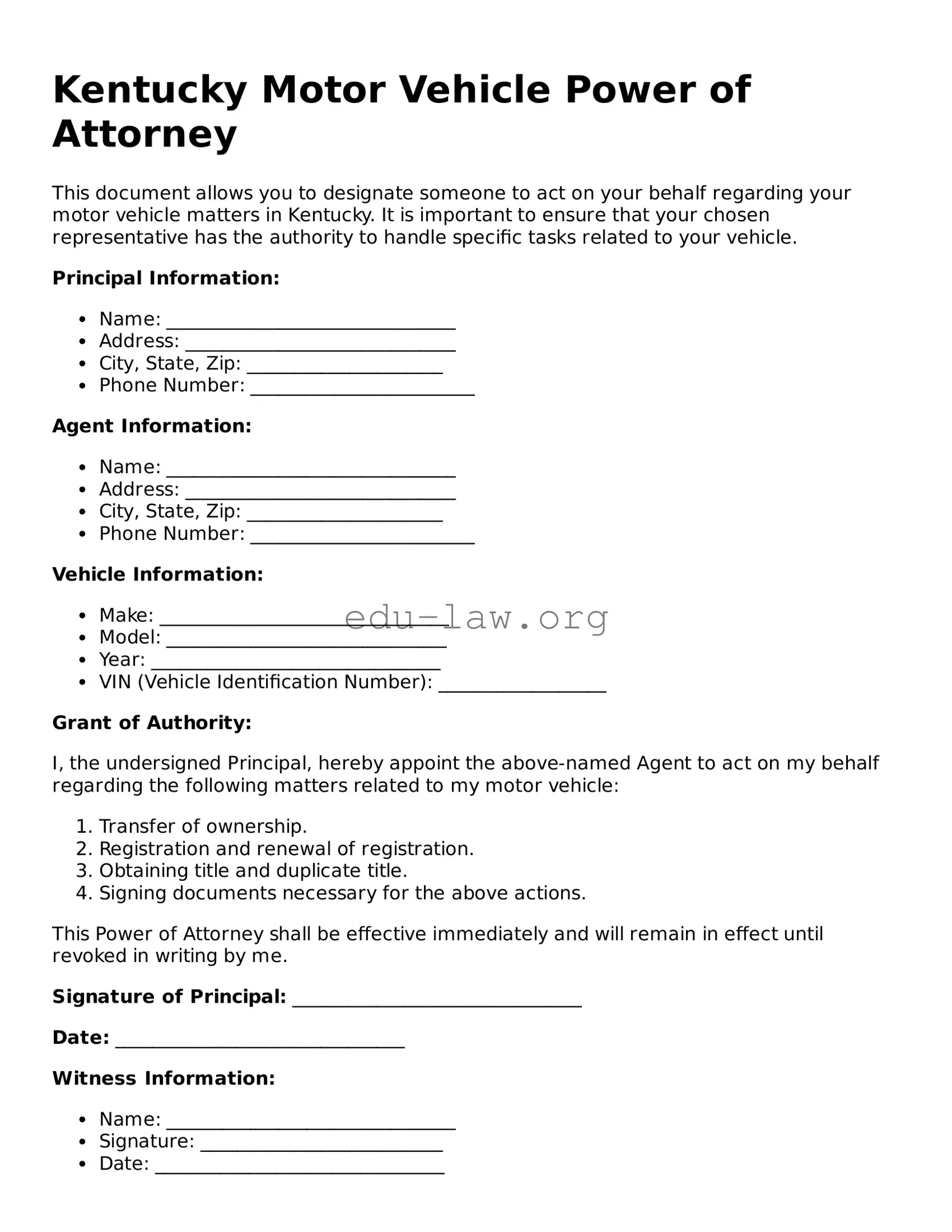
Kentucky Motor Vehicle Power of Attorney
This document allows you to designate someone to act on your behalf regarding your motor vehicle matters in Kentucky. It is important to ensure that your chosen representative has the authority to handle specific tasks related to your vehicle.
Principal Information:
Agent Information:
Vehicle Information:
Grant of Authority:
I, the undersigned Principal, hereby appoint the above-named Agent to act on my behalf regarding the following matters related to my motor vehicle:
This Power of Attorney shall be effective immediately and will remain in effect until revoked in writing by me.
Signature of Principal: _______________________________
Date: _______________________________
Witness Information:
Notary Acknowledgment:
State of Kentucky
County of _____________________________
Subscribed and sworn to before me this _____ day of __________, 20__.
Notary Public Signature: _______________________________
My Commission Expires: _______________________________
| Fact Name | Description |
|---|---|
| Purpose | The Kentucky Motor Vehicle Power of Attorney form allows an individual to designate another person to act on their behalf in matters related to motor vehicles. |
| Governing Law | This form is governed by Kentucky Revised Statutes, specifically KRS 186A.190. |
| Usage | It is commonly used for tasks such as transferring vehicle titles, registering vehicles, or handling other motor vehicle-related transactions. |
| Signature Requirement | The form must be signed by the principal (the person granting authority) and may need to be notarized to be legally binding. |
| Revocation | The power of attorney can be revoked at any time by the principal, provided they notify the agent and any relevant parties. |
Filling out the Kentucky Motor Vehicle Power of Attorney form is a straightforward process that allows you to designate someone to act on your behalf regarding vehicle matters. After completing the form, you will need to ensure it is signed and possibly notarized, depending on your specific needs.
What is a Kentucky Motor Vehicle Power of Attorney form?
The Kentucky Motor Vehicle Power of Attorney form allows one person to grant another person the authority to handle specific tasks related to their vehicle. This could include signing documents, transferring ownership, or dealing with the Kentucky Department of Vehicle Regulation on their behalf.
Who can use this form?
Any vehicle owner in Kentucky can use this form. If you need someone else to manage your vehicle transactions, this form allows you to officially authorize them. Common users include individuals who are unable to be present for vehicle-related tasks due to travel, illness, or other commitments.
What tasks can the appointed person perform?
The person you appoint can perform various tasks, such as signing over the title of the vehicle, registering the vehicle, or applying for a duplicate title. The specific powers granted can be tailored to your needs within the form.
Do I need to have the form notarized?
Yes, the Kentucky Motor Vehicle Power of Attorney form must be notarized. This step is important because it verifies your identity and confirms that you are granting authority willingly. Notarization helps prevent fraud and ensures that the document is legally binding.
How long is the Power of Attorney valid?
The Power of Attorney remains valid until you revoke it or until the specific task is completed, depending on what you specify in the document. If you want to cancel the authority granted, you must provide a written notice to the person you appointed.
Can I use this form for multiple vehicles?
Yes, you can use the Kentucky Motor Vehicle Power of Attorney form for multiple vehicles. Just make sure to list each vehicle clearly on the form. This way, the appointed person will have the authority to act on behalf of all the vehicles you specify.
Where can I obtain the form?
You can obtain the Kentucky Motor Vehicle Power of Attorney form from the Kentucky Department of Vehicle Regulation's website or at local county clerk offices. Ensure you have the most current version to avoid any issues.
Not providing complete information about the vehicle. This includes missing details such as the Vehicle Identification Number (VIN) or the make and model.
Failing to clearly identify the agent. The person designated to act on behalf of the vehicle owner must be specified with full name and address.
Neglecting to sign the form. Without the owner's signature, the document holds no legal weight.
Overlooking the date of signing. The form must include the date to establish when the authority is granted.
Using outdated forms. Always ensure that you are using the most current version of the Power of Attorney form.
Not having the form notarized when required. In some cases, notarization is necessary for the document to be valid.
Forgetting to specify the duration of the authority. It is important to indicate whether the power of attorney is temporary or permanent.
Ignoring state-specific requirements. Each state may have unique rules regarding the Power of Attorney form, and Kentucky is no exception.
When dealing with vehicle transactions in Kentucky, the Motor Vehicle Power of Attorney form is often accompanied by several other important documents. These forms help ensure that all legal aspects of vehicle ownership and transfer are properly addressed. Below are four commonly used documents that may accompany the Power of Attorney.
Having these documents ready can streamline the process of buying or selling a vehicle in Kentucky. Ensuring that all necessary paperwork is completed accurately can save time and prevent potential legal issues down the road.
The Kentucky Motor Vehicle Power of Attorney form is similar to a General Power of Attorney. Both documents allow an individual to appoint another person to act on their behalf. In the case of the General Power of Attorney, the scope is broader and can cover various aspects of financial and legal matters, while the Motor Vehicle Power of Attorney specifically pertains to vehicle-related transactions. This distinction makes the Motor Vehicle Power of Attorney more specialized, focusing solely on matters such as title transfers and registration.
Another document that shares similarities is the Durable Power of Attorney. Like the Motor Vehicle Power of Attorney, this form grants authority to another individual. However, the Durable Power of Attorney remains effective even if the principal becomes incapacitated. This feature is particularly important for individuals who want to ensure their affairs are managed consistently, even in unforeseen circumstances, although it encompasses a wider range of powers beyond just vehicle matters.
The Limited Power of Attorney is also comparable. This document allows a person to delegate specific powers to another individual for a defined period or purpose. While the Motor Vehicle Power of Attorney is inherently limited to vehicle transactions, the Limited Power of Attorney can be tailored to cover various specific tasks. Both documents require clear definitions of the powers granted to avoid confusion and ensure that the agent acts within the intended scope.
A Bill of Sale is another document that relates closely to the Motor Vehicle Power of Attorney. While the Motor Vehicle Power of Attorney authorizes someone to act on behalf of the vehicle owner, a Bill of Sale is a record of the transaction that occurs once the vehicle is sold. Both documents are often used together during vehicle transfers, with the Power of Attorney facilitating the process and the Bill of Sale serving as proof of the transaction.
Lastly, a Vehicle Title Application shares similarities with the Motor Vehicle Power of Attorney. Both documents are essential in the process of vehicle ownership transfer. The Vehicle Title Application is the form that must be filled out to officially transfer the title of a vehicle, while the Motor Vehicle Power of Attorney allows someone else to complete that application on behalf of the owner. Together, they ensure that the transfer of ownership is executed smoothly and legally.
When filling out the Kentucky Motor Vehicle Power of Attorney form, it's important to follow certain guidelines to ensure the document is completed correctly. Here are six things to keep in mind:
Following these steps can help prevent delays or issues with your Power of Attorney. Always double-check your work to ensure everything is in order.
When it comes to the Kentucky Motor Vehicle Power of Attorney form, several misconceptions can lead to confusion. Understanding these can help individuals navigate the process more effectively.
Many people believe that only car dealerships can use this form. In reality, any individual can designate someone else to handle vehicle transactions on their behalf.
Some think that once a Power of Attorney is signed, it lasts indefinitely. However, it can be revoked at any time by the principal, as long as they are mentally competent.
While legal assistance can be helpful, it is not required to fill out the Kentucky Motor Vehicle Power of Attorney form. Individuals can complete it on their own.
This form is versatile. It can also be used for other tasks, such as registering a vehicle or transferring ownership.
Notarization is not a requirement for the Kentucky Motor Vehicle Power of Attorney. However, having it notarized can add an extra layer of security.
People often think that only one agent can be appointed. In fact, you can designate multiple agents to act on your behalf, which can be useful in certain situations.
While this form is specific to Kentucky, it can be recognized in other states for vehicle transactions, provided the laws of those states allow it.
Some individuals worry that their agent will have unchecked authority. The Power of Attorney can be tailored to limit the agent's powers, ensuring they can only act within specified boundaries.
Filling out and utilizing the Kentucky Motor Vehicle Power of Attorney form is a straightforward process, but it requires careful attention to detail. Here are some key takeaways to consider: