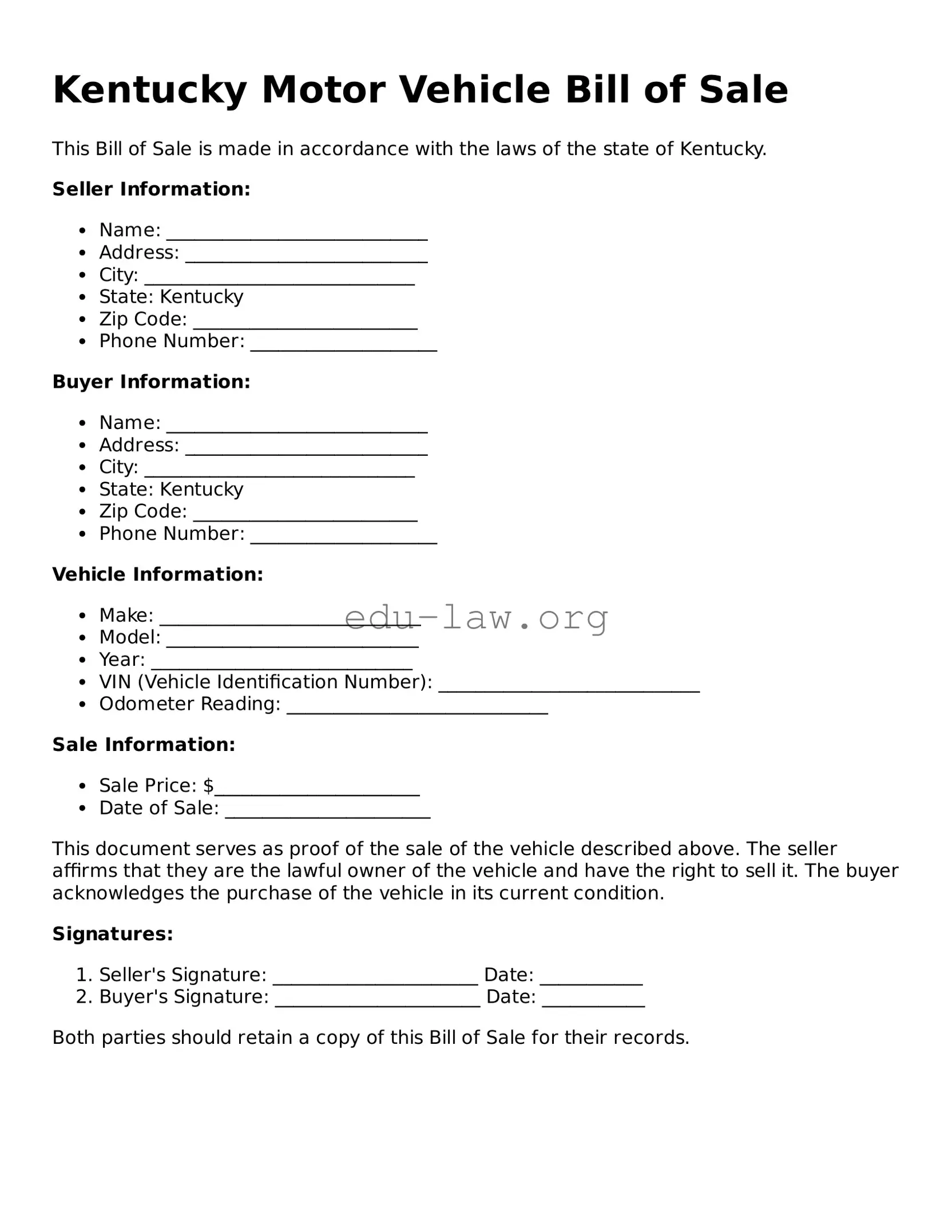
The Kentucky Motor Vehicle Bill of Sale form is an essential document for anyone involved in the buying or selling of a vehicle in the state. This form serves as a legal record of the transaction, detailing key information about the vehicle, such as its make, model, year, and Vehicle Identification Number (VIN). It also captures the names and addresses of both the seller and buyer, ensuring that both parties are clearly identified. Additionally, the form includes space for the sale price and the date of the transaction, which are critical for both tax purposes and future reference. By providing a clear outline of the terms of sale, this document helps protect the interests of both the buyer and seller, offering peace of mind during the transfer of ownership. Understanding the components of the Kentucky Motor Vehicle Bill of Sale form is crucial for a smooth transaction and can help prevent potential disputes down the line.
Kentucky Motor Vehicle Bill of Sale
This Bill of Sale is made in accordance with the laws of the state of Kentucky.
Seller Information:
Buyer Information:
Vehicle Information:
Sale Information:
This document serves as proof of the sale of the vehicle described above. The seller affirms that they are the lawful owner of the vehicle and have the right to sell it. The buyer acknowledges the purchase of the vehicle in its current condition.
Signatures:
Both parties should retain a copy of this Bill of Sale for their records.
| Fact Name | Description |
|---|---|
| Purpose | The Kentucky Motor Vehicle Bill of Sale serves as a legal document that records the sale of a motor vehicle between a buyer and a seller. |
| Governing Law | This form is governed by the Kentucky Revised Statutes, specifically KRS 186A.190. |
| Required Information | Essential details include the vehicle's make, model, year, Vehicle Identification Number (VIN), and the sale price. |
| Signatures | Both the buyer and the seller must sign the Bill of Sale to validate the transaction. |
| Notarization | While notarization is not required, it is recommended to provide additional legal protection. |
| Tax Implications | The Bill of Sale may be used to calculate sales tax when registering the vehicle with the state. |
| Record Keeping | Both parties should retain a copy of the Bill of Sale for their records, as it serves as proof of the transaction. |
| Transfer of Ownership | The Bill of Sale facilitates the transfer of ownership from the seller to the buyer, which is essential for registration. |
| Vehicle Condition | It is advisable to include a statement regarding the condition of the vehicle to avoid future disputes. |
| Usage Beyond Sales | The form can also be used for gifting a vehicle, provided all necessary details are included. |
After obtaining the Kentucky Motor Vehicle Bill of Sale form, ensure you have all necessary information ready. This includes details about the vehicle, the seller, and the buyer. Carefully filling out the form will help facilitate the transfer of ownership.
Once completed, ensure that both parties retain a copy for their records. This document will be essential for registering the vehicle and proving ownership.
What is a Kentucky Motor Vehicle Bill of Sale?
A Kentucky Motor Vehicle Bill of Sale is a legal document that serves as proof of the sale and transfer of ownership of a vehicle. It includes essential information such as the vehicle's make, model, year, VIN (Vehicle Identification Number), and the names and addresses of both the buyer and seller. This document is crucial for registering the vehicle in the new owner's name and can also be useful for tax purposes.
Is a Bill of Sale required in Kentucky?
While a Bill of Sale is not legally required for every vehicle transaction in Kentucky, it is highly recommended. Having a Bill of Sale protects both the buyer and the seller by providing a written record of the transaction. It can help resolve any disputes that may arise regarding the sale, and it is often required when applying for a new title or registration.
What information should be included in the Bill of Sale?
The Bill of Sale should include the following information: the full names and addresses of the buyer and seller, the vehicle's make, model, year, and VIN, the sale price, and the date of the transaction. Additionally, both parties should sign the document to confirm their agreement. Including details such as the odometer reading at the time of sale can also be beneficial.
Can I create my own Bill of Sale, or do I need a specific form?
You can create your own Bill of Sale as long as it contains all the necessary information. However, using a specific form that complies with Kentucky regulations can simplify the process. Many online resources provide templates that are easy to fill out and ensure that you include all required details. This can help avoid mistakes and ensure that the document is valid.
What should I do after completing the Bill of Sale?
After completing the Bill of Sale, both the buyer and seller should keep a copy for their records. The buyer will need to take the signed Bill of Sale to the county clerk’s office when applying for a new title and registration. It’s also advisable for the seller to notify their insurance company of the sale and to remove the vehicle from their policy to avoid any future liability.
Failing to include accurate vehicle information. This includes the make, model, year, and Vehicle Identification Number (VIN). Omitting or misrepresenting these details can lead to issues with registration.
Not providing the correct sale price. The sale price must reflect the actual transaction amount. Understating the price can result in tax complications.
Neglecting to include both parties' signatures. Both the seller and buyer must sign the document for it to be valid. A missing signature can invalidate the sale.
Using incorrect dates. The date of sale should be clearly stated. Incorrect or missing dates can create confusion regarding ownership transfer.
Not providing contact information. Both parties should include their names, addresses, and phone numbers. This information is crucial for future communication and verification.
Overlooking the odometer reading. The current odometer reading must be recorded accurately. Failing to do so can raise legal issues related to mileage fraud.
Forgetting to keep a copy of the bill of sale. Both the seller and buyer should retain a copy for their records. This document serves as proof of the transaction.
When buying or selling a vehicle in Kentucky, the Motor Vehicle Bill of Sale form is essential. However, there are several other documents that often accompany this form to ensure a smooth transaction. Here’s a list of common forms and documents you may need:
Having these documents ready can simplify the process of buying or selling a vehicle in Kentucky. Always ensure that you have everything in order to avoid any complications during the transaction.
The Kentucky Motor Vehicle Bill of Sale form is similar to a general Bill of Sale, which is used for various types of personal property transactions. Like the motor vehicle version, a general Bill of Sale provides essential details about the buyer and seller, the item being sold, and the sale price. Both documents serve as proof of ownership transfer and can be used to resolve disputes or verify the transaction. The general Bill of Sale can apply to items ranging from furniture to electronics, making it a versatile tool for buyers and sellers alike.
An Affidavit of Ownership is another document that shares similarities with the Kentucky Motor Vehicle Bill of Sale. This affidavit is often used when the seller cannot provide a title for the vehicle. It allows the seller to declare their ownership and the details of the vehicle. Both documents require the seller's signature and may need to be notarized. This ensures that the transaction is legitimate and protects both parties involved.
A Purchase Agreement for a vehicle is another document that resembles the Kentucky Motor Vehicle Bill of Sale. This agreement outlines the terms of the sale, including the price, payment method, and any warranties or conditions. While the Bill of Sale serves as proof of the transaction, the Purchase Agreement details the obligations of both parties. Both documents are essential in ensuring a smooth and transparent sale process.
Lastly, a lien release form can be compared to the Kentucky Motor Vehicle Bill of Sale. When a vehicle has an outstanding loan, the lender holds a lien on it. Once the loan is paid off, the lender issues a lien release form, which confirms that the borrower owns the vehicle outright. Both the lien release and the Bill of Sale are crucial for establishing clear ownership and can be necessary for future sales or registrations.
When filling out the Kentucky Motor Vehicle Bill of Sale form, it is important to follow certain guidelines to ensure that the process goes smoothly. Here’s a helpful list of things to do and avoid:
By following these guidelines, you can help ensure that your Bill of Sale is properly completed and that the transaction proceeds without complications.
When it comes to the Kentucky Motor Vehicle Bill of Sale form, there are several misconceptions that can lead to confusion for buyers and sellers alike. Understanding the truth behind these misconceptions is crucial for ensuring a smooth transaction.
Many people believe that a Bill of Sale serves the same purpose as a vehicle title. However, while the Bill of Sale documents the transaction, the title proves ownership. Both are important but serve different roles.
Some individuals think that a Bill of Sale is optional in Kentucky. In reality, while it may not be legally required for every transaction, it is highly recommended to protect both parties and provide a record of the sale.
People often assume that the Bill of Sale must be notarized to be valid. In Kentucky, notarization is not a requirement, although having it notarized can add an extra layer of security.
It is a common belief that only the seller's signature is necessary. In fact, both the buyer and seller should sign the document to ensure that both parties agree to the terms of the sale.
Some think that this form is only relevant for used vehicles. However, it can be used for both new and used vehicles, providing a record of the transaction regardless of the vehicle's age.
Many believe that they must use a specific form provided by the state. While there are recommended forms, a generic Bill of Sale can be used as long as it contains the necessary information.
Some people think that the Bill of Sale is only applicable to private sales between individuals. In reality, it can also be used in transactions involving dealerships or other businesses.
It is often thought that a Bill of Sale does not provide any protection against existing liens on the vehicle. While it does not eliminate liens, it does serve as a record that can help clarify ownership and responsibilities.
Lastly, some individuals believe that once the transaction is complete, there’s no need to keep a copy. In fact, retaining a copy is important for both parties in case of future disputes or questions about ownership.
When filling out and using the Kentucky Motor Vehicle Bill of Sale form, it is important to understand the following key points:
By adhering to these guidelines, you can ensure a smooth transaction and protect the interests of both parties involved in the sale of the vehicle.