In the realm of healthcare decision-making, the Kentucky Medical Power of Attorney form stands as a crucial legal document that empowers individuals to designate a trusted person to make medical decisions on their behalf when they are unable to do so. This form is particularly significant in situations involving serious illness or incapacitation, where timely and informed decisions about medical treatment are essential. By completing this document, individuals can ensure that their healthcare preferences are respected and that their chosen agent can act in accordance with their values and wishes. The form outlines specific powers granted to the agent, including the ability to consent to or refuse medical treatment, access medical records, and communicate with healthcare providers. Importantly, it also allows individuals to specify any limitations on the agent's authority, ensuring that their autonomy is preserved even in challenging circumstances. Understanding the nuances of this form is vital for anyone looking to safeguard their healthcare choices and ensure that their voice is heard, even when they cannot speak for themselves.
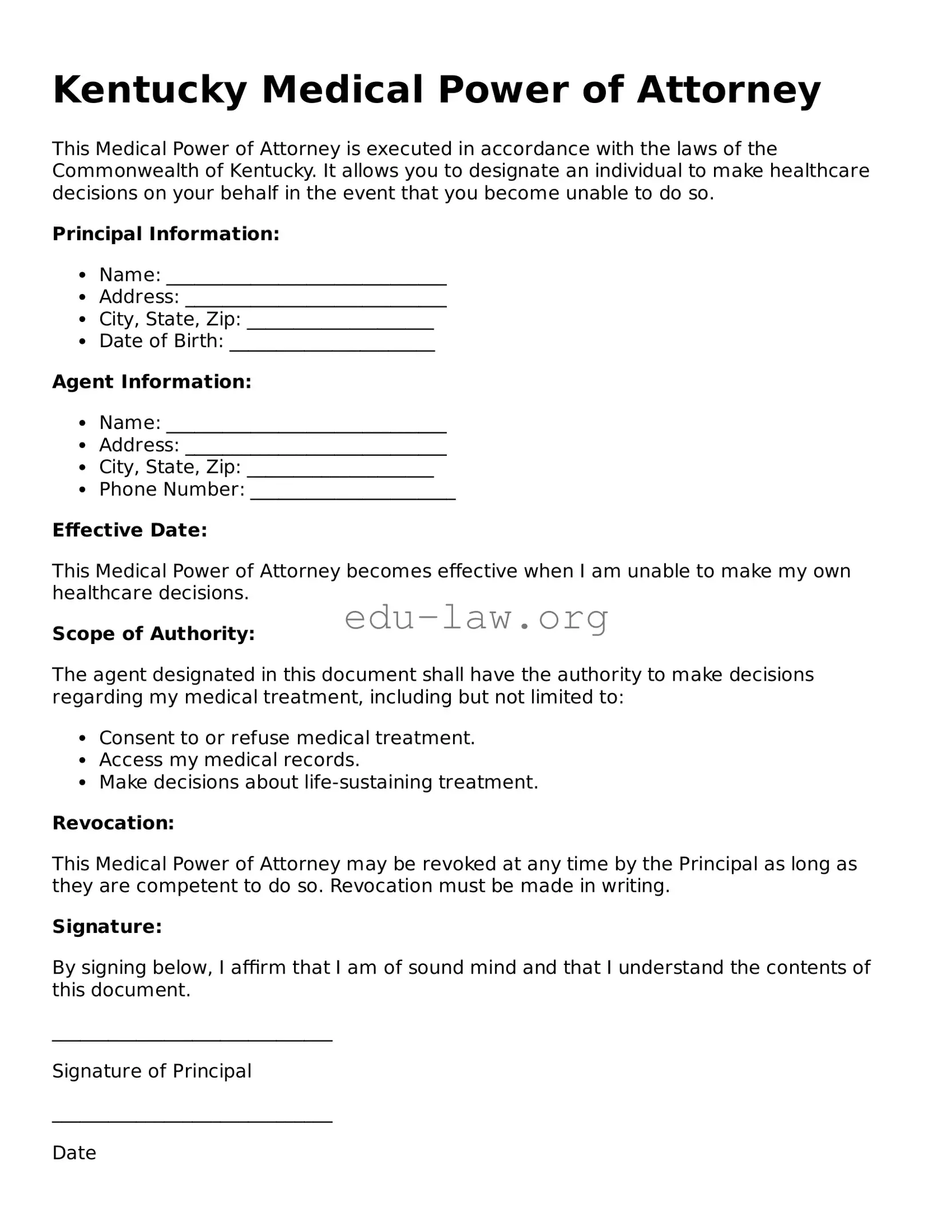
Kentucky Medical Power of Attorney
This Medical Power of Attorney is executed in accordance with the laws of the Commonwealth of Kentucky. It allows you to designate an individual to make healthcare decisions on your behalf in the event that you become unable to do so.
Principal Information:
Agent Information:
Effective Date:
This Medical Power of Attorney becomes effective when I am unable to make my own healthcare decisions.
Scope of Authority:
The agent designated in this document shall have the authority to make decisions regarding my medical treatment, including but not limited to:
Revocation:
This Medical Power of Attorney may be revoked at any time by the Principal as long as they are competent to do so. Revocation must be made in writing.
Signature:
By signing below, I affirm that I am of sound mind and that I understand the contents of this document.
______________________________
Signature of Principal
______________________________
Date
Witnesses:
This document must be signed in the presence of two witnesses who are not related to the Principal or the Agent.
______________________________
Date
| Fact Name | Description |
|---|---|
| Purpose | The Kentucky Medical Power of Attorney form allows an individual to designate another person to make medical decisions on their behalf if they become incapacitated. |
| Governing Law | This form is governed by Kentucky Revised Statutes, Chapter 311, which outlines the legal framework for medical powers of attorney in the state. |
| Eligibility | Any adult resident of Kentucky can create a Medical Power of Attorney, provided they are of sound mind at the time of signing. |
| Revocation | The principal can revoke the Medical Power of Attorney at any time, as long as they are mentally competent to do so. |
| Signature Requirements | The form must be signed by the principal and witnessed by two individuals who are not related to the principal or named as agents in the document. |
Filling out the Kentucky Medical Power of Attorney form is an important step in ensuring that your healthcare preferences are honored. This document allows you to designate someone you trust to make medical decisions on your behalf if you are unable to do so. Follow these steps to complete the form correctly.
Once you have completed the form, store it in a safe place and share copies with your appointed agent, healthcare providers, and family members. This ensures that your medical wishes are known and can be followed when necessary.
What is a Kentucky Medical Power of Attorney?
A Kentucky Medical Power of Attorney is a legal document that allows an individual, known as the principal, to designate another person, referred to as the agent, to make medical decisions on their behalf in the event that they become incapacitated. This document ensures that the principal's healthcare preferences are respected and followed, even when they are unable to communicate those wishes themselves.
Who can serve as an agent in a Kentucky Medical Power of Attorney?
In Kentucky, any competent adult can serve as an agent. This includes family members, friends, or trusted individuals. However, it is advisable to choose someone who understands the principal’s values and wishes regarding medical treatment. Additionally, the agent should be someone who is willing and able to make difficult decisions if necessary.
How do I create a Medical Power of Attorney in Kentucky?
To create a Medical Power of Attorney in Kentucky, the principal must complete a form that complies with state laws. This form must clearly identify the principal and the agent, outline the powers granted to the agent, and be signed by the principal. It is recommended to have the document witnessed or notarized to enhance its validity, although notarization is not strictly required.
Can I revoke a Medical Power of Attorney in Kentucky?
Yes, a principal has the right to revoke a Medical Power of Attorney at any time, as long as they are competent to do so. Revocation can be accomplished by notifying the agent in writing or by creating a new Medical Power of Attorney that explicitly states the previous document is revoked. It is important to inform healthcare providers of the revocation to avoid any confusion regarding medical decision-making authority.
What powers does the agent have under a Medical Power of Attorney?
The agent’s powers can vary based on the language included in the Medical Power of Attorney. Generally, the agent can make decisions about medical treatments, surgical procedures, and end-of-life care. The principal may specify limitations or conditions under which the agent can act, ensuring that their wishes are followed as closely as possible.
Is a Medical Power of Attorney the same as a living will?
No, a Medical Power of Attorney and a living will serve different purposes. A Medical Power of Attorney designates an individual to make medical decisions on behalf of the principal, while a living will outlines the principal’s preferences for medical treatment in specific situations, particularly at the end of life. Both documents can work together to provide comprehensive guidance for healthcare decisions.
When does a Medical Power of Attorney take effect?
A Medical Power of Attorney typically takes effect when the principal is deemed incapacitated by a physician. This means that the principal is unable to make informed decisions regarding their medical care. The document may also specify that it takes effect immediately upon signing, regardless of the principal's capacity.
Can I use a Medical Power of Attorney from another state in Kentucky?
Generally, a Medical Power of Attorney from another state may be recognized in Kentucky, provided it complies with the laws of that state and contains the necessary elements. However, it is advisable to consult with a legal professional to ensure that the document meets Kentucky’s requirements and that there are no complications regarding its enforcement.
Not selecting a trusted agent. It's crucial to choose someone who understands your wishes and can make decisions on your behalf.
Failing to specify the scope of authority. Be clear about what decisions your agent can make regarding your medical care.
Leaving the form unsigned. A signature is necessary to validate the document and make it legally binding.
Not dating the document. A date helps to establish when the authority begins and can prevent confusion later.
Overlooking witness requirements. Kentucky law requires that your Medical Power of Attorney be signed in front of two witnesses or a notary public.
Using vague language. Be specific about your wishes to avoid any misunderstandings regarding your medical care.
Not updating the form when circumstances change. Life events, like a divorce or the death of your agent, may require you to revise the document.
Ignoring state-specific guidelines. Each state has its own rules, so ensure you follow Kentucky’s requirements closely.
Not discussing your wishes with your agent. Open communication is vital. Your agent should know your preferences and values.
Failing to keep copies of the document. Share copies with your agent, healthcare providers, and family members to ensure they know your wishes.
The Kentucky Medical Power of Attorney form is an essential document that allows individuals to designate someone to make healthcare decisions on their behalf if they become unable to do so. However, there are other important forms and documents that often accompany this form to ensure comprehensive healthcare planning and legal clarity. Below are five such documents.
Utilizing these documents in conjunction with the Kentucky Medical Power of Attorney can provide a more comprehensive approach to healthcare planning. By preparing these forms, individuals can ensure that their wishes are respected and that their loved ones are equipped to make informed decisions during challenging times.
The Kentucky Medical Power of Attorney form shares similarities with the Durable Power of Attorney. Both documents allow an individual to appoint someone else to make decisions on their behalf. However, while the Durable Power of Attorney can cover a wide range of financial and legal matters, the Medical Power of Attorney specifically focuses on healthcare decisions. This distinction is crucial for individuals who want to ensure that their medical preferences are respected, especially in situations where they may be unable to communicate their wishes due to illness or injury.
Another document that resembles the Kentucky Medical Power of Attorney is the Living Will. A Living Will outlines an individual's preferences regarding medical treatment in situations where they cannot express their wishes. Like the Medical Power of Attorney, it addresses healthcare decisions but does so in a more directive manner. The Living Will specifies what types of medical interventions an individual does or does not want, while the Medical Power of Attorney designates a trusted person to make those decisions, providing a more flexible approach to healthcare management.
The Advance Healthcare Directive is also similar to the Kentucky Medical Power of Attorney. This document combines elements of both the Medical Power of Attorney and the Living Will. It allows individuals to designate a healthcare agent while also providing specific instructions about their medical treatment preferences. This comprehensive approach ensures that an individual's wishes are clearly communicated and respected, making it a useful tool for those who want to prepare for potential healthcare challenges.
Lastly, the Healthcare Proxy is another document that bears resemblance to the Kentucky Medical Power of Attorney. A Healthcare Proxy allows an individual to appoint someone to make medical decisions on their behalf when they are unable to do so. The key difference lies in the terminology and the specific legal requirements in different states. While the Healthcare Proxy is commonly used in some regions, the underlying principle remains the same: empowering a trusted individual to advocate for a person's healthcare needs and preferences during critical times.
When filling out the Kentucky Medical Power of Attorney form, it is essential to follow specific guidelines to ensure that the document is valid and reflects your wishes. Below is a list of things you should and shouldn't do.
Things You Should Do:
Things You Shouldn't Do:
Many individuals have misunderstandings about the Kentucky Medical Power of Attorney form. Clarifying these misconceptions can help ensure that people make informed decisions regarding their healthcare preferences. Below are seven common misconceptions:
While both documents relate to healthcare decisions, a Medical Power of Attorney specifically designates someone to make decisions on your behalf, whereas a Living Will outlines your wishes regarding end-of-life care.
This is not true. You can revoke or amend your Medical Power of Attorney at any time, as long as you are mentally competent to do so.
Individuals can create this document without a lawyer, as long as they follow the state’s guidelines. However, consulting a legal professional can provide added assurance that the document is valid.
While many people choose family members, it is not a requirement. You can appoint any trusted individual, regardless of their relationship to you.
This misconception overlooks the fact that anyone, regardless of age, can face a medical emergency. It is prudent for adults of all ages to consider having this document in place.
The authority granted to your agent typically becomes effective only when you are unable to make decisions for yourself. This is known as a springing power of attorney.
Healthcare providers are legally obligated to recognize a valid Medical Power of Attorney. It is essential, however, to ensure that the document meets Kentucky’s legal requirements.
Understanding these misconceptions can empower individuals to take control of their healthcare decisions and ensure their wishes are respected.
Filling out and using the Kentucky Medical Power of Attorney form is an important step in ensuring that your healthcare wishes are respected. Here are some key takeaways: