In the state of Kentucky, couples facing the prospect of separation often turn to the Marital Separation Agreement as a crucial tool for navigating the complexities of their changing relationship. This document serves as a formal arrangement that outlines the rights and responsibilities of each spouse during the separation period. Key aspects of the agreement typically include the division of marital property, the allocation of debts, and provisions for child custody and support if children are involved. Additionally, the agreement may address issues such as spousal support, health insurance coverage, and the handling of joint accounts. By clearly defining these elements, the Marital Separation Agreement aims to minimize conflict and provide a structured approach to what can often be an emotionally charged process. It is essential for both parties to understand the implications of the agreement, as it can significantly influence their financial and personal lives moving forward. With careful consideration and mutual consent, this document can pave the way for a more amicable separation, allowing both individuals to focus on their future paths with clarity and purpose.
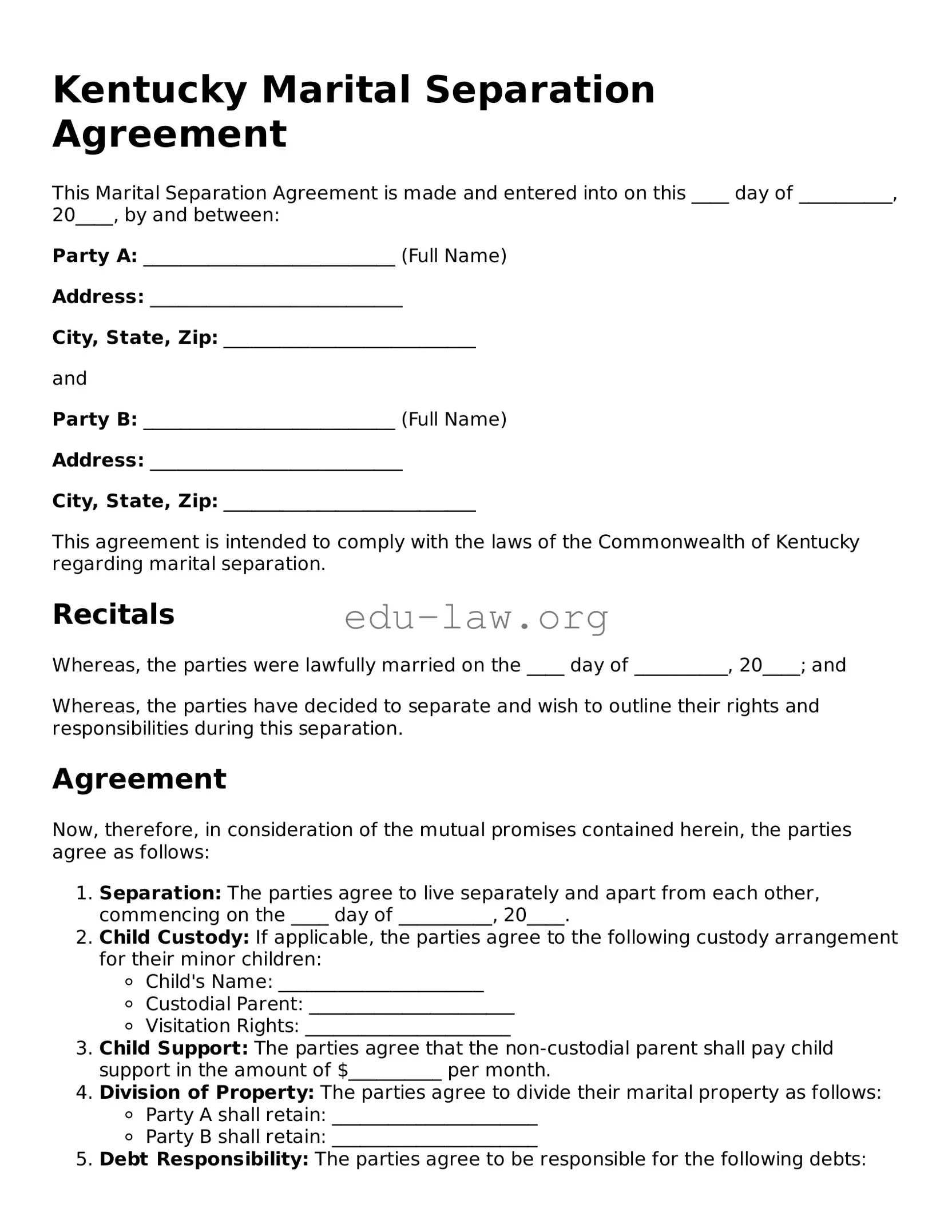
Kentucky Marital Separation Agreement
This Marital Separation Agreement is made and entered into on this ____ day of __________, 20____, by and between:
Party A: ___________________________ (Full Name)
Address: ___________________________
City, State, Zip: ___________________________
and
Party B: ___________________________ (Full Name)
Address: ___________________________
City, State, Zip: ___________________________
This agreement is intended to comply with the laws of the Commonwealth of Kentucky regarding marital separation.
Recitals
Whereas, the parties were lawfully married on the ____ day of __________, 20____; and
Whereas, the parties have decided to separate and wish to outline their rights and responsibilities during this separation.
Agreement
Now, therefore, in consideration of the mutual promises contained herein, the parties agree as follows:
Miscellaneous
This agreement may be modified only in writing and signed by both parties. It represents the entire understanding between the parties and supersedes any prior agreements.
IN WITNESS WHEREOF, the parties have executed this Marital Separation Agreement as of the date first above written.
Party A Signature: ___________________________
Date: ___________________________
Party B Signature: ___________________________
Date: ___________________________
| Fact Name | Description |
|---|---|
| Purpose | The Kentucky Marital Separation Agreement form is designed to outline the terms of separation between spouses, addressing issues such as property division, child custody, and support obligations. |
| Governing Law | This agreement is governed by Kentucky state law, specifically the Kentucky Revised Statutes (KRS) related to family law. |
| Legal Effect | Once signed, the agreement can be enforceable in court, provided it meets legal requirements and both parties have voluntarily agreed to its terms. |
| Modification | The terms of the agreement can be modified in the future if both parties consent and the changes are documented in writing. |
After obtaining the Kentucky Marital Separation Agreement form, you will need to complete it accurately to ensure that both parties understand their rights and obligations. Once filled out, the next steps will involve signing the document and potentially filing it with the court, depending on your situation.
What is a Kentucky Marital Separation Agreement?
A Kentucky Marital Separation Agreement is a legal document that outlines the terms and conditions agreed upon by spouses who are separating but not yet divorced. This agreement typically addresses issues such as the division of property, child custody, child support, and spousal support. It serves to protect both parties' interests during the separation period and can help prevent disputes later on.
How do I create a Marital Separation Agreement in Kentucky?
To create a Marital Separation Agreement in Kentucky, both spouses should first discuss and agree on the terms of their separation. It is advisable to consult with a legal professional who can provide guidance and ensure that the agreement complies with Kentucky law. Once the terms are finalized, the agreement should be drafted in writing, signed by both parties, and ideally notarized to add an extra layer of authenticity.
Is a Marital Separation Agreement legally binding?
Yes, a Marital Separation Agreement can be legally binding in Kentucky, provided that both parties voluntarily agree to its terms and the agreement is properly executed. However, it’s important to note that if circumstances change, either party may seek to modify the agreement through the court. Therefore, ensuring that the agreement is fair and reasonable at the time of signing is crucial.
What happens if one party does not follow the agreement?
If one party fails to adhere to the terms of the Marital Separation Agreement, the other party has the right to seek enforcement through the court. The court may order compliance with the agreement or may impose penalties on the non-compliant party. It’s essential to document any violations and communicate any concerns promptly to address issues before they escalate.
Can a Marital Separation Agreement be modified?
Yes, a Marital Separation Agreement can be modified if both parties agree to the changes. It is advisable to document any modifications in writing and have both parties sign the updated agreement. If one party does not agree to the changes, it may be necessary to seek a court's intervention to resolve the matter.
Incomplete Information: One of the most common mistakes is failing to provide all necessary details. Ensure that every section is filled out completely, including names, addresses, and dates.
Not Specifying Assets and Debts: Clearly listing all marital assets and debts is crucial. Omitting any items can lead to disputes later on.
Ignoring State Requirements: Each state has specific laws regarding separation agreements. Familiarize yourself with Kentucky's requirements to avoid non-compliance.
Failing to Address Child Custody: If children are involved, neglecting to outline custody arrangements can create confusion and conflict. Be specific about visitation rights and responsibilities.
Not Including a Support Agreement: Whether it's child support or spousal support, failing to detail financial obligations can lead to future disagreements. Clearly state the amounts and payment schedules.
Forgetting Signatures: A common oversight is neglecting to sign the agreement. Both parties must sign to validate the document.
Using Ambiguous Language: Clarity is key. Avoid vague terms that can be interpreted in multiple ways. Use precise language to define all terms.
Not Consulting a Lawyer: Attempting to navigate the separation process without legal guidance can lead to costly mistakes. A lawyer can help ensure that the agreement is fair and legally binding.
When navigating a marital separation in Kentucky, various forms and documents may be necessary to ensure a smooth process. Each document serves a specific purpose and can help clarify the rights and responsibilities of both parties. Below is a list of commonly used forms that accompany the Kentucky Marital Separation Agreement.
Understanding these documents can significantly ease the process of separation and divorce. Each form plays a vital role in protecting the interests of both parties, especially when children are involved. It’s always advisable to consult with a legal professional to ensure that all necessary documents are properly completed and submitted.
The Kentucky Marital Separation Agreement form shares similarities with a Divorce Settlement Agreement. Both documents outline the terms of the separation between spouses, including division of property, debt allocation, and arrangements for child custody and support. While a Marital Separation Agreement is used when couples choose to live apart without legally terminating the marriage, a Divorce Settlement Agreement is finalized when the marriage is officially dissolved. In essence, both documents serve to clarify the rights and responsibilities of each party during a significant life transition.
Another document that resembles the Kentucky Marital Separation Agreement is a Cohabitation Agreement. Although typically used by unmarried couples living together, a Cohabitation Agreement addresses similar issues such as property division and financial responsibilities. Like a Marital Separation Agreement, it aims to protect the interests of both parties and provide a clear framework for managing shared assets and liabilities. The key difference lies in the marital status of the individuals involved, but the intent to establish clear terms remains consistent.
The Kentucky Marital Separation Agreement also parallels a Child Custody Agreement. Both documents focus on the welfare of children involved in a separation or divorce. A Child Custody Agreement specifically outlines the arrangements for parenting time, decision-making responsibilities, and child support. While the Marital Separation Agreement encompasses broader financial and property-related issues, it often includes provisions for child custody, making the two documents complementary in nature when children are part of the equation.
A Property Settlement Agreement is another document similar to the Kentucky Marital Separation Agreement. This agreement specifically deals with the division of marital property and debts. Both documents aim to resolve financial matters and ensure that each party understands their rights regarding shared assets. While a Property Settlement Agreement is often part of a divorce process, it can also be included in a Marital Separation Agreement, especially if the parties intend to resolve these issues before pursuing divorce.
Lastly, a Prenuptial Agreement bears similarities to the Kentucky Marital Separation Agreement, as both documents address financial matters and asset division. A Prenuptial Agreement is created before marriage and outlines how assets will be divided in the event of a divorce or separation. While the Marital Separation Agreement is developed during or after the marriage, both documents serve to protect individual interests and clarify expectations regarding financial responsibilities. The focus on asset protection and clarity in both agreements highlights their common purpose, despite the timing of their creation.
When filling out the Kentucky Marital Separation Agreement form, it's important to be careful and thorough. Here are some things you should and shouldn't do:
The Kentucky Marital Separation Agreement form is often surrounded by various misconceptions that can lead to confusion for those considering its use. Below is a list of ten common misconceptions, along with clarifications to provide a clearer understanding.
Understanding these misconceptions can help individuals make informed decisions about their marital separation and the associated legal processes.
When filling out and utilizing the Kentucky Marital Separation Agreement form, it is important to consider several key factors to ensure clarity and compliance with state laws. Here are some essential takeaways: