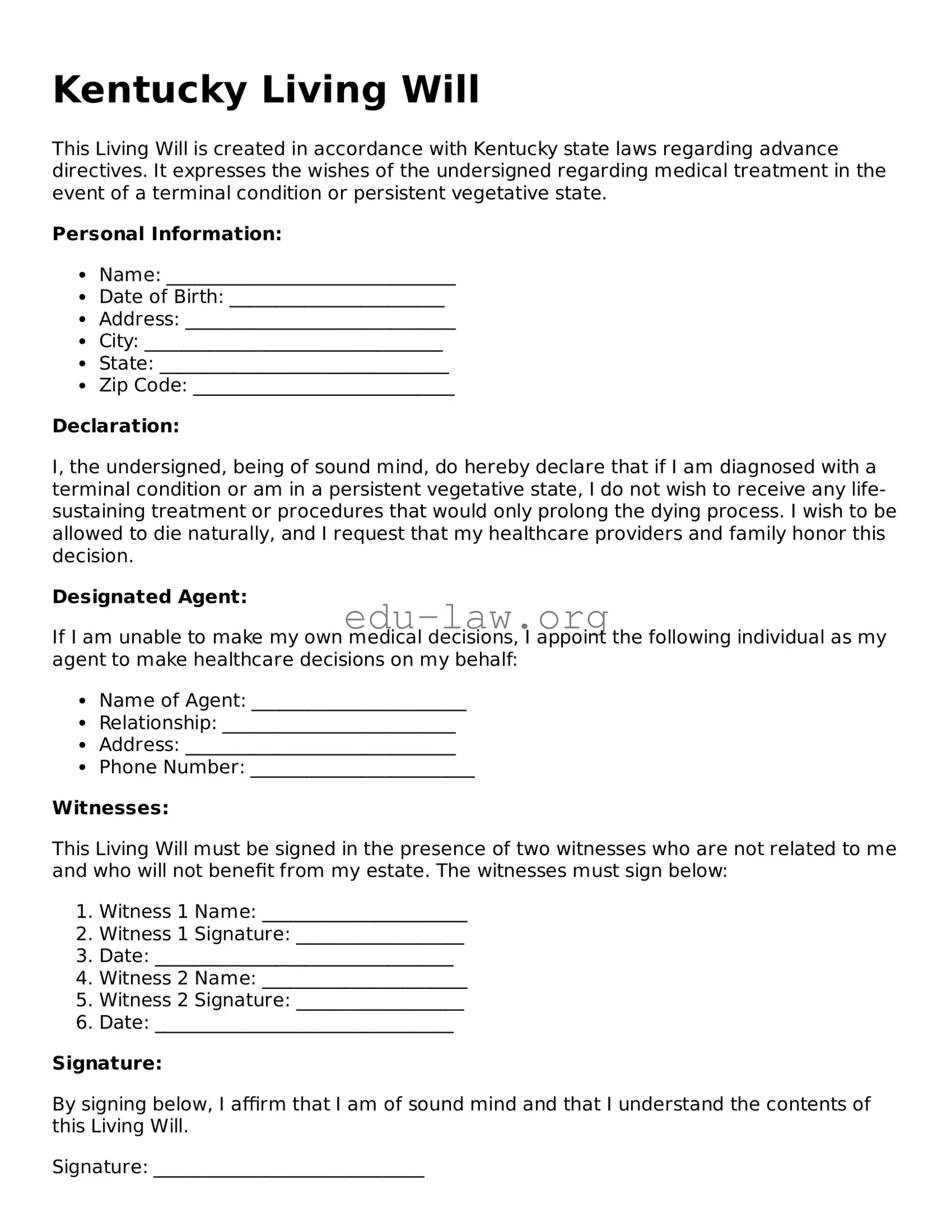
In the state of Kentucky, individuals have the opportunity to express their healthcare preferences through a legal document known as a Living Will. This form plays a crucial role in ensuring that a person's wishes regarding medical treatment are honored when they are unable to communicate those preferences themselves. It specifically addresses situations related to end-of-life care, including the desire to receive or refuse life-sustaining treatments. By outlining specific medical interventions, such as resuscitation efforts, artificial nutrition, and hydration, the Living Will provides clarity to healthcare providers and loved ones during difficult times. Furthermore, it empowers individuals to make decisions about their own health care in advance, thereby reducing uncertainty and potential conflicts among family members. Understanding the components of this form is essential for anyone looking to safeguard their medical choices and ensure that their values are respected when it matters most.
Kentucky Living Will
This Living Will is created in accordance with Kentucky state laws regarding advance directives. It expresses the wishes of the undersigned regarding medical treatment in the event of a terminal condition or persistent vegetative state.
Personal Information:
Declaration:
I, the undersigned, being of sound mind, do hereby declare that if I am diagnosed with a terminal condition or am in a persistent vegetative state, I do not wish to receive any life-sustaining treatment or procedures that would only prolong the dying process. I wish to be allowed to die naturally, and I request that my healthcare providers and family honor this decision.
Designated Agent:
If I am unable to make my own medical decisions, I appoint the following individual as my agent to make healthcare decisions on my behalf:
Witnesses:
This Living Will must be signed in the presence of two witnesses who are not related to me and who will not benefit from my estate. The witnesses must sign below:
Signature:
By signing below, I affirm that I am of sound mind and that I understand the contents of this Living Will.
Signature: _____________________________
Date: _________________________________
| Fact Name | Description |
|---|---|
| Purpose | The Kentucky Living Will form allows individuals to express their wishes regarding medical treatment in the event they become unable to communicate those wishes themselves. |
| Governing Law | The form is governed by Kentucky Revised Statutes, Chapter 311, which outlines the legal framework for advance directives in the state. |
| Signature Requirements | The form must be signed by the individual and witnessed by two adults, or notarized, to ensure its validity. |
| Revocation | Individuals can revoke their Living Will at any time, either verbally or in writing, as long as they are competent to do so. |
Filling out the Kentucky Living Will form is an important step in ensuring your healthcare wishes are respected in the event that you cannot communicate them yourself. This process involves carefully considering your preferences regarding medical treatment and documenting them clearly. Follow these steps to complete the form accurately.
Once you have completed the form, it is essential to discuss your wishes with your loved ones and healthcare providers. This ensures everyone understands your preferences and can act accordingly if the situation arises.
What is a Living Will in Kentucky?
A Living Will is a legal document that allows individuals to express their wishes regarding medical treatment in the event they become unable to communicate their preferences. It specifically addresses end-of-life care and can guide healthcare providers and family members in making decisions that align with the individual's values and desires.
Who can create a Living Will in Kentucky?
In Kentucky, any adult who is at least 18 years old and of sound mind can create a Living Will. This means that individuals must be capable of understanding the nature and consequences of their decisions regarding medical treatment.
What should be included in a Living Will?
A Living Will should clearly outline your preferences for medical treatment, particularly in situations where you are unable to communicate your wishes. This can include decisions about life-sustaining treatments, such as resuscitation, mechanical ventilation, and feeding tubes. It’s also beneficial to include specific instructions or values that guide your choices.
How do I complete a Living Will in Kentucky?
To complete a Living Will in Kentucky, you need to fill out the official form, which can be obtained from various sources, including healthcare providers and legal websites. After filling it out, you must sign the document in the presence of two witnesses or a notary public. This step is crucial, as it validates the document and ensures it meets legal requirements.
Can I change or revoke my Living Will?
Yes, you can change or revoke your Living Will at any time, as long as you are mentally competent. To revoke it, you simply need to destroy the original document or create a new one stating your desire to revoke the previous Living Will. It’s advisable to inform your healthcare providers and family members about any changes to ensure your current wishes are known.
Do I need a lawyer to create a Living Will in Kentucky?
No, you do not need a lawyer to create a Living Will in Kentucky. However, consulting with a legal professional can provide valuable guidance, especially if you have specific concerns or complex medical situations. A lawyer can help ensure that your document accurately reflects your wishes and complies with state laws.
What happens if I don’t have a Living Will?
If you do not have a Living Will and become unable to communicate your medical preferences, healthcare providers will rely on family members or legal representatives to make decisions on your behalf. This can lead to uncertainty and disagreements among loved ones, which may not align with your true wishes.
How is a Living Will different from a Power of Attorney?
A Living Will focuses specifically on your medical treatment preferences when you cannot speak for yourself, while a Power of Attorney (POA) allows you to appoint someone to make decisions on your behalf in various areas, including healthcare and financial matters. A POA can be broader in scope, while a Living Will is limited to medical directives.
Incomplete Information: Individuals often leave sections blank or fail to provide necessary details, such as their full name or date of birth. This can lead to confusion or challenges in validating the document.
Not Signing the Document: A common oversight is forgetting to sign the Living Will. Without a signature, the document may not hold legal weight.
Witness Requirements: Some individuals neglect to have the required witnesses sign the form. In Kentucky, two witnesses are needed, and failure to include them can invalidate the document.
Not Updating the Will: People often fill out the form but fail to revisit it as their circumstances change. Life events, such as marriage or divorce, may necessitate updates to the Living Will.
Ambiguous Language: Using vague or unclear terms can lead to misinterpretation. Specificity is crucial to ensure that healthcare providers understand the individual’s wishes.
Failing to Inform Loved Ones: After completing the Living Will, individuals sometimes forget to discuss it with family members or healthcare proxies. This can create confusion during critical moments when decisions need to be made.
In addition to the Kentucky Living Will form, several other documents can be crucial in ensuring that an individual's healthcare preferences are respected. Each of these documents serves a specific purpose and can help clarify a person's wishes regarding medical treatment and end-of-life care.
These documents, when used alongside the Kentucky Living Will form, can provide comprehensive guidance regarding an individual's healthcare choices. Together, they help ensure that a person's wishes are respected and that their voice is heard in critical medical situations.
The Kentucky Living Will form shares similarities with the Advance Directive, a broader term that encompasses various documents outlining an individual's healthcare preferences. An Advance Directive can include both a Living Will and a Durable Power of Attorney for Health Care. While the Living Will specifically addresses end-of-life decisions, the Advance Directive allows individuals to express their wishes regarding medical treatment and appoint a trusted person to make healthcare decisions on their behalf if they become unable to do so themselves.
Another document akin to the Kentucky Living Will is the Durable Power of Attorney for Health Care. This document grants a designated person the authority to make healthcare decisions for someone who is incapacitated. Unlike a Living Will, which focuses solely on specific medical preferences, the Durable Power of Attorney allows the appointed agent to make decisions based on the individual’s best interests, adapting to unforeseen circumstances that may arise in medical care.
The Do Not Resuscitate (DNR) order is also similar in intent to the Kentucky Living Will, as it expresses a person’s wish to forgo resuscitation efforts in the event of cardiac or respiratory arrest. While a Living Will may outline broader preferences regarding life-sustaining treatments, a DNR is a specific instruction that must be honored by medical personnel, indicating that the individual does not wish to receive CPR or other resuscitative measures.
The Physician Orders for Life-Sustaining Treatment (POLST) form is another document that aligns with the principles of the Kentucky Living Will. POLST is intended for individuals with serious illnesses or those nearing the end of life. It translates the patient’s wishes regarding treatment into actionable medical orders, ensuring that healthcare providers understand and respect the individual’s preferences in a variety of medical situations, much like a Living Will.
The Healthcare Proxy is similar to the Durable Power of Attorney for Health Care, as it designates someone to make medical decisions on behalf of another person. However, a Healthcare Proxy typically comes into effect only when the individual is incapacitated. This document emphasizes the importance of appointing a trusted person to advocate for the patient’s healthcare wishes, paralleling the intent of a Living Will to ensure that one’s preferences are respected.
Another document with similar functions is the Mental Health Advance Directive. This directive specifically addresses preferences regarding mental health treatment. It allows individuals to outline their wishes for care during mental health crises, ensuring that their treatment aligns with their values and preferences. Like the Living Will, it empowers individuals to take control of their healthcare decisions, particularly in vulnerable situations.
Lastly, the Organ Donation Consent form is related to the Kentucky Living Will in that it allows individuals to express their wishes regarding organ donation after death. While the Living Will focuses on medical treatment preferences during life, the Organ Donation Consent form ensures that a person’s wishes regarding organ donation are clearly communicated and respected by healthcare providers and family members, reflecting a holistic approach to end-of-life considerations.
When filling out the Kentucky Living Will form, it's essential to approach the process carefully. Here’s a list of dos and don'ts to guide you:
Many people have misconceptions about the Kentucky Living Will form. Understanding the truth can help you make informed decisions about your healthcare. Here are seven common misconceptions:
Clearing up these misconceptions can empower you to take control of your healthcare decisions. It’s always a good idea to discuss your options with a trusted advisor or attorney.
When considering the Kentucky Living Will form, it is essential to understand its purpose and the implications of your choices. Here are some key takeaways to keep in mind:
Understanding these key points can help ensure that your preferences are respected and that your loved ones are not left to make difficult decisions without guidance.