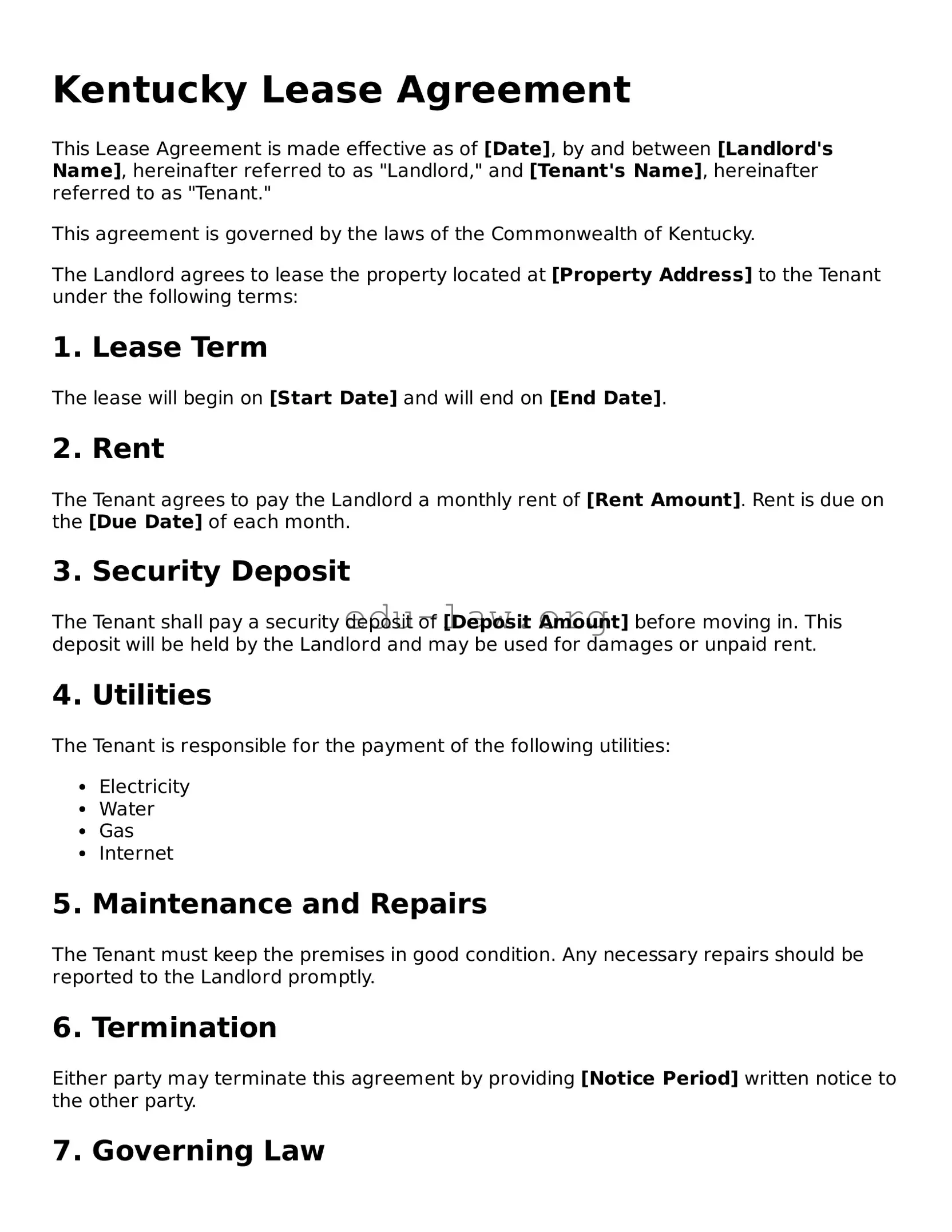
The Kentucky Lease Agreement form is a vital document for landlords and tenants entering into a rental agreement in the state of Kentucky. This form outlines the essential terms of the lease, including the duration of the rental period, the amount of rent due, and the responsibilities of both parties. It addresses important aspects such as security deposits, maintenance obligations, and rules regarding pets or alterations to the property. Additionally, the form specifies the procedures for terminating the lease and the notice periods required. By clearly detailing these terms, the Kentucky Lease Agreement helps prevent misunderstandings and disputes, ensuring a smoother rental experience for both landlords and tenants. Understanding the key components of this agreement is crucial for anyone involved in the rental process in Kentucky.
Kentucky Lease Agreement
This Lease Agreement is made effective as of [Date], by and between [Landlord's Name], hereinafter referred to as "Landlord," and [Tenant's Name], hereinafter referred to as "Tenant."
This agreement is governed by the laws of the Commonwealth of Kentucky.
The Landlord agrees to lease the property located at [Property Address] to the Tenant under the following terms:
1. Lease Term
The lease will begin on [Start Date] and will end on [End Date].
2. Rent
The Tenant agrees to pay the Landlord a monthly rent of [Rent Amount]. Rent is due on the [Due Date] of each month.
3. Security Deposit
The Tenant shall pay a security deposit of [Deposit Amount] before moving in. This deposit will be held by the Landlord and may be used for damages or unpaid rent.
4. Utilities
The Tenant is responsible for the payment of the following utilities:
5. Maintenance and Repairs
The Tenant must keep the premises in good condition. Any necessary repairs should be reported to the Landlord promptly.
6. Termination
Either party may terminate this agreement by providing [Notice Period] written notice to the other party.
7. Governing Law
This Lease Agreement shall be governed by the laws of the Commonwealth of Kentucky.
8. Signatures
By signing below, both parties agree to the terms of this Lease Agreement:
Landlord Signature: ___________________________ Date: ___________
Tenant Signature: ____________________________ Date: ___________
| Fact Name | Description |
|---|---|
| Governing Law | The Kentucky Lease Agreement is governed by Kentucky state law. |
| Purpose | This form is used to outline the terms and conditions of a lease between a landlord and tenant. |
| Duration | The lease agreement specifies the duration of the tenancy, which can be fixed-term or month-to-month. |
| Security Deposit | The form includes provisions regarding the security deposit, including the amount and conditions for return. |
Filling out the Kentucky Lease Agreement form is a straightforward process that requires attention to detail. By following these steps, you can ensure that all necessary information is accurately provided, which will help establish a clear understanding between the landlord and tenant.
Once you have completed these steps, you will have a fully filled Kentucky Lease Agreement form. Make sure to keep a copy for your records, and provide a copy to the other party involved. This will help ensure that both parties are clear on the terms and conditions of the lease.
What is a Kentucky Lease Agreement form?
A Kentucky Lease Agreement form is a legal document that outlines the terms and conditions under which a landlord rents property to a tenant. This agreement includes essential details such as the rental amount, duration of the lease, security deposit, and responsibilities of both parties. It serves to protect the rights of both the landlord and tenant by clearly stating what is expected from each side.
Who should use a Kentucky Lease Agreement?
Anyone involved in a rental arrangement in Kentucky should use a Kentucky Lease Agreement. This includes landlords who want to rent out residential or commercial properties and tenants looking for a place to live or operate a business. Having a formal lease agreement helps ensure that both parties understand their rights and obligations, reducing the likelihood of disputes.
What key elements should be included in the lease?
Several key elements should be included in a Kentucky Lease Agreement. These include the names of the landlord and tenant, the property address, the lease term (start and end dates), the rental amount and payment terms, the security deposit amount, maintenance responsibilities, and any rules or regulations related to the property. Additionally, it’s important to include information on how to handle lease termination or renewal.
How long does a typical lease last?
The duration of a lease can vary widely depending on the agreement between the landlord and tenant. In Kentucky, leases can be short-term (such as month-to-month) or long-term (typically one year). It’s crucial for both parties to discuss and agree on the lease term before signing the agreement. This ensures that everyone is on the same page regarding the length of the rental commitment.
Can a lease be modified after it is signed?
Yes, a lease can be modified after it is signed, but both the landlord and tenant must agree to the changes. Modifications should be documented in writing and signed by both parties to avoid any misunderstandings. This could include changes to the rental amount, lease duration, or specific rules regarding the property. Always communicate openly about any desired changes to maintain a good relationship.
What happens if a tenant breaks the lease?
If a tenant breaks the lease, there can be legal consequences. The landlord may have the right to retain the security deposit and seek additional damages if specified in the lease. It’s essential for tenants to understand the terms regarding early termination of the lease. In some cases, the landlord may allow the tenant to find a replacement or sublet the property, but this typically requires the landlord's approval.
Incomplete Information: One common mistake is failing to fill out all required fields. Missing names, addresses, or dates can lead to confusion and potential disputes later on.
Incorrect Dates: People often miswrite the lease start and end dates. This can create issues regarding the length of tenancy and obligations of both parties.
Neglecting to Specify Rent Details: Rent amount, due dates, and payment methods should be clearly stated. Omitting this information can lead to misunderstandings about financial responsibilities.
Ignoring Terms of Use: Some individuals overlook the importance of specifying rules regarding property use. Not addressing pets, smoking, or maintenance responsibilities can result in conflicts.
Failing to Include Signatures: A lease agreement is not valid without the signatures of both parties. Forgetting this step can render the entire document unenforceable.
Overlooking Local Laws: Each state has specific regulations regarding lease agreements. Ignoring Kentucky’s laws can lead to non-compliance and legal issues.
When entering into a lease agreement in Kentucky, several additional forms and documents may be necessary to ensure clarity and legal compliance. These documents help outline the responsibilities and rights of both the landlord and tenant, as well as provide essential information regarding the property. Below is a list of commonly used forms that accompany the Kentucky Lease Agreement.
These documents work together to provide a comprehensive framework for the landlord-tenant relationship. Having the appropriate forms in place helps prevent misunderstandings and protects the rights of all parties involved.
The Kentucky Lease Agreement shares similarities with the Residential Lease Agreement, which is commonly used across the United States. Both documents outline the terms under which a tenant can occupy a property owned by a landlord. They typically cover essential elements such as the duration of the lease, the amount of rent, and the responsibilities of both parties. While the Kentucky Lease Agreement may have specific provisions tailored to state laws, the fundamental structure and purpose remain consistent with the Residential Lease Agreement.
Another document akin to the Kentucky Lease Agreement is the Commercial Lease Agreement. This type of lease is designed for business premises rather than residential spaces. Like the Kentucky Lease Agreement, it details the terms of occupancy, rent, and responsibilities, but it often includes additional clauses related to business operations, signage, and maintenance of the commercial space. Both agreements serve to protect the interests of landlords and tenants, though they cater to different types of property use.
The Rental Agreement is also similar to the Kentucky Lease Agreement. While the terms "lease" and "rental agreement" are often used interchangeably, a rental agreement typically refers to a shorter-term arrangement, often month-to-month. Both documents outline rental terms, payment schedules, and tenant responsibilities. However, the Kentucky Lease Agreement may include longer-term commitments, often extending for a year or more, providing a different level of stability for both parties.
The Sublease Agreement bears resemblance to the Kentucky Lease Agreement as well. In a sublease, the original tenant leases the property to another individual, creating a new tenant-landlord relationship. Like the Kentucky Lease Agreement, the Sublease Agreement outlines terms such as rent and responsibilities. However, it also includes provisions that address the relationship between the original tenant and the subtenant, which can introduce additional complexities not found in a standard lease.
The Month-to-Month Lease Agreement is another document similar to the Kentucky Lease Agreement. This type of lease allows tenants to occupy a property with no fixed end date, providing flexibility for both parties. While the Kentucky Lease Agreement typically outlines a fixed term, the month-to-month lease focuses on ongoing occupancy. Both agreements detail rental terms and conditions, but the month-to-month lease may require shorter notice periods for termination.
The Lease Option Agreement is also closely related to the Kentucky Lease Agreement. This document not only allows a tenant to lease a property but also provides the option to purchase it at a later date. Similar to the Kentucky Lease Agreement, it includes terms regarding rent and responsibilities. However, it also incorporates specific provisions about the purchase price and the duration of the option, adding an additional layer of complexity to the agreement.
The Cooperative Housing Agreement shares some similarities with the Kentucky Lease Agreement, particularly in the context of shared living arrangements. In cooperative housing, residents typically have shares in the property rather than a traditional lease. However, both documents outline rights and responsibilities, including maintenance and payment obligations. The cooperative agreement may also detail the governance structure of the housing community, which is less common in a standard lease.
The Assignment of Lease Agreement is another document that parallels the Kentucky Lease Agreement. This agreement allows a tenant to transfer their lease obligations to another party. Like the Kentucky Lease Agreement, it contains terms regarding the lease duration and responsibilities. However, the Assignment of Lease Agreement also addresses the original tenant's obligations after the transfer, ensuring that both the landlord and the new tenant are protected.
The Fixed-Term Lease Agreement is similar to the Kentucky Lease Agreement in that it specifies a set duration for tenancy. Both documents outline the rental amount, the rights of the tenant, and the responsibilities of the landlord. However, the Fixed-Term Lease Agreement typically has a defined end date, while the Kentucky Lease Agreement may include specific provisions that reflect Kentucky's legal requirements, ensuring compliance with state laws.
Lastly, the Standard Lease Agreement is a general document that shares many characteristics with the Kentucky Lease Agreement. It serves as a template for landlords and tenants to outline their relationship. Both agreements cover rent, duration, and responsibilities. However, the Standard Lease Agreement may not include state-specific provisions, making the Kentucky Lease Agreement more tailored to the unique legal landscape of Kentucky.
When filling out the Kentucky Lease Agreement form, it’s important to approach the task with care. Here are some guidelines to help ensure that the process goes smoothly.
Things You Should Do:
Things You Shouldn't Do:
By following these guidelines, you can help ensure that your experience with the Kentucky Lease Agreement is as straightforward and stress-free as possible.
Understanding lease agreements can be challenging, especially when it comes to specific forms like the Kentucky Lease Agreement. Here are some common misconceptions that people may have about this document.
Being informed about these misconceptions can help both landlords and tenants navigate the leasing process more effectively. Understanding the Kentucky Lease Agreement is essential for ensuring a fair and clear rental experience.
When filling out and using the Kentucky Lease Agreement form, several important considerations come into play. Understanding these can help ensure that both landlords and tenants are protected and informed throughout the leasing process.
By keeping these key takeaways in mind, individuals can navigate the leasing process more effectively, fostering a positive relationship between landlords and tenants.