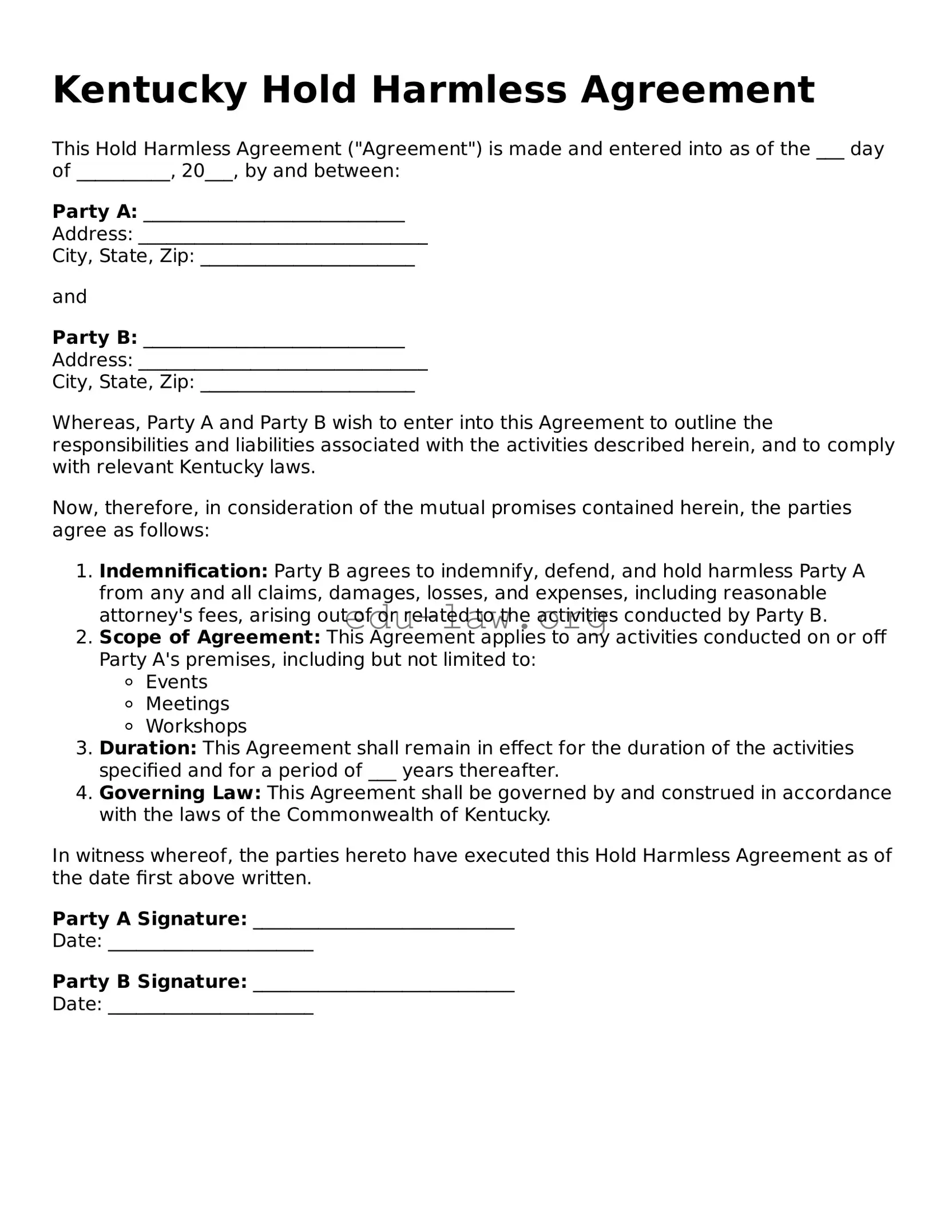
The Kentucky Hold Harmless Agreement form serves as a crucial legal tool designed to protect individuals and organizations from liability in various situations. This agreement outlines the responsibilities of the parties involved, ensuring that one party agrees to assume the risks associated with specific activities or events. By signing this document, individuals can safeguard themselves against potential claims or legal actions arising from accidents or damages. The form typically includes essential details such as the names of the parties, the scope of the activities covered, and any specific terms that clarify the extent of the liability being waived. Understanding the nuances of this agreement is vital for anyone engaging in activities that may expose them to risks, whether in recreational settings, business transactions, or community events. Ultimately, the Kentucky Hold Harmless Agreement form is not just a protective measure; it fosters a sense of trust and accountability among participants, allowing them to engage in activities with greater peace of mind.
Kentucky Hold Harmless Agreement
This Hold Harmless Agreement ("Agreement") is made and entered into as of the ___ day of __________, 20___, by and between:
Party A: ____________________________
Address: _______________________________
City, State, Zip: _______________________
and
Party B: ____________________________
Address: _______________________________
City, State, Zip: _______________________
Whereas, Party A and Party B wish to enter into this Agreement to outline the responsibilities and liabilities associated with the activities described herein, and to comply with relevant Kentucky laws.
Now, therefore, in consideration of the mutual promises contained herein, the parties agree as follows:
In witness whereof, the parties hereto have executed this Hold Harmless Agreement as of the date first above written.
Party A Signature: ____________________________
Date: ______________________
Party B Signature: ____________________________
Date: ______________________
| Fact Name | Details |
|---|---|
| Purpose | The Kentucky Hold Harmless Agreement is designed to protect one party from liability for damages or injuries that may occur during a specific event or activity. |
| Parties Involved | Typically, this agreement involves at least two parties: the indemnitor (the party providing the hold harmless clause) and the indemnitee (the party being protected). |
| Governing Law | This agreement is governed by the laws of the Commonwealth of Kentucky. |
| Enforceability | For the agreement to be enforceable, it must be clear, specific, and voluntarily agreed upon by both parties. |
| Common Uses | It is often used in contracts related to events, rentals, and recreational activities where there is a potential for injury. |
| Limitations | The agreement cannot protect against gross negligence or willful misconduct. Courts may refuse to enforce clauses that attempt to waive liability for such actions. |
Once you have the Kentucky Hold Harmless Agreement form, you will need to fill it out carefully. This form is essential for establishing the terms of liability between parties. Follow these steps to ensure that you complete it correctly.
What is a Kentucky Hold Harmless Agreement?
A Kentucky Hold Harmless Agreement is a legal document designed to protect one party from liability for any injuries or damages that may occur during a specific event or activity. By signing this agreement, one party agrees not to hold the other party responsible for any potential claims that may arise as a result of the event or activity. This type of agreement is commonly used in various situations, including rental agreements, sports activities, and construction projects.
Who typically uses a Hold Harmless Agreement in Kentucky?
Hold Harmless Agreements are often utilized by businesses, event organizers, property owners, and contractors. For instance, if a property owner rents out a venue for an event, they may require the event organizer to sign a Hold Harmless Agreement to protect themselves from any liability arising from accidents or injuries that occur during the event. Similarly, contractors may use these agreements to shield themselves from claims related to their work.
What are the key components of a Hold Harmless Agreement?
A comprehensive Hold Harmless Agreement typically includes the following elements: the names of the parties involved, a clear description of the event or activity, the specific liabilities being waived, and the signatures of both parties. Additionally, it may outline any limitations on liability and specify the governing law, which in this case would be Kentucky law.
Is a Hold Harmless Agreement legally binding in Kentucky?
Yes, a Hold Harmless Agreement can be legally binding in Kentucky, provided it meets certain requirements. Both parties must willingly enter into the agreement, and it must be clear and unambiguous. However, courts may not enforce certain provisions if they are deemed overly broad or if they contravene public policy, particularly in cases involving gross negligence or willful misconduct.
Can a Hold Harmless Agreement be modified or revoked?
Yes, a Hold Harmless Agreement can be modified or revoked, but this typically requires the consent of both parties. Any changes should be documented in writing and signed by both parties to ensure clarity and avoid potential disputes in the future. It’s important to communicate openly about any modifications to maintain a good relationship between the parties involved.
Are there any limitations to a Hold Harmless Agreement?
While Hold Harmless Agreements provide significant protection, they do have limitations. They generally do not protect against gross negligence or intentional misconduct. Additionally, if the agreement is not properly drafted or executed, a court may find it unenforceable. It’s crucial to ensure that the agreement is clear and comprehensive to maximize its effectiveness.
How can I ensure my Hold Harmless Agreement is enforceable?
To enhance the enforceability of a Hold Harmless Agreement, consider the following steps: use clear and concise language, specify the scope of the agreement, and ensure that both parties understand the terms. It may also be beneficial to consult with a legal professional to review the agreement before it is signed, ensuring it complies with Kentucky law and addresses all necessary concerns.
Do I need a lawyer to draft a Hold Harmless Agreement?
While it is possible to draft a Hold Harmless Agreement without legal assistance, consulting a lawyer is highly recommended. A legal professional can help tailor the agreement to your specific needs, ensuring that it is comprehensive and compliant with Kentucky law. This can save you time and potential legal complications down the road.
What should I do if I have questions about a Hold Harmless Agreement?
If you have questions about a Hold Harmless Agreement, it’s wise to seek advice from a legal professional who specializes in contracts or liability issues. They can provide guidance tailored to your situation and help clarify any uncertainties you may have regarding the agreement’s terms or implications.
Not reading the entire agreement thoroughly. Many people rush through the document, missing important clauses that could affect their rights.
Failing to provide accurate personal information. Errors in names, addresses, or contact details can lead to complications later.
Overlooking the specifics of the activities covered. It’s crucial to understand what activities the agreement pertains to, as this can limit liability.
Not understanding the implications of the agreement. Some signers may not realize they are waiving certain rights, which can lead to future disputes.
Neglecting to date the agreement properly. A missing or incorrect date can render the agreement invalid.
Not consulting with a legal professional. Skipping this step can result in misunderstandings about the legal consequences of signing.
Forgetting to keep a copy of the signed agreement. Without documentation, it can be challenging to prove what was agreed upon.
Signing under duress or without full understanding. It's vital to ensure that all parties are entering into the agreement willingly and with clarity.
Ignoring state-specific requirements. Different states may have unique laws regarding Hold Harmless Agreements, and failing to comply can lead to issues.
The Kentucky Hold Harmless Agreement is an important document that helps protect parties from liability in various situations. When using this agreement, you may also encounter other forms and documents that complement it. Here’s a brief overview of some commonly used documents alongside the Hold Harmless Agreement.
Understanding these additional documents can help ensure that all parties are protected and informed. When used together, they create a comprehensive framework for managing risk and liability effectively.
The Release of Liability form is similar to the Kentucky Hold Harmless Agreement. Both documents aim to protect one party from legal claims that may arise from an activity or event. In a Release of Liability, the participant agrees not to hold the organization responsible for any injuries or damages. This helps organizations manage risk, just as the Hold Harmless Agreement does by shifting liability away from one party.
The Indemnity Agreement also shares similarities with the Hold Harmless Agreement. In an Indemnity Agreement, one party agrees to compensate another for any losses or damages incurred. This is akin to the Hold Harmless Agreement, where one party takes on the responsibility for any claims made against the other. Both documents serve to limit financial exposure in various situations.
The Waiver of Claims is another document that functions similarly. A Waiver of Claims allows individuals to relinquish their right to pursue legal action for specific incidents. Like the Hold Harmless Agreement, it serves to protect one party from lawsuits related to risks involved in an activity. Both documents require clear language to ensure that participants understand their rights and responsibilities.
The Consent to Participate form is also comparable. This document is often used in activities where there are inherent risks, such as sports or recreational events. By signing a Consent to Participate, individuals acknowledge the risks involved and agree not to hold the organizers liable for injuries. This concept aligns with the purpose of the Hold Harmless Agreement, which seeks to limit liability for potential harm.
The Liability Waiver is another document that functions similarly to the Hold Harmless Agreement. A Liability Waiver releases one party from responsibility for injuries or damages that may occur during a specific activity. Both documents are designed to protect the party organizing the event or activity, ensuring that participants understand the risks involved and agree to assume them.
The Safety Agreement is also relevant. This document outlines the safety measures that will be taken during an event and may include a clause that holds the organizers harmless from any claims. Like the Hold Harmless Agreement, it emphasizes the importance of safety while also managing liability for the organizers. Both documents reflect a commitment to participant safety while addressing potential legal concerns.
Finally, the Participant Agreement is similar in that it often includes terms that limit liability for the organizers. This document outlines the rules and expectations for participants in an event or activity. By agreeing to the terms, participants acknowledge the risks and agree not to pursue claims against the organizers. This aspect mirrors the Hold Harmless Agreement's goal of shifting liability and protecting one party from legal action.
When filling out the Kentucky Hold Harmless Agreement form, it is essential to approach the task with care. Here are some important do's and don'ts to keep in mind:
When it comes to the Kentucky Hold Harmless Agreement form, there are several misconceptions that people often have. Understanding these can help clarify what the form actually entails.
By addressing these misconceptions, individuals can better understand the purpose and limitations of the Kentucky Hold Harmless Agreement form.
When considering the Kentucky Hold Harmless Agreement, it’s essential to understand its purpose and how to fill it out correctly. Here are some key takeaways to keep in mind:
By keeping these points in mind, you can effectively navigate the process of filling out and using the Kentucky Hold Harmless Agreement.