When it comes to planning for the future and ensuring that your wishes are respected, a General Power of Attorney (GPOA) in Kentucky can be a crucial tool. This legal document allows you to appoint someone you trust—often referred to as your agent or attorney-in-fact—to make decisions on your behalf, should you become unable to do so yourself. The GPOA can cover a wide range of matters, from managing your finances and handling real estate transactions to making medical decisions, depending on how you choose to structure it. One of the key aspects of this form is that it grants broad authority, allowing your agent to act in your best interest across various domains. However, it’s essential to understand that the power you bestow can be customized; you can limit or expand the scope of authority based on your preferences. Additionally, the GPOA must be signed in the presence of a notary public to ensure its validity, providing an extra layer of protection for both you and your agent. Understanding the ins and outs of the Kentucky General Power of Attorney form is vital for anyone looking to safeguard their future and ensure that their personal and financial matters are handled according to their wishes.
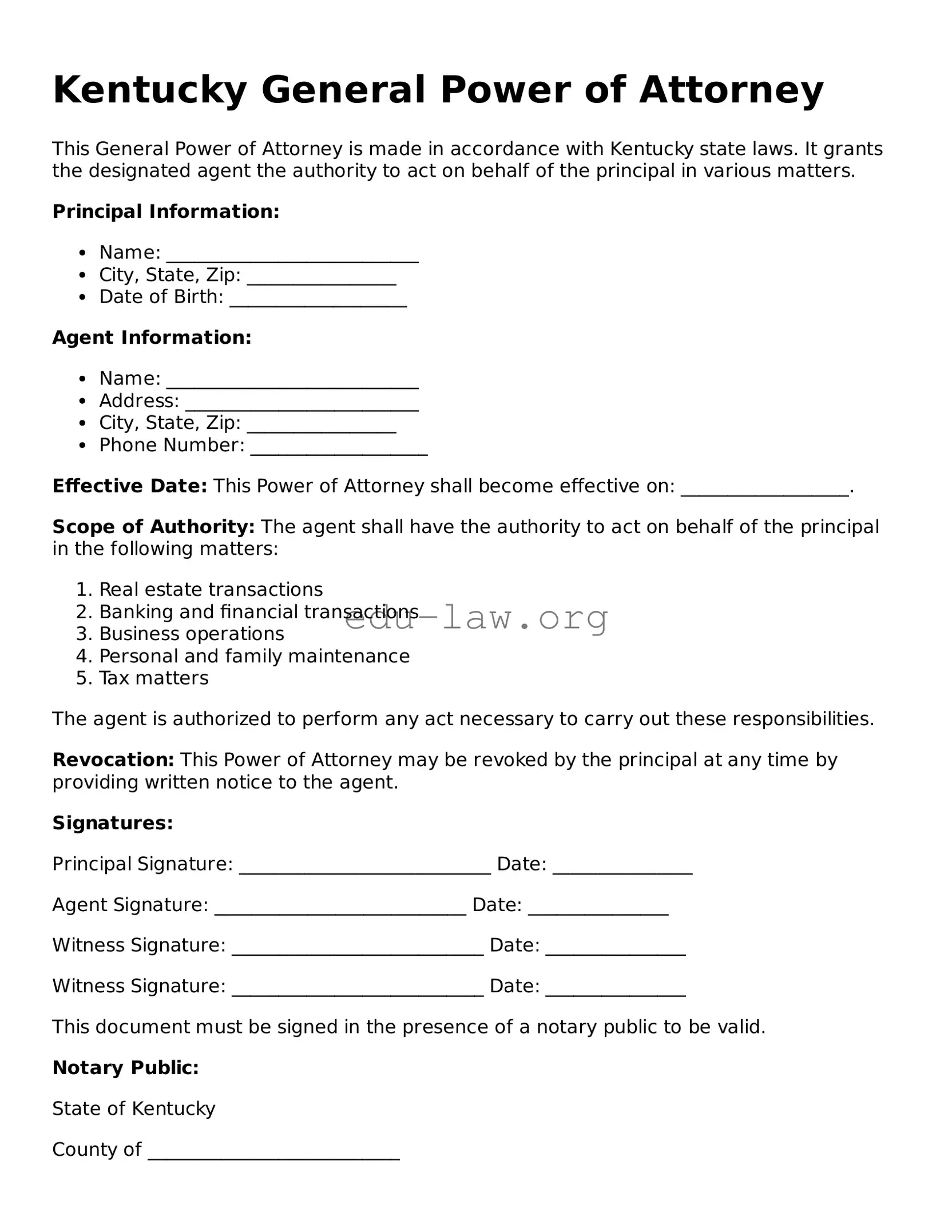
Kentucky General Power of Attorney
This General Power of Attorney is made in accordance with Kentucky state laws. It grants the designated agent the authority to act on behalf of the principal in various matters.
Principal Information:
Agent Information:
Effective Date: This Power of Attorney shall become effective on: __________________.
Scope of Authority: The agent shall have the authority to act on behalf of the principal in the following matters:
The agent is authorized to perform any act necessary to carry out these responsibilities.
Revocation: This Power of Attorney may be revoked by the principal at any time by providing written notice to the agent.
Signatures:
Principal Signature: ___________________________ Date: _______________
Agent Signature: ___________________________ Date: _______________
Witness Signature: ___________________________ Date: _______________
Witness Signature: ___________________________ Date: _______________
This document must be signed in the presence of a notary public to be valid.
Notary Public:
State of Kentucky
County of ___________________________
Subscribed and sworn to before me this ____ day of ____________, 20__.
Notary Public Signature: ___________________________
My commission expires: ___________________________
| Fact Name | Details |
|---|---|
| Definition | A General Power of Attorney allows an individual to appoint someone to manage their financial and legal affairs. |
| Governing Law | The Kentucky General Power of Attorney is governed by KRS Chapter 457. |
| Durability | This form can be made durable, meaning it remains effective even if the principal becomes incapacitated. |
| Signature Requirements | The form must be signed by the principal in the presence of a notary public. |
| Agent's Authority | The appointed agent can perform a wide range of tasks, including managing bank accounts and real estate transactions. |
| Revocation | The principal can revoke the power of attorney at any time, as long as they are mentally competent. |
Filling out the Kentucky General Power of Attorney form is a straightforward process. It requires careful attention to detail to ensure that all necessary information is provided accurately. Once completed, the form allows you to designate someone to act on your behalf in various matters.
What is a General Power of Attorney in Kentucky?
A General Power of Attorney is a legal document that allows one person, known as the agent or attorney-in-fact, to act on behalf of another person, referred to as the principal. This authority can cover a wide range of financial and legal matters, such as managing bank accounts, signing contracts, and handling real estate transactions. It is important to understand that the agent must act in the best interest of the principal and follow their wishes as outlined in the document.
How do I create a General Power of Attorney in Kentucky?
To create a General Power of Attorney in Kentucky, you need to fill out the appropriate form. This form should clearly state your name, the name of your agent, and the powers you are granting. It is advisable to have the document notarized to ensure its validity. While not required, having witnesses can also strengthen the document. After completing the form, keep it in a safe place and share copies with your agent and any relevant institutions.
Can I revoke a General Power of Attorney in Kentucky?
Yes, you can revoke a General Power of Attorney at any time as long as you are mentally competent. To do this, you should create a written revocation document stating your intent to cancel the previous power of attorney. It is important to notify your agent and any institutions that may have a copy of the original document. This ensures that they understand the authority has been revoked and prevents any potential misuse.
What happens if the principal becomes incapacitated?
If the principal becomes incapacitated, the General Power of Attorney typically remains in effect unless it specifically states otherwise. This means that the agent can continue to make decisions on behalf of the principal. However, if you want to ensure that the power of attorney remains effective even if you become incapacitated, you might consider a Durable Power of Attorney, which is designed for that purpose.
Are there any limitations to the powers granted in a General Power of Attorney?
Yes, there can be limitations. The powers granted in a General Power of Attorney can be specified in the document itself. For example, you might choose to limit the agent's authority to specific transactions or types of decisions. Additionally, certain actions, such as making medical decisions, may require a separate document called a Medical Power of Attorney. It is essential to clearly outline any limitations to avoid confusion and ensure that your wishes are respected.
Failing to specify the powers granted: It’s important to clearly outline the specific powers you are granting. Without this clarity, the agent may not have the authority to act on your behalf in certain situations.
Not naming an alternate agent: If the primary agent is unable or unwilling to serve, having an alternate can prevent complications. Many people overlook this step, leaving their affairs unprotected.
Inadequate witness signatures: The state of Kentucky requires that the General Power of Attorney form be signed in the presence of a witness. Failing to meet this requirement can invalidate the document.
Using outdated forms: Laws and requirements can change. Using an outdated version of the form may lead to legal issues. Always ensure you have the most current version available.
Not considering the agent’s qualifications: Choosing someone who lacks the necessary skills or understanding can lead to poor decisions. It’s crucial to select an agent who is trustworthy and capable.
Neglecting to date the document: A missing date can create confusion about when the powers take effect. Always include the date to avoid potential disputes.
Failing to communicate with the agent: It’s essential to discuss your wishes and expectations with the agent. Without this communication, the agent may not act in accordance with your desires.
Not revoking previous powers of attorney: If you have previously granted power of attorney to someone else, ensure that you revoke that authority. Otherwise, conflicts may arise regarding who has the right to act on your behalf.
When creating a General Power of Attorney (POA) in Kentucky, it is often beneficial to consider additional forms and documents that can complement or enhance the authority granted. Each of these documents serves a specific purpose and can help ensure that your intentions are clearly communicated and legally recognized.
Utilizing these additional forms and documents can provide a comprehensive approach to managing one's affairs. Ensuring that all necessary legal tools are in place can help avoid confusion and disputes in the future, ultimately safeguarding the principal's wishes and interests.
The Kentucky General Power of Attorney form shares similarities with the Durable Power of Attorney. Both documents allow an individual to designate another person to act on their behalf in financial and legal matters. However, the key difference lies in durability; a Durable Power of Attorney remains effective even if the principal becomes incapacitated, whereas a General Power of Attorney typically becomes void under such circumstances. This makes the Durable Power of Attorney a crucial option for individuals concerned about future health issues.
Another document that resembles the Kentucky General Power of Attorney is the Limited Power of Attorney. Like the General Power of Attorney, this document allows one person to act on behalf of another. However, the Limited Power of Attorney restricts the agent’s authority to specific tasks or for a defined period. This can be beneficial for individuals who want to grant authority for a particular transaction without giving full control over their affairs.
The Healthcare Power of Attorney also shares similarities with the Kentucky General Power of Attorney, but it specifically pertains to medical decisions. In both cases, one person designates another to make decisions on their behalf. The Healthcare Power of Attorney is vital when it comes to medical treatment choices, especially if the individual becomes unable to communicate their wishes. This document ensures that healthcare decisions align with the individual's preferences.
The Financial Power of Attorney is another document akin to the Kentucky General Power of Attorney. Both empower an agent to handle financial matters on behalf of the principal. However, the Financial Power of Attorney focuses solely on financial transactions, such as managing bank accounts, paying bills, or filing taxes. This specificity can provide clarity and limit the scope of authority granted to the agent.
Lastly, the Revocable Living Trust shares some characteristics with the Kentucky General Power of Attorney. Both documents allow for the management of assets and can facilitate the transfer of authority. However, a Revocable Living Trust is primarily used for estate planning, allowing individuals to manage their assets during their lifetime and specify how those assets should be distributed upon death. This can help avoid probate, providing a smoother transition for beneficiaries.
When filling out the Kentucky General Power of Attorney form, it’s important to get it right. Here’s a helpful list of dos and don’ts to guide you through the process.
Following these guidelines can help make the process smoother and ensure that your intentions are clearly communicated. Good luck!
When it comes to the Kentucky General Power of Attorney form, several misconceptions can lead to confusion. Here are five common misunderstandings:
Many believe that a General Power of Attorney is limited to financial decisions. In reality, it can cover a wide range of areas, including healthcare decisions and property management, depending on how it is drafted.
Some people think that once a General Power of Attorney is created, it lasts forever. However, it can be revoked at any time by the principal, or it may automatically terminate under certain circumstances, such as the principal’s death or incapacitation.
While consulting a lawyer can be beneficial, it is not mandatory to create a General Power of Attorney in Kentucky. Individuals can complete the form themselves, provided they understand the requirements and implications.
Some believe that every action a power of attorney can take must be explicitly stated in writing. While it’s important to outline major powers, some authority can be implied based on the powers granted.
This is a common myth. A properly executed General Power of Attorney can remain effective even if the principal becomes incapacitated, unless it is specifically stated that it becomes invalid under such circumstances.
Understanding these misconceptions is crucial for anyone considering a General Power of Attorney in Kentucky. It ensures that you make informed decisions that align with your needs and intentions.
When filling out and using the Kentucky General Power of Attorney form, it is essential to understand several key points to ensure that the document is valid and effective. Here are some important takeaways:
Understanding these key points will help ensure that the General Power of Attorney form is completed correctly and serves its intended purpose effectively.