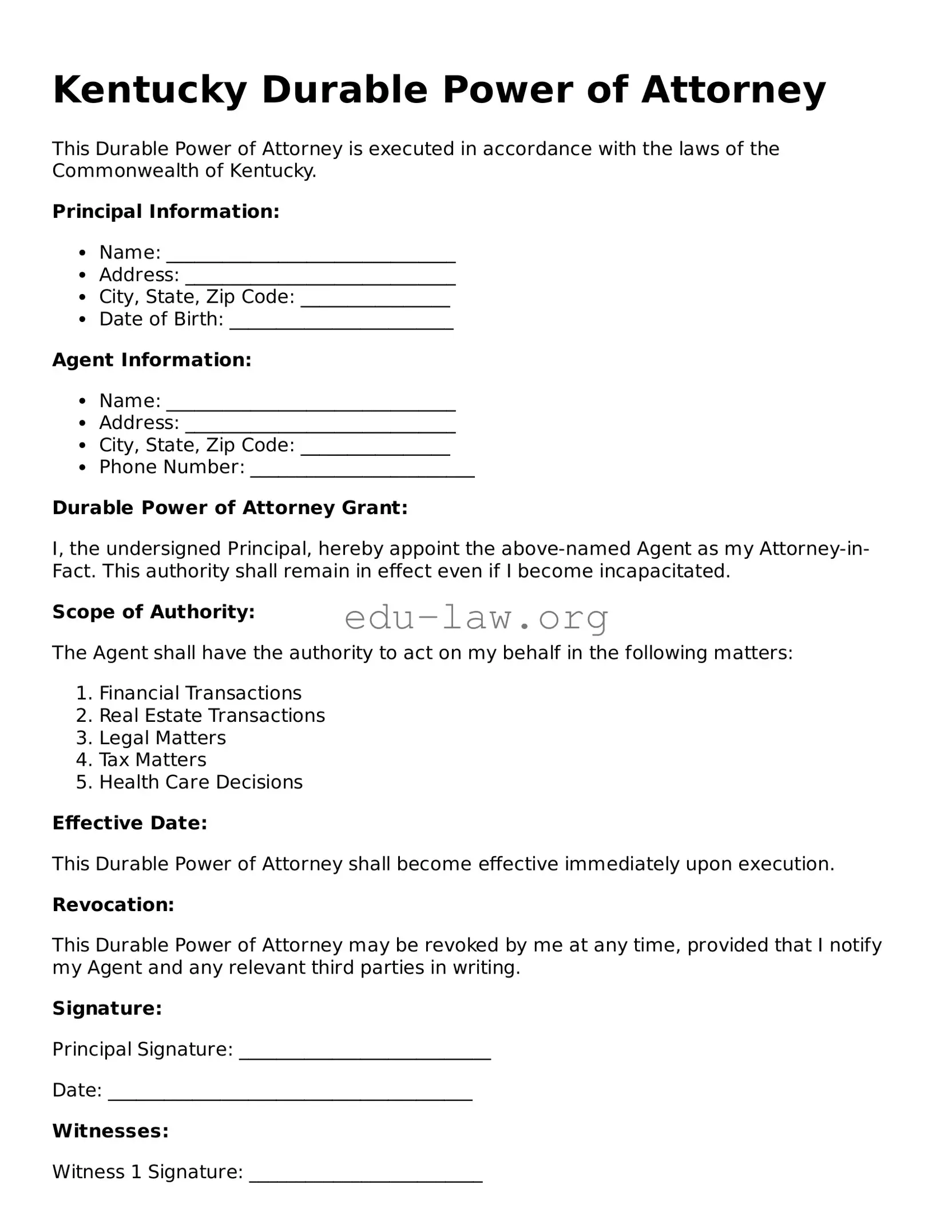
The Kentucky Durable Power of Attorney form serves as a crucial legal document, empowering individuals to designate a trusted person to make decisions on their behalf when they can no longer do so. This form is particularly important for managing financial and healthcare matters, ensuring that your wishes are respected even in times of incapacity. By completing this document, you grant your agent the authority to handle a variety of responsibilities, from paying bills and managing investments to making medical decisions. It's essential to understand that this power remains effective even if you become incapacitated, distinguishing it from a standard power of attorney. The form must be signed in accordance with Kentucky law, which includes specific witnessing and notarization requirements. Furthermore, choosing the right agent is vital; this person should be reliable, trustworthy, and capable of acting in your best interest. Overall, the Kentucky Durable Power of Attorney is a proactive step in safeguarding your future and ensuring that your personal and financial affairs are managed according to your preferences.
Kentucky Durable Power of Attorney
This Durable Power of Attorney is executed in accordance with the laws of the Commonwealth of Kentucky.
Principal Information:
Agent Information:
Durable Power of Attorney Grant:
I, the undersigned Principal, hereby appoint the above-named Agent as my Attorney-in-Fact. This authority shall remain in effect even if I become incapacitated.
Scope of Authority:
The Agent shall have the authority to act on my behalf in the following matters:
Effective Date:
This Durable Power of Attorney shall become effective immediately upon execution.
Revocation:
This Durable Power of Attorney may be revoked by me at any time, provided that I notify my Agent and any relevant third parties in writing.
Signature:
Principal Signature: ___________________________
Date: _______________________________________
Witnesses:
Witness 1 Signature: _________________________
Witness 2 Signature: _________________________
Notarization:
State of Kentucky
County of ________________________________
Subscribed and sworn before me this _____ day of ______________, 20__.
Notary Public Signature: ______________________
My commission expires: ______________________
| Fact Name | Details |
|---|---|
| Definition | A Kentucky Durable Power of Attorney allows a person to appoint someone else to make decisions on their behalf if they become unable to do so. |
| Governing Law | Kentucky Revised Statutes, Chapter 386 |
| Durability | This form remains effective even if the principal becomes incapacitated. |
| Principal | The person who creates the Durable Power of Attorney is known as the principal. |
| Agent | The individual appointed to act on behalf of the principal is referred to as the agent or attorney-in-fact. |
| Signing Requirements | The form must be signed by the principal and acknowledged before a notary public. |
| Revocation | The principal can revoke the Durable Power of Attorney at any time while they are still competent. |
| Limitations | Some powers may be limited or excluded, depending on the principal's wishes. |
| Use Cases | This document is commonly used for financial and healthcare decisions when the principal cannot make those decisions themselves. |
Filling out the Kentucky Durable Power of Attorney form is an important step in planning for future decisions regarding your financial and legal matters. After completing the form, it will need to be signed and witnessed according to Kentucky law to ensure its validity.
What is a Durable Power of Attorney in Kentucky?
A Durable Power of Attorney (DPOA) in Kentucky is a legal document that allows an individual, known as the principal, to appoint someone else, called an agent or attorney-in-fact, to make decisions on their behalf. This authority remains effective even if the principal becomes incapacitated. The DPOA can cover a wide range of decisions, including financial matters, healthcare, and property management, depending on the specific powers granted within the document.
How do I create a Durable Power of Attorney in Kentucky?
To create a Durable Power of Attorney in Kentucky, the principal must be at least 18 years old and of sound mind. The document must be in writing and should clearly state that it is a durable power of attorney. It is advisable to specify the powers being granted to the agent. The principal must sign the document in the presence of a notary public or two witnesses, who also need to sign. This ensures that the document is legally valid and can be recognized by financial institutions and healthcare providers.
Can I revoke a Durable Power of Attorney in Kentucky?
Yes, a Durable Power of Attorney can be revoked at any time as long as the principal is mentally competent. The revocation should be done in writing, and it is best to notify the agent and any institutions or individuals who were relying on the original DPOA. Additionally, destroying the original document can help prevent any confusion regarding the authority of the agent.
What happens if I do not have a Durable Power of Attorney?
If an individual does not have a Durable Power of Attorney and becomes incapacitated, a court may need to appoint a guardian or conservator to make decisions on their behalf. This process can be lengthy, costly, and may not reflect the individual's preferences. Having a DPOA in place allows for more control over who makes decisions and ensures that those decisions align with the principal's wishes.
Not specifying the powers granted: It is crucial to clearly outline the specific powers you wish to grant your agent. Vague language can lead to misunderstandings or disputes later on.
Failing to name a successor agent: In the event that your primary agent is unable or unwilling to act, naming a successor ensures that your wishes are still carried out.
Not signing the document: A Durable Power of Attorney is only valid if it is signed by you. Ensure that your signature is present, as well as the date of signing.
Ignoring witness and notarization requirements: Depending on state law, your document may need to be witnessed or notarized to be legally binding. Check the requirements to avoid invalidation.
Using outdated forms: Laws change over time, and using an outdated form can lead to complications. Always ensure you are using the most current version of the Durable Power of Attorney form.
Not discussing your wishes with your agent: Communication is key. Failing to discuss your wishes can lead to confusion and may result in decisions that do not align with your intentions.
Overlooking limitations on powers: If you want to limit the powers granted to your agent, be specific about what they can and cannot do. Omitting this information can give your agent broader authority than intended.
Not keeping copies of the document: It is important to retain copies of the Durable Power of Attorney for your records and to provide them to your agent and any relevant institutions.
Failing to review the document regularly: Life circumstances change. Regularly reviewing and updating your Durable Power of Attorney ensures that it continues to reflect your current wishes.
Assuming all agents will act in your best interest: While you may trust your chosen agent, it is wise to consider the potential for conflicts of interest. Be thoughtful about who you select.
A Kentucky Durable Power of Attorney form is an important legal document that allows an individual to designate another person to make decisions on their behalf. Alongside this form, there are several other documents that may be utilized to ensure comprehensive planning and protection of one’s interests. Here are some commonly used forms and documents:
Each of these documents serves a unique purpose and can work together to create a comprehensive plan for managing personal and financial affairs. It is essential to consider these options carefully to ensure that one's wishes are respected and that appropriate decisions can be made when necessary.
The Kentucky Durable Power of Attorney (DPOA) form shares similarities with the General Power of Attorney (GPOA). Both documents allow individuals to designate an agent to make decisions on their behalf. However, the key difference lies in the durability aspect. While a GPOA becomes invalid if the principal becomes incapacitated, a DPOA remains effective even when the principal is unable to make decisions. This feature makes the DPOA particularly useful for long-term planning, ensuring that the agent can act when the principal cannot.
Another document comparable to the DPOA is the Medical Power of Attorney (MPOA). This form specifically grants authority to an agent to make healthcare decisions for the principal. Like the DPOA, the MPOA remains effective during periods of incapacity. The main distinction is that the MPOA focuses solely on medical decisions, while the DPOA can cover a broader range of financial and legal matters.
The Living Will is also similar to the DPOA, but it serves a different purpose. A Living Will outlines an individual's wishes regarding medical treatment in the event of terminal illness or incapacitation. While the DPOA allows an agent to make decisions, the Living Will communicates the principal's preferences directly. Both documents are essential for comprehensive end-of-life planning.
The Revocable Trust is another document that bears similarities to the DPOA. A Revocable Trust allows individuals to manage their assets during their lifetime and specifies how those assets should be distributed after death. Like the DPOA, it provides flexibility and control over financial matters. However, a Revocable Trust does not appoint an agent but rather designates a trustee to manage the trust assets.
The Irrevocable Trust differs from the DPOA in that it cannot be altered once established. This type of trust is often used for asset protection or estate tax planning. While a DPOA allows for changes in agent authority as needed, an Irrevocable Trust locks in the terms and conditions agreed upon at its creation, providing a different approach to asset management.
The Guardianship document is another relevant comparison. A Guardianship is a legal arrangement where a court appoints an individual to make decisions for someone who is unable to do so. While the DPOA is created voluntarily by the principal, Guardianship is established through court intervention. This makes the DPOA a more flexible and less invasive option for managing one’s affairs.
The Advance Directive is similar to the DPOA in that it encompasses both the Living Will and the MPOA. An Advance Directive combines the principal’s healthcare preferences with the designation of an agent to make medical decisions. While the DPOA focuses on financial and legal matters, the Advance Directive ensures that healthcare wishes are also addressed, providing a holistic approach to decision-making.
Power of Attorney for Finances is another document closely related to the DPOA. This form specifically grants authority to an agent to handle financial matters, similar to the broader powers granted by the DPOA. The distinction lies in the scope of authority; the DPOA may include legal and healthcare decisions, while the Power of Attorney for Finances is limited to financial transactions.
Lastly, the Special Power of Attorney allows an agent to act on behalf of the principal for specific tasks or transactions. This document is narrower in scope compared to the DPOA, which grants broader authority. The Special Power of Attorney is useful for particular situations, such as selling property or managing a specific investment, while the DPOA provides a more comprehensive framework for ongoing decision-making.
When filling out the Kentucky Durable Power of Attorney form, it is essential to follow specific guidelines to ensure that the document is valid and effective. Below is a list of things you should and shouldn't do.
By adhering to these guidelines, you can create a valid and effective Durable Power of Attorney that meets your needs and protects your interests.
Understanding the Kentucky Durable Power of Attorney form is crucial for anyone considering this important legal document. However, several misconceptions can lead to confusion. Here are eight common misunderstandings:
Many believe that a Durable Power of Attorney is limited to financial decisions. In reality, it can also cover healthcare decisions, depending on how it is drafted.
Some think the document only takes effect when the person is unable to make decisions. However, a Durable Power of Attorney can be effective immediately upon signing, unless specified otherwise.
While it is true that a principal can revoke a Durable Power of Attorney, they must be mentally competent to do so. If the principal becomes incapacitated, revocation may not be possible.
This is not accurate. Each state has its own requirements and forms. The Kentucky Durable Power of Attorney has specific provisions that may differ from other states.
While an agent has broad authority, the Durable Power of Attorney can limit the powers granted. The principal can specify what decisions the agent is allowed to make.
This is a misconception. While it is advisable to seek legal advice, individuals can create a Durable Power of Attorney themselves using state-approved forms.
Many assume that only seniors need a Durable Power of Attorney. However, anyone over the age of 18 can benefit from having one in place, as emergencies can happen at any age.
This is false. A principal can modify or revoke the Durable Power of Attorney at any time while they are competent, allowing for changes as circumstances evolve.
Being informed about these misconceptions can help individuals make better decisions regarding their legal and financial planning. It is always wise to consult with a legal professional for personalized advice.
Filling out and using the Kentucky Durable Power of Attorney form is an important step in ensuring that your financial and medical decisions are managed according to your wishes in the event that you become incapacitated. Here are some key takeaways to consider: