In the state of Kentucky, the Do Not Resuscitate (DNR) Order form serves as a critical legal document for individuals who wish to make their end-of-life care preferences known. This form allows patients to express their desire not to receive cardiopulmonary resuscitation (CPR) or other life-sustaining treatments in the event of cardiac or respiratory arrest. It is essential for individuals to complete this form in consultation with their healthcare providers, ensuring that their wishes are clearly understood and documented. The DNR Order must be signed by both the patient and a physician, providing legal backing to the patient’s decision. Furthermore, it is vital for individuals to keep copies of the signed form in accessible locations, such as with their primary care physician and family members, to ensure that emergency responders and healthcare providers can easily access this information when needed. Understanding the implications of a DNR Order is crucial, as it not only reflects personal choices regarding medical interventions but also fosters meaningful conversations about end-of-life care among families and healthcare teams.
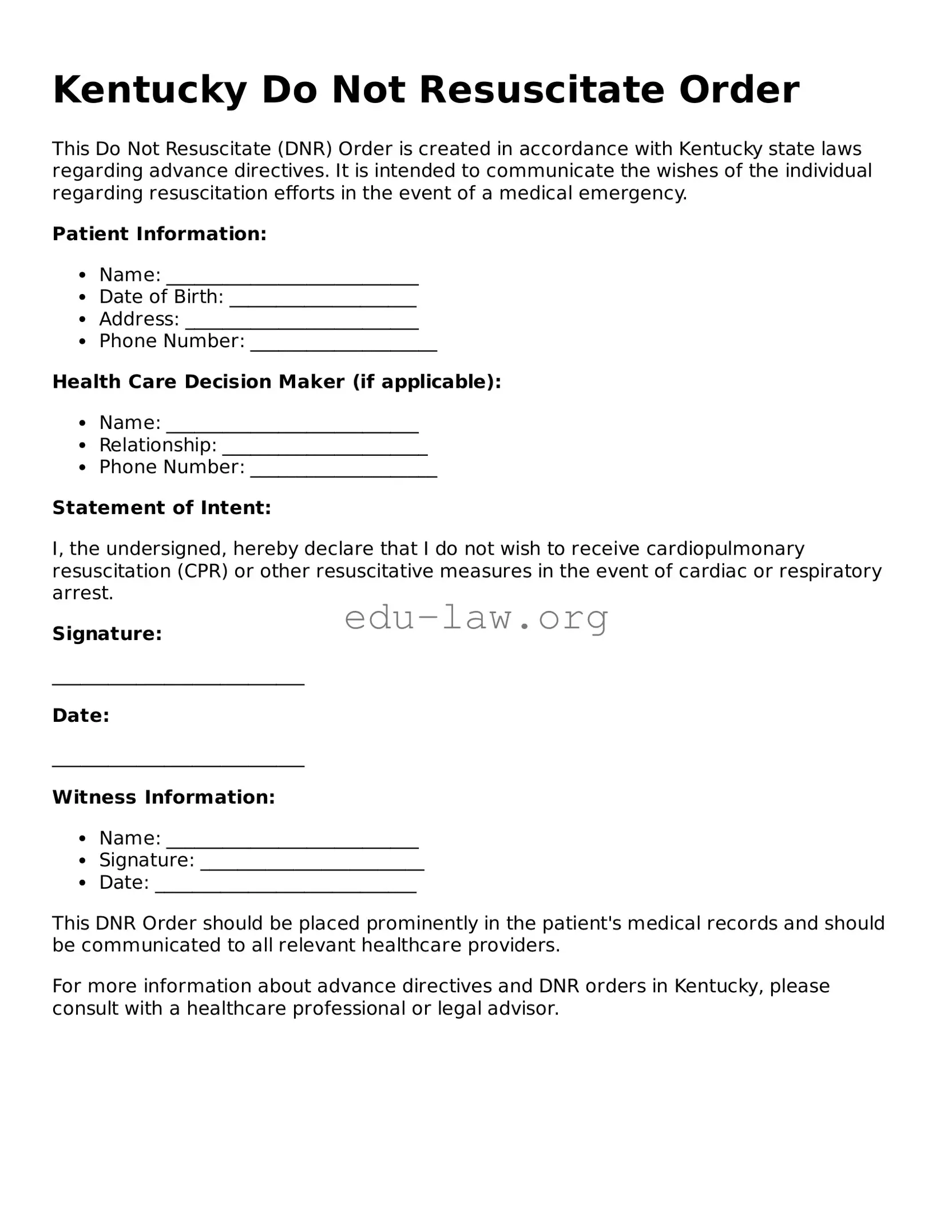
Kentucky Do Not Resuscitate Order
This Do Not Resuscitate (DNR) Order is created in accordance with Kentucky state laws regarding advance directives. It is intended to communicate the wishes of the individual regarding resuscitation efforts in the event of a medical emergency.
Patient Information:
Health Care Decision Maker (if applicable):
Statement of Intent:
I, the undersigned, hereby declare that I do not wish to receive cardiopulmonary resuscitation (CPR) or other resuscitative measures in the event of cardiac or respiratory arrest.
Signature:
___________________________
Date:
___________________________
Witness Information:
This DNR Order should be placed prominently in the patient's medical records and should be communicated to all relevant healthcare providers.
For more information about advance directives and DNR orders in Kentucky, please consult with a healthcare professional or legal advisor.
| Fact Name | Description |
|---|---|
| Governing Law | The Kentucky Do Not Resuscitate (DNR) Order is governed by KRS 311.623. |
| Purpose | The DNR Order allows individuals to refuse resuscitation efforts in the event of cardiac or respiratory arrest. |
| Eligibility | Any adult who is competent to make medical decisions can complete a DNR Order. |
| Signature Requirement | The form must be signed by the patient or their legally authorized representative. |
| Healthcare Provider's Role | A physician must sign the DNR Order for it to be valid and enforceable. |
| Form Availability | The Kentucky DNR Order form is available through healthcare providers and online resources. |
| Revocation | A DNR Order can be revoked at any time by the patient or their representative. |
| Emergency Medical Services | Emergency medical personnel must honor a valid DNR Order presented at the scene. |
Filling out the Kentucky Do Not Resuscitate Order form is an important step in expressing your healthcare preferences. Once you have completed the form, it should be shared with your healthcare providers and kept in a place where it can be easily accessed in case of a medical emergency.
What is a Do Not Resuscitate Order (DNR) in Kentucky?
A Do Not Resuscitate Order (DNR) is a medical order that instructs healthcare providers not to perform cardiopulmonary resuscitation (CPR) if a patient stops breathing or their heart stops beating. In Kentucky, this order is used to respect the wishes of individuals who do not want aggressive life-saving measures in certain medical situations. The DNR form must be completed and signed by a physician and the patient or their legal representative to be valid.
How do I obtain a DNR form in Kentucky?
You can obtain a DNR form from a healthcare provider, such as a hospital or physician's office. Additionally, the form is available online through the Kentucky Department for Public Health's website. It is essential to ensure that the form is completed correctly and signed by the appropriate parties to ensure its legality and effectiveness.
What information is required on the Kentucky DNR form?
The Kentucky DNR form requires specific information, including the patient's name, date of birth, and medical record number. It must also include the signatures of the patient or their legal representative and a physician. The physician’s signature confirms that the patient has been informed about the implications of the DNR order and has made an informed decision regarding their care.
Can a DNR order be revoked in Kentucky?
Yes, a DNR order can be revoked at any time by the patient or their legal representative. To revoke the order, the individual should inform their healthcare provider and ensure that any copies of the DNR form are destroyed. It is also advisable to create a new document indicating the revocation to avoid any confusion in medical situations.
Not Understanding the Form's Purpose: Many individuals mistakenly believe that a Do Not Resuscitate (DNR) order is the same as a living will. A DNR specifically addresses resuscitation efforts in the event of cardiac arrest, while a living will outlines broader healthcare wishes.
Missing Signatures: A common error is failing to secure the required signatures. The form must be signed by both the patient and a healthcare provider. Without these signatures, the order is not valid.
Incorrect Patient Information: Providing inaccurate personal details can lead to confusion. It's crucial to ensure that the patient's name, date of birth, and other identifying information are correct and clearly written.
Not Discussing the Order with Family: Some individuals fill out the form without discussing their wishes with family members. This can lead to misunderstandings and conflict during critical moments.
Using Outdated Forms: People sometimes use old versions of the DNR form. Always check that you are using the most current version to avoid any legal issues.
Failing to Communicate the DNR Status: After completing the form, it’s essential to inform healthcare providers and family members. Keeping the DNR order accessible and visible is vital for ensuring that your wishes are honored.
The Kentucky Do Not Resuscitate (DNR) Order form is a critical document for individuals who wish to express their preferences regarding resuscitation efforts in the event of a medical emergency. Along with this form, several other documents may be utilized to ensure that a person's healthcare wishes are clearly communicated and respected. Below is a list of related forms and documents commonly used in conjunction with the DNR Order form.
Understanding these forms and documents can help individuals make informed decisions about their healthcare preferences. It is essential to discuss these wishes with family members and healthcare providers to ensure that they are honored in critical situations.
The Advance Directive is a crucial document that outlines a person's healthcare preferences in case they become unable to communicate those wishes. Similar to the Kentucky Do Not Resuscitate Order (DNR), it allows individuals to express their desires regarding medical treatment, including life-sustaining measures. While a DNR specifically addresses the desire not to receive CPR or other resuscitation efforts, an Advance Directive can cover a broader range of healthcare decisions, including preferences for pain management, organ donation, and the use of feeding tubes. Both documents aim to ensure that medical care aligns with the patient's values and choices.
The Living Will is another important document that shares similarities with the Kentucky DNR. A Living Will allows individuals to specify their wishes regarding medical treatment in situations where they are terminally ill or permanently unconscious. Like the DNR, it is designed to guide healthcare providers in making decisions that reflect the patient's preferences. However, while the DNR focuses solely on resuscitation efforts, the Living Will can encompass a wider array of treatment options, including the withdrawal of life support and other interventions that may prolong life without hope of recovery.
The Physician Orders for Life-Sustaining Treatment (POLST) form is also comparable to the DNR. POLST is a medical order that translates a patient’s wishes regarding life-sustaining treatment into actionable orders for healthcare providers. This document is often used for patients with serious illnesses or those nearing the end of life. It is more comprehensive than a DNR, as it covers various treatment preferences, including resuscitation, hospitalization, and comfort care. Both the POLST and DNR serve to communicate a patient's wishes clearly, but POLST is designed to be used in conjunction with ongoing medical treatment discussions.
The Medical Power of Attorney (MPOA) is another document that relates closely to the Kentucky DNR. An MPOA designates a trusted individual to make healthcare decisions on behalf of the patient if they become incapacitated. While the DNR specifies a patient’s wishes regarding resuscitation, the MPOA empowers an appointed agent to make decisions that may include the use or withholding of life-sustaining treatments. Both documents work together to ensure that a patient’s healthcare preferences are honored, particularly in critical situations where they cannot speak for themselves.
Lastly, the Do Not Intubate (DNI) order is similar to the Kentucky DNR in that it addresses specific medical interventions. A DNI order specifically instructs healthcare providers not to perform intubation, which is the process of inserting a tube into the airway to assist with breathing. While the DNR focuses on resuscitation efforts, the DNI is more targeted and may be used in conjunction with a DNR to provide a clearer picture of a patient’s wishes regarding respiratory support. Both documents emphasize the importance of respecting a patient’s autonomy and preferences in medical care.
When filling out the Kentucky Do Not Resuscitate (DNR) Order form, it is essential to follow certain guidelines to ensure that the document is valid and reflects your wishes. Here are six important dos and don'ts to consider:
By adhering to these guidelines, you can ensure that your DNR order is properly executed and respected in medical situations.
Understanding the Kentucky Do Not Resuscitate (DNR) Order form is crucial for making informed healthcare decisions. However, several misconceptions can lead to confusion. Here are four common misunderstandings:
By clarifying these misconceptions, individuals can better navigate their healthcare choices and ensure their wishes are respected.
Filling out and using the Kentucky Do Not Resuscitate Order (DNR) form is an important decision for individuals and their families. Here are key takeaways to consider:
Being informed about the DNR process can provide peace of mind for you and your loved ones.