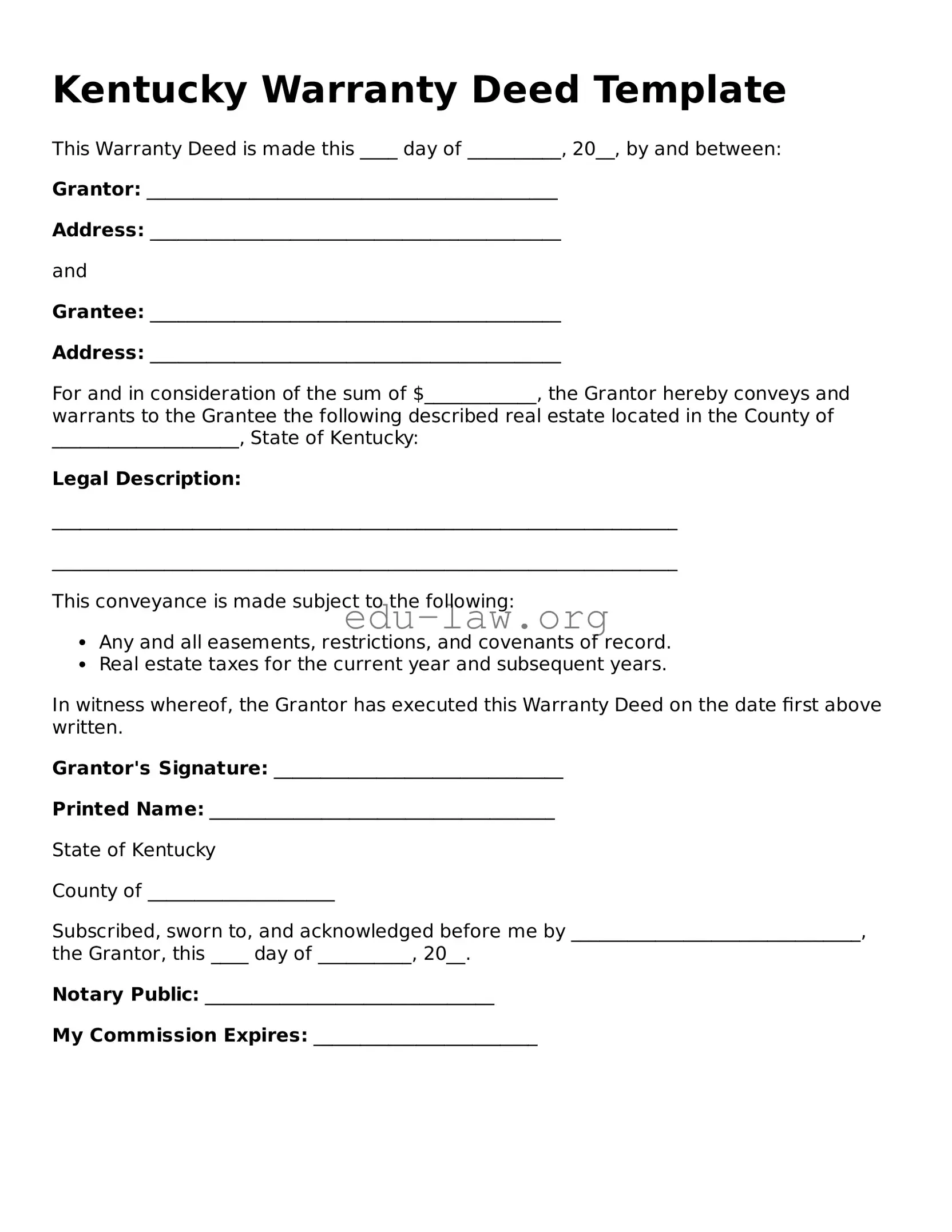
The Kentucky Deed form serves as a crucial legal instrument in the transfer of real property ownership within the state. This document outlines the specifics of the transaction, including the names of the parties involved, a detailed description of the property being transferred, and the consideration exchanged for the deed. It is essential for ensuring that the transfer is recognized by the state and protects the rights of both the grantor and grantee. The form typically requires signatures from both parties, and in some cases, notarization may be necessary to validate the transaction. Understanding the nuances of the Kentucky Deed form can help individuals navigate the complexities of property ownership and ensure compliance with state regulations. By utilizing this form, property owners can facilitate a smooth transfer process while safeguarding their legal interests.
Kentucky Warranty Deed Template
This Warranty Deed is made this ____ day of __________, 20__, by and between:
Grantor: ____________________________________________
Address: ____________________________________________
and
Grantee: ____________________________________________
Address: ____________________________________________
For and in consideration of the sum of $____________, the Grantor hereby conveys and warrants to the Grantee the following described real estate located in the County of ____________________, State of Kentucky:
Legal Description:
___________________________________________________________________
___________________________________________________________________
This conveyance is made subject to the following:
In witness whereof, the Grantor has executed this Warranty Deed on the date first above written.
Grantor's Signature: _______________________________
Printed Name: _____________________________________
State of Kentucky
County of ____________________
Subscribed, sworn to, and acknowledged before me by _______________________________, the Grantor, this ____ day of __________, 20__.
Notary Public: _______________________________
My Commission Expires: ________________________
| Fact Name | Description |
|---|---|
| Document Type | The Kentucky Deed form is a legal document used to transfer property ownership. |
| Governing Law | This form is governed by the Kentucky Revised Statutes (KRS) Chapter 381. |
| Parties Involved | The deed involves at least two parties: the grantor (seller) and the grantee (buyer). |
| Property Description | A complete and accurate description of the property must be included in the deed. |
| Signature Requirement | The grantor must sign the deed for it to be valid. |
| Notarization | Notarization of the grantor's signature is required to ensure authenticity. |
| Recording | The deed should be recorded with the county clerk's office to provide public notice of the property transfer. |
| Types of Deeds | Common types of deeds in Kentucky include warranty deeds and quitclaim deeds. |
After obtaining the Kentucky Deed form, it is essential to complete it accurately to ensure proper recording. Once the form is filled out, it will need to be signed and submitted to the appropriate county clerk’s office for processing.
What is a Kentucky Deed form?
A Kentucky Deed form is a legal document used to transfer ownership of real property from one party to another within the state of Kentucky. It outlines the details of the transaction, including the names of the buyer and seller, the property description, and any terms of the sale.
What types of deeds are available in Kentucky?
In Kentucky, there are several types of deeds, including Warranty Deeds, Quitclaim Deeds, and Special Warranty Deeds. A Warranty Deed provides the highest level of protection to the buyer, guaranteeing that the seller holds clear title to the property. A Quitclaim Deed transfers any interest the seller may have without making guarantees about the title. Special Warranty Deeds offer limited protection, covering only the time the seller owned the property.
How do I complete a Kentucky Deed form?
To complete a Kentucky Deed form, start by filling in the names and addresses of the grantor (seller) and grantee (buyer). Include a detailed legal description of the property, which can often be found in previous deeds or property tax records. Sign the deed in front of a notary public. Ensure all required information is accurate to avoid issues during the transfer.
Do I need to have the deed notarized?
Yes, in Kentucky, a deed must be notarized to be legally binding. The notary public will verify the identities of the parties involved and witness the signing of the document. This step is essential to ensure the deed is valid and can be recorded.
How do I record a Kentucky Deed?
To record a Kentucky Deed, take the completed and notarized document to the county clerk's office where the property is located. There, you will submit the deed for recording and pay any associated fees. Recording the deed provides public notice of the transfer and protects the buyer's ownership rights.
What fees are associated with recording a deed in Kentucky?
Recording fees in Kentucky vary by county. Typically, there is a base fee for recording the deed, plus additional charges based on the number of pages. It is advisable to check with the local county clerk's office for the exact fee schedule.
Can I use a Kentucky Deed form for any type of property?
Yes, a Kentucky Deed form can be used for various types of real property, including residential, commercial, and vacant land. However, ensure that the form is appropriate for the specific type of transaction you are conducting.
What should I do if I need help with a Kentucky Deed form?
If you need assistance with a Kentucky Deed form, consider consulting a real estate attorney or a professional familiar with property transactions. They can provide guidance on completing the form correctly and ensure that all legal requirements are met.
Not including all necessary parties. It's crucial to ensure that all individuals involved in the property transaction are named on the deed. This includes both the grantor (seller) and the grantee (buyer).
Incorrectly describing the property. The property description must be accurate and detailed. Omitting details or using vague terms can lead to confusion and potential legal issues.
Failing to sign the deed. A deed is not valid unless it is signed by the grantor. Forgetting this step can invalidate the entire document.
Not having the deed notarized. In Kentucky, notarization is often required for the deed to be legally recognized. Skipping this step can lead to complications.
Using outdated forms. Laws and requirements can change. Always use the most current version of the Kentucky Deed form to avoid issues.
Neglecting to include the date of the transaction. The date is essential for establishing the timeline of ownership. Omitting it can create confusion.
Not checking for liens or encumbrances. Before completing the deed, it's important to ensure there are no outstanding debts or claims against the property. This protects the buyer's interests.
Overlooking local filing requirements. Each county in Kentucky may have specific rules regarding the filing of deeds. Be sure to check local regulations to ensure compliance.
When completing a property transaction in Kentucky, several forms and documents may be necessary in addition to the Kentucky Deed form. Each document plays a crucial role in ensuring that the transfer of ownership is smooth and legally binding.
Having these documents prepared and organized can significantly streamline the property transfer process in Kentucky. Ensure you consult with a real estate professional to confirm that you have all necessary paperwork for your specific transaction.
The Kentucky Deed form is similar to the Warranty Deed, which provides a guarantee from the seller that they hold clear title to the property and have the right to sell it. This document protects the buyer by ensuring that there are no hidden claims or liens against the property. In essence, a Warranty Deed offers a level of security that the seller's ownership is legitimate and free from disputes, making it a critical document in real estate transactions.
Another document that shares similarities with the Kentucky Deed form is the Quitclaim Deed. Unlike the Warranty Deed, a Quitclaim Deed transfers whatever interest the seller has in the property without making any promises about the title's validity. This type of deed is often used between family members or in situations where the parties trust each other, as it does not offer the same protections as a Warranty Deed.
The Special Warranty Deed is also comparable to the Kentucky Deed form. This document is a hybrid between a Warranty Deed and a Quitclaim Deed. It guarantees that the seller has not encumbered the property during their ownership but does not provide assurances about the property's history before that time. This type of deed is often used in commercial real estate transactions, where sellers want to limit their liability.
The Bargain and Sale Deed is another document that resembles the Kentucky Deed. It implies that the seller has the right to sell the property but does not offer any warranties regarding the title. This type of deed is often used in foreclosure sales or tax sales, where the seller may not have a complete history of the property. Buyers should be cautious with this type of deed, as it does not provide the same level of protection as a Warranty Deed.
A Grant Deed is also similar to the Kentucky Deed form. This document guarantees that the seller has not sold the property to anyone else and that the property is free from encumbrances, except those disclosed to the buyer. While it offers more protection than a Quitclaim Deed, it does not provide the same level of assurance as a Warranty Deed. Grant Deeds are commonly used in residential real estate transactions.
The Trustee’s Deed is another document that bears resemblance to the Kentucky Deed. This type of deed is used when a property is transferred by a trustee, often in the context of a trust or estate. It conveys the property to the beneficiary, but similar to a Bargain and Sale Deed, it typically does not provide warranties regarding the title. Buyers should exercise caution and conduct thorough due diligence when dealing with Trustee’s Deeds.
Lastly, the Executor’s Deed is comparable to the Kentucky Deed form in that it is used to transfer property from an estate after a person has passed away. This document is executed by the executor of the estate and may or may not provide warranties regarding the title. The Executor’s Deed is essential for ensuring that the property is legally transferred to the heirs or beneficiaries, but it may carry some risks depending on the estate's history.
When filling out the Kentucky Deed form, it's essential to follow specific guidelines to ensure the document is valid and legally binding. Below is a list of things you should and shouldn't do:
Following these guidelines can help ensure that the deed is processed smoothly and that the transfer of property is legally recognized.
Understanding the Kentucky Deed form is essential for anyone involved in property transactions in the state. However, several misconceptions can lead to confusion. Here is a list of common misunderstandings:
Clarifying these misconceptions can help ensure that property transactions proceed smoothly and legally in Kentucky.
When filling out and using the Kentucky Deed form, there are several important considerations to keep in mind. The following key takeaways can help ensure a smooth process:
Understanding these aspects can facilitate a more effective and legally sound property transfer process in Kentucky.