In the state of Kansas, managing the affairs of a deceased loved one can be a daunting task, especially when it comes to settling their estate. The Kansas Small Estate Affidavit offers a streamlined process for individuals dealing with estates that fall below a certain value threshold. This form allows heirs or beneficiaries to claim the decedent’s assets without the need for formal probate proceedings, thereby simplifying what can often be a lengthy and complicated process. To qualify, the total value of the estate must not exceed $50,000, excluding certain types of property. The affidavit must include essential information such as the decedent's name, date of death, and details about the assets being claimed. Additionally, it requires the signatures of all heirs, affirming their agreement on the distribution of the estate. By utilizing this form, individuals can efficiently transfer property and settle debts, ensuring that the decedent’s wishes are honored while minimizing the administrative burden on the surviving family members.
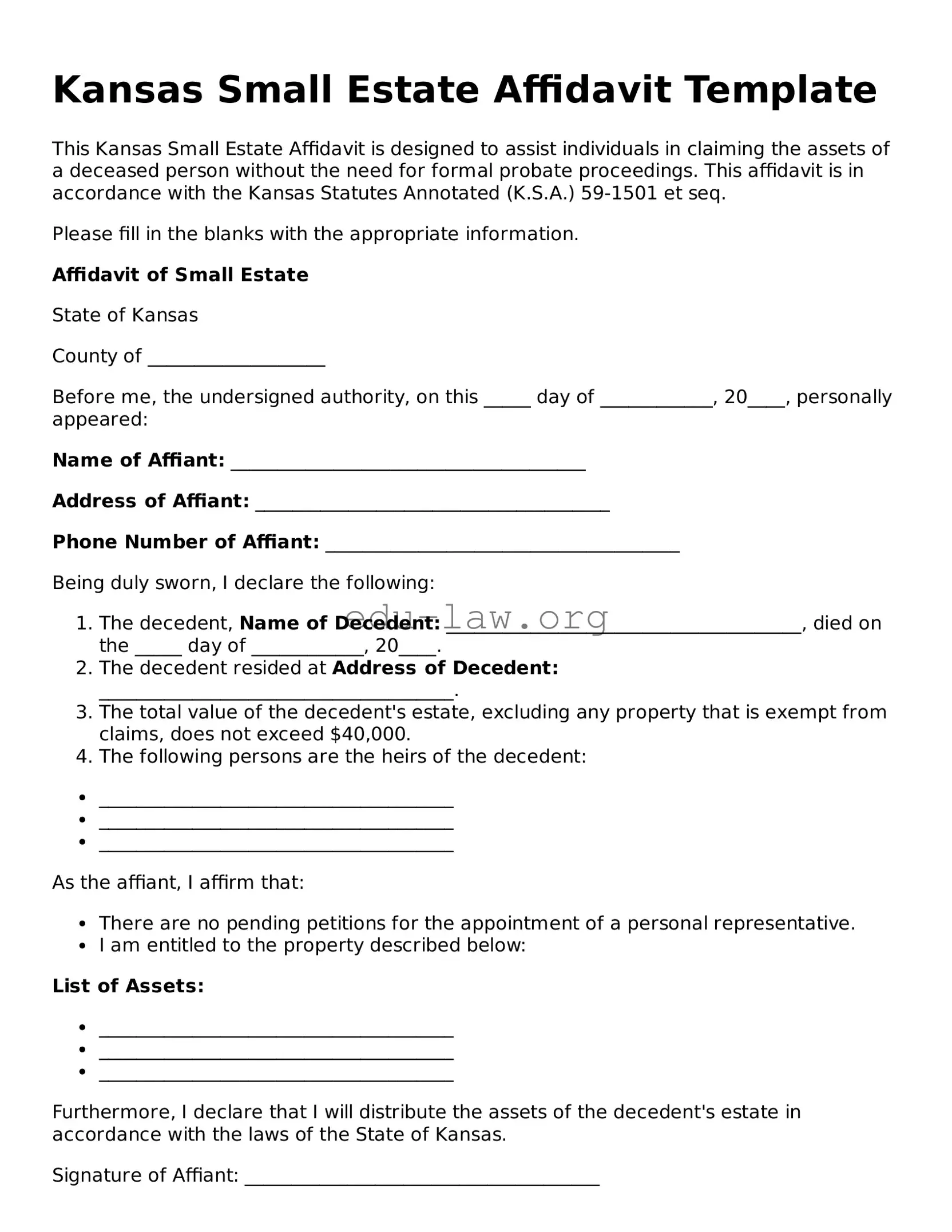
Kansas Small Estate Affidavit Template
This Kansas Small Estate Affidavit is designed to assist individuals in claiming the assets of a deceased person without the need for formal probate proceedings. This affidavit is in accordance with the Kansas Statutes Annotated (K.S.A.) 59-1501 et seq.
Please fill in the blanks with the appropriate information.
Affidavit of Small Estate
State of Kansas
County of ___________________
Before me, the undersigned authority, on this _____ day of ____________, 20____, personally appeared:
Name of Affiant: ______________________________________
Address of Affiant: ______________________________________
Phone Number of Affiant: ______________________________________
Being duly sworn, I declare the following:
As the affiant, I affirm that:
List of Assets:
Furthermore, I declare that I will distribute the assets of the decedent's estate in accordance with the laws of the State of Kansas.
Signature of Affiant: ______________________________________
Subscribed and sworn to before me this _____ day of ____________, 20____.
Notary Public: ______________________________________
My Commission Expires: ________________________________
| Fact Name | Details |
|---|---|
| Purpose | The Kansas Small Estate Affidavit allows individuals to settle the estate of a deceased person without going through formal probate, provided certain conditions are met. |
| Eligibility | To use this form, the total value of the estate must not exceed $40,000 for individuals or $100,000 for married couples, excluding certain assets. |
| Governing Law | The use of the Kansas Small Estate Affidavit is governed by Kansas Statutes Annotated, specifically K.S.A. 59-1501 through K.S.A. 59-1507. |
| Filing Process | The affidavit must be signed by the affiant and filed with the appropriate court or presented to financial institutions to access the deceased's assets. |
After gathering the necessary information and documents, you'll be ready to complete the Kansas Small Estate Affidavit form. This form allows you to claim assets of a deceased person without going through a lengthy probate process. Follow these steps carefully to ensure everything is filled out correctly.
Once the form is submitted, the court will process your affidavit. If everything is in order, you should receive confirmation that you can proceed with claiming the assets listed in the affidavit. Keep a copy of the submitted form for your records.
What is a Kansas Small Estate Affidavit?
A Kansas Small Estate Affidavit is a legal document that allows individuals to settle the estate of a deceased person without going through the full probate process. This form is typically used when the total value of the estate is below a certain threshold, making it a simpler and more efficient way to transfer assets. It can help heirs or beneficiaries claim property, bank accounts, and other assets without the need for lengthy court proceedings.
Who can use the Small Estate Affidavit in Kansas?
In Kansas, the Small Estate Affidavit can be used by heirs or beneficiaries of a deceased person’s estate. Generally, this includes individuals who are named in the will or those who would inherit under state law if there is no will. To qualify, the total value of the estate must be below the limit set by Kansas law, which is currently $40,000 for personal property and $200,000 for real property. It’s important to check current laws, as these limits can change.
How do I complete the Small Estate Affidavit?
Completing the Small Estate Affidavit involves filling out a specific form provided by the state. You will need to provide information about the deceased, including their name, date of death, and details about their assets. Additionally, you must list the heirs and their relationship to the deceased. It’s crucial to ensure that all information is accurate and complete. After filling out the form, it must be signed in front of a notary public to be considered valid.
What happens after I submit the Small Estate Affidavit?
Once the Small Estate Affidavit is completed and notarized, it can be submitted to financial institutions, property holders, or other entities that hold the deceased's assets. They will review the affidavit to verify the information and determine if they can release the assets to you. Keep in mind that some institutions may have their own requirements, so it’s wise to check with them beforehand to ensure a smooth process.
Can I use the Small Estate Affidavit if there is a will?
Yes, you can use the Small Estate Affidavit even if there is a will. However, the will must be valid and clearly outline the distribution of the deceased’s assets. If the estate falls within the small estate limits, the affidavit can help facilitate the transfer of assets as specified in the will. If there are disputes among heirs or complications with the will, it may be advisable to consult a legal professional for guidance.
Incorrectly identifying the decedent: It's crucial to provide the full name and date of death of the deceased. Omitting this information or using nicknames can lead to delays or rejections.
Failing to list all assets: Some individuals forget to include all the assets owned by the decedent. This may include bank accounts, real estate, or personal property. An incomplete list can invalidate the affidavit.
Not including liabilities: While the focus is on assets, failing to mention any debts or liabilities can create problems. The affidavit should reflect a clear picture of the decedent’s financial situation.
Signing without witnesses: The affidavit must be signed in front of a notary public, and in some cases, witnesses may also be required. Neglecting this step can lead to issues with the validity of the document.
Using outdated forms: Laws and forms can change. Always ensure that the most current version of the Kansas Small Estate Affidavit is being used to avoid complications.
Inaccurate valuations: Providing incorrect values for the assets can raise red flags. It's important to be as accurate as possible to prevent legal challenges.
Not understanding the eligibility requirements: Before filling out the form, individuals should confirm that the estate qualifies as a small estate under Kansas law. Misunderstanding these criteria can lead to wasted time and effort.
Neglecting to keep copies: After submitting the affidavit, it's wise to keep copies of all documents filed. This can be helpful for future reference or if any disputes arise.
The Kansas Small Estate Affidavit is a useful tool for settling the estates of individuals who have passed away with limited assets. Alongside this form, several other documents may be necessary to ensure a smooth process. Below is a list of commonly used forms that can accompany the Small Estate Affidavit.
Having these documents ready can streamline the process of settling an estate in Kansas. It’s essential to ensure all paperwork is complete and accurate to avoid delays and complications.
The Kansas Small Estate Affidavit is similar to a probate petition. Both documents serve to facilitate the transfer of assets after someone has passed away. However, while a probate petition typically requires a court's approval to validate the distribution of an estate, the Small Estate Affidavit allows heirs to claim property without going through the lengthy probate process. This makes it a more efficient option for smaller estates, streamlining the transfer of assets to beneficiaries.
Another document that resembles the Kansas Small Estate Affidavit is the Affidavit of Heirship. This affidavit is often used to establish the rightful heirs of a deceased person's estate. Like the Small Estate Affidavit, it provides a way for heirs to assert their claims without going through court. However, the Affidavit of Heirship focuses primarily on identifying heirs, while the Small Estate Affidavit is specifically designed to facilitate the transfer of the decedent’s assets.
The Will is also comparable to the Kansas Small Estate Affidavit, as both documents deal with the distribution of a deceased person's assets. A Will outlines the deceased's wishes regarding asset distribution and requires probate for validation. In contrast, the Small Estate Affidavit allows for a more straightforward transfer of assets when the estate falls below a certain value, thus bypassing the complexities of probate entirely.
Lastly, the Transfer on Death (TOD) deed shares similarities with the Small Estate Affidavit. Both documents aim to simplify the transfer of property after death. A TOD deed allows property owners to designate beneficiaries who will automatically inherit the property upon the owner's death, avoiding probate. The Small Estate Affidavit, while addressing a broader range of assets, serves a similar purpose by enabling heirs to claim property directly, thus expediting the process of asset distribution.
When filling out the Kansas Small Estate Affidavit form, it’s crucial to follow certain guidelines to ensure the process goes smoothly. Here are ten things you should and shouldn’t do:
Following these guidelines can help prevent delays and ensure that the small estate process is handled efficiently.
The Kansas Small Estate Affidavit is a valuable tool for settling the estates of individuals who have passed away. However, several misconceptions surround its use. Below is a list of ten common misunderstandings about this form, along with clarifications to help demystify the process.
Understanding these misconceptions can help individuals navigate the process of settling an estate more effectively. Proper knowledge of the Kansas Small Estate Affidavit can lead to more informed decisions during what can be a challenging time.
Filling out and using the Kansas Small Estate Affidavit form can simplify the process of settling a small estate. Here are key takeaways to keep in mind:
Understanding these points can help ensure a smoother process when dealing with small estates in Kansas.