The Kansas Quitclaim Deed form serves as a crucial legal instrument in real estate transactions, allowing property owners to transfer their interests in real estate to another party without making any guarantees about the title. This form is particularly useful in situations where the grantor may not be able to provide a warranty of title, such as in transactions between family members or in cases of divorce. The document typically includes essential information such as the names of the parties involved, a description of the property being transferred, and the signature of the grantor. Additionally, it may require notarization to ensure the validity of the transfer. Understanding the nuances of the Kansas Quitclaim Deed is important for anyone involved in property transactions, as it can affect ownership rights and future claims against the property. By utilizing this form, individuals can facilitate a straightforward transfer process while being aware of the limitations that come with it.
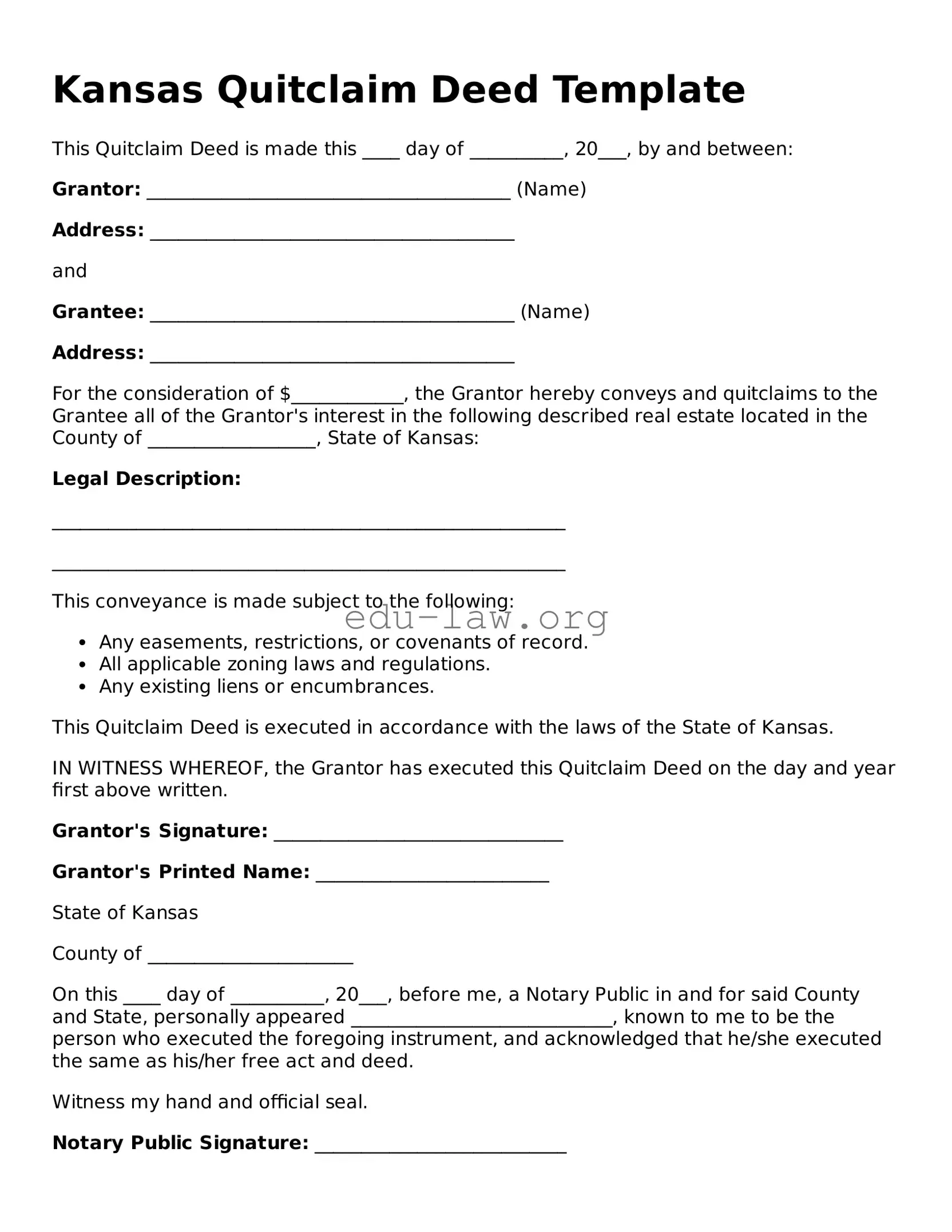
Kansas Quitclaim Deed Template
This Quitclaim Deed is made this ____ day of __________, 20___, by and between:
Grantor: _______________________________________ (Name)
Address: _______________________________________
and
Grantee: _______________________________________ (Name)
Address: _______________________________________
For the consideration of $____________, the Grantor hereby conveys and quitclaims to the Grantee all of the Grantor's interest in the following described real estate located in the County of __________________, State of Kansas:
Legal Description:
_______________________________________________________
_______________________________________________________
This conveyance is made subject to the following:
This Quitclaim Deed is executed in accordance with the laws of the State of Kansas.
IN WITNESS WHEREOF, the Grantor has executed this Quitclaim Deed on the day and year first above written.
Grantor's Signature: _______________________________
Grantor's Printed Name: _________________________
State of Kansas
County of ______________________
On this ____ day of __________, 20___, before me, a Notary Public in and for said County and State, personally appeared ____________________________, known to me to be the person who executed the foregoing instrument, and acknowledged that he/she executed the same as his/her free act and deed.
Witness my hand and official seal.
Notary Public Signature: ___________________________
My Commission Expires: ___________________________
| Fact Name | Description |
|---|---|
| Definition | A quitclaim deed is a legal document that transfers ownership of property from one person to another without any guarantees about the title. |
| Governing Law | The Kansas Quitclaim Deed is governed by Kansas Statutes Annotated, Chapter 58, Article 2201. |
| Usage | This form is commonly used among family members, in divorce settlements, or to clear up title issues. |
| Title Transfer | With a quitclaim deed, the grantor transfers whatever interest they have in the property, if any, to the grantee. |
| Consideration | While some quitclaim deeds may involve payment, they can also be executed as gifts or for nominal consideration. |
| Notarization | The deed must be signed in front of a notary public to be legally binding in Kansas. |
| Recording | To protect the grantee’s interest, the quitclaim deed should be recorded with the county register of deeds. |
| Limitations | Since quitclaim deeds do not guarantee title, buyers should conduct thorough title searches before relying on them. |
After you have gathered all necessary information, you are ready to fill out the Kansas Quitclaim Deed form. This form is essential for transferring property ownership and must be completed accurately to ensure a smooth process.
Once you have completed these steps, the deed will be officially recorded, and the property ownership will be transferred. Be sure to keep a copy of the recorded deed for your records.
What is a Kansas Quitclaim Deed?
A Kansas Quitclaim Deed is a legal document used to transfer ownership of real estate from one party to another. Unlike a warranty deed, it does not guarantee that the property is free of liens or other claims. The person transferring the property, known as the grantor, simply relinquishes any interest they may have in the property to the recipient, known as the grantee.
When should I use a Quitclaim Deed?
This type of deed is often used in situations where the parties know each other and trust each other, such as transferring property between family members or in divorce settlements. If you are unsure about the title or the condition of the property, you may want to consider a different type of deed that provides more protection.
How do I fill out a Quitclaim Deed in Kansas?
To fill out a Quitclaim Deed, you will need to provide specific information, including the names of the grantor and grantee, a legal description of the property, and the date of the transfer. It is essential to ensure that all information is accurate and complete to avoid any future disputes. You can find templates online or consult with a legal professional for assistance.
Does a Quitclaim Deed need to be notarized?
Yes, in Kansas, a Quitclaim Deed must be notarized to be legally valid. After signing the deed, the grantor must take it to a notary public, who will verify their identity and witness the signing. This step is crucial for the deed to be recorded in the county where the property is located.
How do I record a Quitclaim Deed in Kansas?
To record a Quitclaim Deed, you will need to take the notarized document to the county clerk or register of deeds in the county where the property is located. There may be a small fee for recording the deed. Once recorded, the deed becomes part of the public record, providing legal notice of the transfer of ownership.
Are there any tax implications when using a Quitclaim Deed?
While transferring property via a Quitclaim Deed does not usually trigger a tax event, it is essential to be aware of potential property tax implications. In some cases, the transfer may affect the property’s assessed value or lead to reassessment. Consulting a tax professional can provide clarity on any specific concerns.
Can a Quitclaim Deed be contested?
Yes, a Quitclaim Deed can be contested, especially if there are claims of fraud, undue influence, or lack of capacity at the time of signing. If someone believes the deed was executed improperly, they may seek legal action to challenge its validity. It is crucial to ensure that all parties fully understand the implications before signing.
What if the grantor has multiple properties?
If the grantor owns multiple properties, each property must be listed separately in the Quitclaim Deed, along with its legal description. It is important to be clear and specific about which property or properties are being transferred to avoid confusion or disputes in the future.
Can I use a Quitclaim Deed to transfer property into a trust?
Yes, a Quitclaim Deed can be used to transfer property into a trust. This is a common practice for estate planning purposes. However, it is advisable to consult with an attorney who specializes in estate planning to ensure that the transfer is done correctly and that all legal requirements are met.
Failing to include the correct names of the grantor and grantee. It is essential to ensure that the names match the legal documents and identification.
Not providing a complete legal description of the property. A vague or incomplete description can lead to confusion or disputes later on.
Omitting the notarization of the document. A quitclaim deed must be signed in front of a notary public to be legally valid.
Using the incorrect form. Ensure that you are using the most current version of the Kansas Quitclaim Deed form, as outdated forms may not be accepted.
Not including the date of execution. The date is crucial for establishing the timeline of ownership transfer.
Forgetting to file the deed with the appropriate county office. After completing the deed, it must be recorded to be effective against third parties.
Neglecting to pay the required fees associated with filing the deed. Each county may have different fee structures, so it’s important to check ahead.
Failing to understand the implications of a quitclaim deed. Unlike a warranty deed, a quitclaim deed offers no guarantees about the title’s validity.
Not consulting with a legal professional if unsure about the process. Seeking guidance can prevent mistakes that could complicate the transfer of property.
When dealing with property transfers in Kansas, a Quitclaim Deed is a common document used. However, several other forms and documents may also be necessary to ensure a smooth transaction. Here’s a list of some important documents that often accompany a Quitclaim Deed.
Understanding these documents can help you navigate the property transfer process more effectively. Always consider consulting with a professional to ensure everything is handled correctly.
A warranty deed is one of the most common documents used in real estate transactions. Like a quitclaim deed, it transfers ownership of property from one party to another. However, a warranty deed provides additional assurances. The seller guarantees that they hold clear title to the property and have the right to sell it. This means that if any issues arise regarding ownership or claims from third parties, the seller is responsible for resolving them. This added layer of protection makes warranty deeds a preferred choice for many buyers who want peace of mind.
A special warranty deed is another document that shares similarities with a quitclaim deed. This type of deed also transfers property ownership but offers limited warranties. The seller guarantees that they have not done anything to harm the title during their ownership. Unlike a warranty deed, which covers the entire history of the property, a special warranty deed only protects against issues that arose while the seller owned the property. This can be a middle ground for sellers who want to provide some assurance to buyers without taking on full liability.
A grant deed is often used in some states and has characteristics similar to a quitclaim deed. When a grant deed is executed, the seller transfers ownership to the buyer and makes certain implied guarantees. These include assurances that the property has not been sold to anyone else and that there are no undisclosed encumbrances. While a grant deed does not offer the same level of protection as a warranty deed, it does provide more security than a quitclaim deed, making it a popular option in real estate transactions.
An easement agreement is another document that can be compared to a quitclaim deed. While it does not transfer ownership of property, it grants a right to use someone else's property for a specific purpose, such as accessing a road or utility lines. Similar to a quitclaim deed, an easement agreement can be executed without a guarantee of clear title. This means that the party granting the easement may not be fully aware of any existing issues with the title, which can pose risks for the party receiving the easement.
A lease agreement, while fundamentally different in purpose, shares some similarities with a quitclaim deed in terms of property rights. A lease allows one party to use another party's property for a specified period in exchange for rent. Like a quitclaim deed, a lease does not convey ownership; rather, it grants temporary rights to use the property. Both documents require clear communication between the parties to ensure mutual understanding of the rights being transferred.
A bill of sale is another document that can be likened to a quitclaim deed, but it is primarily used for the transfer of personal property rather than real estate. When someone sells a vehicle or equipment, a bill of sale serves as proof of the transaction. Similar to a quitclaim deed, it does not guarantee that the seller has clear title to the item being sold. Buyers should be cautious, as there may be existing liens or claims against the personal property that could affect ownership.
Lastly, a trust deed, often used in real estate transactions, has similarities to a quitclaim deed in that it involves the transfer of property rights. A trust deed secures a loan by transferring property to a trustee until the borrower repays the loan. While it is not a direct transfer of ownership like a quitclaim deed, it does create an interest in the property that can be enforced. Both documents involve trust and reliance on the parties’ intentions, making clear communication essential in both scenarios.
When filling out a Kansas Quitclaim Deed form, it is essential to follow specific guidelines to ensure the document is valid and effective. Here are some important dos and don’ts to consider:
Understanding the Kansas Quitclaim Deed form is essential for anyone involved in property transactions. However, several misconceptions can lead to confusion. Here are four common misconceptions explained:
This is partially true. A Quitclaim Deed transfers whatever interest the grantor has in the property. It does not guarantee that the grantor has full ownership or any ownership at all.
This is incorrect. A Warranty Deed provides guarantees about the title and protects the buyer against future claims. In contrast, a Quitclaim Deed does not offer such protections.
This is false. While Quitclaim Deeds are often used in family transactions, they can be used between any parties. The key factor is the intent to transfer interest.
This is misleading. While a Quitclaim Deed is effective once executed, it can be challenged in court or revoked if certain legal criteria are met.
When filling out and using the Kansas Quitclaim Deed form, keep these key takeaways in mind: