In the realm of financial transactions, the Kansas Promissory Note form serves as a vital tool for both lenders and borrowers. This legally binding document outlines the terms under which money is borrowed, ensuring clarity and protection for all parties involved. Key components of the form include the principal amount, interest rate, repayment schedule, and any applicable late fees, all of which establish a clear framework for repayment. Furthermore, the note may specify whether it is secured or unsecured, indicating if collateral backs the loan. The importance of a well-drafted promissory note cannot be overstated; it not only fosters trust between the lender and borrower but also provides a legal recourse in case of default. Understanding the nuances of this form can empower individuals and businesses to navigate their financial commitments with confidence.
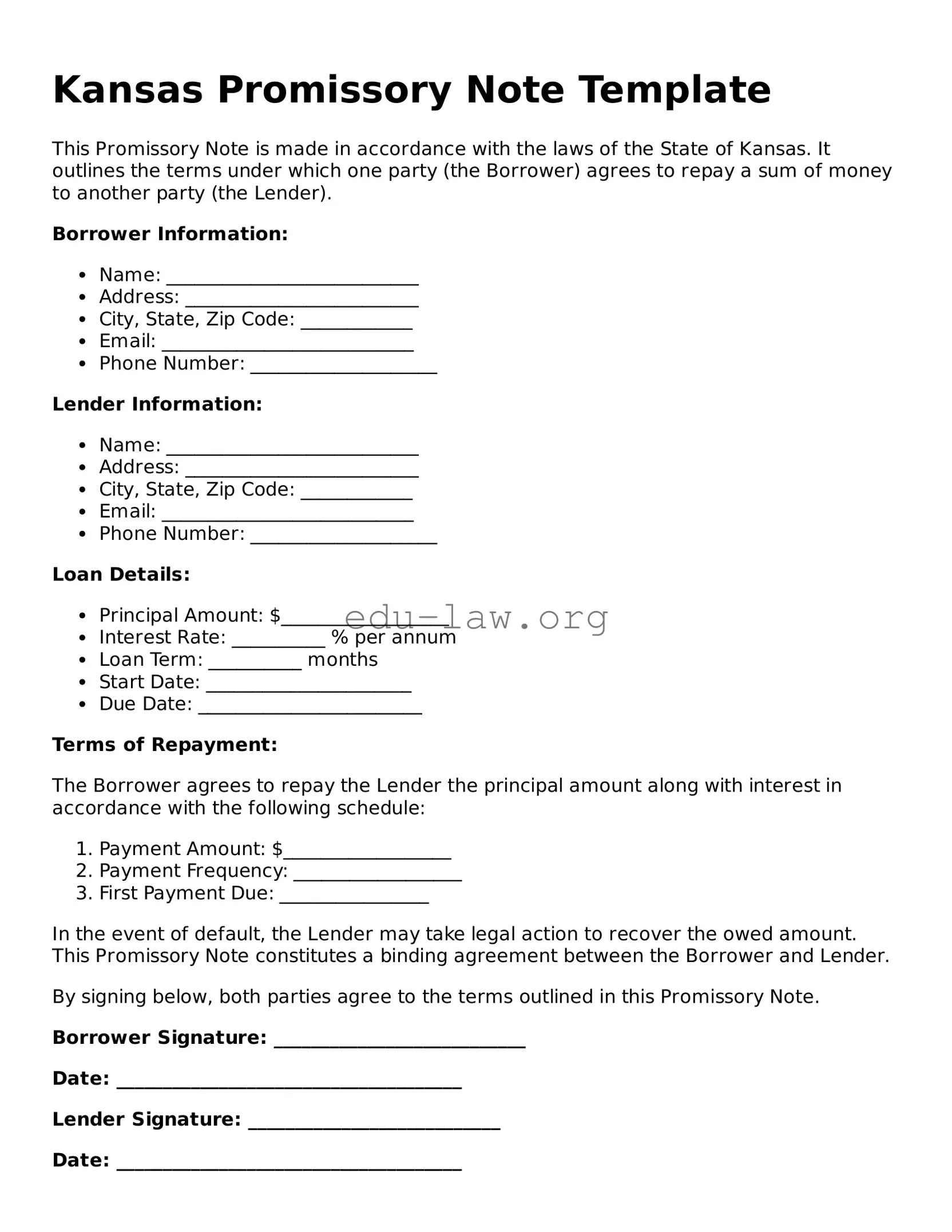
Kansas Promissory Note Template
This Promissory Note is made in accordance with the laws of the State of Kansas. It outlines the terms under which one party (the Borrower) agrees to repay a sum of money to another party (the Lender).
Borrower Information:
Lender Information:
Loan Details:
Terms of Repayment:
The Borrower agrees to repay the Lender the principal amount along with interest in accordance with the following schedule:
In the event of default, the Lender may take legal action to recover the owed amount. This Promissory Note constitutes a binding agreement between the Borrower and Lender.
By signing below, both parties agree to the terms outlined in this Promissory Note.
Borrower Signature: ___________________________
Date: _____________________________________
Lender Signature: ___________________________
Date: _____________________________________
| Fact Name | Description |
|---|---|
| Definition | A Kansas Promissory Note is a written promise to pay a specified amount of money to a designated party at a future date or on demand. |
| Governing Law | The promissory note is governed by the Uniform Commercial Code (UCC) as adopted in Kansas, specifically K.S.A. 84-3-104. |
| Key Components | It typically includes the principal amount, interest rate, payment terms, and the signatures of the borrower and lender. |
| Enforceability | For a promissory note to be enforceable, it must be clear, unambiguous, and signed by the borrower. |
| Types of Notes | Kansas recognizes various types of promissory notes, including secured and unsecured notes, each with different implications for the lender's rights. |
Once you have the Kansas Promissory Note form in front of you, it’s time to fill it out. This document is essential for outlining the terms of a loan agreement between a borrower and a lender. Follow the steps below to complete the form accurately.
After completing the form, ensure that both parties keep a copy for their records. This will help avoid any misunderstandings in the future regarding the terms of the loan.
What is a Kansas Promissory Note?
A Kansas Promissory Note is a legal document that outlines a borrower's promise to repay a specific amount of money to a lender under agreed-upon terms. It serves as a written record of the loan, detailing the amount borrowed, interest rates, repayment schedule, and any penalties for late payments.
Who can use a Kansas Promissory Note?
Anyone can use a Kansas Promissory Note, including individuals, businesses, and organizations. It is commonly used for personal loans, business loans, and transactions between friends or family members. However, it is essential that both parties understand the terms before signing.
What information is required in a Kansas Promissory Note?
The note must include the names and addresses of both the borrower and lender, the principal amount of the loan, the interest rate, the repayment schedule, and the maturity date. Additionally, it may include any collateral securing the loan and the consequences of default.
Is a Kansas Promissory Note legally binding?
Yes, a properly executed Kansas Promissory Note is legally binding. Once signed by both parties, it creates an obligation for the borrower to repay the loan according to the specified terms. If the borrower fails to comply, the lender may take legal action to recover the owed amount.
Do I need a lawyer to create a Kansas Promissory Note?
While it is not legally required to have a lawyer draft a Kansas Promissory Note, consulting one is advisable. A lawyer can ensure that the document meets all legal requirements and adequately protects your interests, especially for larger loans or complex agreements.
Can a Kansas Promissory Note be modified?
Yes, a Kansas Promissory Note can be modified if both parties agree to the changes. It is essential to document any modifications in writing and have both parties sign the revised agreement to avoid future disputes.
What happens if the borrower defaults on a Kansas Promissory Note?
If the borrower defaults, the lender has the right to take legal action to recover the owed amount. This may include filing a lawsuit or seeking a judgment against the borrower. The specific remedies available will depend on the terms outlined in the note and Kansas law.
Where can I obtain a Kansas Promissory Note form?
You can obtain a Kansas Promissory Note form from various sources, including legal websites, office supply stores, or through a lawyer. Ensure that the form complies with Kansas laws and includes all necessary information before use.
Incorrect Borrower Information: One of the most common mistakes is failing to provide accurate personal details for the borrower. This includes the full name, address, and contact information. Omitting any of these can lead to complications in the future.
Missing Lender Details: Just as with the borrower, it is crucial to include complete information for the lender. Ensure that the lender’s name and address are correctly listed to avoid any disputes later on.
Unclear Loan Amount: Clearly stating the amount of the loan is essential. Some people write ambiguous figures or fail to specify whether the amount is in dollars or another currency, which can create confusion.
Omitting Interest Rate: If the loan includes an interest rate, it must be clearly defined. Leaving this out can lead to misunderstandings about repayment expectations.
Failure to Specify Repayment Terms: Clearly outlining the repayment schedule is critical. Whether payments are due monthly, quarterly, or annually should be explicitly stated to prevent any potential issues.
Not Signing the Document: A promissory note is not legally binding without the necessary signatures. Both the borrower and lender must sign the document to validate the agreement.
A Kansas Promissory Note is a crucial document that outlines the terms of a loan agreement between a borrower and a lender. However, several other forms and documents often accompany it to ensure clarity and legal compliance. Below is a list of these documents, each serving a specific purpose in the lending process.
Each of these documents plays a vital role in the lending process, ensuring that both parties understand their rights and obligations. Proper documentation helps protect both the borrower and the lender, fostering a transparent and trustworthy lending environment.
A promissory note is often compared to a loan agreement, as both documents outline the terms under which money is borrowed and repaid. A loan agreement typically includes more detailed provisions, such as the purpose of the loan, repayment schedule, interest rates, and consequences for default. While a promissory note serves as a straightforward promise to pay, a loan agreement can be more comprehensive, detailing the rights and responsibilities of both the lender and the borrower. This added complexity can provide greater legal protection and clarity for both parties involved.
Another document similar to a promissory note is a mortgage. A mortgage serves as a security instrument for a loan used to purchase real estate. While a promissory note outlines the borrower's promise to repay the loan, the mortgage establishes the lender's right to take possession of the property if the borrower fails to meet their repayment obligations. In essence, the mortgage acts as collateral, giving the lender a legal claim to the property, whereas the promissory note focuses solely on the repayment terms.
Then there is a personal guarantee, which is often used in business transactions. A personal guarantee is a promise made by an individual to repay a debt if the primary borrower defaults. This document is similar to a promissory note in that it represents a commitment to pay; however, it typically involves a third party who agrees to take on the debt obligation. This additional layer can provide lenders with extra security, as they can pursue the personal guarantor for repayment if the business fails to pay its debts.
A demand note is another document that shares similarities with a promissory note. A demand note is a type of promissory note that allows the lender to request repayment at any time. Unlike standard promissory notes that have fixed repayment terms, demand notes provide more flexibility for the lender. However, this can create uncertainty for the borrower, as they may be required to repay the loan unexpectedly, which can lead to financial strain.
Additionally, a security agreement can be likened to a promissory note. This document is used when a borrower pledges collateral to secure a loan. While a promissory note outlines the borrower's promise to repay the loan, the security agreement details the specific collateral being used and the lender's rights to that collateral in the event of default. Together, these documents create a framework that protects the lender's interests while providing the borrower with access to funds.
Lastly, a lease agreement bears some resemblance to a promissory note, particularly in the context of rental payments. In a lease agreement, the tenant agrees to pay rent over a specified period, similar to how a borrower agrees to repay a loan. Both documents establish a financial obligation; however, a lease agreement often includes additional terms regarding property use, maintenance responsibilities, and termination conditions, which are not typically found in a promissory note.
When filling out the Kansas Promissory Note form, it is essential to follow certain guidelines to ensure accuracy and compliance. Here is a list of things you should and shouldn't do:
Following these guidelines will help ensure that your Kansas Promissory Note is completed correctly and legally binding. It is crucial to handle this document with care to avoid potential disputes in the future.
Below is a list of ten common misconceptions about the Kansas Promissory Note form, along with explanations to clarify each point.
All promissory notes must be notarized. This is not true. While notarization can add an extra layer of authenticity, it is not a legal requirement for a promissory note to be valid in Kansas.
Promissory notes are only used for loans between banks. In reality, promissory notes can be used in a variety of situations, including personal loans between individuals, business transactions, and real estate deals.
A promissory note must be in writing to be enforceable. While it is advisable to have a written document, oral agreements can also be considered valid promissory notes under certain circumstances, although proving the terms may be difficult.
Interest rates on promissory notes are always fixed. This is a misconception. Interest rates can be either fixed or variable, depending on the agreement between the parties involved.
Only individuals can issue promissory notes. This is incorrect. Businesses and organizations can also issue promissory notes as part of their financing strategies.
All promissory notes are the same. This is misleading. Promissory notes can vary widely in terms of terms, conditions, and legal requirements based on state laws and the specifics of the agreement.
Once signed, a promissory note cannot be changed. This is false. Parties can amend the terms of a promissory note, but such changes should be documented in writing and signed by all parties involved.
Promissory notes do not need to include a repayment schedule. This is not accurate. A clear repayment schedule is essential for both parties to understand their obligations and avoid disputes.
If a promissory note is lost, it cannot be enforced. This is incorrect. While losing a promissory note can complicate enforcement, it can still be enforced through other means, such as providing evidence of the agreement.
Only one party needs to sign a promissory note. This is misleading. For the note to be binding, it typically requires the signature of the borrower, and sometimes the lender’s signature is also necessary, depending on the circumstances.
When it comes to using the Kansas Promissory Note form, there are several important aspects to consider. Here are key takeaways that can help you navigate this process effectively:
By understanding these key points, you can effectively fill out and utilize the Kansas Promissory Note form, ensuring clarity and protection for both parties involved in the transaction.