In the heart of Kansas, couples preparing for marriage often consider the benefits of a prenuptial agreement. This legal document serves as a proactive measure to clarify financial expectations and protect individual assets before tying the knot. A Kansas Prenuptial Agreement typically outlines how property will be divided in the event of a divorce, addresses spousal support, and can even dictate how debts will be handled. It’s essential for both parties to fully disclose their financial situations to ensure fairness and transparency. Additionally, the agreement must be in writing and signed by both parties to be enforceable. Understanding the nuances of this form can help couples navigate their financial futures with confidence, fostering open communication and mutual respect as they embark on their journey together.
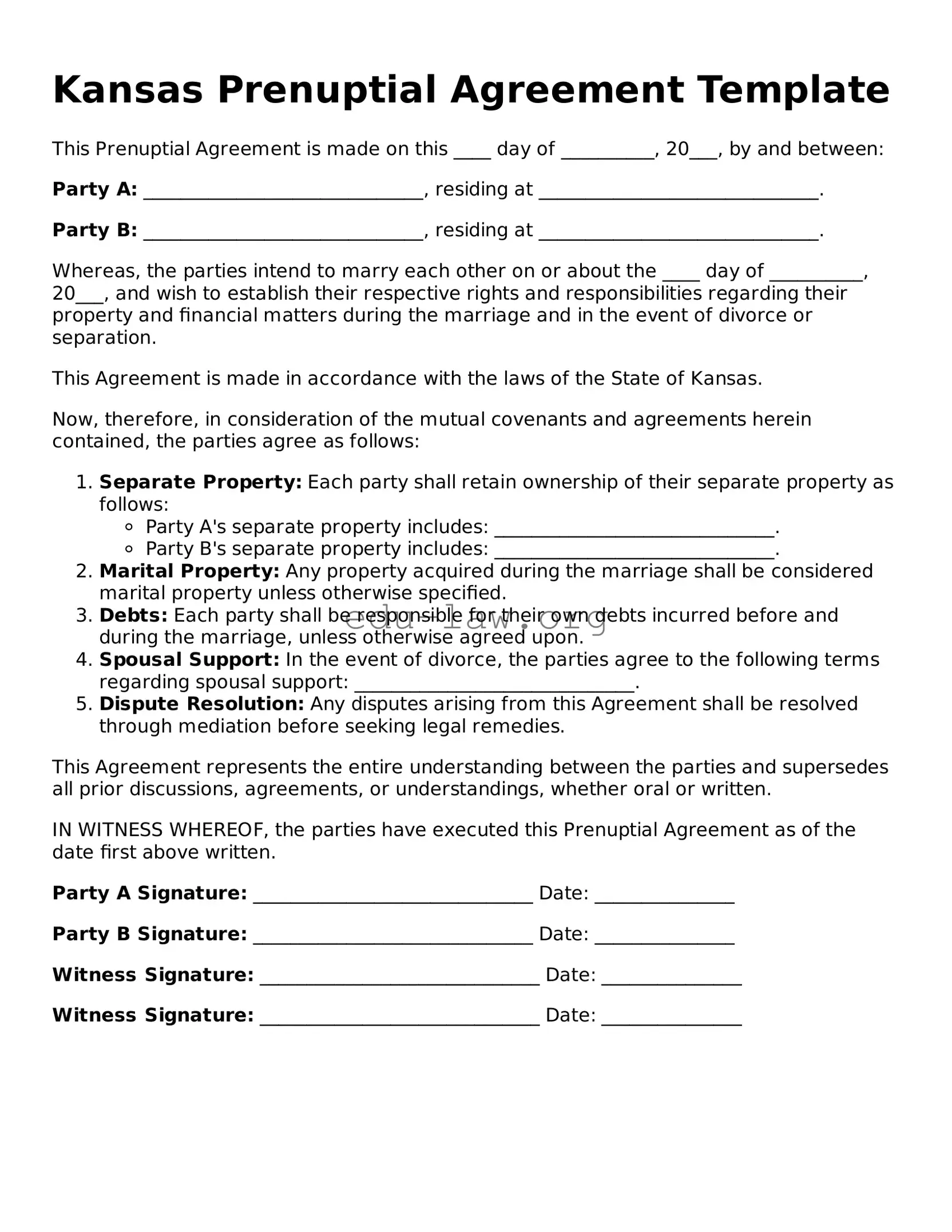
Kansas Prenuptial Agreement Template
This Prenuptial Agreement is made on this ____ day of __________, 20___, by and between:
Party A: ______________________________, residing at ______________________________.
Party B: ______________________________, residing at ______________________________.
Whereas, the parties intend to marry each other on or about the ____ day of __________, 20___, and wish to establish their respective rights and responsibilities regarding their property and financial matters during the marriage and in the event of divorce or separation.
This Agreement is made in accordance with the laws of the State of Kansas.
Now, therefore, in consideration of the mutual covenants and agreements herein contained, the parties agree as follows:
This Agreement represents the entire understanding between the parties and supersedes all prior discussions, agreements, or understandings, whether oral or written.
IN WITNESS WHEREOF, the parties have executed this Prenuptial Agreement as of the date first above written.
Party A Signature: ______________________________ Date: _______________
Party B Signature: ______________________________ Date: _______________
Witness Signature: ______________________________ Date: _______________
Witness Signature: ______________________________ Date: _______________
| Fact Name | Details |
|---|---|
| Governing Law | The Kansas Prenuptial Agreement is governed by Kansas Statutes Annotated, Chapter 23, Article 24. |
| Purpose | This agreement helps couples outline the division of assets and responsibilities in the event of divorce or separation. |
| Requirements | Both parties must voluntarily sign the agreement, and it should be in writing to be enforceable. |
| Disclosure | Full financial disclosure from both parties is recommended to ensure fairness and transparency. |
| Enforceability | A prenuptial agreement may be challenged in court if it is found to be unconscionable or signed under duress. |
| Modification | Changes to the agreement can be made at any time, but they must also be in writing and signed by both parties. |
Filling out a Kansas Prenuptial Agreement form is an important step for couples considering marriage. This document can help clarify financial arrangements and protect both parties' interests. Here’s how to complete the form correctly.
After completing the form, both parties should keep a copy for their records. It's advisable to consult with a legal professional to ensure everything is in order and complies with Kansas law.
What is a prenuptial agreement in Kansas?
A prenuptial agreement, often called a prenup, is a legal document that couples create before getting married. It outlines how assets and debts will be divided in the event of a divorce or separation. In Kansas, this agreement can also address spousal support and other financial matters. It helps provide clarity and security for both parties, ensuring that everyone understands their rights and obligations from the outset of the marriage.
Why should I consider a prenuptial agreement?
Many couples find that a prenuptial agreement offers peace of mind. If one or both partners have significant assets, debts, or children from previous relationships, a prenup can help protect those interests. It can also prevent potential disputes in the future, making the process of divorce less contentious. Ultimately, it allows couples to have open discussions about finances and expectations, fostering a stronger foundation for the marriage.
What should be included in a Kansas prenuptial agreement?
While every prenup can be tailored to the couple's unique situation, common elements include the identification of individual and joint assets, debt responsibilities, and provisions for spousal support. It’s also wise to address how property will be handled in the event of divorce or death. Including clauses for future financial changes or children can also be beneficial. The goal is to create a comprehensive document that reflects both partners' wishes.
Do I need a lawyer to create a prenuptial agreement in Kansas?
While it’s not legally required to have a lawyer draft your prenuptial agreement, it is highly recommended. A legal professional can help ensure that the agreement complies with Kansas laws and is enforceable in court. They can also provide valuable advice on what to include, helping to avoid potential pitfalls. Having independent legal counsel for both parties can also strengthen the agreement's validity.
Can a prenuptial agreement be changed after marriage?
Yes, a prenuptial agreement can be modified or revoked after marriage. However, both parties must agree to the changes, and it’s best to document these modifications in writing. Just like the original agreement, any changes should ideally be reviewed by legal professionals to ensure they are enforceable and reflect both parties' current intentions.
How is a prenuptial agreement enforced in Kansas?
For a prenuptial agreement to be enforceable in Kansas, it must meet certain legal standards. This includes being in writing, signed by both parties, and made voluntarily. It’s important that both individuals fully disclose their assets and debts when creating the agreement. If disputes arise, a court will evaluate the agreement based on its fairness and whether it was entered into without coercion.
What happens if we don’t have a prenuptial agreement?
If a couple does not have a prenuptial agreement in place and later divorces, Kansas law will dictate how assets and debts are divided. This may not align with either party’s wishes, potentially leading to disputes. Without a prenup, the court will consider factors such as the duration of the marriage and each spouse's contributions when making decisions about property division and spousal support. Having a prenup can provide clarity and prevent unwanted outcomes.
Not fully disclosing assets and debts: One of the most common mistakes is failing to provide a complete picture of financial situations. Both parties should list all assets and debts to ensure transparency.
Using vague language: Ambiguities can lead to misunderstandings. It's important to be clear and specific about the terms and conditions outlined in the agreement.
Not considering future changes: Life circumstances can change. Failing to include provisions for future income, property acquisitions, or children can create complications later.
Ignoring state laws: Each state has its own requirements for prenuptial agreements. Not adhering to Kansas laws can render the agreement unenforceable.
Not seeking legal advice: Some individuals attempt to fill out the form without consulting a lawyer. Legal guidance can help navigate complex issues and ensure the agreement is valid.
Failing to sign in front of witnesses: Proper execution of the agreement often requires signatures in the presence of witnesses. Neglecting this step can jeopardize the agreement's validity.
Not reviewing the agreement periodically: After the initial signing, it's crucial to revisit the agreement as life changes. Regular reviews can help keep the terms relevant and fair.
A prenuptial agreement is an important document for couples planning to marry. Along with this agreement, there are several other forms and documents that may be useful in the process of preparing for marriage and protecting individual interests. Below is a list of common documents often used alongside a Kansas Prenuptial Agreement.
Each of these documents plays a significant role in ensuring clarity and protection for both parties in a marriage. It’s advisable to consult with a legal professional when preparing these forms to ensure they meet all legal requirements and adequately reflect the couple's intentions.
The Kansas Prenuptial Agreement is similar to a Marital Settlement Agreement. Both documents serve to outline the division of assets and responsibilities between spouses, either before marriage or during a divorce. While a prenuptial agreement is created prior to marriage to establish terms in case of a divorce, a marital settlement agreement is typically executed during or after the dissolution of marriage. Both documents aim to clarify financial matters and protect individual interests.
Another similar document is the Postnuptial Agreement. Like a prenuptial agreement, a postnuptial agreement is a contract between spouses regarding the division of property and financial responsibilities. The key difference lies in timing; a postnuptial agreement is established after the marriage has taken place. Both agreements require full disclosure of assets and can help prevent disputes in the event of separation or divorce.
The Cohabitation Agreement also shares similarities with the Kansas Prenuptial Agreement. This document is designed for couples who live together but are not married. It outlines the rights and responsibilities of each partner regarding property and finances. Both agreements aim to protect individual interests and clarify expectations, although a cohabitation agreement is specifically tailored for unmarried couples.
A Property Settlement Agreement is another document that resembles a prenuptial agreement. This type of agreement is often utilized during divorce proceedings to determine how marital property will be divided. Like a prenuptial agreement, it aims to provide clarity and avoid future disputes. However, a property settlement agreement is executed after the marriage has ended, focusing on the distribution of assets rather than pre-marital arrangements.
The Separation Agreement is similar in function to a prenuptial agreement but is used when couples decide to live apart before finalizing a divorce. This document outlines how the couple will handle financial obligations, child custody, and property division during their separation. Both agreements seek to provide clarity and protect individual rights, though a separation agreement is typically temporary until a divorce is finalized.
An Estate Plan can also be compared to a prenuptial agreement, as both documents address the distribution of assets. An estate plan outlines how an individual’s assets will be managed and distributed after their death. While a prenuptial agreement focuses on asset division during a marriage or divorce, both documents aim to protect individual interests and ensure that wishes are respected.
The Non-Disclosure Agreement (NDA) bears some resemblance to a prenuptial agreement in that both can include clauses about confidentiality. An NDA is a legal contract that prevents one party from disclosing sensitive information shared between parties. In a prenuptial agreement, confidentiality clauses may protect financial information and personal matters from being disclosed during divorce proceedings, thus serving a similar protective purpose.
The Business Partnership Agreement can also be likened to a prenuptial agreement, especially for couples who run a business together. This document outlines each partner's roles, responsibilities, and how profits and losses will be shared. Both agreements aim to clarify expectations and protect individual interests, although a business partnership agreement focuses on professional relationships rather than personal ones.
Lastly, the Child Custody Agreement shares similarities with a prenuptial agreement in terms of establishing clear guidelines and expectations. While a prenuptial agreement addresses financial matters, a child custody agreement focuses on the upbringing and care of children in the event of a divorce. Both documents strive to provide clarity and prevent disputes, ensuring that the best interests of all parties involved are considered.
When filling out the Kansas Prenuptial Agreement form, it is important to approach the process carefully. Here are some guidelines to consider:
When it comes to prenuptial agreements in Kansas, there are several misconceptions that can lead to confusion. Understanding the facts can help couples make informed decisions. Here are nine common misconceptions:
Understanding these misconceptions can pave the way for more productive discussions about prenuptial agreements. Couples can approach the topic with confidence and clarity, ensuring that their agreement reflects their values and goals.
When considering a prenuptial agreement in Kansas, several important aspects should be understood to ensure the document serves its intended purpose effectively. Below are key takeaways regarding the completion and utilization of the Kansas Prenuptial Agreement form:
Understanding these key points can help individuals navigate the process of creating a prenuptial agreement in Kansas, ensuring that both parties are adequately informed and protected.