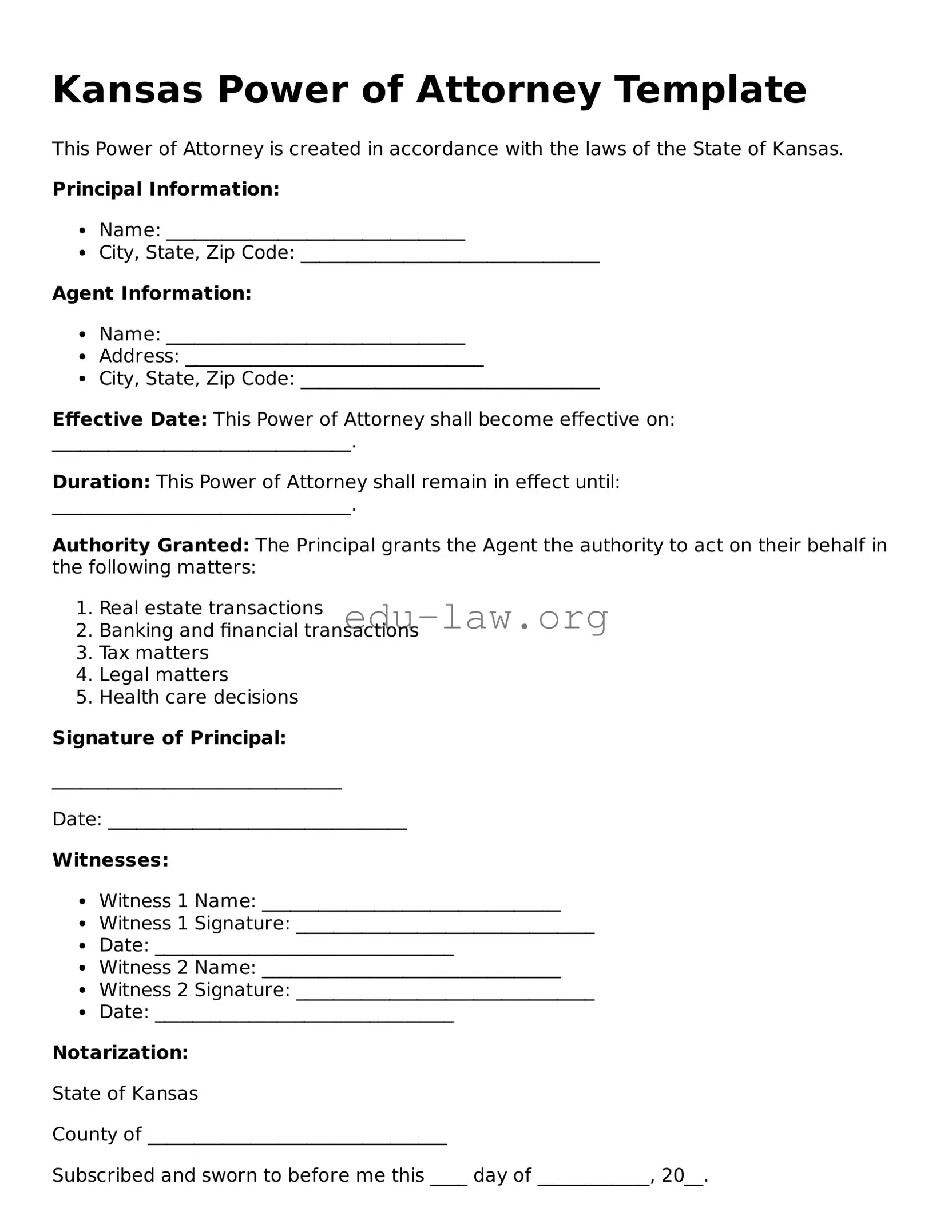
The Kansas Power of Attorney form serves as a crucial legal document that empowers individuals to designate someone else to make decisions on their behalf. This form can be particularly important in situations where a person may be unable to manage their own affairs due to illness, absence, or incapacity. It allows the appointed agent, also known as the attorney-in-fact, to handle various matters, including financial transactions, healthcare decisions, and property management. In Kansas, the form must be completed with specific requirements to ensure its validity, such as being signed by the principal and notarized. Understanding the nuances of this document is essential for anyone considering granting power of attorney, as it not only outlines the scope of authority granted but also includes provisions for revocation and limitations. By clarifying the responsibilities and powers of the agent, the Kansas Power of Attorney form helps individuals maintain control over their personal and financial affairs, even when they cannot actively participate in those decisions.
Kansas Power of Attorney Template
This Power of Attorney is created in accordance with the laws of the State of Kansas.
Principal Information:
Agent Information:
Effective Date: This Power of Attorney shall become effective on: ________________________________.
Duration: This Power of Attorney shall remain in effect until: ________________________________.
Authority Granted: The Principal grants the Agent the authority to act on their behalf in the following matters:
Signature of Principal:
_______________________________
Date: ________________________________
Witnesses:
Notarization:
State of Kansas
County of ________________________________
Subscribed and sworn to before me this ____ day of ____________, 20__.
_______________________________
Notary Public Signature
My commission expires: ________________________________
| Fact Name | Details |
|---|---|
| Definition | A Kansas Power of Attorney form allows a person to designate another individual to act on their behalf in financial or legal matters. |
| Governing Law | The Kansas Power of Attorney is governed by the Kansas Statutes Annotated, specifically K.S.A. 58-6501 et seq. |
| Types of Authority | The form can grant general or specific powers, allowing the agent to manage a wide range of tasks or limited duties. |
| Durability | A durable Power of Attorney remains effective even if the principal becomes incapacitated. |
| Agent's Responsibilities | The agent must act in the best interest of the principal and manage their affairs responsibly. |
| Signing Requirements | The form must be signed by the principal and notarized to be legally valid in Kansas. |
| Revocation | The principal can revoke the Power of Attorney at any time, as long as they are competent to do so. |
| Limitations | Some actions, like making a will or certain health care decisions, cannot be delegated through this form. |
Filling out the Kansas Power of Attorney form is an important step in ensuring that your financial and legal matters can be managed by someone you trust in case you are unable to do so yourself. Once you have completed the form, it will need to be signed and notarized to be legally valid. Below are the steps to guide you through the process of filling out the form.
What is a Power of Attorney in Kansas?
A Power of Attorney (POA) in Kansas is a legal document that allows one person to authorize another person to act on their behalf in various matters. This can include financial decisions, medical choices, and other legal actions. The person granting the authority is known as the principal, while the person receiving it is called the agent or attorney-in-fact. It is essential to choose someone you trust, as they will have significant control over your affairs.
What types of Power of Attorney are available in Kansas?
Kansas recognizes several types of Power of Attorney, including Durable Power of Attorney, Medical Power of Attorney, and Limited Power of Attorney. A Durable Power of Attorney remains effective even if the principal becomes incapacitated. In contrast, a Medical Power of Attorney specifically allows the agent to make healthcare decisions when the principal is unable to do so. A Limited Power of Attorney grants authority for specific tasks or for a limited period, making it a flexible option for particular situations.
How do I create a Power of Attorney in Kansas?
To create a Power of Attorney in Kansas, you need to fill out the appropriate form, which can be obtained from various sources, including legal websites and local government offices. The form must be signed by the principal in the presence of a notary public. It’s important to ensure that the document clearly outlines the powers being granted and any limitations. Once completed, the Power of Attorney should be shared with the agent and any relevant institutions, such as banks or healthcare providers.
Can I revoke a Power of Attorney in Kansas?
Yes, you can revoke a Power of Attorney in Kansas at any time, as long as you are mentally competent. To do this, you should create a written revocation document that states your intention to cancel the existing Power of Attorney. It’s advisable to notify the agent and any institutions that were relying on the original document. Keeping a copy of the revocation for your records is also a good practice to avoid any confusion in the future.
Not Specifying Powers Clearly: One common mistake is failing to clearly outline the powers granted to the agent. Individuals may use vague language or leave sections blank, which can lead to confusion about what the agent is authorized to do.
Neglecting to Date the Document: Another frequent error involves forgetting to date the Power of Attorney form. A lack of a date can raise questions about the validity of the document, especially if there are disputes about when the powers were intended to take effect.
Inadequate Witness or Notary Requirements: Many people overlook the necessity of having the document properly witnessed or notarized. In Kansas, specific rules dictate how many witnesses are required, and failing to adhere to these can invalidate the Power of Attorney.
Not Reviewing for Updates: Lastly, individuals often forget to review and update their Power of Attorney when significant life changes occur, such as marriage, divorce, or the birth of a child. An outdated document may not reflect current wishes or circumstances.
When preparing a Kansas Power of Attorney, several other forms and documents may be useful to ensure comprehensive coverage of your legal needs. Below is a list of common documents that often accompany the Power of Attorney form. Each document serves a specific purpose and can help clarify intentions and responsibilities.
Each of these documents can play a crucial role in ensuring that your wishes are respected and that your affairs are managed according to your preferences. It is advisable to consider these forms carefully when preparing your Power of Attorney.
The Kansas Power of Attorney form shares similarities with the General Power of Attorney. Both documents grant an individual the authority to act on behalf of another person in various matters, including financial and legal decisions. The General Power of Attorney is broad in scope, allowing the agent to manage a wide range of affairs. In Kansas, this document can be tailored to specific needs, just like the Kansas Power of Attorney, which can be limited to certain tasks or decisions.
Another document akin to the Kansas Power of Attorney is the Durable Power of Attorney. This form remains effective even if the principal becomes incapacitated, ensuring that the agent can continue to make decisions on behalf of the principal. The Kansas Power of Attorney can also be made durable, providing similar protections. Both documents emphasize the importance of having a trusted individual in charge during times of incapacity.
The Medical Power of Attorney is another related document. This form specifically allows an agent to make healthcare decisions for the principal when they are unable to do so. While the Kansas Power of Attorney primarily focuses on financial and legal matters, it can also include healthcare provisions. Thus, both documents serve to empower individuals to make critical decisions on behalf of someone else, ensuring that their wishes are respected.
A Living Will is similar to the Kansas Power of Attorney in that it addresses end-of-life decisions. While the Kansas Power of Attorney appoints someone to make decisions, a Living Will outlines the principal's wishes regarding medical treatment in specific situations. Both documents are essential for ensuring that personal preferences are honored when individuals cannot communicate them directly.
The Revocable Trust shares similarities with the Kansas Power of Attorney in terms of managing assets. A Revocable Trust allows individuals to place their assets in a trust, which can be managed by a trustee. If the individual becomes incapacitated, the trustee can continue to manage the assets without the need for a court-appointed guardian. Like the Kansas Power of Attorney, this document provides a way to ensure that financial matters are handled according to the principal’s wishes.
Finally, the Advance Directive is another document that parallels the Kansas Power of Attorney. An Advance Directive combines elements of a Living Will and a Medical Power of Attorney, allowing individuals to express their healthcare preferences and appoint someone to make decisions for them. Both documents are crucial for planning ahead and ensuring that a person’s values and wishes are respected in medical situations.
When filling out the Kansas Power of Attorney form, it is crucial to follow certain guidelines to ensure the document is valid and effective. Here are eight important dos and don'ts to keep in mind:
The Kansas Power of Attorney form is an important legal document that allows individuals to appoint someone to make decisions on their behalf. However, several misconceptions exist about this form. Here are four common misunderstandings:
Many people believe that a Power of Attorney is only necessary for seniors. In reality, anyone can benefit from having this document, especially if they anticipate needing assistance with financial or medical decisions.
Some think that granting a Power of Attorney means the agent has unlimited power. However, the document can be tailored to specify the extent of authority granted, allowing individuals to maintain control over their decisions.
There is a belief that once a Power of Attorney is signed, it cannot be changed. In fact, individuals can revoke or modify the document at any time, as long as they are mentally competent.
While legal assistance can be helpful, it is not necessary to have a lawyer draft a Power of Attorney. Many resources are available that provide templates and guidance for individuals who wish to create their own document.
Understanding these misconceptions can help individuals make informed decisions about their legal needs and ensure they have the appropriate documents in place.
Filling out and using the Kansas Power of Attorney form is an important step for anyone looking to grant someone else the authority to act on their behalf. Here are some key takeaways to keep in mind:
By keeping these key points in mind, you can effectively utilize the Kansas Power of Attorney form to ensure your affairs are managed according to your wishes.