When it comes to ensuring the well-being of a child, having the right legal tools in place is essential. The Kansas Power of Attorney for a Child form serves as a vital document that allows a parent or legal guardian to designate another individual to make decisions on behalf of their child. This form is particularly useful in situations where the parent cannot be present, such as during travel or extended absences. Key aspects of the form include the ability to grant authority for medical care, educational decisions, and other important matters affecting the child's welfare. It is designed to be straightforward, ensuring that caregivers can step in seamlessly when needed. By clearly outlining the powers granted, this form helps prevent confusion and ensures that the child’s needs are met promptly and effectively. Understanding how to properly complete and utilize this document can provide peace of mind for parents and guardians alike.
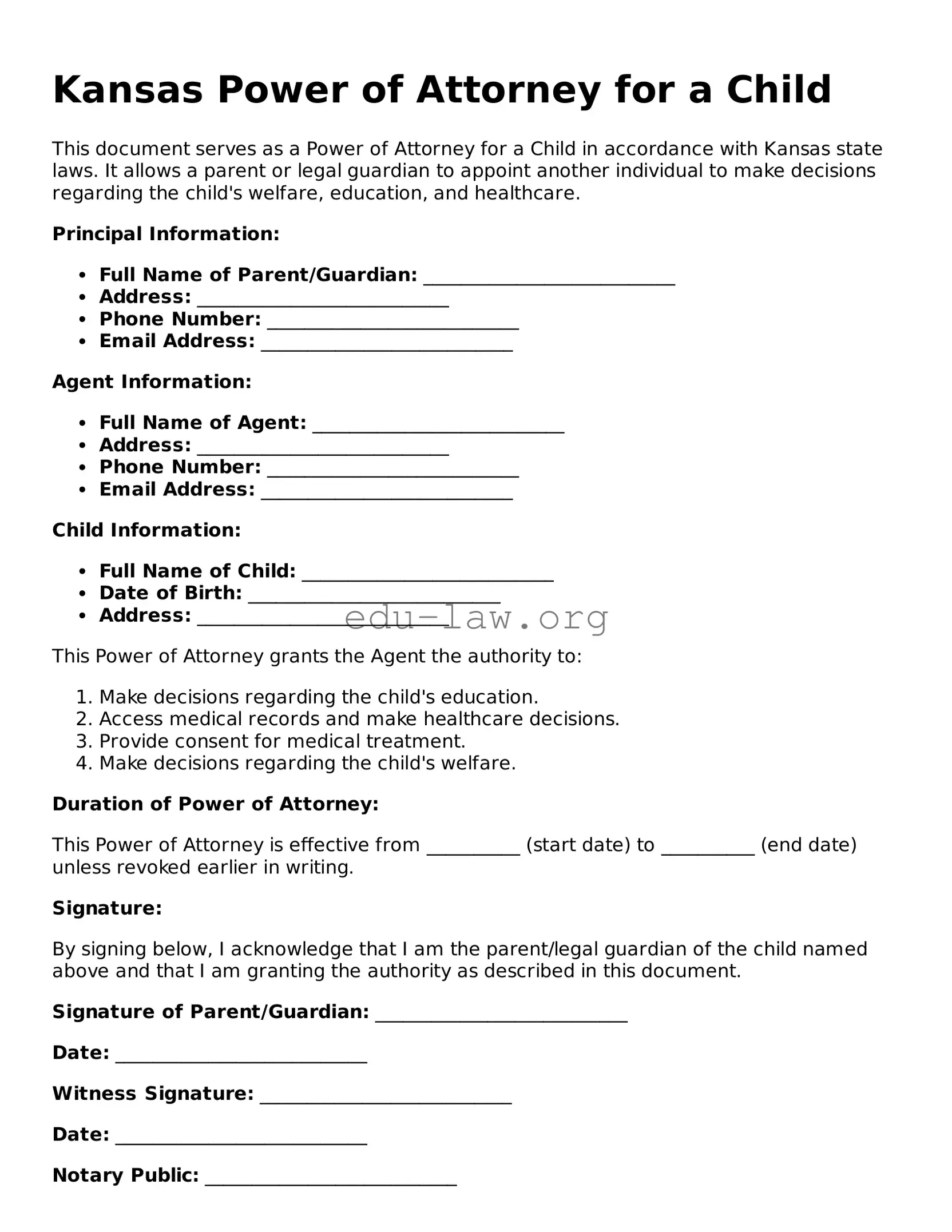
Kansas Power of Attorney for a Child
This document serves as a Power of Attorney for a Child in accordance with Kansas state laws. It allows a parent or legal guardian to appoint another individual to make decisions regarding the child's welfare, education, and healthcare.
Principal Information:
Agent Information:
Child Information:
This Power of Attorney grants the Agent the authority to:
Duration of Power of Attorney:
This Power of Attorney is effective from __________ (start date) to __________ (end date) unless revoked earlier in writing.
Signature:
By signing below, I acknowledge that I am the parent/legal guardian of the child named above and that I am granting the authority as described in this document.
Signature of Parent/Guardian: ___________________________
Date: ___________________________
Witness Signature: ___________________________
Date: ___________________________
Notary Public: ___________________________
Date: ___________________________
| Fact Name | Description |
|---|---|
| Purpose | The Kansas Power of Attorney for a Child form allows a parent or legal guardian to delegate authority to another adult to make decisions for their child. |
| Governing Law | This form is governed by Kansas Statutes Annotated, Chapter 38, Article 2201. |
| Duration | The authority granted can be temporary or permanent, depending on the parent's wishes and the specified terms in the form. |
| Eligibility | Only a parent or legal guardian may complete this form to delegate authority to another adult. |
| Scope of Authority | The form can grant authority for medical decisions, educational matters, and general care, depending on what is specified. |
| Revocation | A parent can revoke the Power of Attorney at any time by providing written notice to the designated agent. |
| Notarization | The form must be signed in the presence of a notary public to be legally valid. |
| Limitations | This form does not allow the agent to make decisions regarding the child's adoption or to consent to marriage. |
After obtaining the Kansas Power of Attorney for a Child form, you will need to complete it carefully. This form allows a parent or legal guardian to designate another adult to make decisions regarding the care and custody of their child. Follow the steps below to fill out the form accurately.
Once you have completed the form, ensure that all information is accurate and legible. Keep a copy for your records and provide the designated individual with their copy. This will help facilitate any necessary decisions regarding the child’s care.
What is a Kansas Power of Attorney for a Child form?
The Kansas Power of Attorney for a Child form is a legal document that allows a parent or guardian to grant another adult the authority to make decisions on behalf of their child. This can include decisions about education, healthcare, and general welfare. It is often used when parents are temporarily unavailable, such as during travel or medical emergencies.
Who can be appointed as an agent in the Power of Attorney for a Child?
Any responsible adult can be appointed as an agent. This could be a relative, family friend, or neighbor. However, it is crucial to choose someone trustworthy and capable of making decisions in the best interest of the child.
How long is the Power of Attorney for a Child valid?
The validity of the Power of Attorney for a Child can vary based on the specific terms outlined in the document. Generally, it remains in effect until the specified end date, the parent revokes it, or the child reaches the age of majority, which is 18 in Kansas.
Do I need to have the Power of Attorney for a Child form notarized?
Yes, the form must be notarized to be legally valid in Kansas. This means that a notary public must witness the signing of the document. This step helps to ensure that the form is executed properly and can help prevent disputes regarding its validity.
Can I revoke the Power of Attorney for a Child once it is signed?
Yes, you can revoke the Power of Attorney at any time as long as you are of sound mind. To do this, you should provide a written notice of revocation to the agent and any relevant parties. It's also a good idea to notify any institutions or agencies that may have received the original document.
What happens if the agent cannot fulfill their duties?
If the appointed agent is unable to fulfill their responsibilities, the Power of Attorney may include provisions for an alternate agent. If no alternate is named, or if both the primary and alternate agents are unavailable, the parent may need to appoint a new agent through a new Power of Attorney form.
Is legal advice recommended when creating a Power of Attorney for a Child?
While it is not strictly necessary to seek legal advice, it is highly recommended. A legal professional can help ensure that the document meets all legal requirements and adequately reflects your wishes. This can provide peace of mind and help avoid potential issues in the future.
Failing to provide complete information about the child. Ensure that the child's full name, date of birth, and address are accurately filled in.
Not specifying the powers granted. Clearly outline what decisions the agent can make on behalf of the child, such as medical or educational decisions.
Overlooking the necessity of signatures. Both the parent and the agent must sign the document for it to be valid.
Neglecting to date the form. Without a date, it may lead to confusion regarding the validity of the Power of Attorney.
Using unclear language. Avoid vague terms; instead, use straightforward language to prevent misunderstandings.
Not considering the duration of the Power of Attorney. Specify how long the authority will last, whether it’s for a specific period or until revoked.
Failing to keep copies of the completed form. Retain copies for both the parent and the agent to ensure everyone has access to the document.
When creating a Power of Attorney for a Child in Kansas, it is often helpful to have additional documents ready. These forms can provide clarity and support to the authority granted to the agent. Below are some commonly used forms and documents that may accompany the Power of Attorney for a Child.
Having these documents prepared alongside the Power of Attorney for a Child can help ensure that all aspects of the child's care and well-being are covered. This proactive approach can ease potential challenges and provide peace of mind for both the child and the agent.
The Kansas Power of Attorney for a Child form shares similarities with the General Power of Attorney. Both documents allow an individual to appoint another person to make decisions on their behalf. In the case of the General Power of Attorney, this authority can extend to a wide range of decisions, including financial and legal matters. However, the Kansas Power of Attorney for a Child specifically focuses on the care and welfare of a minor, making it more tailored to parenting and guardianship issues.
Another document that is comparable is the Medical Power of Attorney. This form grants an agent the authority to make healthcare decisions for another person. Like the Power of Attorney for a Child, the Medical Power of Attorney can be crucial in emergencies when the individual is unable to communicate their wishes. However, the Medical Power of Attorney is limited to healthcare decisions, while the Kansas Power of Attorney for a Child encompasses broader aspects of a child's upbringing.
The Guardianship Agreement is also similar, as it establishes a legal relationship where one person is given the authority to care for another. In this case, the Kansas Power of Attorney for a Child allows a parent to designate someone to make decisions temporarily, whereas a Guardianship Agreement often involves a court process and grants more permanent authority over a child’s care and welfare.
The Child Custody Agreement is another relevant document. This agreement outlines the arrangements for the care and control of a child following a divorce or separation. While the Kansas Power of Attorney for a Child allows for temporary decision-making authority, a Child Custody Agreement addresses long-term living arrangements and parental responsibilities, often involving legal proceedings.
The Adoption Agreement is similar in that it involves the legal transfer of parental rights. Both documents deal with the welfare of a child, but the Kansas Power of Attorney for a Child is typically temporary and does not sever the biological parent's rights. In contrast, an Adoption Agreement permanently transfers those rights to the adoptive parents.
The Affidavit of Support can also be compared to the Kansas Power of Attorney for a Child. This document is often used in immigration contexts, where one individual agrees to financially support another. While both forms establish responsibilities, the Affidavit of Support focuses on financial obligations, whereas the Power of Attorney for a Child emphasizes caregiving and decision-making authority.
Lastly, the Caregiver Authorization Affidavit is similar in its purpose to allow someone other than a parent to make decisions for a child. This document is often used in situations where a child is being cared for by relatives or friends. Like the Kansas Power of Attorney for a Child, it enables caregivers to access medical care and make educational decisions, but it may not provide the same breadth of authority as a Power of Attorney.
When filling out the Kansas Power of Attorney for a Child form, it’s important to follow some key guidelines. Here’s a list of what to do and what to avoid:
Following these guidelines will help ensure that the form is completed correctly and serves its intended purpose.
When it comes to the Kansas Power of Attorney for a Child form, misunderstandings can lead to confusion and complications. Here are six common misconceptions:
Understanding these misconceptions can help ensure that the power of attorney is used effectively and appropriately for the benefit of the child involved.
Filling out and using the Kansas Power of Attorney for a Child form can seem daunting, but it’s a straightforward process that can provide peace of mind. Here are some key takeaways to keep in mind:
Using the Kansas Power of Attorney for a Child form can simplify childcare arrangements during emergencies or extended absences. By following these key takeaways, you can ensure that your child's well-being is always prioritized.