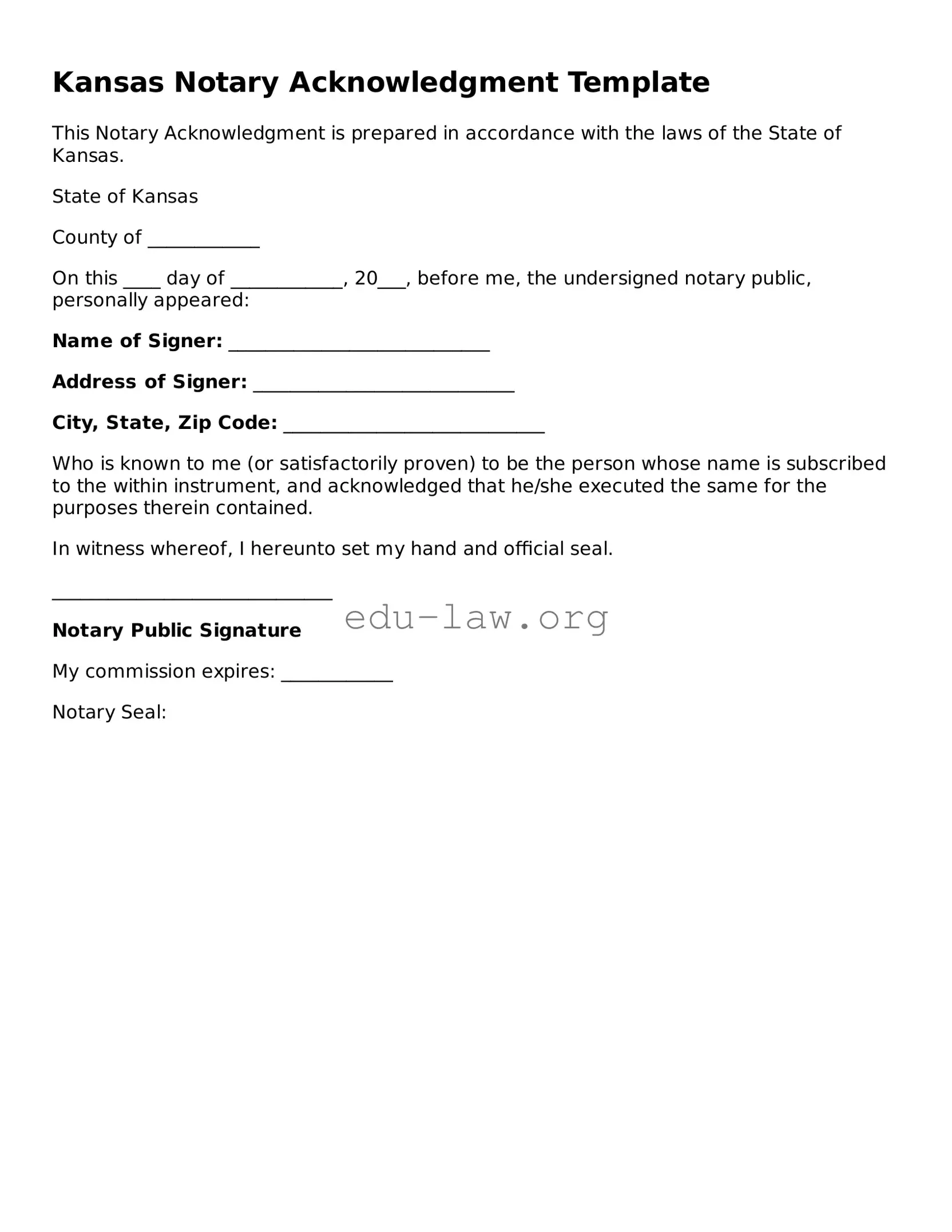
The Kansas Notary Acknowledgement form plays a crucial role in the notarization process, ensuring that documents are legally recognized and can be trusted. This form is used when a notary public verifies the identity of a signer and confirms that they have willingly signed a document. Typically, it includes essential details such as the name of the signer, the date of signing, and the notary's information. The form also requires the notary's signature and seal, which add an extra layer of authenticity. Understanding the significance of this form is vital for anyone involved in legal transactions, as it helps prevent fraud and ensures that documents are executed correctly. Whether you're a business owner, a homeowner, or an individual needing to authenticate important papers, knowing how to properly complete and utilize the Kansas Notary Acknowledgement form can streamline your process and provide peace of mind.
Kansas Notary Acknowledgment Template
This Notary Acknowledgment is prepared in accordance with the laws of the State of Kansas.
State of Kansas
County of ____________
On this ____ day of ____________, 20___, before me, the undersigned notary public, personally appeared:
Name of Signer: ____________________________
Address of Signer: ____________________________
City, State, Zip Code: ____________________________
Who is known to me (or satisfactorily proven) to be the person whose name is subscribed to the within instrument, and acknowledged that he/she executed the same for the purposes therein contained.
In witness whereof, I hereunto set my hand and official seal.
______________________________
Notary Public Signature
My commission expires: ____________
Notary Seal:
| Fact Name | Description |
|---|---|
| Purpose | The Kansas Notary Acknowledgement form is used to verify the identity of individuals signing a document and to confirm that they did so willingly. |
| Governing Law | This form is governed by the Kansas Statutes Annotated, specifically K.S.A. 53-501 through K.S.A. 53-506, which outline the requirements for notarization in the state. |
| Signature Requirement | Individuals must sign the document in the presence of a notary public for the acknowledgment to be valid. |
| Notary's Role | The notary public must complete the form by providing their signature, seal, and the date of notarization, ensuring the document is officially acknowledged. |
Once you have the Kansas Notary Acknowledgement form in hand, you’ll need to fill it out carefully. This form is essential for verifying the identity of the signer and ensuring that the document is executed properly. Follow these steps to complete the form accurately.
Make sure all information is accurate before submitting the form. Double-checking helps prevent any issues down the line.
What is a Kansas Notary Acknowledgement form?
The Kansas Notary Acknowledgement form is a legal document used to verify that a person has signed a document willingly and in the presence of a notary public. This form serves to confirm the identity of the signer and ensures that they understand the contents of the document they are signing. It is often used for deeds, contracts, and other important legal documents.
Who can act as a notary public in Kansas?
In Kansas, a notary public must be at least 18 years old, a resident of the state, and possess the ability to read and write English. Notaries are appointed by the Secretary of State and must complete a training program. They are authorized to perform notarial acts, including taking acknowledgments, administering oaths, and witnessing signatures.
How do I complete a Kansas Notary Acknowledgement form?
To complete the form, the signer must appear before the notary public. The notary will ask the signer to provide identification to confirm their identity. After verifying the identity, the notary will fill out the form, including details such as the date, the name of the signer, and the type of document being acknowledged. The signer will then sign the form in the notary's presence.
Is a Kansas Notary Acknowledgement form required for all documents?
No, a Notary Acknowledgement form is not required for every document. However, it is often necessary for documents that need to be recorded with a government office, such as property deeds or certain legal agreements. Always check the specific requirements for the type of document you are preparing.
What happens if the notary makes a mistake on the form?
If a notary makes an error on the acknowledgement form, it can lead to complications. The notary should correct the mistake immediately, if possible, and initial the correction. In some cases, it may be necessary to redo the acknowledgement entirely. Notaries are responsible for maintaining accurate records, so any errors should be addressed promptly to avoid legal issues.
How long is a Kansas Notary Acknowledgement form valid?
The validity of a Kansas Notary Acknowledgement form generally depends on the document it accompanies. The acknowledgment itself does not expire; however, the underlying document may have its own validity period. It is essential to ensure that the document is executed within the appropriate time frame to maintain its legal standing.
Failing to include the date of the acknowledgment. The date is crucial as it establishes when the notary performed the acknowledgment.
Not providing the signer's name clearly. The name should match the identification presented to the notary to avoid any discrepancies.
Leaving out the notary's signature. This is essential for validating the acknowledgment. Without it, the document may be considered incomplete.
Using an incorrect notary seal. The seal must be legible and contain the required information, including the notary's name and commission number.
Not specifying the type of document being acknowledged. Clarity about the document helps establish the context of the acknowledgment.
Failing to indicate whether the signer is acting in their individual capacity or on behalf of another entity. This distinction can affect the legal standing of the document.
Overlooking the jurisdiction where the acknowledgment takes place. This information is necessary to ensure the acknowledgment is valid in the relevant legal context.
When engaging in various legal and business transactions, individuals often encounter the Kansas Notary Acknowledgement form. This form serves to verify the identity of the signers and confirms that they willingly signed the document in question. However, several other forms and documents may accompany it to ensure that the transaction is complete and legally sound. Below is a list of common documents that are frequently used alongside the Kansas Notary Acknowledgement form.
Each of these documents plays a crucial role in ensuring that legal transactions are clear and enforceable. When used together with the Kansas Notary Acknowledgement form, they help create a comprehensive legal framework that protects the interests of all parties involved.
The Kansas Notary Acknowledgment form shares similarities with the Affidavit. An affidavit is a written statement confirmed by oath or affirmation, often used as evidence in court. Like the notary acknowledgment, it requires a notary public to witness the signing of the document. Both forms serve to verify the identity of the signer and ensure that the document is executed voluntarily. They provide a level of assurance that the information contained within is truthful, as the signer is legally bound by their statements.
Another document akin to the Kansas Notary Acknowledgment is the Power of Attorney (POA). A Power of Attorney grants one person the authority to act on behalf of another in legal or financial matters. Similar to the notary acknowledgment, the signing of a POA must be notarized to ensure its validity. This notarization process helps prevent fraud and confirms that the person granting the authority understands the implications of their decision, just as the acknowledgment form verifies the signer’s intent and understanding.
The Deed is also comparable to the Kansas Notary Acknowledgment form. A deed is a legal document that signifies the transfer of property ownership. Like the acknowledgment form, a deed must be signed in the presence of a notary public to be considered valid. The notary’s role is to confirm the identity of the parties involved and ensure that they are signing the document willingly. This process is crucial for maintaining the integrity of property transactions and protecting the rights of all parties involved.
Additionally, the Certificate of Acknowledgment bears resemblance to the Kansas Notary Acknowledgment form. This certificate is often attached to various legal documents to confirm that a notary has verified the identity of the signer. Both documents serve the purpose of establishing authenticity and ensuring that the signatures are legitimate. The certificate provides a formal record that the notary has performed their duties, much like the acknowledgment form affirms the signer’s identity and intent.
Lastly, the Jurat is another document that shares characteristics with the Kansas Notary Acknowledgment. A jurat is a certification that a signer has sworn to the truthfulness of the contents of a document in front of a notary public. While the acknowledgment focuses on verifying the identity and intent of the signer, the jurat emphasizes the truthfulness of the statements made. Both require the presence of a notary, ensuring that the signing process is conducted properly and legally.
When completing the Kansas Notary Acknowledgement form, it is essential to follow specific guidelines to ensure accuracy and compliance. Below is a list of things you should and shouldn't do.
Following these guidelines will help ensure that the notary acknowledgment is valid and enforceable. Take the time to review the form carefully before submission.
Understanding the Kansas Notary Acknowledgement form is important for anyone involved in legal documents. However, there are several misconceptions that can lead to confusion. Here are five common misconceptions:
By understanding these misconceptions, individuals can navigate the notary process more effectively and ensure their documents are handled correctly.
When it comes to filling out and using the Kansas Notary Acknowledgement form, there are several important points to keep in mind. Here are some key takeaways:
By following these guidelines, you can ensure that the Kansas Notary Acknowledgement form is filled out correctly and serves its intended purpose.