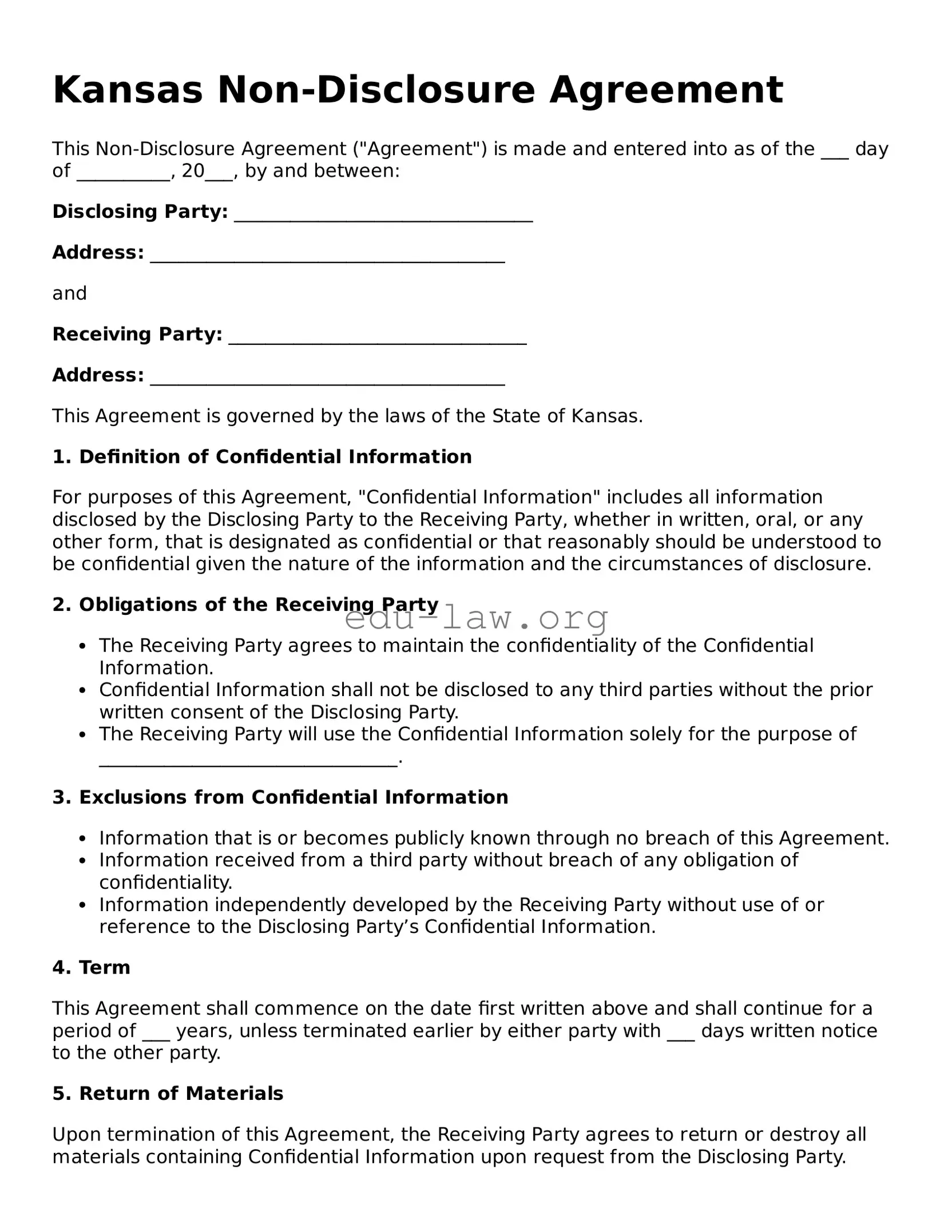
The Kansas Non-disclosure Agreement (NDA) form serves as a crucial legal tool for individuals and businesses seeking to protect sensitive information from unauthorized disclosure. This document outlines the obligations of the parties involved, ensuring that confidential information remains secure. Typically, the NDA specifies what constitutes confidential information, the duration of the agreement, and the consequences for breach of contract. By establishing clear guidelines, the form helps foster trust between parties while safeguarding trade secrets, proprietary data, and other sensitive materials. Whether used in employment settings, business negotiations, or collaborative projects, the Kansas NDA is essential for maintaining confidentiality and promoting a secure environment for sharing valuable information.
Kansas Non-Disclosure Agreement
This Non-Disclosure Agreement ("Agreement") is made and entered into as of the ___ day of __________, 20___, by and between:
Disclosing Party: ________________________________
Address: ______________________________________
and
Receiving Party: ________________________________
Address: ______________________________________
This Agreement is governed by the laws of the State of Kansas.
1. Definition of Confidential Information
For purposes of this Agreement, "Confidential Information" includes all information disclosed by the Disclosing Party to the Receiving Party, whether in written, oral, or any other form, that is designated as confidential or that reasonably should be understood to be confidential given the nature of the information and the circumstances of disclosure.
2. Obligations of the Receiving Party
3. Exclusions from Confidential Information
4. Term
This Agreement shall commence on the date first written above and shall continue for a period of ___ years, unless terminated earlier by either party with ___ days written notice to the other party.
5. Return of Materials
Upon termination of this Agreement, the Receiving Party agrees to return or destroy all materials containing Confidential Information upon request from the Disclosing Party.
6. Miscellaneous
IN WITNESS WHEREOF, the parties hereto have executed this Non-Disclosure Agreement as of the date first above written.
Disclosing Party Signature: ________________________________
Date: ________________________________
Receiving Party Signature: ________________________________
Date: ________________________________
| Fact Name | Details |
|---|---|
| Definition | A Kansas Non-disclosure Agreement (NDA) is a legal contract that protects confidential information shared between parties. |
| Purpose | The primary purpose of an NDA is to prevent the unauthorized disclosure of sensitive information. |
| Governing Law | The NDA is governed by the laws of the State of Kansas. |
| Parties Involved | Typically, the agreement involves at least two parties: the disclosing party and the receiving party. |
| Duration | The duration of confidentiality obligations can vary, often lasting several years or until the information becomes public. |
| Enforceability | For an NDA to be enforceable, it must be clear, reasonable, and not overly broad in its restrictions. |
| Consequences of Breach | Violating the terms of an NDA can lead to legal action, including potential damages and injunctions. |
After obtaining the Kansas Non-disclosure Agreement form, you will need to complete it accurately. This process involves providing specific information and ensuring that all sections are filled out correctly. Once completed, the form will be ready for signatures and further action.
What is a Kansas Non-disclosure Agreement (NDA)?
A Kansas Non-disclosure Agreement is a legal document that helps protect confidential information shared between parties. This agreement ensures that sensitive information, such as business plans, trade secrets, or proprietary data, remains private. Both parties agree not to disclose this information to unauthorized individuals or entities.
Who should use a Non-disclosure Agreement in Kansas?
Any individual or business that plans to share confidential information with another party should consider using an NDA. This includes entrepreneurs sharing ideas with potential investors, businesses discussing partnerships, or employees accessing sensitive company information. Using an NDA helps establish trust and protects valuable information.
What are the key components of a Kansas Non-disclosure Agreement?
An effective NDA typically includes the following components: a clear definition of what constitutes confidential information, the obligations of both parties regarding the information, the duration of confidentiality, and any exclusions from confidentiality. It may also outline the consequences of breaching the agreement. Each of these elements plays a crucial role in ensuring both parties understand their responsibilities.
How long does the confidentiality obligation last?
The duration of the confidentiality obligation can vary based on the specific terms outlined in the NDA. Generally, this period can range from a few years to indefinitely, depending on the nature of the information shared. It's important for both parties to agree on a timeframe that protects their interests while being reasonable.
What happens if someone breaches the Non-disclosure Agreement?
If a party breaches the NDA, the other party may have the right to seek legal remedies. This could include monetary damages or injunctive relief, which is a court order to stop the disclosing party from further sharing the confidential information. The specific consequences will depend on the terms of the NDA and the severity of the breach.
Failing to provide complete contact information. Make sure to include full names, addresses, and phone numbers for all parties involved.
Not specifying the purpose of the disclosure. Clearly state why the information is being shared to avoid confusion later.
Using vague language. Be precise in your wording to ensure that all parties understand their obligations.
Overlooking the definition of confidential information. Clearly define what constitutes confidential information to prevent misunderstandings.
Neglecting to include the duration of confidentiality. Specify how long the information must remain confidential.
Not addressing the consequences of breach. Outline the potential repercussions for failing to uphold the agreement.
Forgetting to include all parties involved. Ensure that everyone who will have access to the confidential information is listed in the agreement.
Failing to date the agreement. A date is essential for establishing the timeline of the agreement.
Not obtaining signatures from all parties. All involved parties must sign the agreement to make it valid.
Ignoring state-specific requirements. Familiarize yourself with any unique provisions or regulations that apply to Kansas.
When entering into a Non-disclosure Agreement (NDA) in Kansas, it is often beneficial to accompany it with other important documents. These forms can provide additional clarity and legal protection for all parties involved. Below is a list of commonly used documents that can enhance the effectiveness of an NDA.
Using these documents in conjunction with a Kansas Non-disclosure Agreement can provide a comprehensive approach to protecting sensitive information. Each document serves a unique purpose, ensuring that all parties are on the same page and that their interests are safeguarded.
The Kansas Non-Disclosure Agreement (NDA) shares similarities with the Confidentiality Agreement. Both documents aim to protect sensitive information from being disclosed to unauthorized parties. They establish a legal obligation for the receiving party to keep information private, thus fostering trust in business relationships. The terms and conditions outlined in both agreements typically cover the definition of confidential information, the obligations of the parties, and the duration of confidentiality.
Another document akin to the Kansas NDA is the Proprietary Information Agreement. This agreement specifically focuses on protecting proprietary information, which is often a subset of confidential information. It emphasizes the importance of safeguarding intellectual property and trade secrets. Like the NDA, it includes clauses that define what constitutes proprietary information and the responsibilities of the parties involved.
The Mutual Non-Disclosure Agreement (MNDA) is also comparable to the Kansas NDA. Unlike a standard NDA, which typically involves one party disclosing information to another, an MNDA allows both parties to share confidential information with each other. This document is particularly useful in collaborative projects where both sides need to protect their respective sensitive data.
A License Agreement often overlaps with the Kansas NDA in terms of confidentiality. While primarily focused on granting permission to use intellectual property, it usually contains clauses that require both parties to maintain confidentiality regarding the licensed material. This ensures that sensitive information related to the intellectual property remains protected throughout the licensing period.
The Employment Confidentiality Agreement is another document similar to the Kansas NDA. Employers often require employees to sign this agreement to protect sensitive business information they may access during their employment. It outlines the employee's obligation to keep company secrets confidential, even after their employment ends, mirroring the protective nature of the NDA.
The Non-Circumvention Agreement can also be likened to the Kansas NDA. This document prevents one party from bypassing the other to engage directly with a third party, often in business dealings. While its primary focus is on preventing circumvention, it frequently includes confidentiality provisions to protect sensitive information shared during negotiations.
Lastly, the Joint Venture Agreement may resemble the Kansas NDA in certain aspects. When two or more parties collaborate on a project, they often share confidential information. This agreement typically includes confidentiality clauses to ensure that sensitive data exchanged during the venture is kept private, similar to the protections offered by a standard NDA.
When filling out the Kansas Non-disclosure Agreement form, it is important to follow certain guidelines to ensure everything is completed correctly. Here are some things you should and shouldn't do:
By following these guidelines, you can help ensure that the Non-disclosure Agreement is filled out properly. This will protect your interests and those of the other party involved.
Here are seven common misconceptions about the Kansas Non-disclosure Agreement (NDA) form, along with explanations to clarify each point:
When filling out and using the Kansas Non-disclosure Agreement (NDA) form, it is important to keep several key points in mind. This will help ensure that the agreement serves its intended purpose effectively.
By following these guidelines, parties can effectively use the Kansas Non-disclosure Agreement to protect their sensitive information.