In the competitive landscape of today's job market, protecting business interests and intellectual property is crucial. The Kansas Non-compete Agreement form serves as a vital tool for employers seeking to safeguard their proprietary information and prevent former employees from joining rival companies or starting competing ventures. This agreement outlines specific terms under which an employee agrees not to engage in similar work within a defined geographic area and for a specified duration after leaving the company. Key components include the scope of restricted activities, the duration of the agreement, and the geographic limitations imposed. Additionally, the form emphasizes the necessity of mutual consent, ensuring that both parties understand and agree to the terms laid out. By utilizing this form, businesses can establish clear boundaries that help maintain their competitive edge while also providing employees with a transparent understanding of their post-employment obligations.
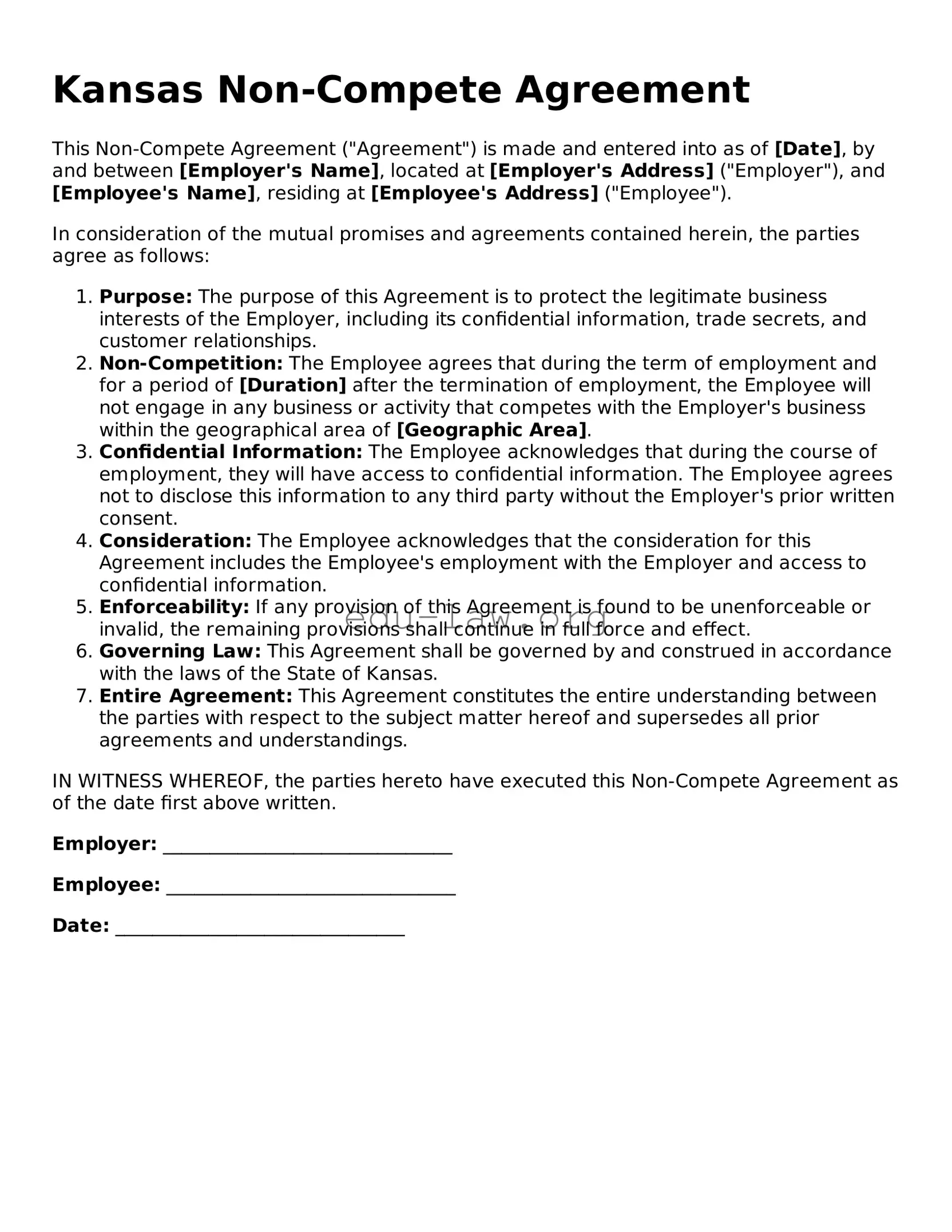
Kansas Non-Compete Agreement
This Non-Compete Agreement ("Agreement") is made and entered into as of [Date], by and between [Employer's Name], located at [Employer's Address] ("Employer"), and [Employee's Name], residing at [Employee's Address] ("Employee").
In consideration of the mutual promises and agreements contained herein, the parties agree as follows:
IN WITNESS WHEREOF, the parties hereto have executed this Non-Compete Agreement as of the date first above written.
Employer: _______________________________
Employee: _______________________________
Date: _______________________________
| Fact Name | Details |
|---|---|
| Governing Law | Kansas Statutes Annotated, Chapter 50, Article 1A |
| Purpose | To protect business interests by restricting employee competition after leaving a job. |
| Duration | The agreement can specify a duration, typically ranging from 6 months to 2 years. |
| Geographic Scope | Non-compete agreements must define a reasonable geographic area where the restrictions apply. |
| Consideration | Employees must receive something of value, such as a job offer or training, in exchange for signing. |
| Enforceability | Kansas courts may enforce non-compete agreements if they are reasonable in scope and duration. |
| Exceptions | Non-compete agreements cannot restrict an employee from working in their profession indefinitely. |
Completing the Kansas Non-compete Agreement form requires careful attention to detail. After filling out the form, it will need to be reviewed and signed by all parties involved. Ensure that all information is accurate and clearly stated to avoid any potential disputes in the future.
What is a Kansas Non-compete Agreement?
A Kansas Non-compete Agreement is a legal document that restricts an employee from working for a competitor or starting a similar business for a specified period after leaving their current employer. This agreement helps protect the employer's business interests, trade secrets, and customer relationships.
Are non-compete agreements enforceable in Kansas?
Yes, non-compete agreements can be enforceable in Kansas, but they must meet certain criteria. The agreement should be reasonable in terms of duration, geographic scope, and the interests it protects. Courts will evaluate these factors to determine if the agreement is fair and necessary to protect legitimate business interests.
How long can a non-compete agreement last in Kansas?
The duration of a non-compete agreement in Kansas should be reasonable. Typically, agreements lasting one to two years are often considered acceptable. However, the specific circumstances of the business and the nature of the work may influence what is deemed reasonable.
What happens if I violate a non-compete agreement?
If you violate a non-compete agreement, your former employer may take legal action against you. This could include seeking an injunction to prevent you from working for a competitor or pursuing damages for any losses incurred due to the violation. It's important to understand the terms of your agreement to avoid potential legal issues.
Can I negotiate the terms of a non-compete agreement?
Yes, you can negotiate the terms of a non-compete agreement before signing it. It's advisable to discuss any concerns you have with your employer. You might want to address the duration, geographic restrictions, or specific job functions covered by the agreement. Clear communication can lead to a more balanced agreement.
Do I need a lawyer to create a non-compete agreement?
While it's not mandatory to have a lawyer draft a non-compete agreement, consulting with one is highly recommended. A legal professional can ensure that the agreement complies with Kansas law and effectively protects your interests. They can also help clarify any complex terms and ensure that the agreement is enforceable.
Not Understanding the Scope of the Agreement: Many individuals fail to grasp the full extent of what a non-compete agreement entails. They may overlook the specific industries, geographic areas, or time frames that the agreement covers, leading to potential conflicts later on.
Inadequate Review of Terms: Rushing through the terms can result in missed details. It's crucial to read and comprehend each clause. Some may not realize that certain terms can be negotiable or that they may impose restrictions that affect future employment opportunities.
Failure to Seek Legal Advice: Skipping the step of consulting with a legal professional can be a significant mistake. An attorney can provide insights into the enforceability of the agreement and help clarify any confusing language.
Signing Without Clarification: Some individuals sign the agreement without asking questions or seeking clarification on ambiguous terms. This can lead to misunderstandings about what is expected and what rights are being waived.
Ignoring State-Specific Laws: Non-compete agreements can vary significantly by state. Ignoring the specific laws and regulations in Kansas may result in signing an agreement that is not legally enforceable, or that could limit job prospects unfairly.
When entering into a Kansas Non-compete Agreement, several other forms and documents may be relevant. These documents help clarify the terms of the agreement, protect both parties, and ensure compliance with legal standards. Below is a list of commonly used forms that can accompany a non-compete agreement.
Each of these documents plays a vital role in the employment relationship and the enforcement of a non-compete agreement. Understanding their purposes can help both employers and employees navigate their rights and responsibilities effectively.
The Kansas Non-compete Agreement shares similarities with the Non-disclosure Agreement (NDA). Both documents aim to protect sensitive information and trade secrets. While the non-compete restricts an individual from working with competitors after leaving a company, the NDA focuses on preventing the sharing of confidential information during and after employment. Each agreement serves to safeguard a business's interests, but they do so through different mechanisms and timeframes.
Another document akin to the Kansas Non-compete Agreement is the Employment Agreement. This contract outlines the terms of employment, including job responsibilities, compensation, and termination conditions. While the employment agreement sets the stage for the employer-employee relationship, it may also include non-compete clauses to prevent employees from joining rival firms after their tenure. Thus, both documents work together to define the relationship and protect the company's assets.
The Confidentiality Agreement is also similar to the Kansas Non-compete Agreement. Like the NDA, it seeks to protect proprietary information. However, a confidentiality agreement can be broader in scope, covering any information deemed confidential, whereas a non-compete specifically restricts future employment opportunities. Both agreements emphasize the importance of protecting business interests but do so in different contexts.
The Non-solicitation Agreement is another relevant document. This agreement prevents former employees from soliciting clients or employees from their previous employer. While a non-compete restricts an individual's ability to work for competitors, a non-solicitation agreement focuses on maintaining business relationships. Together, they create a comprehensive strategy for protecting a company's market position.
The Release of Claims document also shares a connection with the Kansas Non-compete Agreement. This document typically releases an employer from liability for any claims an employee might have after leaving the company. While it does not directly address competition, it often accompanies non-compete agreements to ensure that employees waive their rights to challenge the enforceability of such clauses. Both documents contribute to a smoother transition for both parties.
Lastly, the Severance Agreement can be compared to the Kansas Non-compete Agreement. This document outlines the terms under which an employee receives severance pay upon leaving a company. Often, severance agreements include non-compete clauses as a condition for receiving benefits. Thus, both documents work in tandem to provide financial security while protecting the employer's interests in the competitive landscape.
When filling out the Kansas Non-compete Agreement form, it's important to approach the process carefully. Here are some guidelines to help you navigate this task effectively.
By following these dos and don'ts, you can help protect your rights and interests while ensuring that you understand the implications of the agreement you are entering into.
Non-compete agreements are often misunderstood, leading to confusion for both employers and employees in Kansas. Here are four common misconceptions about these agreements:
Understanding these misconceptions can help both employers and employees navigate the complexities of non-compete agreements in Kansas more effectively.
When filling out and using the Kansas Non-compete Agreement form, it is important to keep several key points in mind. Here are ten essential takeaways: