The Kansas Motor Vehicle Power of Attorney form is a crucial document for anyone needing to delegate authority regarding their vehicle. This form allows an individual, known as the principal, to appoint another person, referred to as the agent, to handle specific tasks related to the vehicle. These tasks can include signing titles, registering the vehicle, or completing necessary paperwork for sales or transfers. The form is particularly useful in situations where the principal cannot be present to manage these responsibilities, such as during travel or illness. It ensures that the agent can act on behalf of the principal without delay, streamlining the process of vehicle management. Understanding the requirements and implications of this form is essential for both parties involved, as it establishes a legal framework for actions taken on behalf of the vehicle owner. Properly completing and executing the form safeguards the interests of the principal while granting the agent the authority needed to perform necessary tasks efficiently.
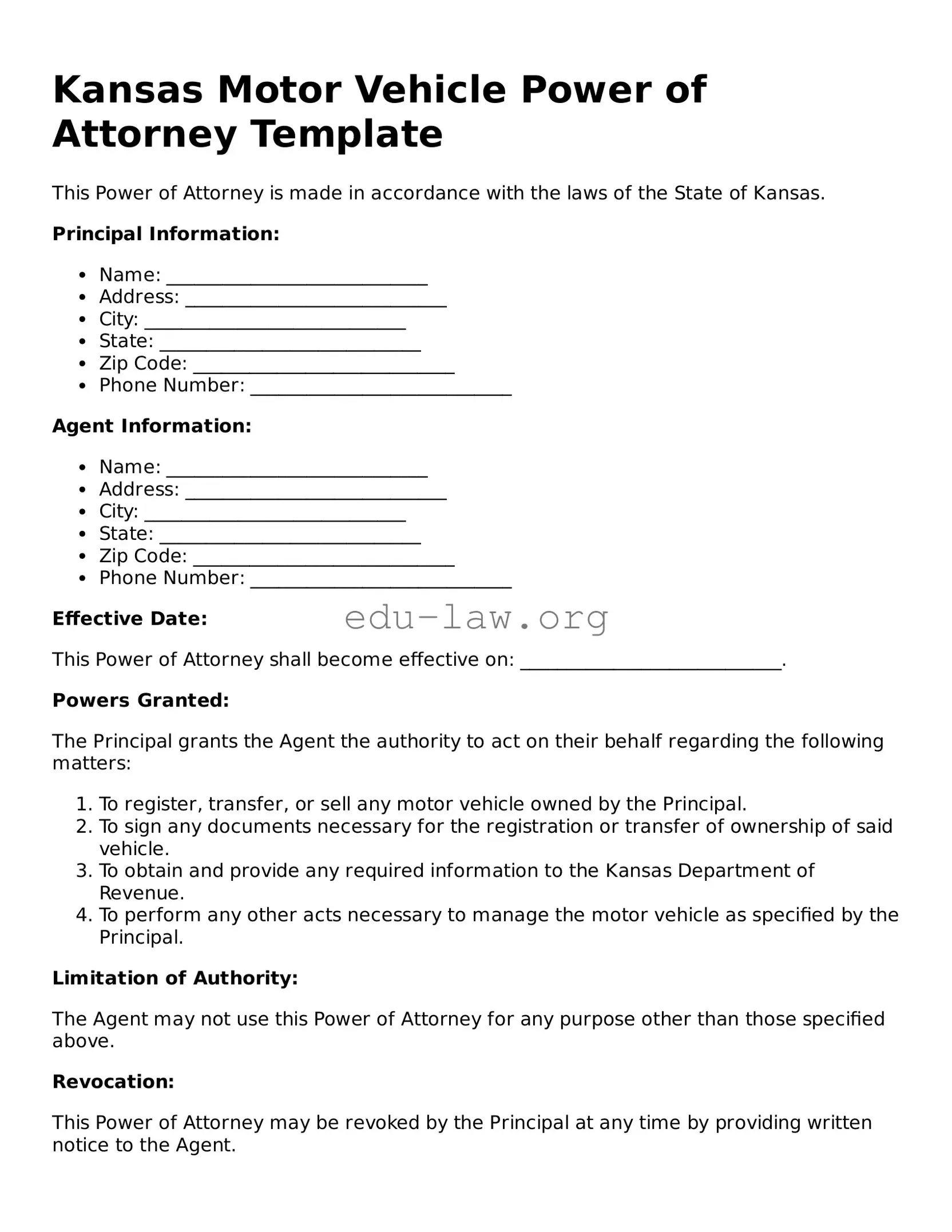
Kansas Motor Vehicle Power of Attorney Template
This Power of Attorney is made in accordance with the laws of the State of Kansas.
Principal Information:
Agent Information:
Effective Date:
This Power of Attorney shall become effective on: ____________________________.
Powers Granted:
The Principal grants the Agent the authority to act on their behalf regarding the following matters:
Limitation of Authority:
The Agent may not use this Power of Attorney for any purpose other than those specified above.
Revocation:
This Power of Attorney may be revoked by the Principal at any time by providing written notice to the Agent.
Signature:
By signing below, the Principal acknowledges that they understand the contents of this document and voluntarily grant the authority specified herein.
Principal's Signature: ____________________________
Date: ____________________________
Witness Signature: ____________________________
Date: ____________________________
Notary Public:
State of Kansas
County of ____________________________
Subscribed and sworn before me this _____ day of ____________, 20__.
Notary Public Signature: ____________________________
My Commission Expires: ____________________________
| Fact Name | Description |
|---|---|
| Purpose | The Kansas Motor Vehicle Power of Attorney form allows an individual to appoint another person to handle specific motor vehicle-related tasks on their behalf. |
| Governing Law | This form is governed by Kansas Statutes Annotated (K.S.A.) § 58-650 et seq., which outlines the legal framework for powers of attorney in the state. |
| Authorized Actions | The appointed agent can perform tasks such as signing documents, transferring ownership, and registering vehicles. |
| Duration | The authority granted through this form remains effective until revoked by the principal or until the specified expiration date, if applicable. |
| Notarization | In Kansas, the form must be notarized to ensure its validity and to confirm the identity of the principal. |
| Revocation | The principal can revoke the Power of Attorney at any time, provided they do so in writing and notify the agent and relevant parties. |
Filling out the Kansas Motor Vehicle Power of Attorney form is an important step when you need someone else to handle vehicle-related matters on your behalf. This could include tasks like transferring ownership or registering a vehicle. Below are the steps to guide you through the process of completing the form accurately.
What is a Kansas Motor Vehicle Power of Attorney form?
The Kansas Motor Vehicle Power of Attorney form is a legal document that allows one person, known as the principal, to appoint another person, known as the agent, to act on their behalf regarding motor vehicle matters. This may include tasks such as transferring vehicle titles, registering vehicles, or handling other related transactions. This form is particularly useful when the principal is unable to attend to these matters personally, whether due to being out of state, illness, or other reasons.
Who can be appointed as an agent in the Kansas Motor Vehicle Power of Attorney?
In Kansas, the agent can be any competent adult. This means that the person you choose should be at least 18 years old and capable of understanding the responsibilities associated with the role. Many people appoint trusted family members, friends, or legal representatives to ensure that their motor vehicle affairs are handled properly. It is important to choose someone you trust, as they will have the authority to make decisions regarding your vehicle.
How do I complete the Kansas Motor Vehicle Power of Attorney form?
Completing the Kansas Motor Vehicle Power of Attorney form is a straightforward process. First, you will need to provide your name and contact information as the principal. Next, you will enter the name and contact details of the agent you are appointing. Additionally, you may need to specify the powers you are granting to the agent, such as the ability to transfer ownership or register a vehicle. Once the form is filled out, it must be signed and dated in the presence of a notary public to ensure its validity. This notarization adds an extra layer of security and helps prevent any potential disputes.
Is the Kansas Motor Vehicle Power of Attorney form revocable?
Yes, the Kansas Motor Vehicle Power of Attorney form is revocable. As the principal, you have the right to revoke or change the authority granted to your agent at any time, as long as you are mentally competent. To revoke the power of attorney, you should complete a revocation form and notify your agent of the change. It is also advisable to inform any institutions or entities that may have relied on the original power of attorney, such as the Department of Motor Vehicles, to avoid any confusion in the future. Keeping clear communication is essential in these situations.
Failing to provide complete information about the principal. The principal's name, address, and contact details must be clearly stated. Omitting any of this information can lead to confusion or invalidation of the document.
Not specifying the powers granted. The form should clearly outline the specific powers being delegated to the attorney-in-fact. Leaving this section vague can result in misunderstandings about what actions the attorney-in-fact can take.
Neglecting to sign and date the form. A signature is essential for the document to be legally binding. Without it, the power of attorney may not be recognized.
Forgetting to have the form notarized. In Kansas, notarization is often required for the power of attorney to be valid. Failing to have the document notarized can lead to complications in its enforcement.
Using outdated forms. Laws and requirements can change over time. It is crucial to ensure that the most current version of the form is being used to avoid legal issues.
Not reviewing the document before submission. Errors can occur during the completion of the form. Taking the time to carefully review the document can prevent mistakes that might invalidate the power of attorney.
The Kansas Motor Vehicle Power of Attorney form allows an individual to designate someone else to handle specific vehicle-related transactions on their behalf. This is particularly useful for those who may be unable to attend to these matters in person. Along with this form, several other documents are often utilized to ensure smooth and legal processing of vehicle transactions.
Understanding these accompanying documents can help streamline the process of managing vehicle transactions in Kansas. Each plays a vital role in ensuring that all legal requirements are met, making the transition smoother for all parties involved.
The Kansas Motor Vehicle Power of Attorney form is similar to the General Power of Attorney. Both documents allow one person to grant another individual the authority to act on their behalf in various matters. While the General Power of Attorney can cover a wide range of activities, including financial and legal decisions, the Motor Vehicle Power of Attorney is specifically focused on matters related to motor vehicles, such as transferring titles or registering vehicles. This specificity makes the Motor Vehicle version a more targeted tool for vehicle-related transactions.
Another similar document is the Durable Power of Attorney. Like the Kansas Motor Vehicle Power of Attorney, the Durable Power of Attorney permits someone to make decisions on behalf of another person. The key difference lies in the durability aspect; the Durable Power of Attorney remains effective even if the principal becomes incapacitated. In contrast, the Kansas Motor Vehicle Power of Attorney typically does not address incapacity and is often limited to specific transactions involving motor vehicles.
The Limited Power of Attorney is also akin to the Kansas Motor Vehicle Power of Attorney. Both documents empower an individual to act on behalf of another, but the Limited Power of Attorney restricts authority to specific tasks or a defined timeframe. This makes it suitable for situations where the principal only wants to delegate certain responsibilities, such as handling vehicle sales or registrations, without granting broader powers that a General Power of Attorney would entail.
The Vehicle Title Application is another document that shares similarities with the Kansas Motor Vehicle Power of Attorney. While the Vehicle Title Application is a form used to apply for a title for a vehicle, the Motor Vehicle Power of Attorney allows someone to act on behalf of the owner to complete this application. Both documents are essential in the vehicle registration process, but they serve different roles in ensuring legal ownership and transfer of vehicles.
The Bill of Sale is also comparable to the Kansas Motor Vehicle Power of Attorney. A Bill of Sale is a document that records the sale of a vehicle and transfers ownership from one party to another. While the Motor Vehicle Power of Attorney enables someone to facilitate the sale or transfer of the vehicle, the Bill of Sale serves as proof of that transaction. Both documents are crucial in ensuring that vehicle ownership is legally recognized and properly documented.
The Affidavit of Heirship is another document that can relate to the Kansas Motor Vehicle Power of Attorney. This affidavit is used to establish the rightful heirs of a deceased person's estate, including any vehicles owned. If a vehicle needs to be transferred to an heir, the Motor Vehicle Power of Attorney can authorize someone to handle that transfer on behalf of the estate. Both documents play significant roles in the transfer of vehicle ownership, particularly in situations involving inheritance.
Lastly, the Release of Liability form shares a connection with the Kansas Motor Vehicle Power of Attorney. This form is used to notify the Department of Motor Vehicles when a vehicle is sold or transferred, relieving the previous owner of future liability associated with the vehicle. The Motor Vehicle Power of Attorney can authorize someone to complete this process on behalf of the owner, ensuring that all necessary steps are taken to protect the seller from any future claims related to the vehicle.
When filling out the Kansas Motor Vehicle Power of Attorney form, it's important to follow certain guidelines to ensure that the document is completed correctly. Here are some key do's and don'ts to keep in mind:
Here are ten common misconceptions about the Kansas Motor Vehicle Power of Attorney form:
When filling out and using the Kansas Motor Vehicle Power of Attorney form, it's important to keep several key points in mind. Here are some essential takeaways: