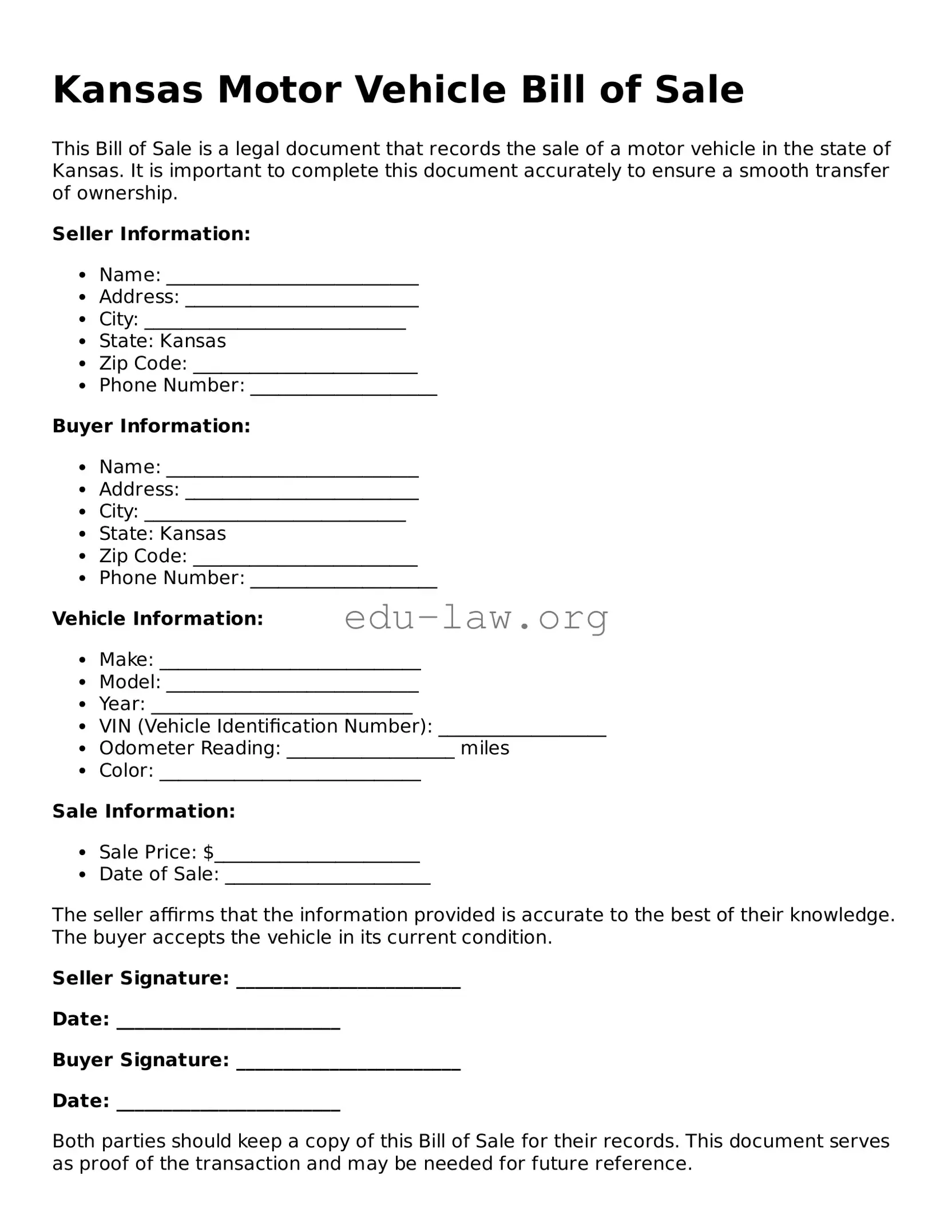
The Kansas Motor Vehicle Bill of Sale form serves as a crucial document in the transfer of ownership for vehicles within the state. This form captures essential details such as the buyer's and seller's names, addresses, and contact information, ensuring that both parties are clearly identified. It also includes vital information about the vehicle itself, including the make, model, year, and Vehicle Identification Number (VIN), which helps to prevent disputes over ownership. Additionally, the form outlines the sale price and any terms of the sale, providing clarity and protection for both the buyer and seller. By documenting the transaction, this form plays a significant role in the registration process and can be essential for tax purposes. Understanding the importance of this document is key for anyone involved in buying or selling a vehicle in Kansas.
Kansas Motor Vehicle Bill of Sale
This Bill of Sale is a legal document that records the sale of a motor vehicle in the state of Kansas. It is important to complete this document accurately to ensure a smooth transfer of ownership.
Seller Information:
Buyer Information:
Vehicle Information:
Sale Information:
The seller affirms that the information provided is accurate to the best of their knowledge. The buyer accepts the vehicle in its current condition.
Seller Signature: ________________________
Date: ________________________
Buyer Signature: ________________________
Date: ________________________
Both parties should keep a copy of this Bill of Sale for their records. This document serves as proof of the transaction and may be needed for future reference.
| Fact Name | Description |
|---|---|
| Purpose | The Kansas Motor Vehicle Bill of Sale form is used to document the sale of a vehicle between a buyer and a seller. |
| Governing Law | This form is governed by the Kansas Statutes Annotated, specifically K.S.A. 8-135. |
| Required Information | It requires details such as the vehicle's make, model, year, and VIN. |
| Seller Information | The seller must provide their name and address on the form. |
| Buyer Information | The buyer's name and address must also be included. |
| Sale Price | The sale price of the vehicle needs to be clearly stated. |
| Date of Sale | The date when the sale takes place must be recorded. |
| Signatures | Both the buyer and seller must sign the form to make it valid. |
| Notarization | While notarization is not required, it is recommended for added security. |
| Use for Registration | This form is often needed when registering the vehicle in the buyer's name. |
After obtaining the Kansas Motor Vehicle Bill of Sale form, you will need to fill it out accurately. This document is essential for the transfer of ownership of a vehicle. Make sure to have all relevant information on hand to complete the form correctly.
Once you have completed the form, keep a copy for your records. The buyer will need this document for registration and title transfer at the DMV.
What is a Kansas Motor Vehicle Bill of Sale?
A Kansas Motor Vehicle Bill of Sale is a legal document that records the sale of a vehicle between a seller and a buyer. It serves as proof of the transaction and includes essential details about the vehicle, such as its make, model, year, and Vehicle Identification Number (VIN). This document is important for both parties to establish ownership and can be used when registering the vehicle with the state.
Do I need a Bill of Sale to sell a vehicle in Kansas?
While a Bill of Sale is not legally required in Kansas to complete a vehicle sale, it is highly recommended. This document provides protection for both the seller and the buyer by documenting the terms of the sale. In the event of a dispute or if the buyer needs to register the vehicle, having a Bill of Sale can simplify the process and serve as evidence of the transaction.
What information should be included in the Bill of Sale?
The Bill of Sale should include specific details to ensure clarity and legality. Key information includes the names and addresses of both the seller and buyer, the vehicle's make, model, year, and VIN, the sale price, and the date of the transaction. Additionally, both parties should sign the document. Including any warranties or conditions of the sale can also be beneficial.
Can I create my own Bill of Sale, or do I need a specific form?
You can create your own Bill of Sale in Kansas, as long as it includes all the necessary information. However, using a standardized form can help ensure that you don’t miss any crucial details. Many online resources provide templates that comply with Kansas laws, making it easier to create a valid document.
Is a Bill of Sale required for registering a vehicle in Kansas?
When registering a vehicle in Kansas, a Bill of Sale is not strictly required, but it is often helpful. The Kansas Department of Revenue typically requires proof of ownership, which can be satisfied by presenting the vehicle title. However, if the title is not available or if there are specific circumstances, a Bill of Sale can help clarify ownership and facilitate the registration process.
How do I complete a Bill of Sale?
Completing a Bill of Sale involves filling in the necessary information accurately. Start by entering the names and addresses of both the seller and buyer. Next, provide the vehicle details, including the make, model, year, and VIN. Specify the sale price and the date of the transaction. Finally, both parties should sign the document to validate it. It's advisable to keep a copy for your records.
What if the vehicle has a lien on it?
If there is a lien on the vehicle, it’s crucial to address this before completing the sale. The seller must ensure that the lien is satisfied, meaning that any outstanding loans or debts related to the vehicle are paid off. The Bill of Sale should also note the existence of the lien and clarify how it will be resolved. Failure to do so can lead to complications for the buyer, who may face claims on the vehicle after the sale.
Where can I obtain a Kansas Motor Vehicle Bill of Sale form?
You can obtain a Kansas Motor Vehicle Bill of Sale form from various sources. Many websites offer free downloadable templates that comply with state requirements. Additionally, local Department of Revenue offices may provide forms or guidance on how to create a Bill of Sale. It’s important to ensure that any form you use includes all necessary information to be legally valid.
Failing to provide accurate vehicle information. Ensure that the VIN (Vehicle Identification Number), make, model, and year are correct. Incorrect details can lead to issues with registration.
Not including the purchase price. It is essential to state the amount paid for the vehicle. Omitting this information may raise questions during the title transfer process.
Neglecting to sign the document. Both the buyer and seller must sign the bill of sale. Without signatures, the document is not valid.
Forgetting to date the form. Always include the date of the transaction. This information is crucial for record-keeping and legal purposes.
Not providing personal information. Include full names and addresses of both parties. This helps in verifying identities and ensuring a smooth transaction.
When completing a vehicle transaction in Kansas, several documents may accompany the Motor Vehicle Bill of Sale to ensure a smooth transfer of ownership. Each of these forms serves a specific purpose in the process, helping both the seller and buyer protect their interests.
Having these documents in order can simplify the buying and selling process, providing clarity and protection for both parties involved. It is advisable to gather all necessary paperwork before finalizing any vehicle sale to ensure compliance with Kansas regulations.
The Kansas Motor Vehicle Bill of Sale form shares similarities with the general Bill of Sale, which is used for various types of personal property transactions. Like the motor vehicle version, a general Bill of Sale serves as a legal document that records the transfer of ownership from one party to another. It typically includes details such as the names of the buyer and seller, a description of the item being sold, and the sale price. Both documents protect the interests of both parties by providing proof of the transaction.
Another document that resembles the Kansas Motor Vehicle Bill of Sale is the Vehicle Title. This document is crucial in establishing ownership of a vehicle. While the Bill of Sale confirms the sale, the title is an official record that indicates who legally owns the vehicle. In many cases, the Bill of Sale is required to obtain a new title after a sale, making both documents essential for a smooth transfer of ownership.
The Purchase Agreement is another document that bears similarities to the Kansas Motor Vehicle Bill of Sale. This agreement outlines the terms of the sale, including payment methods, delivery conditions, and any warranties. While the Bill of Sale finalizes the transaction, the Purchase Agreement serves as a preliminary document that details the expectations of both the buyer and seller before the sale is completed.
In addition, the Odometer Disclosure Statement is closely related to the Kansas Motor Vehicle Bill of Sale. This document is required in many states when a vehicle is sold, and it verifies the mileage on the vehicle at the time of sale. Both documents work together to ensure transparency and protect buyers from potential fraud regarding a vehicle's condition and history.
The Affidavit of Vehicle Ownership is another document that can be compared to the Kansas Motor Vehicle Bill of Sale. This affidavit is often used when the original title is lost or unavailable. It allows the seller to declare ownership and transfer rights without the title. Similar to the Bill of Sale, this document serves to establish ownership and facilitate the transfer process.
The Release of Liability form is also relevant in this context. This document protects the seller by informing the Department of Motor Vehicles (DMV) that they are no longer responsible for the vehicle after the sale. While the Bill of Sale confirms the transaction, the Release of Liability ensures that the seller is no longer liable for any incidents involving the vehicle post-sale.
The Vehicle Registration Application is another document that complements the Kansas Motor Vehicle Bill of Sale. After purchasing a vehicle, the new owner must register it with the DMV. The Bill of Sale serves as proof of purchase and is often required when submitting the registration application. Both documents are essential for ensuring that the vehicle is legally registered in the buyer's name.
Finally, the Insurance Policy Declaration page can also be seen as similar to the Kansas Motor Vehicle Bill of Sale. When a vehicle changes ownership, the new owner typically needs to secure insurance. The Bill of Sale provides the necessary details about the vehicle for the insurance company, while the Declaration page outlines the coverage details. Both documents work in tandem to ensure that the vehicle is adequately insured under the new owner's name.
When completing the Kansas Motor Vehicle Bill of Sale form, it is essential to follow specific guidelines to ensure accuracy and compliance. Here is a list of things you should and shouldn't do:
The Kansas Motor Vehicle Bill of Sale form is an important document for anyone buying or selling a vehicle in the state. However, several misconceptions surround its use and requirements. Here are nine common misunderstandings:
Many people believe that a Bill of Sale is only needed for dealership transactions. In reality, it is crucial for private sales as well, serving as proof of the transaction and protecting both parties.
Some assume that only the seller's signature is required. However, both the buyer and seller should sign the Bill of Sale to ensure clarity and mutual agreement.
While a handwritten Bill of Sale is acceptable, using a typed form is recommended for clarity and professionalism. This can help prevent misunderstandings later.
Many people think notarization is unnecessary. While it is not a requirement in Kansas, having the document notarized can add an extra layer of security and authenticity.
This form is often associated with used vehicles, but it is also applicable for new vehicle sales. Any transfer of ownership requires a Bill of Sale.
Some individuals believe that they need to file the Bill of Sale with the Kansas Department of Revenue. In fact, it is primarily for personal records and does not need to be submitted.
While the Bill of Sale signifies an agreement, it does not eliminate the possibility of disputes. Buyers should still conduct due diligence before completing the transaction.
The Bill of Sale is not a title transfer. It serves as a record of the sale, while the title transfer is a separate process that officially changes ownership with the state.
While there are recommended elements to include, such as the vehicle's VIN and purchase price, there is no strict format mandated by the state. Flexibility exists in how the information is presented.
Understanding these misconceptions can help ensure a smoother transaction process when buying or selling a vehicle in Kansas. Always keep accurate records and consider consulting a professional if unsure about any aspect of the process.
When filling out and using the Kansas Motor Vehicle Bill of Sale form, it's important to keep several key points in mind. This document serves as proof of the sale and transfer of ownership for a vehicle. Here are some essential takeaways:
By following these guidelines, you can help ensure a smooth and successful vehicle transaction in Kansas.