The Kansas Medical Power of Attorney form is an essential legal document that allows individuals to appoint a trusted person to make healthcare decisions on their behalf in the event they become incapacitated. This form not only ensures that a person's medical preferences are honored but also provides clarity and direction to healthcare providers during critical times. Key components of the form include the designation of an agent, who will act in the individual's best interests, and specific instructions regarding medical treatment preferences. It is crucial for the appointed agent to understand the individual's values and wishes to make informed decisions. Additionally, the form must be signed and witnessed to be valid, emphasizing the importance of adhering to state regulations. By establishing a Medical Power of Attorney, individuals can secure peace of mind, knowing that their healthcare choices will be respected, even when they cannot communicate them directly.
Kansas Medical Power of Attorney
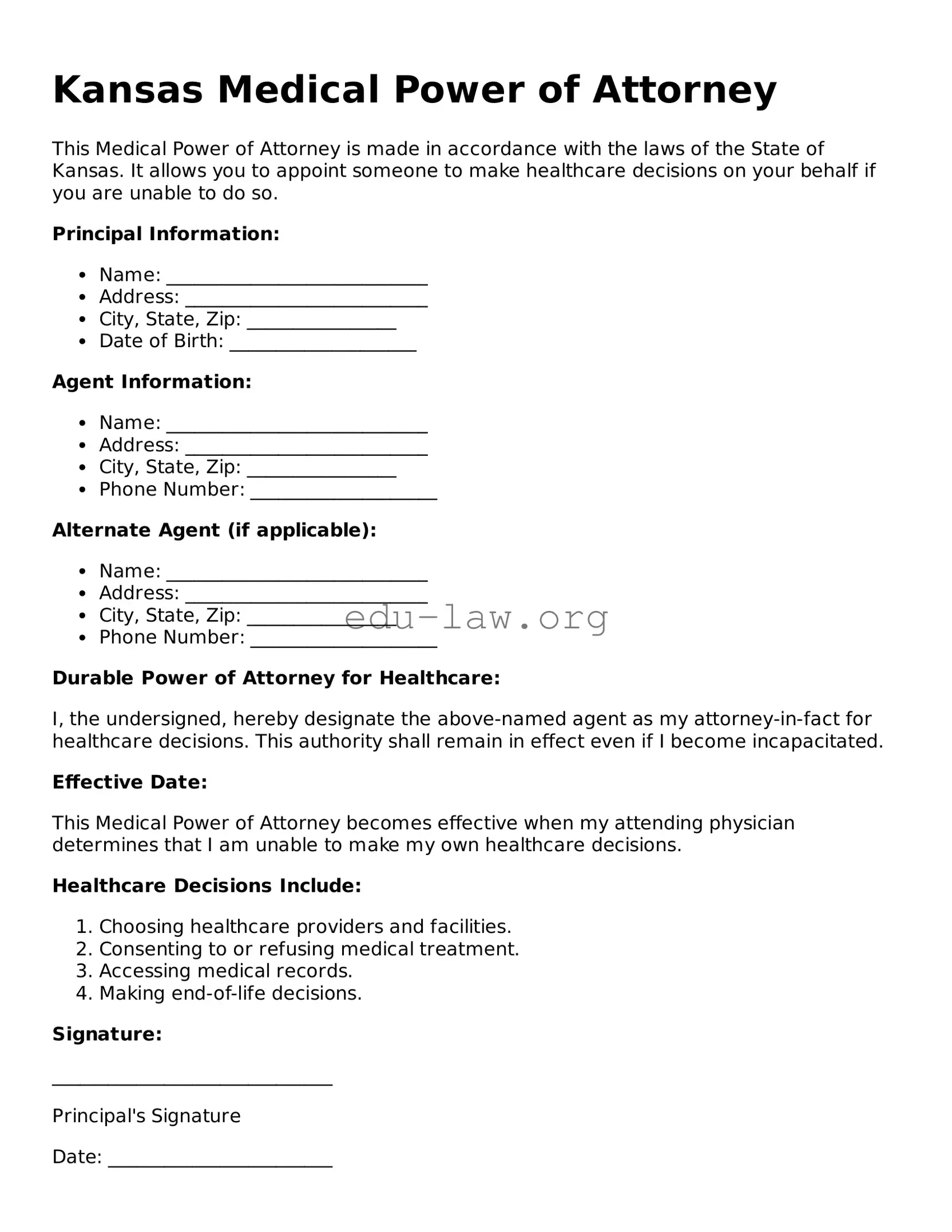
This Medical Power of Attorney is made in accordance with the laws of the State of Kansas. It allows you to appoint someone to make healthcare decisions on your behalf if you are unable to do so.
Principal Information:
Agent Information:
Alternate Agent (if applicable):
Durable Power of Attorney for Healthcare:
I, the undersigned, hereby designate the above-named agent as my attorney-in-fact for healthcare decisions. This authority shall remain in effect even if I become incapacitated.
Effective Date:
This Medical Power of Attorney becomes effective when my attending physician determines that I am unable to make my own healthcare decisions.
Healthcare Decisions Include:
Signature:
______________________________
Principal's Signature
Date: ________________________
Witnesses:
Two witnesses must sign below. They cannot be related to you or entitled to any portion of your estate.
Date: ________________________
| Fact Name | Description |
|---|---|
| Definition | A Kansas Medical Power of Attorney allows an individual to designate another person to make healthcare decisions on their behalf if they become unable to do so. |
| Governing Law | This form is governed by the Kansas Statutes Annotated, specifically K.S.A. 75-3220 et seq. |
| Eligibility | Any competent adult can create a Medical Power of Attorney in Kansas. |
| Principal and Agent | The person who creates the document is called the principal, while the person designated to make decisions is known as the agent. |
| Durability | This power of attorney remains effective even if the principal becomes incapacitated. |
| Revocation | The principal can revoke the Medical Power of Attorney at any time, as long as they are still competent. |
| Witness Requirements | The form must be signed in the presence of two witnesses or notarized to be valid. |
| Healthcare Provider Responsibilities | Healthcare providers must honor the decisions made by the agent as long as they are in accordance with the principal's wishes. |
Filling out the Kansas Medical Power of Attorney form is an important step in ensuring that your healthcare wishes are respected. Once you have completed the form, you will need to have it signed and witnessed according to state requirements. This will help ensure that your chosen agent can make medical decisions on your behalf if you are unable to do so.
What is a Kansas Medical Power of Attorney?
A Kansas Medical Power of Attorney is a legal document that allows you to appoint someone to make healthcare decisions on your behalf if you become unable to do so. This can include decisions about medical treatment, surgeries, and end-of-life care. It ensures that your healthcare preferences are respected even when you cannot communicate them yourself.
Who can be appointed as my agent in a Medical Power of Attorney?
You can choose any competent adult to act as your agent. This could be a family member, friend, or trusted advisor. It’s important to select someone who understands your values and wishes regarding medical care. Your agent should be someone you trust to make decisions that align with your preferences.
Do I need a witness or notary to sign the Kansas Medical Power of Attorney?
Can I revoke my Medical Power of Attorney once it is created?
Yes, you can revoke your Kansas Medical Power of Attorney at any time. To do this, you should notify your agent and any healthcare providers involved in your care. It’s a good idea to put your revocation in writing and to destroy any copies of the original document to avoid confusion.
What happens if I don’t have a Medical Power of Attorney?
If you do not have a Medical Power of Attorney and become unable to make your own medical decisions, your family may need to go through a legal process to determine who can make those decisions for you. This can lead to delays and conflicts among family members. Having a Medical Power of Attorney helps ensure that your wishes are followed and can ease the burden on your loved ones during difficult times.
Failing to select a qualified agent. It's crucial to choose someone who understands your healthcare preferences and can make decisions on your behalf.
Not specifying the scope of authority. Be clear about what decisions your agent can make. Vague language can lead to confusion during critical moments.
Neglecting to sign and date the form. Without your signature and the date, the document may not be valid.
Forgetting to have witnesses or a notary present. Kansas law requires that the form be witnessed or notarized to ensure its legality.
Using outdated forms. Always use the most current version of the Kansas Medical Power of Attorney form to ensure compliance with state laws.
Not discussing your wishes with your agent. Open communication about your healthcare preferences is essential for effective decision-making.
Overlooking the need for regular updates. Life circumstances change. Review and update your document periodically to reflect your current wishes.
Assuming that all medical decisions are covered. Be specific about types of treatments or interventions you may want or refuse.
Ignoring state-specific requirements. Each state has unique regulations regarding medical power of attorney forms. Familiarize yourself with Kansas laws to avoid pitfalls.
The Kansas Medical Power of Attorney form is an essential document for individuals who wish to designate someone to make healthcare decisions on their behalf in the event they become incapacitated. However, several other forms and documents often accompany this form to ensure comprehensive planning for medical and personal decisions. Below is a list of these documents, each serving a unique purpose in the realm of healthcare and estate planning.
In summary, the Kansas Medical Power of Attorney form is part of a broader framework of documents that facilitate healthcare and personal decision-making. By understanding and utilizing these additional forms, individuals can better prepare for the future and ensure their wishes are honored in both health and financial matters.
The Kansas Medical Power of Attorney form is similar to the Durable Power of Attorney. Both documents allow an individual to designate someone else to make decisions on their behalf. While the Durable Power of Attorney can cover a wide range of financial and legal matters, the Medical Power of Attorney specifically focuses on healthcare decisions. This distinction is important for individuals who want to ensure that their medical preferences are respected without extending that authority to other areas of their life.
Another document that resembles the Kansas Medical Power of Attorney is the Living Will. A Living Will outlines an individual’s wishes regarding medical treatment in situations where they may not be able to communicate their preferences. While the Medical Power of Attorney appoints a person to make decisions, the Living Will provides specific instructions about the types of medical care one does or does not want. Together, they work to ensure that a person’s healthcare choices are honored.
The Advance Directive is also similar to the Kansas Medical Power of Attorney. This document combines elements of both the Medical Power of Attorney and the Living Will. It allows individuals to appoint a healthcare proxy while also specifying their wishes regarding medical treatment. This dual function helps clarify both who will make decisions and what those decisions should be, providing comprehensive guidance for healthcare providers and loved ones.
The Healthcare Proxy form is another document that shares similarities with the Kansas Medical Power of Attorney. Like the Medical Power of Attorney, a Healthcare Proxy designates an individual to make medical decisions for someone else. The key difference lies in the terminology; the Healthcare Proxy is often used in different states or contexts but serves the same purpose of ensuring that someone trusted can advocate for a person’s medical needs.
The Do Not Resuscitate (DNR) order also relates to the Kansas Medical Power of Attorney. While the Medical Power of Attorney allows someone to make healthcare decisions, a DNR specifically instructs medical personnel not to perform CPR if a person stops breathing or their heart stops beating. This document can be included as part of a broader medical directive, ensuring that specific wishes regarding resuscitation are clearly communicated.
The Physician Orders for Life-Sustaining Treatment (POLST) form is another document that complements the Kansas Medical Power of Attorney. The POLST translates a patient’s healthcare wishes into actionable medical orders. It is particularly useful for individuals with serious illnesses. While the Medical Power of Attorney allows for the appointment of a decision-maker, the POLST provides immediate guidance to healthcare providers regarding a patient’s treatment preferences.
The Mental Health Care Power of Attorney is similar in function to the Kansas Medical Power of Attorney but focuses specifically on mental health decisions. This document allows individuals to appoint someone to make decisions regarding their mental health treatment. It ensures that a trusted person can advocate for the individual’s needs during times when they may not be able to do so themselves.
The Revocation of Power of Attorney form is also related to the Kansas Medical Power of Attorney. This document allows an individual to formally cancel a previously granted Power of Attorney. It is important for individuals to know that they can change their mind about who makes decisions on their behalf, and this form provides a clear way to communicate that change.
Lastly, the Consent to Treatment form is similar in that it involves healthcare decisions. This document is used to give permission for medical treatment or procedures. While the Medical Power of Attorney allows someone to make decisions on behalf of another, the Consent to Treatment form is typically signed by the individual themselves, ensuring that they are actively agreeing to the proposed medical care.
When filling out the Kansas Medical Power of Attorney form, it's important to be careful and informed. Here’s a list of things you should and shouldn’t do:
When it comes to the Kansas Medical Power of Attorney form, several misconceptions often arise. Understanding the truth behind these myths can help individuals make informed decisions about their healthcare choices. Here are five common misconceptions:
By clarifying these misconceptions, individuals can better prepare for their healthcare needs and ensure their preferences are honored in any situation.
When filling out and using the Kansas Medical Power of Attorney form, keep the following key points in mind: