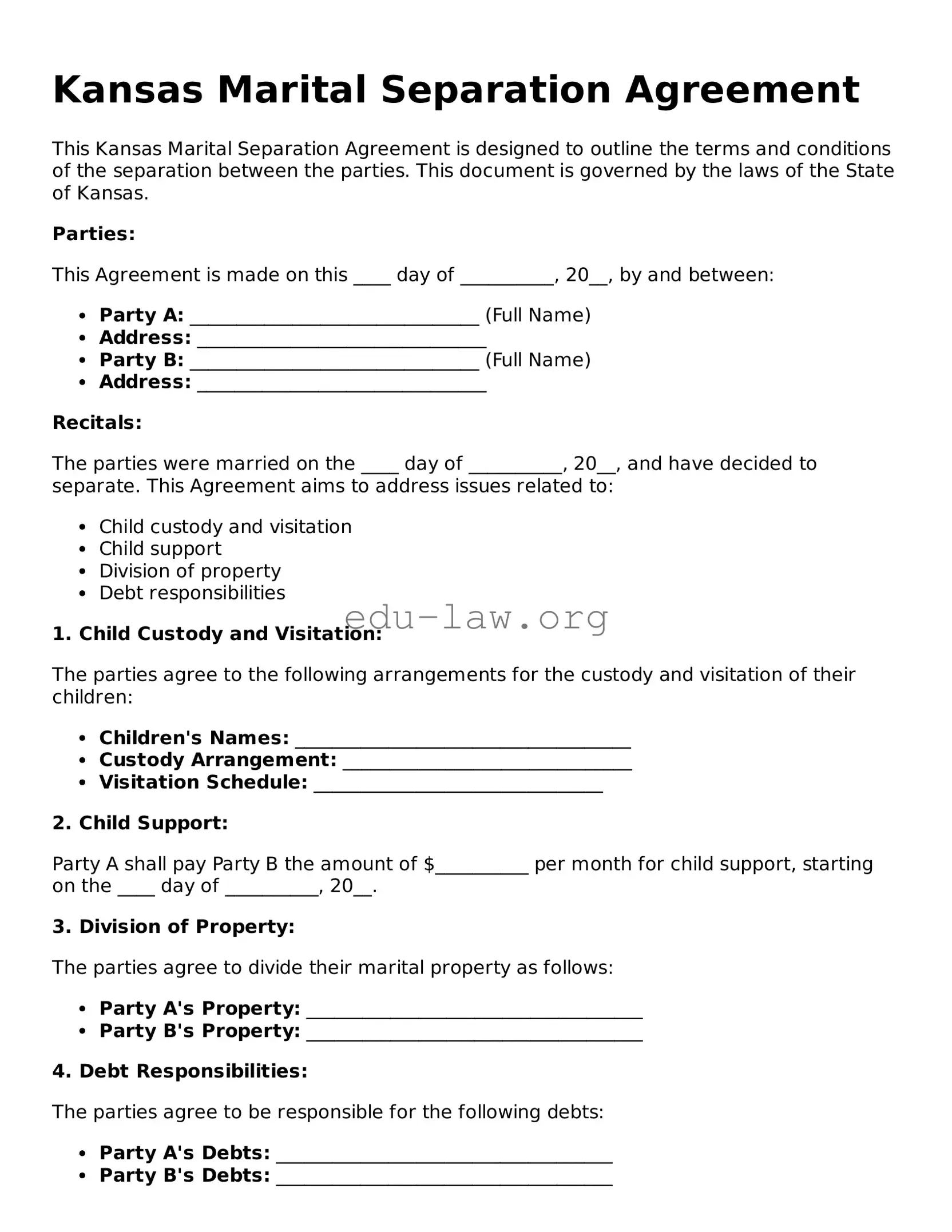
In the state of Kansas, couples considering a separation may find the Kansas Marital Separation Agreement form to be an essential tool in navigating their transition. This document serves as a formal agreement between spouses who wish to live apart while outlining the terms of their separation. Key aspects typically covered in the form include the division of property and debts, arrangements for child custody and support, and provisions for spousal support, if applicable. By clearly detailing these elements, the agreement helps to minimize misunderstandings and conflicts during what can be a challenging time. Additionally, having a written agreement can provide both parties with a sense of security and clarity as they move forward with their lives separately. Understanding the importance of this form can lead to a more amicable separation process, allowing individuals to focus on their future while ensuring that their rights and responsibilities are well defined.
Kansas Marital Separation Agreement
This Kansas Marital Separation Agreement is designed to outline the terms and conditions of the separation between the parties. This document is governed by the laws of the State of Kansas.
Parties:
This Agreement is made on this ____ day of __________, 20__, by and between:
Recitals:
The parties were married on the ____ day of __________, 20__, and have decided to separate. This Agreement aims to address issues related to:
1. Child Custody and Visitation:
The parties agree to the following arrangements for the custody and visitation of their children:
2. Child Support:
Party A shall pay Party B the amount of $__________ per month for child support, starting on the ____ day of __________, 20__.
3. Division of Property:
The parties agree to divide their marital property as follows:
4. Debt Responsibilities:
The parties agree to be responsible for the following debts:
5. Miscellaneous:
This Agreement constitutes the entire understanding between the parties and supersedes any prior agreements or understandings, whether written or oral. It may only be modified in writing, signed by both parties.
Signatures:
By signing below, both parties agree to the terms of this Kansas Marital Separation Agreement.
Party A: _______________________________ Date: __________
Party B: _______________________________ Date: __________
Witness: _______________________________ Date: __________
| Fact Name | Details |
|---|---|
| Definition | A Kansas Marital Separation Agreement is a legal document outlining the terms of separation between spouses. |
| Governing Law | This agreement is governed by the laws of the State of Kansas. |
| Purpose | The agreement serves to clarify the rights and responsibilities of each spouse during the separation. |
| Child Custody | It may include provisions for child custody, visitation, and support arrangements. |
| Property Division | The document typically addresses the division of marital property and debts. |
| Spousal Support | Provisions for spousal support or alimony can also be included in the agreement. |
| Voluntary Agreement | Both spouses must voluntarily agree to the terms outlined in the document. |
| Notarization | While notarization is not always required, it is recommended for added legal protection. |
| Legal Counsel | Consulting with a lawyer is advisable to ensure that both parties understand their rights. |
| Enforceability | The agreement can be enforced in court if both parties comply with its terms. |
After obtaining the Kansas Marital Separation Agreement form, you will need to provide specific information regarding your marriage and the terms of your separation. Ensure that all details are accurate to avoid complications later on.
What is a Kansas Marital Separation Agreement?
A Kansas Marital Separation Agreement is a legal document that outlines the terms and conditions agreed upon by spouses who wish to live separately while remaining legally married. This agreement addresses various aspects such as division of property, child custody, and support obligations. It serves to clarify each party's rights and responsibilities during the separation period.
Is a Marital Separation Agreement legally binding in Kansas?
Yes, once both parties sign the Kansas Marital Separation Agreement, it becomes legally binding. However, it is essential to ensure that the agreement is fair and reasonable to both parties. If disputes arise later, a court may enforce the terms of the agreement, provided it complies with state laws.
Can a Marital Separation Agreement be modified?
Yes, a Marital Separation Agreement can be modified if both parties agree to the changes. It’s important to document any modifications in writing and have both parties sign the revised agreement. This helps prevent misunderstandings and ensures clarity moving forward.
What should be included in a Kansas Marital Separation Agreement?
Key components of a Kansas Marital Separation Agreement typically include the division of assets and debts, child custody arrangements, visitation schedules, child support, spousal support, and any other relevant terms. Each situation is unique, so it’s important to tailor the agreement to fit your specific circumstances.
Do I need a lawyer to create a Marital Separation Agreement?
While it’s not legally required to have a lawyer draft a Kansas Marital Separation Agreement, it is highly recommended. A legal professional can help ensure that the agreement is comprehensive, fair, and compliant with state laws. They can also provide guidance on potential issues that may arise during the separation.
How does a Marital Separation Agreement affect divorce proceedings?
A Marital Separation Agreement can streamline the divorce process by establishing terms that both parties have already agreed upon. When the time comes to file for divorce, the court may refer to the separation agreement to finalize matters such as property division and child custody, potentially reducing conflict and court time.
What happens if one party violates the Marital Separation Agreement?
If one party fails to adhere to the terms outlined in the Kansas Marital Separation Agreement, the other party may seek legal recourse. This could involve going back to court to enforce the agreement or to seek modifications. Courts generally take violations seriously, especially when it comes to child custody and support issues.
Incomplete Information: One of the most common mistakes is leaving sections of the form blank. Every relevant detail should be filled out to avoid delays or complications.
Incorrect Names or Dates: Ensure that names, dates of marriage, and separation are accurate. Errors in these details can lead to legal confusion.
Failure to Address Assets and Debts: Not listing all assets and debts can result in future disputes. It is crucial to provide a comprehensive inventory to protect both parties.
Ignoring Child Custody and Support Issues: If children are involved, neglecting to outline custody arrangements and support obligations can create significant challenges later on.
Not Seeking Legal Advice: Many individuals attempt to fill out the form without consulting a legal professional. This can lead to misunderstandings of rights and responsibilities.
A Kansas Marital Separation Agreement is an important document for couples who are separating but not yet divorced. It outlines the terms of the separation, including division of property, child custody, and support arrangements. Along with this agreement, several other forms and documents may be necessary to ensure a smooth separation process. Here’s a list of some commonly used documents that might accompany the Marital Separation Agreement:
Each of these documents plays a crucial role in ensuring that both parties have a clear understanding of their rights and responsibilities during and after the separation process. By preparing these forms, couples can help facilitate a smoother transition and reduce potential conflicts down the road.
The Kansas Marital Separation Agreement shares similarities with a Divorce Settlement Agreement. Both documents outline the terms and conditions under which a couple will separate their lives, including the division of property, debts, and, if applicable, child custody arrangements. While a marital separation agreement is used when couples choose to live apart without immediately seeking a divorce, a divorce settlement agreement is finalized during the divorce process. The key difference lies in the intent; one is a temporary arrangement, while the other is permanent and legally binding upon the dissolution of marriage.
Another document akin to the Kansas Marital Separation Agreement is the Child Custody Agreement. This document specifically focuses on the arrangements for children following a separation or divorce. It details custody arrangements, visitation rights, and child support obligations. While the marital separation agreement may include provisions for children, the child custody agreement is more comprehensive in addressing the best interests of the child, ensuring that their needs are prioritized during the separation process.
The Property Settlement Agreement is also similar to the Kansas Marital Separation Agreement. This document specifically deals with the division of marital property and debts. In both agreements, couples must come to an understanding about how to fairly divide their assets and liabilities. However, the property settlement agreement is often more detailed and formal, as it is typically executed in conjunction with divorce proceedings. It ensures that both parties are clear about their rights and obligations regarding property after the marriage ends.
Lastly, a Cohabitation Agreement bears resemblance to the Kansas Marital Separation Agreement. Although primarily used by unmarried couples living together, a cohabitation agreement outlines the rights and responsibilities of each partner in the relationship. Similar to a marital separation agreement, it can address issues such as property division and financial responsibilities. The main distinction is that a cohabitation agreement is established before any separation occurs, while the marital separation agreement is created during a time of transition, reflecting the couple's decision to separate.
When completing the Kansas Marital Separation Agreement form, it's important to approach the process thoughtfully. Here are ten guidelines to help ensure that you fill out the form correctly and effectively.
Many people have misunderstandings about the Kansas Marital Separation Agreement form. These misconceptions can lead to confusion during a challenging time. Here are five common misconceptions:
A marital separation agreement is not a divorce. It allows couples to live separately while outlining their rights and responsibilities. Divorce legally ends the marriage, whereas separation maintains the marital status.
While a separation agreement can be legally binding, it must meet certain requirements. If it is not properly executed or if it violates state laws, a court may not enforce it.
Simply having a separation agreement does not mean assets and debts will be divided automatically. Couples must explicitly outline how they will handle these issues in the agreement.
A separation agreement does not negate the obligation to pay child support. Parents must still address child support in the agreement, ensuring it aligns with state guidelines.
Even couples without children can benefit from a marital separation agreement. It helps clarify financial responsibilities and property division, regardless of whether children are involved.
When filling out and using the Kansas Marital Separation Agreement form, there are several important points to keep in mind. These takeaways can help ensure that the process goes smoothly and that all necessary details are addressed.
By keeping these key points in mind, individuals can navigate the Marital Separation Agreement process more effectively.