Planning for the future can be daunting, especially when it comes to healthcare decisions. In Kansas, the Living Will form plays a crucial role in ensuring your medical wishes are respected when you can no longer communicate them yourself. This legal document allows individuals to outline their preferences regarding life-sustaining treatments and end-of-life care. By specifying what types of medical interventions you would or would not want, you empower your loved ones and healthcare providers to make decisions that align with your values. The form addresses key aspects such as resuscitation efforts, artificial nutrition, and hydration, making it essential for anyone who wants to take charge of their medical care. Understanding how to properly complete this form is vital, as it can provide peace of mind for both you and your family during challenging times.
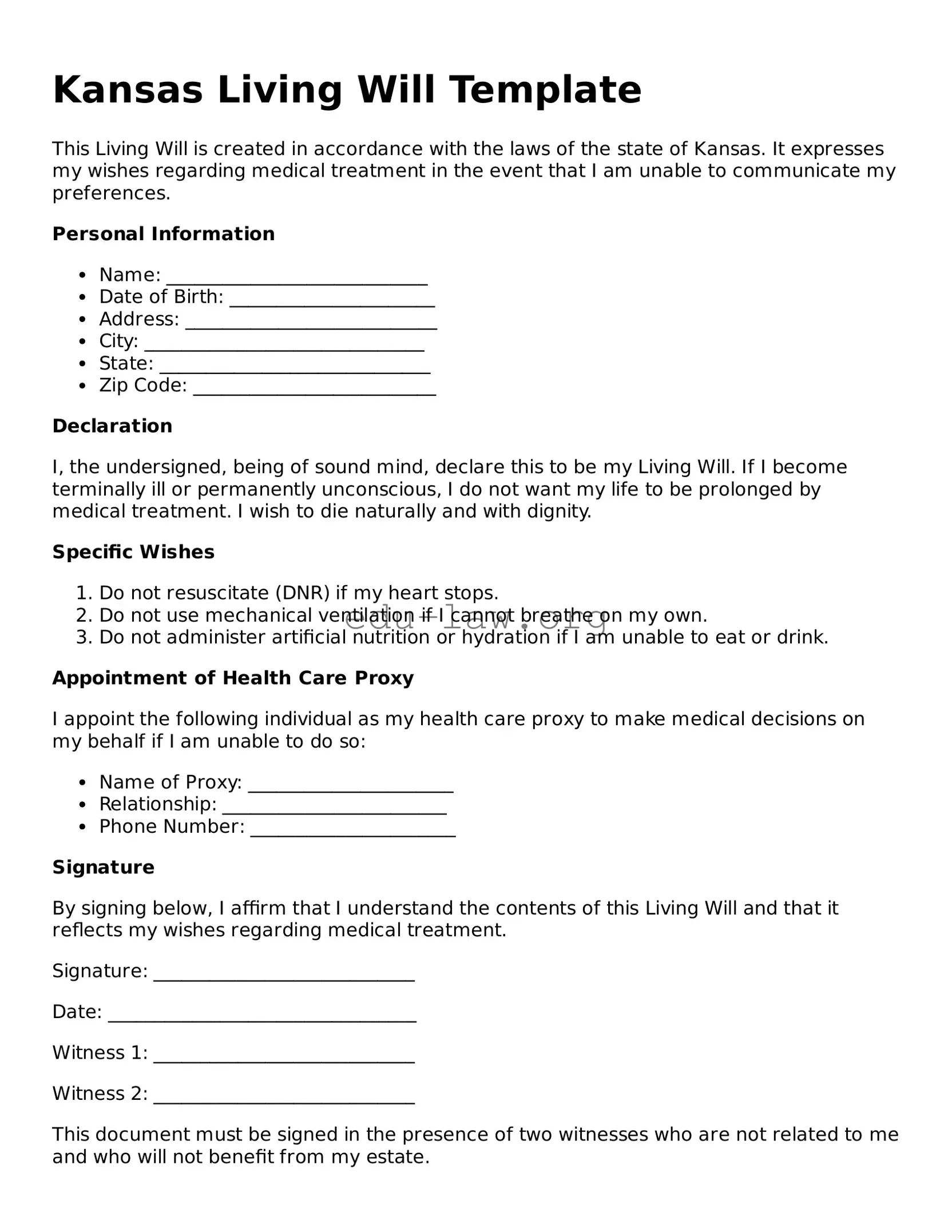
Kansas Living Will Template
This Living Will is created in accordance with the laws of the state of Kansas. It expresses my wishes regarding medical treatment in the event that I am unable to communicate my preferences.
Personal Information
Declaration
I, the undersigned, being of sound mind, declare this to be my Living Will. If I become terminally ill or permanently unconscious, I do not want my life to be prolonged by medical treatment. I wish to die naturally and with dignity.
Specific Wishes
Appointment of Health Care Proxy
I appoint the following individual as my health care proxy to make medical decisions on my behalf if I am unable to do so:
Signature
By signing below, I affirm that I understand the contents of this Living Will and that it reflects my wishes regarding medical treatment.
Signature: ____________________________
Date: _________________________________
Witness 1: ____________________________
Witness 2: ____________________________
This document must be signed in the presence of two witnesses who are not related to me and who will not benefit from my estate.
| Fact Name | Description |
|---|---|
| Purpose | The Kansas Living Will form allows individuals to outline their preferences for medical treatment in case they become unable to communicate their wishes. |
| Governing Law | The form is governed by the Kansas Statutes Annotated, specifically K.S.A. 65-28,100 through 65-28,113. |
| Eligibility | Any adult who is of sound mind can complete a Living Will in Kansas, ensuring their healthcare wishes are respected. |
| Witness Requirement | The form must be signed in the presence of two witnesses, who must also sign the document to validate it. |
| Revocation | Individuals can revoke their Living Will at any time, as long as they communicate their intent clearly. |
| Healthcare Provider Obligations | Healthcare providers are required to honor the directives outlined in a Living Will, provided it is valid and properly executed. |
| Durability | The Kansas Living Will remains effective until it is revoked or the individual passes away, ensuring long-term adherence to the stated wishes. |
Completing the Kansas Living Will form is an important step in expressing your healthcare preferences. Once you have filled out the form, it will be essential to ensure it is signed and witnessed properly to ensure its validity. Follow the steps below to accurately complete the form.
What is a Kansas Living Will?
A Kansas Living Will is a legal document that allows individuals to express their wishes regarding medical treatment in the event they become unable to communicate their preferences. This document typically addresses end-of-life care and specifies the types of medical interventions an individual does or does not want to receive.
Who should create a Living Will in Kansas?
Any adult who wishes to have control over their medical treatment in situations where they cannot speak for themselves should consider creating a Living Will. This includes individuals with chronic illnesses, those undergoing major surgeries, or anyone who wants to ensure their healthcare preferences are known and respected.
How do I create a Living Will in Kansas?
To create a Living Will in Kansas, you must complete a specific form that outlines your healthcare preferences. This form must be signed in the presence of two witnesses or a notary public to be legally binding. It’s essential to ensure that your witnesses are not related to you or stand to gain anything from your estate.
Can I change or revoke my Living Will?
Yes, you can change or revoke your Living Will at any time, as long as you are of sound mind. To revoke it, you can destroy the document or create a new Living Will that explicitly states your updated wishes. Inform your healthcare provider and loved ones about any changes to ensure your preferences are understood.
What happens if I don’t have a Living Will?
If you do not have a Living Will, medical decisions may be made by your family members or legal representatives, which may not align with your wishes. This can lead to confusion and potential conflicts during critical moments. Having a Living Will helps avoid these situations and ensures your preferences are followed.
Is a Living Will the same as a Durable Power of Attorney for Healthcare?
No, a Living Will and a Durable Power of Attorney for Healthcare serve different purposes. A Living Will outlines your medical treatment preferences, while a Durable Power of Attorney designates someone to make healthcare decisions on your behalf if you are unable to do so. Many people choose to have both documents to ensure comprehensive coverage of their healthcare wishes.
Where should I keep my Living Will?
Store your Living Will in a safe but accessible place. Provide copies to your healthcare provider, family members, and anyone designated as your healthcare agent. Make sure that those involved in your care know where to find the document when needed.
Failing to clearly identify the individual making the Living Will. It is essential to include full name and address to avoid any confusion.
Not signing the document. A Living Will is only valid if it is signed by the individual. Without a signature, it cannot be honored.
Omitting a date. Including the date of signing is crucial for determining the validity of the document over time.
Using vague language. Clear and specific language helps ensure that the individual's wishes are understood and followed.
Not discussing the Living Will with family members. Open communication about end-of-life wishes can prevent confusion and conflict.
Failing to update the Living Will. Changes in health status or personal beliefs may require revisions to the document.
Neglecting to have witnesses sign the document. Kansas law requires at least two witnesses to validate the Living Will.
Not storing the Living Will in an accessible location. The document should be easily retrievable in case it is needed.
Assuming that a Living Will is the same as a Power of Attorney. These are different documents and serve distinct purposes.
When preparing for future healthcare decisions, individuals often consider several important documents alongside the Kansas Living Will form. Each of these documents serves a unique purpose and can provide clarity and guidance in times of need. Below is a list of commonly used forms and documents that complement the Living Will.
Understanding these documents can empower individuals to make informed decisions about their healthcare and end-of-life preferences. Each form plays a vital role in ensuring that personal wishes are respected and that loved ones are supported during difficult times.
The Kansas Living Will form is similar to the Advance Directive, which is a broader term encompassing various documents that express an individual's healthcare preferences. An Advance Directive can include both a Living Will and a Durable Power of Attorney for Health Care. While a Living Will specifically addresses end-of-life decisions, an Advance Directive allows individuals to outline their wishes regarding medical treatment in various scenarios, including when they are unable to communicate their preferences.
Another document akin to the Kansas Living Will is the Durable Power of Attorney for Health Care. This document designates a trusted person to make healthcare decisions on your behalf if you become incapacitated. Unlike a Living Will, which focuses on specific medical treatments, the Durable Power of Attorney allows your chosen representative to make broader decisions based on your values and wishes, providing flexibility in unforeseen circumstances.
The Medical Power of Attorney is also similar to the Kansas Living Will. This document empowers someone to make medical decisions for you when you are unable to do so. While the Living Will outlines specific treatment preferences, the Medical Power of Attorney allows your designated agent to interpret your wishes and act accordingly, ensuring that your healthcare choices are respected even when you can’t voice them.
The Do Not Resuscitate (DNR) order is another important document that aligns with the principles of a Living Will. A DNR specifically instructs medical personnel not to perform CPR or other life-saving measures if your heart stops or you stop breathing. This document is often used in conjunction with a Living Will, as both express a person’s wishes regarding end-of-life care and the extent of medical intervention they desire.
Then there’s the Physician Orders for Life-Sustaining Treatment (POLST) form. This document is designed for individuals with serious health conditions who want to ensure their treatment preferences are followed. Like a Living Will, a POLST outlines specific medical interventions, but it is signed by a physician and is meant to be more actionable in emergency situations, making it a vital tool for those with complex medical needs.
The Advance Care Planning document is also similar to the Kansas Living Will. This document encourages individuals to think about their healthcare preferences and discuss them with family and healthcare providers. While it may not be a legally binding document like a Living Will, it serves as a guide for loved ones and healthcare professionals, ensuring that your values and wishes are considered in medical decisions.
Another related document is the Healthcare Proxy, which allows you to appoint someone to make healthcare decisions for you when you cannot. This is similar to the Durable Power of Attorney for Health Care but may be more informal. The Healthcare Proxy emphasizes the importance of having someone you trust who understands your values and can advocate for your wishes in medical situations.
Lastly, the Statement of Wishes document can be compared to a Living Will. This informal document allows individuals to express their healthcare preferences and values without the legal formalities of a Living Will. While it may not have the same legal weight, it can provide guidance to family members and healthcare providers about what matters most to you, ensuring your wishes are honored even in challenging situations.
Filling out a Kansas Living Will form is an important step in ensuring your healthcare wishes are respected. Here’s a list of ten things to keep in mind while completing this document.
When it comes to the Kansas Living Will form, several misconceptions can lead to confusion. Understanding the truth behind these myths is essential for making informed decisions about end-of-life care. Here are six common misconceptions:
By clearing up these misconceptions, individuals can better navigate the process of creating a Living Will and ensure their wishes are respected during critical moments.
When considering the Kansas Living Will form, it is essential to understand its purpose and the implications it holds for individuals and their families. Here are some key takeaways to guide you through the process:
By keeping these takeaways in mind, individuals can navigate the process of creating a Living Will with greater confidence and clarity.