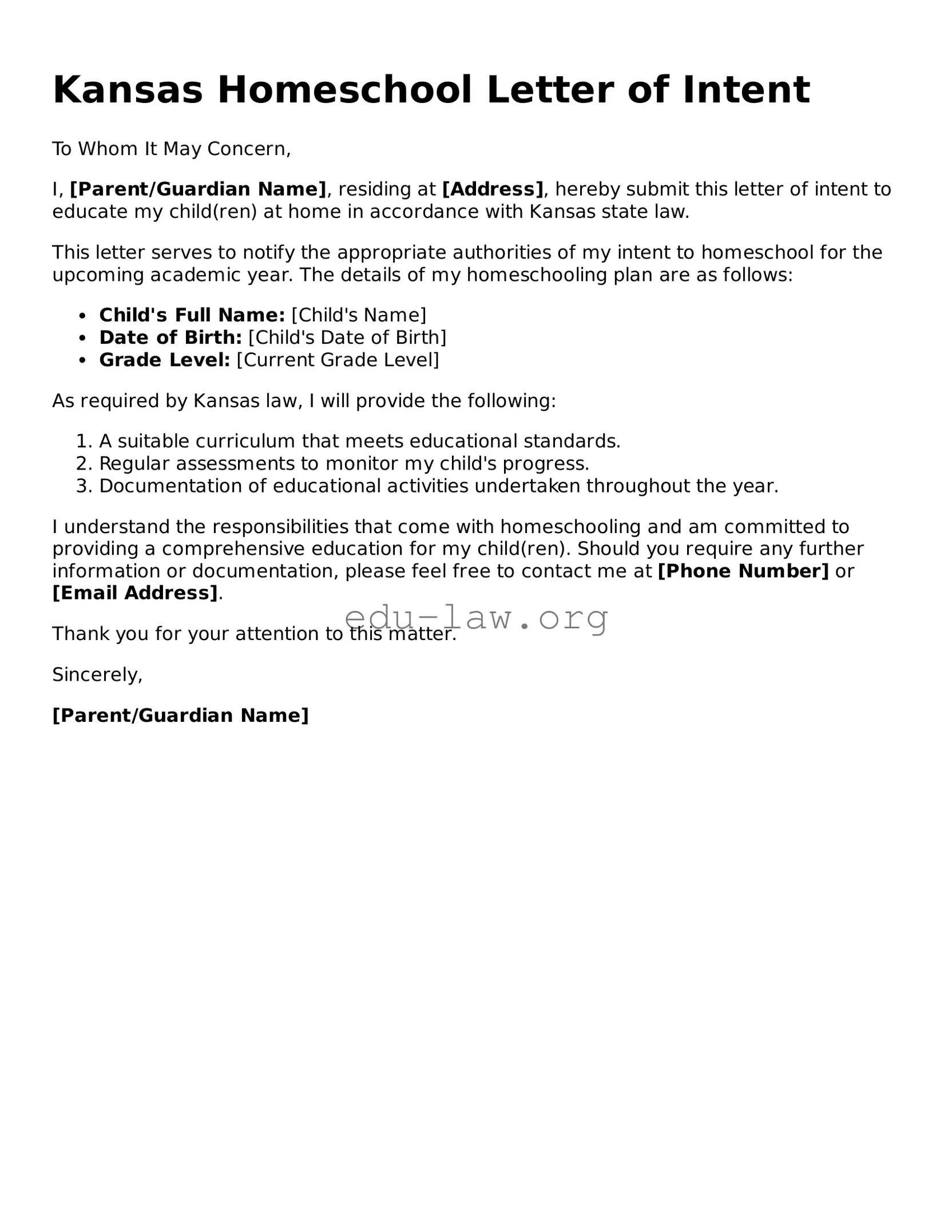
For families considering homeschooling in Kansas, understanding the requirements is crucial to ensure a smooth educational journey. One key step in this process is the Kansas Homeschool Letter of Intent form, which serves as a formal notification to the local school district of your intent to homeschool your child. This form typically requires essential information such as the names and ages of the children being homeschooled, as well as the address of the residence. By submitting this letter, parents demonstrate their commitment to providing a structured learning environment outside of traditional schooling. It's important to note that while this form is a straightforward requirement, it also opens the door to a wealth of educational opportunities tailored to each child's unique learning style. Understanding how to fill out this form correctly can set the foundation for a successful homeschooling experience, allowing families to embrace the freedom and flexibility that comes with personalized education.
Kansas Homeschool Letter of Intent
To Whom It May Concern,
I, [Parent/Guardian Name], residing at [Address], hereby submit this letter of intent to educate my child(ren) at home in accordance with Kansas state law.
This letter serves to notify the appropriate authorities of my intent to homeschool for the upcoming academic year. The details of my homeschooling plan are as follows:
As required by Kansas law, I will provide the following:
I understand the responsibilities that come with homeschooling and am committed to providing a comprehensive education for my child(ren). Should you require any further information or documentation, please feel free to contact me at [Phone Number] or [Email Address].
Thank you for your attention to this matter.
Sincerely,
[Parent/Guardian Name]
| Fact Name | Description |
|---|---|
| Governing Law | The Kansas Homeschool Letter of Intent is governed by K.S.A. 72-1131. |
| Purpose | The form serves as a notification to the local school district of a family's intent to homeschool. |
| Submission Deadline | Parents must submit the letter within 14 days of beginning the homeschool program. |
| Required Information | The form requires the names and ages of all children being homeschooled. |
| Annual Renewal | There is no requirement for annual renewal of the Letter of Intent once submitted. |
| Record Keeping | Families must maintain educational records, though they are not required to submit them with the letter. |
| Local School District | The letter must be submitted to the local school district where the family resides. |
| Format | The form can be handwritten or typed, as long as it includes all required information. |
| Notification of Changes | Parents are encouraged to notify the school district of any changes in the homeschooling status. |
| Legal Protections | Submitting the Letter of Intent provides legal protections for families choosing to homeschool. |
Once you have decided to homeschool your child in Kansas, the next step is to complete the Homeschool Letter of Intent form. This document notifies the local school district of your intent to educate your child at home. Below are the steps to fill out the form accurately.
What is the Kansas Homeschool Letter of Intent form?
The Kansas Homeschool Letter of Intent form is a document that parents or guardians must submit to their local school district when they choose to homeschool their children. This form serves as a formal notification of the intent to provide home education and outlines the educational approach that will be taken.
Who needs to submit the Letter of Intent?
Any parent or guardian who plans to homeschool their child in Kansas must submit the Letter of Intent. This requirement applies to children who are of compulsory school age, typically between the ages of 7 and 18.
When should I submit the Letter of Intent?
The Letter of Intent should be submitted at the beginning of the homeschooling period, ideally before the school year starts. However, if you decide to homeschool mid-year, you should submit the form as soon as you make that decision.
Is there a specific format for the Letter of Intent?
The Letter of Intent does not have a standardized format, but it should include essential information such as the parent’s name, the child’s name, and a statement of intent to homeschool. It is advisable to check with your local school district for any specific requirements they may have.
Do I need to provide additional documentation with the Letter of Intent?
Generally, the Letter of Intent itself is sufficient. However, some school districts may request additional information, such as an educational plan or proof of curriculum. It is best to contact your local district to confirm their requirements.
What happens after I submit the Letter of Intent?
Once you submit the Letter of Intent, the school district will acknowledge receipt of your form. They may provide you with information about local homeschooling resources, support groups, or any additional requirements that may apply.
Can I withdraw my child from public school to homeschool at any time?
Yes, you can withdraw your child from public school at any time to begin homeschooling. However, it is important to notify the school of your decision and submit the Letter of Intent to the school district promptly.
Are there any penalties for not submitting the Letter of Intent?
Failure to submit the Letter of Intent can result in the school district considering your child to be truant. This may lead to legal consequences or requirements to enroll your child in a public or private school. It is essential to follow the proper procedures to avoid complications.
Can I change my mind after submitting the Letter of Intent?
Yes, if you decide to change your educational approach or return to public schooling, you can do so. It is advisable to inform the school district of any changes in your educational plans to ensure compliance with local regulations.
Where can I find more information about homeschooling in Kansas?
For more information about homeschooling in Kansas, you can visit the Kansas State Department of Education website. Additionally, local homeschooling support groups and organizations can provide resources and guidance to help you navigate the homeschooling process.
Incorrect Name of the Student: Parents often misspell their child's name or provide an incorrect name. Ensure the name matches the birth certificate.
Missing Parent Information: Some forms lack complete details about the parent or guardian. Include full names, addresses, and contact information.
Omitting the Date: Failing to date the form can lead to confusion. Always include the date of submission.
Not Specifying Educational Plans: Parents sometimes forget to outline their educational approach. Clearly state the curriculum or methods you plan to use.
Leaving Out Required Signatures: Some forget to sign the form. A signature is necessary to validate the document.
Submitting the Form Late: Parents may miss deadlines. Ensure you submit the letter within the required timeframe.
Inaccurate Contact Information: Providing outdated or incorrect contact details can hinder communication. Double-check phone numbers and email addresses.
When parents decide to homeschool their children in Kansas, they often need to complete the Kansas Homeschool Letter of Intent form. This form is an essential first step in the homeschooling process. However, it is not the only document that may be required or useful during this educational journey. Below is a list of other forms and documents that are commonly used alongside the Letter of Intent.
Each of these documents plays a significant role in the homeschooling process in Kansas. By keeping organized records and utilizing these forms, parents can create a structured and effective educational experience for their children. This preparation not only benefits the students but also helps parents navigate the homeschooling landscape with confidence.
The Kansas Homeschool Letter of Intent form shares similarities with the Affidavit of Homeschooling form used in various states. Like the Letter of Intent, the Affidavit serves as a formal declaration that a parent or guardian is choosing to educate their child at home. Both documents require basic information about the child and the parent, including names and addresses. The key difference lies in the legal requirements of each state, as some may require additional documentation or specific information to be included.
Another document that resembles the Kansas Homeschool Letter of Intent is the Notice of Intent to Homeschool, commonly used in states like New York. This notice informs local education authorities of a family's decision to homeschool. Similar to the Kansas form, it typically includes the names of the children being homeschooled and the educational plans for the year. Both documents aim to ensure that the state is aware of homeschooling families and their educational intentions.
The Home Education Registration form, found in states such as Pennsylvania, is also comparable. This form registers a child for homeschooling and outlines the educational program. Like the Kansas Letter of Intent, it requires the parent's signature and may include information about the curriculum being used. Both documents help establish a record of the family's commitment to homeschooling.
The Declaration of Intent to Homeschool is used in states like Virginia and serves a similar purpose. It is a written statement that parents submit to notify the school district of their intent to educate their children at home. This declaration often requires information about the educational approach and the child's age, much like the Kansas form. Both documents facilitate communication between homeschooling families and educational authorities.
The Homeschooling Exemption Form is another document that bears resemblance to the Kansas Homeschool Letter of Intent. This form is used in some states to request exemption from compulsory school attendance laws. It typically requires parents to outline their educational plans, similar to the Letter of Intent. Both forms help parents clarify their homeschooling status to local education officials.
In states such as Texas, the Home School Affidavit serves a similar function. Parents submit this affidavit to affirm their choice to homeschool their children. Much like the Kansas form, it includes essential details about the children and the educational approach. Both documents are crucial for establishing the legitimacy of a homeschooling program in the eyes of the law.
The Notification of Home Education form used in states like Ohio also resembles the Kansas Homeschool Letter of Intent. This notification informs the local school district of a family's decision to homeschool. It usually requires basic information about the child and the parent, similar to the Kansas form. Both documents help ensure that the homeschooling process is recognized by local authorities.
The Homeschooling Enrollment Form, found in some states, is another document that is akin to the Kansas Letter of Intent. This form is often required to officially enroll a child in a homeschooling program. It typically includes information about the educational curriculum and the child's details. Like the Kansas form, it serves to formalize the homeschooling arrangement with educational authorities.
Finally, the Educational Plan for Home Education document is similar in purpose to the Kansas Homeschool Letter of Intent. This plan outlines the curriculum and educational goals for the year. While the Kansas form focuses on intent, the Educational Plan provides a more detailed roadmap for the homeschooling journey. Both documents are essential for ensuring that parents meet their educational obligations.
When filling out the Kansas Homeschool Letter of Intent form, it's important to follow certain guidelines to ensure that the process goes smoothly. Below is a list of things you should and shouldn't do.
Misconceptions about the Kansas Homeschool Letter of Intent form can lead to confusion for families considering homeschooling. Here are seven common misunderstandings:
Understanding these misconceptions can help families navigate the homeschooling process in Kansas more effectively.
Filling out and using the Kansas Homeschool Letter of Intent form is an important step for families choosing to homeschool their children. Below are key takeaways to consider:
Understanding these key points can help ensure a smooth homeschooling experience in Kansas.