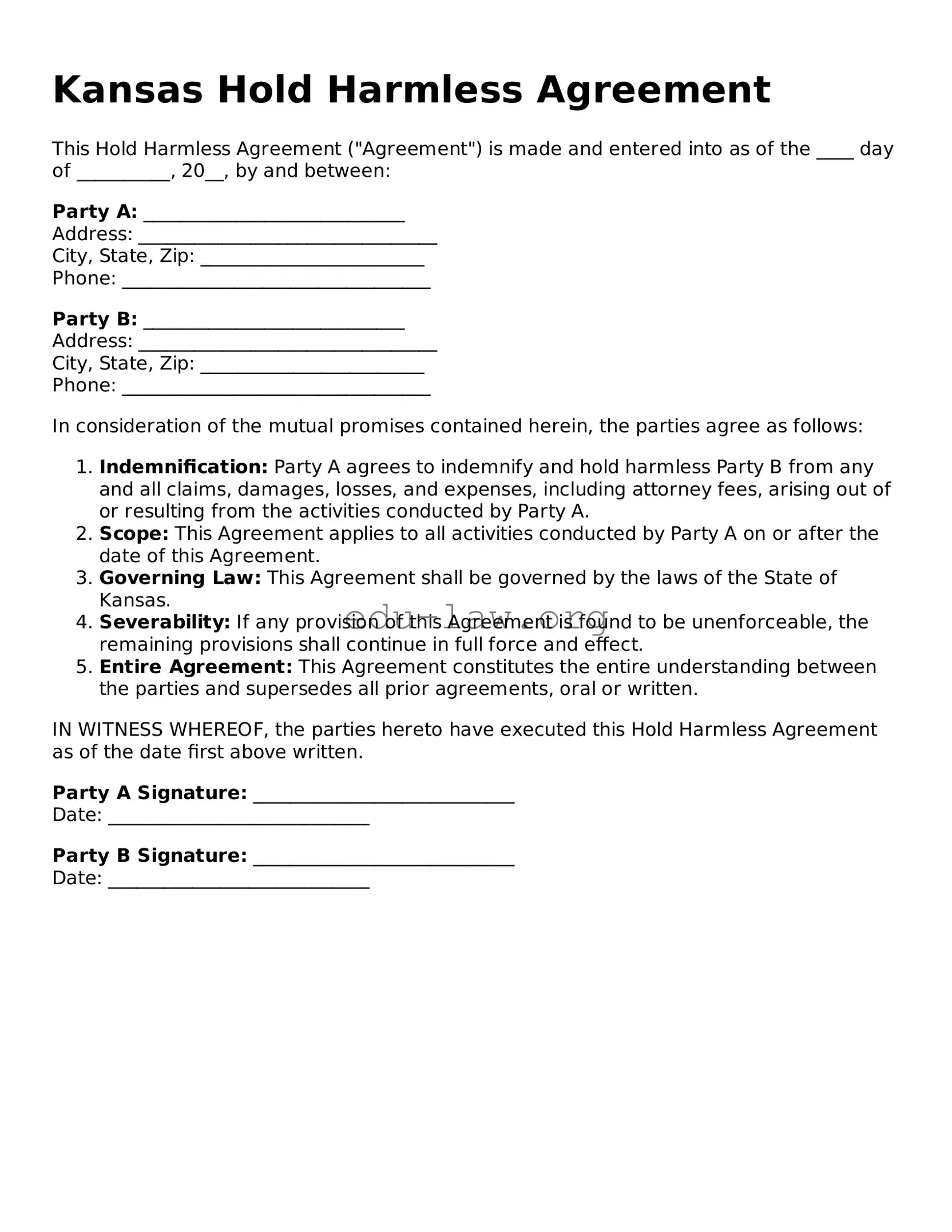
The Kansas Hold Harmless Agreement form serves as a critical tool for individuals and organizations seeking to manage liability in various situations. This document outlines the responsibilities and expectations of parties involved in an agreement, ensuring that one party agrees to protect the other from legal claims or damages that may arise during specific activities or events. By clearly stating the terms under which liability is waived, the form provides a sense of security for those participating in potentially risky endeavors, such as events, construction projects, or recreational activities. It typically includes essential elements such as the identification of the parties involved, a detailed description of the activities covered, and the scope of liability being waived. Understanding the nuances of this agreement is vital for anyone looking to navigate the complexities of liability and risk management effectively. Properly executed, the Kansas Hold Harmless Agreement can foster trust and cooperation among parties, allowing them to engage in activities with a clearer understanding of their rights and responsibilities.
Kansas Hold Harmless Agreement
This Hold Harmless Agreement ("Agreement") is made and entered into as of the ____ day of __________, 20__, by and between:
Party A: ____________________________
Address: ________________________________
City, State, Zip: ________________________
Phone: _________________________________
Party B: ____________________________
Address: ________________________________
City, State, Zip: ________________________
Phone: _________________________________
In consideration of the mutual promises contained herein, the parties agree as follows:
IN WITNESS WHEREOF, the parties hereto have executed this Hold Harmless Agreement as of the date first above written.
Party A Signature: ____________________________
Date: ____________________________
Party B Signature: ____________________________
Date: ____________________________
| Fact Name | Details |
|---|---|
| Purpose | The Kansas Hold Harmless Agreement is designed to protect one party from legal liability for injuries or damages that may occur during a specific activity or event. |
| Parties Involved | Typically, the agreement involves two parties: the indemnitor (the party assuming the risk) and the indemnitee (the party being protected). |
| Governing Law | This agreement is governed by the laws of the State of Kansas, which provides specific legal standards for such contracts. |
| Key Components | Essential elements include a clear description of the activity, the scope of indemnification, and the duration of the agreement. |
| Enforceability | For the agreement to be enforceable, it must be in writing and signed by both parties, demonstrating mutual consent. |
| Limitations | The agreement may not protect against gross negligence or willful misconduct, which can limit its effectiveness in certain situations. |
| Common Uses | It is often used in recreational activities, events, and service agreements, where one party seeks to mitigate risk. |
| Legal Advice | Consulting with a legal professional before signing a Hold Harmless Agreement is advisable to understand rights and obligations fully. |
After obtaining the Kansas Hold Harmless Agreement form, the next steps involve accurately completing the required fields. This ensures that the document is properly filled out and ready for submission.
Once the form is completed, it should be reviewed for accuracy before submission to the appropriate parties. Ensure that all signatures are present and that any additional requirements are met.
What is a Kansas Hold Harmless Agreement?
A Kansas Hold Harmless Agreement is a legal document that protects one party from liability for any injuries or damages that may occur during a specified activity or event. It typically involves two parties: one who is providing a service or allowing use of property, and another who is participating in that service or activity.
Who typically uses a Hold Harmless Agreement?
This agreement is commonly used by organizations, businesses, and individuals who host events, provide services, or allow others to use their property. Examples include schools, sports organizations, and rental property owners.
What are the main components of a Hold Harmless Agreement?
The main components usually include the names of the parties involved, a description of the activity or event, the specific liabilities being waived, and the signatures of both parties. It may also include terms regarding insurance coverage and legal jurisdiction.
Is a Hold Harmless Agreement legally binding in Kansas?
Yes, a Hold Harmless Agreement can be legally binding in Kansas, provided it meets certain legal requirements. Both parties must willingly agree to the terms, and the agreement must be clear and specific about the liabilities being waived.
Can a Hold Harmless Agreement protect against all types of liability?
No, a Hold Harmless Agreement cannot protect against all types of liability. For example, it generally cannot waive liability for gross negligence or willful misconduct. Courts may not enforce provisions that are deemed unfair or overly broad.
How does one create a Hold Harmless Agreement?
Creating a Hold Harmless Agreement involves drafting a document that clearly outlines the terms and conditions. It is often advisable to consult with a legal professional to ensure that the agreement is properly structured and complies with Kansas laws.
Do both parties need to sign the agreement?
Yes, both parties should sign the Hold Harmless Agreement for it to be valid. Signatures indicate that both parties understand and agree to the terms outlined in the document.
Can a Hold Harmless Agreement be revoked?
Generally, a Hold Harmless Agreement can be revoked if both parties agree to do so. However, any revocation should be documented in writing to avoid future disputes.
What happens if someone gets injured despite the agreement?
If someone gets injured despite the Hold Harmless Agreement, the injured party may still seek compensation. The enforceability of the agreement will depend on the circumstances surrounding the injury and the specific language in the agreement.
Where can I find a template for a Kansas Hold Harmless Agreement?
Templates for a Kansas Hold Harmless Agreement can often be found online, through legal websites, or by consulting with an attorney. It’s important to choose a template that is tailored to Kansas law and the specific needs of the parties involved.
Incomplete Information: Many individuals forget to fill out all required fields. This can lead to delays or rejection of the agreement. Always double-check that your name, address, and any other necessary details are fully filled in.
Incorrect Dates: Entering the wrong dates can create confusion. Ensure that you accurately list the date of signing and any relevant event dates associated with the agreement.
Not Understanding the Terms: Some people sign the agreement without fully understanding what they are agreeing to. It’s important to read and comprehend each clause to know your rights and obligations.
Missing Signatures: Forgetting to sign the document is a common mistake. Both parties must sign the agreement for it to be valid. Make sure you have all necessary signatures before submitting.
Failure to Keep Copies: After filling out the form, some individuals neglect to make copies for their records. Always keep a copy of the signed agreement for your own protection and reference.
When engaging in activities that require a Kansas Hold Harmless Agreement, it is often necessary to consider additional documents that complement this agreement. These forms help clarify responsibilities, outline expectations, and ensure legal protection for all parties involved. Below are some commonly used forms that may accompany the Hold Harmless Agreement.
Incorporating these documents alongside the Kansas Hold Harmless Agreement can provide a comprehensive framework for managing risk and protecting all parties involved. Understanding the role of each form helps ensure that you are adequately prepared for any situation that may arise.
The Kansas Hold Harmless Agreement is similar to a Liability Waiver. A Liability Waiver is often used to protect businesses from legal claims by individuals who participate in activities that may pose risks. Like the Hold Harmless Agreement, it requires participants to acknowledge potential dangers and agree not to hold the business responsible for any injuries or damages that may occur. Both documents emphasize the importance of informed consent and the understanding of risks involved.
Another document that resembles the Kansas Hold Harmless Agreement is the Indemnity Agreement. This agreement involves one party agreeing to compensate another for certain damages or losses. While the Hold Harmless Agreement focuses on preventing claims against a party, the Indemnity Agreement often shifts the financial burden of claims from one party to another. Both serve to protect parties from unforeseen liabilities, but they do so in slightly different ways.
The Release of Liability form is yet another document akin to the Kansas Hold Harmless Agreement. This form is commonly used in recreational activities, where participants agree to relinquish their right to sue for injuries sustained during the activity. Similar to the Hold Harmless Agreement, it requires participants to acknowledge the risks involved and accept responsibility for their own safety. Both documents are designed to minimize legal exposure for the organizers or businesses involved.
A Service Agreement can also share similarities with the Hold Harmless Agreement. While primarily focused on defining the terms of a service, it may include clauses that limit liability for the service provider. This is akin to the Hold Harmless Agreement, where one party agrees to protect another from legal claims. In both cases, the intent is to clarify responsibilities and reduce the risk of litigation.
The Non-Disclosure Agreement (NDA) may seem different at first glance, but it can have overlapping elements with the Hold Harmless Agreement. An NDA protects confidential information, while the Hold Harmless Agreement protects against legal claims. Both documents aim to establish clear boundaries and responsibilities, ensuring that parties understand the consequences of their actions. They are tools for risk management in different contexts.
The Confidentiality Agreement is similar to the Kansas Hold Harmless Agreement in that it protects sensitive information from being disclosed. While the Hold Harmless Agreement shields parties from legal claims, the Confidentiality Agreement prevents the sharing of proprietary information. Both agreements require parties to acknowledge their obligations and the importance of protecting certain interests, although they focus on different aspects of risk.
The Property Damage Waiver can also be compared to the Hold Harmless Agreement. This waiver is often used in rental agreements, where a renter agrees not to hold the property owner responsible for damages that may occur during the rental period. Like the Hold Harmless Agreement, it aims to limit liability for one party while ensuring that the other party understands the risks involved in using the property.
The Employment Agreement may include clauses similar to those found in the Kansas Hold Harmless Agreement. Employers often include provisions that protect them from legal claims related to employee actions. These clauses serve to clarify the responsibilities of employees and employers, much like the Hold Harmless Agreement clarifies the responsibilities of the parties involved in a specific activity.
Lastly, the Tenant Release Agreement is comparable to the Kansas Hold Harmless Agreement. In rental situations, tenants may agree to release landlords from liability for injuries occurring on the property. This agreement serves to protect landlords from lawsuits, similar to how the Hold Harmless Agreement protects one party from claims arising from another party’s actions. Both documents are essential in managing risk in rental relationships.
When completing the Kansas Hold Harmless Agreement form, it is essential to follow specific guidelines to ensure accuracy and legality. Here is a list of things you should and shouldn't do:
The Kansas Hold Harmless Agreement is often misunderstood, leading to confusion among those who encounter it. Below are some common misconceptions about this form, along with clarifications to help demystify its purpose and function.
Understanding these misconceptions can help individuals navigate the complexities of Hold Harmless Agreements more effectively. Awareness of the realities behind these forms fosters better decision-making and risk management.
The Kansas Hold Harmless Agreement form is a legal document that helps protect individuals and organizations from liability. Here are some key takeaways regarding its use:
Using the Kansas Hold Harmless Agreement form effectively can help mitigate risks and clarify responsibilities among parties involved in various activities.