When planning for the future, ensuring that your financial and legal affairs are in capable hands can provide peace of mind. The Kansas General Power of Attorney form is a crucial document that empowers an individual, known as the agent or attorney-in-fact, to act on behalf of another person, referred to as the principal. This form covers a wide range of responsibilities, including managing bank accounts, signing checks, handling real estate transactions, and making investment decisions. It is essential for individuals who may become incapacitated or wish to delegate authority for any reason. The form is designed to be flexible, allowing the principal to specify the extent of the powers granted, whether they are broad or limited. Furthermore, it can be revoked at any time, as long as the principal is still mentally competent. Understanding the nuances of this form is vital for ensuring that your wishes are honored and that your financial interests are protected.
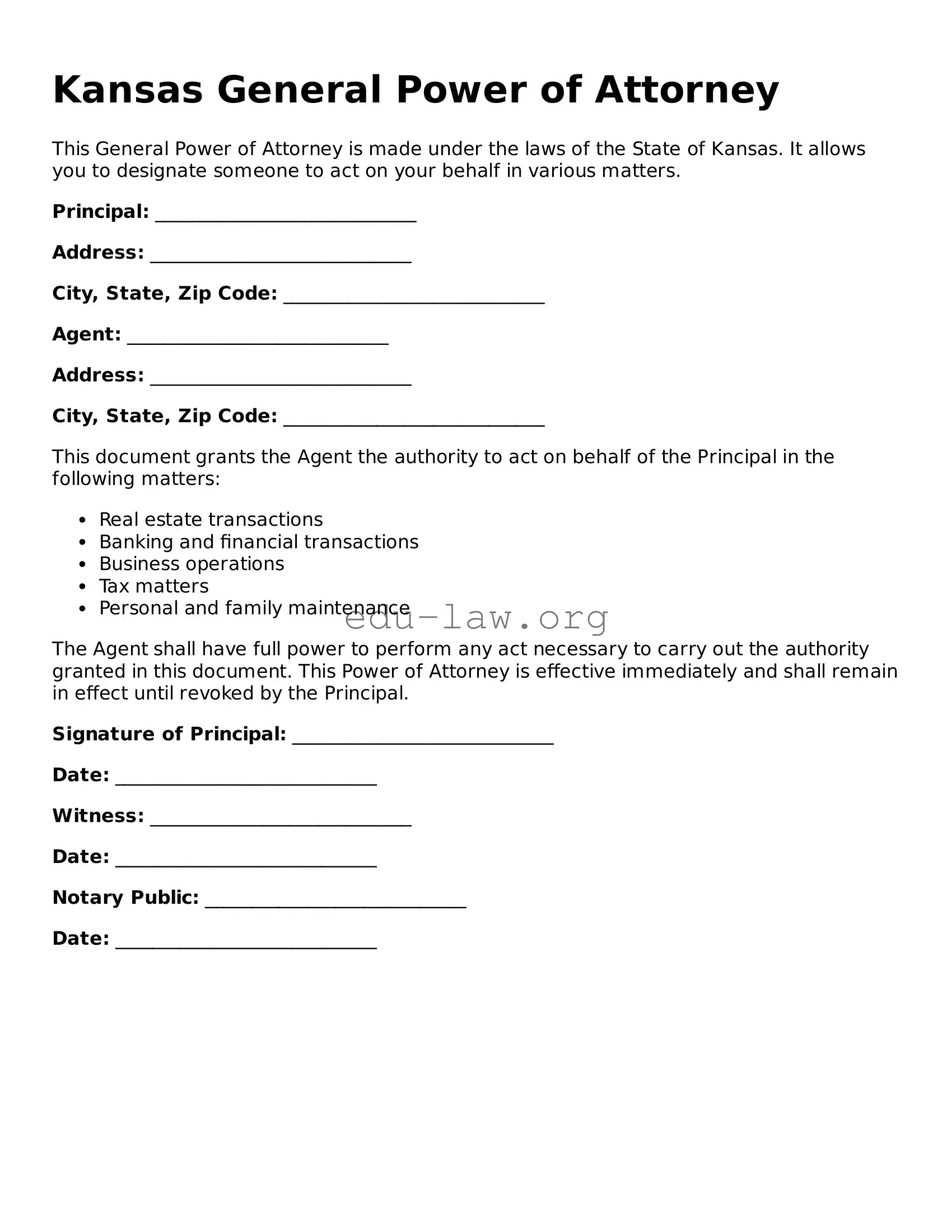
Kansas General Power of Attorney
This General Power of Attorney is made under the laws of the State of Kansas. It allows you to designate someone to act on your behalf in various matters.
Principal: ____________________________
Address: ____________________________
City, State, Zip Code: ____________________________
Agent: ____________________________
Address: ____________________________
City, State, Zip Code: ____________________________
This document grants the Agent the authority to act on behalf of the Principal in the following matters:
The Agent shall have full power to perform any act necessary to carry out the authority granted in this document. This Power of Attorney is effective immediately and shall remain in effect until revoked by the Principal.
Signature of Principal: ____________________________
Date: ____________________________
Witness: ____________________________
Date: ____________________________
Notary Public: ____________________________
Date: ____________________________
| Fact Name | Details |
|---|---|
| Definition | A Kansas General Power of Attorney allows an individual to appoint someone else to manage their financial and legal affairs. |
| Governing Law | The Kansas General Power of Attorney is governed by the Kansas Statutes Annotated, specifically K.S.A. 58-6501 et seq. |
| Durability | This form can be durable, meaning it remains effective even if the principal becomes incapacitated. |
| Agent Authority | The agent can perform a wide range of actions, including managing bank accounts, selling property, and handling tax matters. |
| Signing Requirements | The principal must sign the document in the presence of a notary public for it to be valid. |
| Revocation | The principal can revoke the power of attorney at any time, provided they are competent to do so. |
| Expiration | Unless specified otherwise, a General Power of Attorney does not have a predetermined expiration date. |
| Limitations | Some actions, such as making healthcare decisions, require a separate document, like a Medical Power of Attorney. |
Filling out the Kansas General Power of Attorney form is an important step in designating someone to act on your behalf in various matters. Once completed, this document will grant the selected individual the authority to make decisions and handle transactions as specified in the form. Here’s how to fill it out effectively.
What is a Kansas General Power of Attorney?
A Kansas General Power of Attorney is a legal document that allows one person (the principal) to grant another person (the agent) the authority to make decisions on their behalf. This can include financial matters, property management, and other legal affairs. The agent can act in the principal's best interest, following their wishes as outlined in the document.
Who can create a General Power of Attorney in Kansas?
Any adult who is mentally competent can create a General Power of Attorney in Kansas. This means the person must understand the nature of the document and the powers they are granting to the agent. It’s important that the principal is not under duress or influenced by others when signing the document.
What powers can be granted through a General Power of Attorney?
The powers granted can be quite broad. They typically include managing bank accounts, paying bills, buying or selling property, and making investment decisions. However, the principal can specify which powers they wish to grant or limit. It’s essential to be clear about what you want the agent to do.
Does a General Power of Attorney need to be notarized in Kansas?
Yes, in Kansas, a General Power of Attorney must be signed in the presence of a notary public. This step adds a layer of verification to ensure that the document is valid and that the principal is indeed giving consent willingly.
Can I revoke a General Power of Attorney in Kansas?
Absolutely. A principal can revoke a General Power of Attorney at any time, as long as they are still mentally competent. To revoke it, the principal should create a written notice stating the revocation and notify the agent and any relevant third parties, like banks or healthcare providers.
What happens if the principal becomes incapacitated?
If the principal becomes incapacitated, the General Power of Attorney remains effective unless it is specifically stated to terminate upon incapacity. This means the agent can continue to act on the principal's behalf. However, if a Durable Power of Attorney is created, it explicitly remains in effect even if the principal loses their mental capacity.
Can I limit the powers granted in a General Power of Attorney?
Yes, you can limit the powers granted in a General Power of Attorney. You can specify what your agent can and cannot do. This is often done to ensure that the agent only acts within certain boundaries, protecting your interests and wishes.
Is a General Power of Attorney the same as a Durable Power of Attorney?
No, they are not the same. A General Power of Attorney usually becomes invalid if the principal becomes incapacitated. In contrast, a Durable Power of Attorney remains valid even if the principal loses their mental capacity. It’s crucial to choose the right type based on your needs.
Can I use a General Power of Attorney created in another state in Kansas?
Generally, a General Power of Attorney created in another state can be recognized in Kansas, but it must comply with Kansas laws. It’s wise to review the document to ensure it meets all necessary requirements or consult with a legal professional to avoid any issues.
What should I consider before choosing an agent for my General Power of Attorney?
Choosing an agent is a significant decision. Consider their trustworthiness, reliability, and ability to make sound decisions. It’s also important to discuss your wishes with them beforehand. This conversation can help ensure they understand your preferences and are willing to act in your best interest.
Not Specifying Powers Clearly: One common mistake is failing to clearly outline the specific powers granted. It’s important to be precise about what decisions the agent can make. General terms can lead to confusion and disputes later.
Omitting Agent's Information: Some individuals forget to include the complete name and contact details of the agent. This information is crucial for identification and communication purposes.
Neglecting to Date the Document: A power of attorney should always be dated. Without a date, it can be difficult to determine when the authority was granted, which may lead to complications.
Not Signing in Front of a Notary: Many people overlook the requirement for a notary public. Signing the document without notarization can render it invalid, especially when dealing with financial institutions.
Failing to Review State Requirements: Each state has its own laws regarding power of attorney forms. Ignoring Kansas-specific requirements can lead to issues, so it’s essential to ensure compliance with local laws.
When creating a Kansas General Power of Attorney, it’s essential to consider additional forms and documents that may complement or enhance the authority granted. Each of these documents serves a specific purpose, ensuring that your intentions are clearly communicated and legally upheld.
These documents collectively provide a comprehensive approach to managing your affairs, both during your lifetime and beyond. It’s advisable to consult with a legal professional to ensure that all documents are tailored to your specific needs and comply with Kansas law.
The Kansas General Power of Attorney (GPOA) form shares similarities with the Durable Power of Attorney (DPOA). Both documents allow individuals to appoint someone to make decisions on their behalf. However, the key difference lies in durability. The DPOA remains effective even if the principal becomes incapacitated, while the GPOA typically terminates upon the principal's incapacity unless specified otherwise. This makes the DPOA a preferred choice for those seeking long-term management of their affairs in case of unforeseen health issues.
Another document comparable to the GPOA is the Medical Power of Attorney (MPOA). While the GPOA can cover a wide range of financial and legal matters, the MPOA specifically focuses on healthcare decisions. The MPOA grants authority to an agent to make medical choices when the principal is unable to do so. This distinction is crucial for individuals wanting to ensure that their healthcare preferences are honored, separate from their financial affairs.
The Living Will is also similar to the GPOA but serves a different purpose. A Living Will outlines an individual's wishes regarding medical treatment in situations where they cannot communicate their preferences. Unlike the GPOA, which appoints someone to act on behalf of the principal, a Living Will provides directives that healthcare providers must follow. This document is essential for those who want to specify their end-of-life care choices in advance.
The Revocable Trust is another document that bears resemblance to the GPOA. Both documents allow for the management of assets, but a Revocable Trust is a legal entity that holds property. The principal can change or revoke the trust during their lifetime. The GPOA, on the other hand, is a straightforward appointment of authority to another individual. Trusts can offer additional benefits, such as avoiding probate, which the GPOA does not provide.
The Special Power of Attorney (SPOA) is also related to the GPOA. While the GPOA grants broad powers, the SPOA is limited to specific tasks or decisions. For example, a person might use an SPOA to authorize someone to sell a property or manage a particular investment. This document is beneficial for individuals who want to delegate authority for specific actions without relinquishing control over their entire estate.
The Financial Power of Attorney (FPOA) is another document that aligns closely with the GPOA. Both allow for financial decision-making, but the FPOA is generally more tailored to financial matters alone. It can cover a wide range of financial transactions, from managing bank accounts to filing taxes. The GPOA may include financial powers but typically encompasses a broader scope of authority, including legal and personal matters.
The Power of Attorney for Child Care is similar in that it allows a designated person to make decisions on behalf of another. This document is specifically focused on parental rights and responsibilities. For instance, parents may use this form to authorize a relative or friend to care for their child in their absence. While it serves a different purpose than the GPOA, both documents empower another individual to act on behalf of someone else.
Lastly, the Healthcare Proxy is akin to the GPOA but is more focused on medical decisions. This document allows an individual to appoint someone to make healthcare decisions when they are unable to do so. While the GPOA may include healthcare decisions, the Healthcare Proxy is specifically designed to address medical issues, ensuring that the appointed agent can make informed choices about treatment and care.
When filling out the Kansas General Power of Attorney form, it is important to follow specific guidelines to ensure accuracy and legality. Below are key things to do and avoid.
Things You Should Do:
Things You Shouldn't Do:
The Kansas General Power of Attorney form is a powerful legal document, but many people have misconceptions about its purpose and function. Let’s clear up some of these misunderstandings.
While it often covers financial decisions, it can also grant authority over healthcare and other personal matters, depending on how it’s drafted.
Your agent can be anyone you trust, such as a family member or friend. They do not need to have legal training.
You can revoke a General Power of Attorney at any time, as long as you are mentally competent.
A General Power of Attorney ceases to be effective once the principal passes away. It does not extend to estate matters.
The agent must act in your best interests and follow the guidelines you’ve set in the document.
While both grant authority, a Durable Power of Attorney remains effective even if you become incapacitated, whereas a General Power of Attorney does not.
While notarization is highly recommended for legal recognition, it is not always required in Kansas. Check local laws for specifics.
Anyone, regardless of age, can benefit from having a General Power of Attorney in place to prepare for unexpected situations.
Every situation is unique. Tailoring the document to your specific needs ensures it serves its intended purpose effectively.
Understanding these misconceptions can help you make informed decisions about using a Kansas General Power of Attorney. Always consider consulting with a legal professional for personalized guidance.
When filling out and using the Kansas General Power of Attorney form, keep these key takeaways in mind:
Taking these steps will help ensure that your General Power of Attorney is effective and serves your intended purpose.