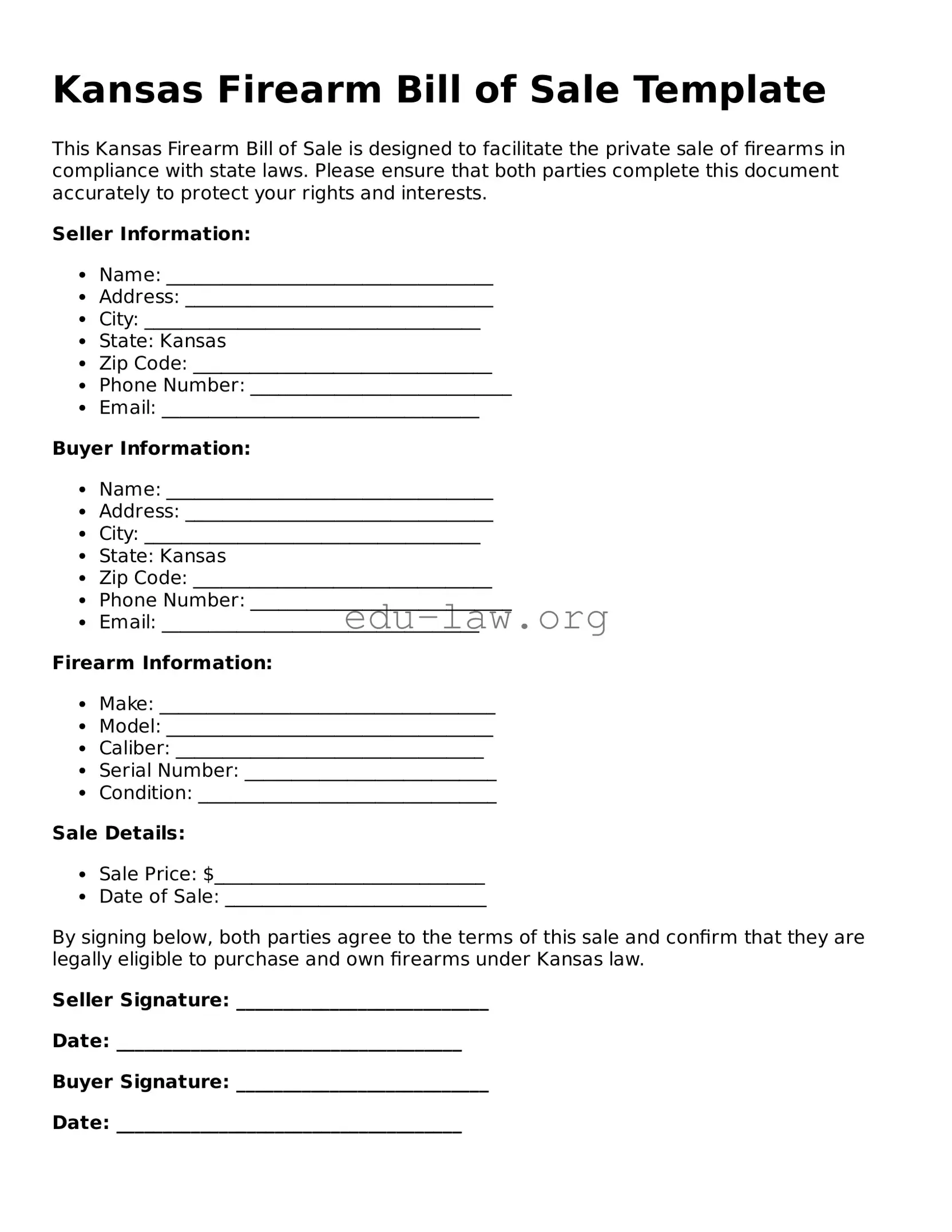
The Kansas Firearm Bill of Sale form serves as an important document for individuals engaged in the sale or transfer of firearms within the state. This form provides a clear record of the transaction, ensuring that both the buyer and seller have a written agreement that outlines the details of the sale. Key elements included in the form are the names and addresses of both parties, a description of the firearm being sold, and the sale price. Additionally, the form may require the seller to affirm that they are legally allowed to sell the firearm, while the buyer must confirm their eligibility to purchase it. By documenting these essential details, the Firearm Bill of Sale form helps protect both parties and promotes responsible firearm ownership. Understanding this form is crucial for anyone looking to buy or sell a firearm in Kansas, as it not only facilitates the transaction but also complies with state regulations.
Kansas Firearm Bill of Sale Template
This Kansas Firearm Bill of Sale is designed to facilitate the private sale of firearms in compliance with state laws. Please ensure that both parties complete this document accurately to protect your rights and interests.
Seller Information:
Buyer Information:
Firearm Information:
Sale Details:
By signing below, both parties agree to the terms of this sale and confirm that they are legally eligible to purchase and own firearms under Kansas law.
Seller Signature: ___________________________
Date: _____________________________________
Buyer Signature: ___________________________
Date: _____________________________________
Keep a copy of this Bill of Sale for your records. It serves as proof of the transaction and may be necessary for future reference.
| Fact Name | Description |
|---|---|
| Purpose | The Kansas Firearm Bill of Sale form serves as a legal document to record the sale or transfer of a firearm between parties. |
| Governing Law | This form is governed by Kansas Statutes Annotated (K.S.A.) 50-601 et seq., which outlines the laws regarding the sale and transfer of firearms. |
| Parties Involved | The form requires the names and addresses of both the seller and the buyer to ensure proper identification of the parties involved. |
| Firearm Description | A detailed description of the firearm, including make, model, caliber, and serial number, must be included in the form. |
| Date of Transaction | The date on which the sale or transfer occurs must be clearly stated on the form. |
| Consideration | The form should specify the amount of money or other consideration exchanged for the firearm. |
| Signatures | Both the seller and buyer must sign the form to validate the transaction and acknowledge the terms. |
| Record Keeping | It is advisable for both parties to keep a copy of the completed Bill of Sale for their records. |
| Legal Age Requirement | Both the seller and buyer must be at least 18 years old to legally engage in the sale of a firearm in Kansas. |
| Background Checks | While the Bill of Sale does not require a background check, it is recommended that the buyer undergoes one for safety and compliance. |
Filling out the Kansas Firearm Bill of Sale form is an important step in ensuring a smooth transfer of ownership. After completing the form, both the buyer and seller should keep a copy for their records. This documentation can help clarify ownership and protect both parties in case of future disputes.
What is a Kansas Firearm Bill of Sale form?
A Kansas Firearm Bill of Sale form is a legal document used to record the sale or transfer of a firearm between two parties. This form provides proof of the transaction and helps protect both the buyer and seller by documenting important details about the sale.
Is the Kansas Firearm Bill of Sale form required by law?
No, a Bill of Sale is not legally required in Kansas for private firearm sales. However, it is highly recommended to create a record of the transaction. This can help resolve any future disputes or legal issues that may arise regarding ownership.
What information is included in the form?
The form typically includes details such as the names and addresses of both the buyer and seller, the date of the transaction, a description of the firearm (including make, model, and serial number), and the purchase price. Both parties should sign the document to confirm the sale.
Can I create my own Kansas Firearm Bill of Sale form?
Yes, you can create your own Bill of Sale. However, it is important to ensure that all necessary information is included and that it complies with Kansas laws. Using a template or form specifically designed for firearm sales can simplify this process.
Do I need to have the Bill of Sale notarized?
Notarization is not required for a Kansas Firearm Bill of Sale. However, having the document notarized can add an extra layer of security and legitimacy to the transaction. It can also help if you ever need to provide proof of ownership.
What if the firearm has a lien on it?
If there is a lien on the firearm, the seller must disclose this information to the buyer. The sale should not proceed until the lien is resolved. It’s crucial for the buyer to ensure that they are purchasing a firearm that is free of any legal claims.
Can a non-resident purchase a firearm in Kansas?
Yes, non-residents can purchase firearms in Kansas. However, they must comply with both federal and state laws. It is advisable for non-residents to familiarize themselves with these regulations before making a purchase.
What should I do if I lose my Bill of Sale?
If you lose your Bill of Sale, it is recommended to create a new one. Both the buyer and seller should sign this new document and keep copies for their records. If possible, you may also want to include a note about the lost document in the new Bill of Sale.
Is there a specific age requirement to buy a firearm in Kansas?
Yes, in Kansas, a person must be at least 18 years old to purchase a firearm from a private seller. For purchases from licensed dealers, federal law requires buyers to be at least 21 years old for handguns.
Where can I find a Kansas Firearm Bill of Sale form?
You can find a Kansas Firearm Bill of Sale form online through various legal websites, or you can use a template from a reputable source. Make sure to choose a form that is specifically tailored for Kansas to ensure compliance with state laws.
Incomplete Information: One of the most common mistakes is failing to fill out all required fields. Buyers and sellers must provide their names, addresses, and relevant firearm details. Omitting even a single piece of information can render the form invalid.
Incorrect Dates: Entering the wrong date can lead to confusion about when the transaction took place. It is essential to ensure that the date reflects the actual day of the sale.
Misidentifying the Firearm: When describing the firearm, accuracy is crucial. Mistakes in the make, model, or serial number can create legal complications. Always double-check these details before finalizing the form.
Failure to Sign: Both parties must sign the form for it to be valid. Neglecting to do so can lead to disputes about the transaction. Ensure that all signatures are legible and placed in the correct locations.
Not Including Witness Information: In some cases, having a witness sign the form is necessary. Failing to include this can make the bill of sale less credible in the eyes of the law.
Using Outdated Forms: Laws and regulations can change, so using an outdated version of the Firearm Bill of Sale form may not comply with current requirements. Always check for the most recent version.
Not Keeping Copies: After completing the form, both parties should retain a copy for their records. Failing to do so can complicate future transactions or disputes regarding ownership.
When completing a firearm transaction in Kansas, several other forms and documents may be necessary to ensure the process is smooth and compliant with local laws. Below is a list of commonly used documents that can accompany the Kansas Firearm Bill of Sale form.
Having these documents prepared can help facilitate a successful and legal firearm transaction in Kansas. Always ensure that you are aware of and comply with local laws and regulations when engaging in such transactions.
The Kansas Firearm Bill of Sale form shares similarities with a standard Bill of Sale used for personal property transactions. Both documents serve as proof of transfer of ownership from one party to another. They typically include details such as the names of the buyer and seller, a description of the item, and the sale price. While the firearm bill of sale specifically pertains to firearms, the general bill of sale can apply to a wide range of items, from vehicles to electronics.
A Vehicle Bill of Sale is another document that resembles the Kansas Firearm Bill of Sale. Like the firearm bill, it acts as a legal record of the transfer of ownership. It includes key information such as the vehicle identification number (VIN), make, model, and year of the vehicle. Both documents protect the seller and buyer by providing a written record of the transaction, which can be crucial in case of disputes.
The Boat Bill of Sale is similar in function and purpose to the Kansas Firearm Bill of Sale. This document records the sale of a boat, including details like the hull identification number (HIN), make, and model. Just as with firearms, a boat bill of sale serves as proof that ownership has changed hands, helping to avoid potential legal issues in the future.
An ATV Bill of Sale also shares characteristics with the Kansas Firearm Bill of Sale. This document is used for the sale of all-terrain vehicles. It includes information about the ATV, such as the make, model, and VIN. Both documents ensure that the buyer has proof of ownership and that the seller has documentation of the sale, which is particularly important for registration purposes.
When filling out the Kansas Firearm Bill of Sale form, it’s important to ensure that the process goes smoothly. Here’s a list of things you should and shouldn’t do:
When it comes to the Kansas Firearm Bill of Sale form, misunderstandings abound. Here are nine common misconceptions that many people have:
Many believe that a Bill of Sale is optional. In reality, while it may not be legally required, having one can protect both the buyer and seller by providing proof of the transaction.
Some think that only licensed firearm dealers need to complete this form. However, private sales between individuals also benefit from a Bill of Sale, ensuring clarity and legality.
This form does not replace the need for a background check. Buyers must still undergo the appropriate checks, especially when purchasing from a dealer.
Each state has its own laws regarding firearm sales. Kansas has specific requirements, and it’s essential to understand them before proceeding with a sale.
While it documents the transaction, it does not guarantee that the seller has the legal right to sell the firearm. Buyers should ensure that the seller is the rightful owner.
Some people think that notarization is mandatory. In Kansas, notarization is not required for a Bill of Sale, though it can add an extra layer of security.
This form is specifically for firearms, but similar documentation can be beneficial for other types of property transactions. It’s not exclusive to guns.
While signing the Bill of Sale indicates agreement, it’s important to ensure that all terms are clear and understood by both parties to avoid future disputes.
Many fear that completing the Bill of Sale is a daunting task. In reality, it is a straightforward process that simply requires basic information about the buyer, seller, and firearm.
Understanding these misconceptions can help individuals navigate firearm transactions more effectively and responsibly in Kansas.
When dealing with the Kansas Firearm Bill of Sale form, there are several important points to keep in mind. Understanding these takeaways can help ensure a smooth transaction. Here are the key considerations:
By following these key takeaways, you can navigate the process of filling out and using the Kansas Firearm Bill of Sale form with confidence.