In the state of Kansas, planning for the future involves more than just financial considerations; it also requires ensuring that your healthcare and personal affairs are managed according to your wishes should you become unable to make decisions for yourself. One essential tool in this planning process is the Durable Power of Attorney (DPOA) form. This legal document allows you to appoint a trusted individual, known as your agent, to make decisions on your behalf in various situations, ranging from medical care to financial transactions. Unlike a regular power of attorney, the durable version remains effective even if you become incapacitated, providing peace of mind that your preferences will be honored. The DPOA form in Kansas covers critical aspects such as the scope of authority granted to your agent, any specific limitations you wish to impose, and instructions for healthcare decisions. Understanding how to properly complete and execute this form can empower you to take control of your future, ensuring that your voice is heard even when you cannot speak for yourself.
Kansas Durable Power of Attorney
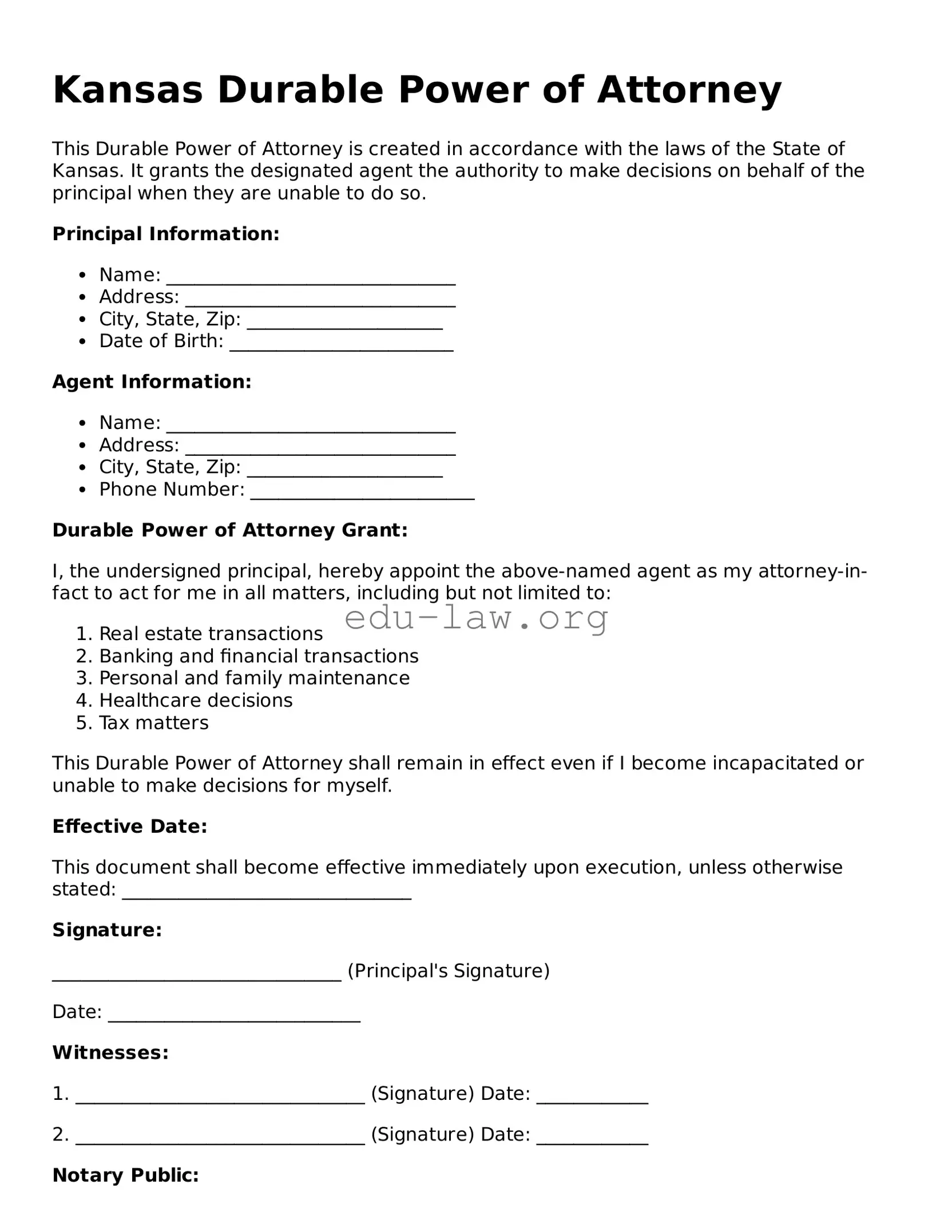
This Durable Power of Attorney is created in accordance with the laws of the State of Kansas. It grants the designated agent the authority to make decisions on behalf of the principal when they are unable to do so.
Principal Information:
Agent Information:
Durable Power of Attorney Grant:
I, the undersigned principal, hereby appoint the above-named agent as my attorney-in-fact to act for me in all matters, including but not limited to:
This Durable Power of Attorney shall remain in effect even if I become incapacitated or unable to make decisions for myself.
Effective Date:
This document shall become effective immediately upon execution, unless otherwise stated: _______________________________
Signature:
_______________________________ (Principal's Signature)
Date: ___________________________
Witnesses:
1. _______________________________ (Signature) Date: ____________
2. _______________________________ (Signature) Date: ____________
Notary Public:
State of Kansas, County of ________________
Subscribed and sworn to before me this _____ day of ___________, 20__.
_______________________________ (Notary Public Signature)
My commission expires: ________________
| Fact Name | Description |
|---|---|
| Definition | A Kansas Durable Power of Attorney allows an individual to appoint someone else to make decisions on their behalf, even if they become incapacitated. |
| Governing Law | The form is governed by the Kansas Statutes Annotated, specifically K.S.A. 58-6501 et seq. |
| Durability | This document remains effective even if the principal becomes mentally or physically incapacitated, unlike a standard power of attorney. |
| Revocation | The principal can revoke the durable power of attorney at any time, provided they are mentally competent to do so. |
Filling out the Kansas Durable Power of Attorney form is an important step in designating someone to manage your financial and legal affairs. It’s essential to ensure that the form is completed accurately to reflect your wishes clearly. Here’s how to fill it out step by step.
Once you have filled out the form and completed all necessary steps, it is advisable to discuss your decisions with your agent and any family members who may be affected. This ensures everyone understands your intentions and can support your choices effectively.
What is a Kansas Durable Power of Attorney?
A Kansas Durable Power of Attorney is a legal document that allows you to appoint someone to make decisions on your behalf if you become unable to do so. This can include financial decisions, medical care, and other important matters. The term "durable" means that the authority granted continues even if you become incapacitated.
Who can be appointed as an agent in a Durable Power of Attorney?
Any competent adult can be appointed as your agent. This can be a family member, friend, or a trusted advisor. It is important to choose someone you trust to act in your best interest and who understands your wishes.
Does the Durable Power of Attorney need to be notarized?
Yes, in Kansas, the Durable Power of Attorney must be signed in the presence of a notary public. This adds an extra layer of authenticity to the document, ensuring that it is legally binding.
Can I revoke my Durable Power of Attorney once it is created?
Yes, you can revoke your Durable Power of Attorney at any time, as long as you are mentally competent. To revoke, you should create a written document stating your intention to revoke and notify your agent and any institutions that may have relied on the original document.
What happens if I become incapacitated and do not have a Durable Power of Attorney?
If you become incapacitated without a Durable Power of Attorney in place, your family may need to go through a court process to obtain guardianship or conservatorship. This can be time-consuming and costly, and may not reflect your personal wishes.
Can I specify what powers my agent has in the Durable Power of Attorney?
Yes, you can specify the powers granted to your agent in the document. This can include financial transactions, managing real estate, and making healthcare decisions. Clearly outlining these powers can help avoid confusion and ensure your wishes are followed.
Is a Durable Power of Attorney effective immediately?
A Durable Power of Attorney can be effective immediately upon signing or can be set to become effective only upon your incapacity. You should clearly indicate your preference in the document.
Can I use a Durable Power of Attorney created in another state in Kansas?
Generally, a Durable Power of Attorney created in another state may be recognized in Kansas, but it is advisable to check the specific requirements of Kansas law. It may be beneficial to create a new document that complies with Kansas regulations for clarity.
What should I do with the Durable Power of Attorney once it is completed?
Once completed, keep the original document in a safe place. Provide copies to your appointed agent, any relevant family members, and financial institutions or healthcare providers that may need it. Ensuring that key people have access to the document is crucial for it to be effective.
Can I change my Durable Power of Attorney after it is signed?
Yes, you can change your Durable Power of Attorney at any time while you are still competent. This may involve creating a new document or amending the existing one. Always inform your agent and any institutions that have your previous document of any changes.
Not specifying the powers granted: Many individuals fail to clearly outline the specific powers they wish to grant their agent. This can lead to confusion and potential disputes later on.
Choosing the wrong agent: Selecting someone who may not act in your best interest can have serious consequences. It is crucial to choose a trustworthy and responsible person.
Not signing the document: A Durable Power of Attorney must be signed by the principal. Without a signature, the document is not valid.
Failing to date the form: Omitting the date can create uncertainty about when the powers take effect. Always include the date of signing.
Ignoring witness requirements: Kansas law requires that the Durable Power of Attorney be witnessed or notarized. Failing to meet these requirements can invalidate the document.
Not reviewing the document: After filling out the form, individuals often neglect to review it for accuracy. Mistakes or omissions can lead to complications.
Assuming the document is permanent: Some people believe that a Durable Power of Attorney cannot be revoked. In reality, it can be revoked at any time as long as the principal is competent.
Overlooking alternate agents: It is wise to name alternate agents in case the primary agent is unable or unwilling to act. Neglecting this can leave you without representation.
Not discussing the decision with the agent: Failing to communicate your wishes and expectations with the chosen agent can lead to misunderstandings and conflicts.
When creating a Kansas Durable Power of Attorney, it's often helpful to consider additional forms and documents that can complement this important legal tool. Each of these documents serves a unique purpose and can help ensure that your wishes are respected in various situations.
Having these documents in place alongside your Kansas Durable Power of Attorney can provide clarity and peace of mind. They ensure that your wishes are honored and that your loved ones have clear guidance in times of need.
The Kansas Durable Power of Attorney (DPOA) is similar to a General Power of Attorney (GPOA). Both documents allow an individual to appoint someone else to make decisions on their behalf. However, the DPOA remains effective even if the principal becomes incapacitated, while the GPOA typically ends if the principal loses their ability to make decisions. This makes the DPOA a more robust option for long-term planning.
A Medical Power of Attorney (MPOA) is another document that shares similarities with the DPOA. While the DPOA can cover a wide range of financial and legal decisions, the MPOA specifically focuses on healthcare decisions. It allows the appointed agent to make medical choices when the principal is unable to do so. Both documents empower someone to act on behalf of another, but they serve different purposes.
Similar to the DPOA, the Healthcare Proxy allows an individual to designate someone to make healthcare decisions. The key difference lies in the scope of authority. The Healthcare Proxy is focused solely on health-related decisions, while the DPOA can encompass financial and legal matters. Both documents ensure that someone trusted is making decisions when the principal cannot.
The Revocable Living Trust shares some characteristics with the DPOA, particularly in terms of asset management. A Revocable Living Trust allows an individual to place their assets into a trust while retaining control over them during their lifetime. Like the DPOA, it can help avoid probate and ensure that assets are managed according to the principal's wishes, even if they become incapacitated.
A Financial Power of Attorney (FPOA) is another document that functions similarly to the DPOA. Both grant authority to an agent to manage financial matters. However, the DPOA is often broader in scope, allowing for a variety of decisions beyond just financial transactions. The FPOA typically focuses on financial issues alone, making it a more limited option.
The Guardianship document is related to the DPOA in that both involve decision-making for individuals who cannot make decisions for themselves. Guardianship is a court-appointed arrangement, while the DPOA is created by the principal without court intervention. Both aim to protect the interests of individuals who may need assistance due to incapacity.
The Conservatorship document is similar to the DPOA in that it also involves someone managing the affairs of another person. A conservatorship is established through the court and is typically used when someone is unable to manage their own financial or personal affairs. In contrast, the DPOA allows individuals to choose their agent without court involvement, offering more flexibility and control.
Lastly, the Advance Directive is akin to the DPOA, particularly in its role in healthcare decision-making. An Advance Directive combines elements of both the Living Will and the MPOA, allowing individuals to express their medical treatment preferences and appoint someone to make decisions on their behalf. While the DPOA covers a broader range of decisions, the Advance Directive specifically addresses healthcare issues.
When filling out the Kansas Durable Power of Attorney form, follow these guidelines to ensure accuracy and compliance.
When considering a Kansas Durable Power of Attorney (DPOA), it’s essential to understand the common misconceptions surrounding this important legal document. Here are four prevalent misunderstandings:
This is not true. While many people associate DPOAs with older individuals, anyone can benefit from having one. Life is unpredictable, and a DPOA can be vital for anyone who wants to ensure their financial and healthcare decisions are managed according to their wishes in case they become incapacitated.
This misconception overlooks the fact that the agent's authority is limited to what the principal specifies in the document. The agent must act in the best interest of the principal and follow the guidelines laid out in the DPOA. Misuse of power can lead to legal consequences.
In Kansas, a DPOA can be set up to become effective immediately or only upon the principal's incapacitation. It’s crucial to clarify this aspect when drafting the document to ensure it aligns with the principal's intentions.
While both documents are essential for planning, they serve different purposes. A DPOA focuses on financial and legal decisions, whereas a living will outlines preferences for medical treatment in end-of-life situations. Understanding these distinctions is vital for effective estate planning.
When considering the Kansas Durable Power of Attorney form, it is essential to understand its significance and how to use it effectively. Here are some key takeaways:
Understanding these points can help you make informed decisions about your financial future and ensure that your wishes are respected when you can no longer communicate them yourself.