In Kansas, the Do Not Resuscitate (DNR) Order form serves as a crucial document for individuals who wish to communicate their preferences regarding medical interventions in the event of a life-threatening situation. This form empowers patients to make informed choices about their end-of-life care, ensuring that their wishes are respected by healthcare providers. The DNR Order is designed to prevent the initiation of cardiopulmonary resuscitation (CPR) and other life-sustaining measures when a person's heart stops or they stop breathing. It is essential for individuals to discuss their decisions with family members and healthcare professionals to ensure clarity and understanding. The form must be completed and signed by a physician, and it is important for patients to keep a copy readily available, as well as to inform their loved ones about its existence. Understanding the implications of a DNR Order can provide peace of mind during difficult times, allowing individuals to maintain control over their healthcare choices even when they may not be able to communicate those wishes themselves.
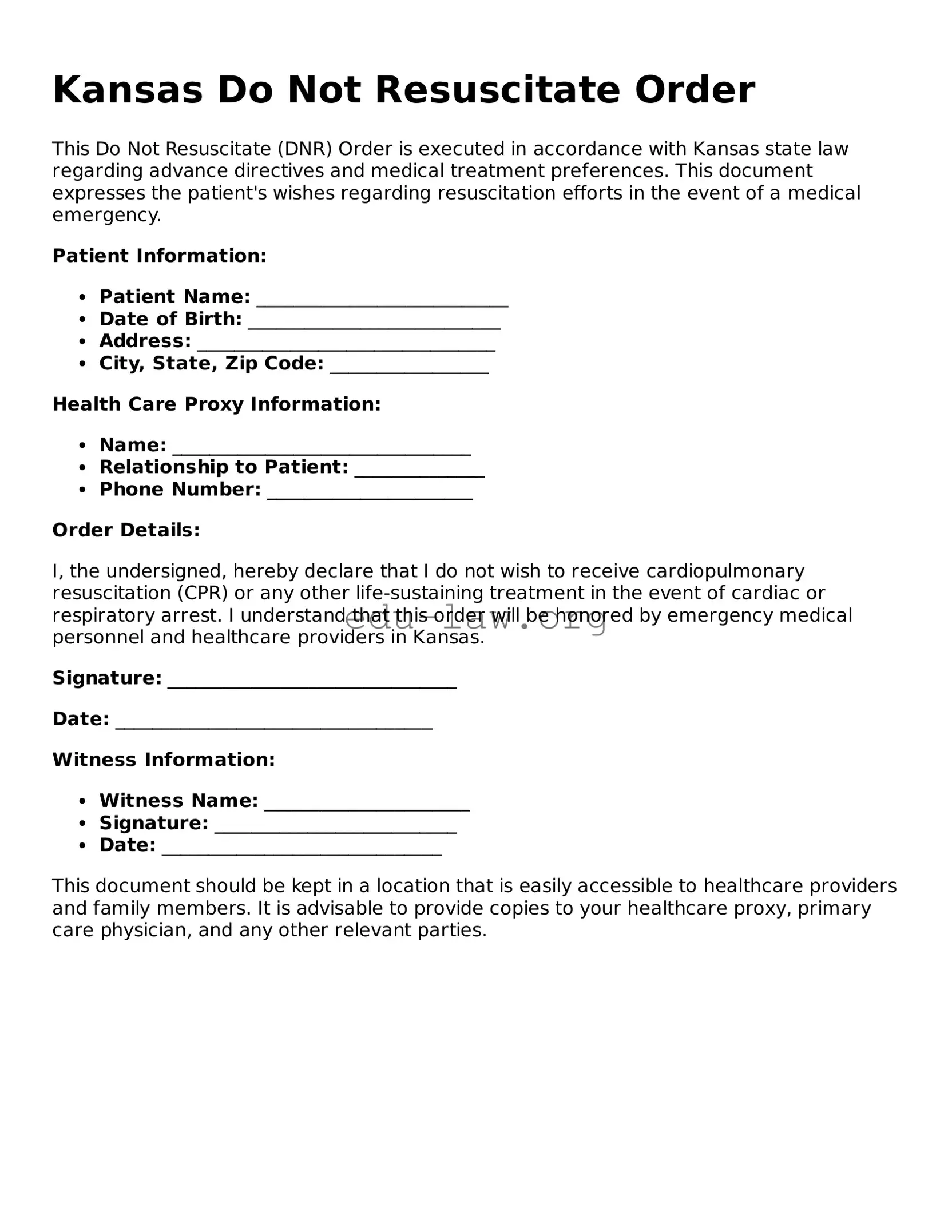
Kansas Do Not Resuscitate Order
This Do Not Resuscitate (DNR) Order is executed in accordance with Kansas state law regarding advance directives and medical treatment preferences. This document expresses the patient's wishes regarding resuscitation efforts in the event of a medical emergency.
Patient Information:
Health Care Proxy Information:
Order Details:
I, the undersigned, hereby declare that I do not wish to receive cardiopulmonary resuscitation (CPR) or any other life-sustaining treatment in the event of cardiac or respiratory arrest. I understand that this order will be honored by emergency medical personnel and healthcare providers in Kansas.
Signature: _______________________________
Date: __________________________________
Witness Information:
This document should be kept in a location that is easily accessible to healthcare providers and family members. It is advisable to provide copies to your healthcare proxy, primary care physician, and any other relevant parties.
| Fact Name | Description |
|---|---|
| Governing Law | The Kansas Do Not Resuscitate Order is governed by K.S.A. 65-4901 et seq. |
| Purpose | This form allows individuals to refuse resuscitation in the event of cardiac or respiratory arrest. |
| Eligibility | Any adult can complete a Do Not Resuscitate Order in Kansas, as long as they are of sound mind. |
| Signature Requirement | The form must be signed by the individual or their authorized representative. |
| Healthcare Provider Notification | Healthcare providers must be informed of the existence of the Do Not Resuscitate Order. |
| Form Validity | The order remains valid until revoked by the individual or their representative. |
| Emergency Medical Services | Emergency Medical Services must comply with the Do Not Resuscitate Order in the field. |
| Availability | The Kansas Do Not Resuscitate Order form can be obtained from healthcare providers or online. |
Filling out the Kansas Do Not Resuscitate Order form is an important step in expressing your medical preferences. After completing the form, ensure that it is signed and shared with your healthcare provider and family members to avoid confusion in emergency situations.
What is a Do Not Resuscitate (DNR) Order in Kansas?
A Do Not Resuscitate Order is a legal document that allows a person to refuse cardiopulmonary resuscitation (CPR) in the event of a cardiac arrest or respiratory failure. In Kansas, this order ensures that emergency medical personnel do not perform resuscitation efforts if the individual has specified their wishes not to be resuscitated.
Who can request a DNR Order?
In Kansas, any adult who is capable of making informed decisions about their medical care can request a DNR Order. This includes individuals with terminal illnesses or those who wish to avoid aggressive medical interventions at the end of life. Additionally, a legal guardian or healthcare proxy can request a DNR on behalf of an individual who is unable to do so.
How do I obtain a DNR Order in Kansas?
To obtain a DNR Order, you must complete the Kansas Do Not Resuscitate Order form. This form can be obtained from healthcare providers, hospitals, or online resources. After filling out the form, it must be signed by a physician and the individual requesting the DNR, or their authorized representative. It is important to keep copies of the signed order in easily accessible locations.
Is a DNR Order valid in all healthcare settings?
Yes, a DNR Order is valid in all healthcare settings in Kansas, including hospitals, nursing homes, and at home. However, it is crucial to ensure that the order is properly completed and signed. Emergency medical personnel will honor the DNR Order as long as it is presented and meets the legal requirements.
Can a DNR Order be revoked?
Yes, a DNR Order can be revoked at any time. The individual who signed the order or their authorized representative can verbally express their wish to revoke it or can destroy the written document. It is advisable to inform healthcare providers of any changes to ensure that your current wishes are respected.
What should I do if I change my mind about my DNR Order?
If you change your mind about your DNR Order, you can revoke it as mentioned earlier. You should inform your healthcare provider and ensure that any copies of the previous DNR Order are removed from your medical records. It is also helpful to create a new order if you decide to continue with different directives regarding your medical care.
Where should I keep my DNR Order?
Keep your DNR Order in a place that is easily accessible to you and your loved ones. It is advisable to keep a copy in your medical records, at home, and with your healthcare proxy. Inform family members and caregivers about the location of the order to ensure that it can be quickly retrieved if needed.
Not understanding the purpose of the form: Many individuals fill out the Kansas Do Not Resuscitate Order form without fully grasping its intent. This form is designed to communicate a person's wishes regarding resuscitation efforts in the event of a medical emergency. It is crucial to be clear about what it means to decline resuscitation.
Failing to discuss with healthcare providers: A common mistake is not consulting with doctors or healthcare professionals before completing the form. Engaging in a conversation about medical conditions, treatment options, and the implications of a DNR order can help ensure that the decision aligns with personal values and health circumstances.
Inaccurate or incomplete information: Some individuals may neglect to fill out all required sections of the form or provide incorrect information. This can lead to confusion and potentially result in unwanted medical interventions. Double-checking all entries is essential.
Not updating the form: Life circumstances can change, and so can a person’s wishes regarding resuscitation. Failing to review and update the DNR order periodically can result in outdated directives that no longer reflect current preferences.
Not sharing the form: After completing the DNR order, it’s important to share copies with family members and healthcare providers. If the form is not easily accessible during a medical emergency, it may not be honored, leading to unwanted resuscitation efforts.
Ignoring state-specific requirements: Each state has its own regulations regarding DNR orders. Some individuals may overlook specific Kansas requirements, such as signatures or witness statements, which can render the form invalid. Familiarizing oneself with local laws is vital.
When considering a Kansas Do Not Resuscitate (DNR) Order, it's essential to understand that it often accompanies several other important documents. These forms help ensure that your healthcare preferences are clear and respected. Below is a list of commonly used forms and documents that work alongside a DNR order.
Understanding these documents can help ensure that your healthcare wishes are respected and followed. It’s always a good idea to discuss your preferences with your family and healthcare providers to ensure everyone is on the same page.
The Kansas Do Not Resuscitate Order (DNR) form shares similarities with the Advance Directive. An Advance Directive is a legal document that allows individuals to outline their preferences for medical treatment in case they become unable to communicate those wishes. Like the DNR, it is intended to guide healthcare providers in making decisions that align with a person's values and desires. Both documents aim to ensure that a patient's treatment aligns with their wishes, particularly in situations where they may be incapacitated. In essence, they empower individuals to maintain control over their healthcare choices even when they cannot speak for themselves.
Another document akin to the Kansas DNR is the Physician Orders for Life-Sustaining Treatment (POLST) form. The POLST form is designed for individuals with serious illnesses or those nearing the end of life. It translates a patient’s treatment preferences into actionable medical orders that healthcare providers must follow. Similar to the DNR, the POLST form addresses specific medical interventions, including resuscitation efforts, and is intended to ensure that a patient's wishes are respected in emergency situations. Both documents serve as critical tools for communication between patients and healthcare providers regarding end-of-life care.
The Living Will is another document that parallels the Kansas DNR. A Living Will outlines a person’s wishes regarding medical treatment in situations where they are terminally ill or permanently unconscious. It specifies the types of medical interventions an individual does or does not want, particularly life-sustaining treatments. While the DNR specifically addresses resuscitation efforts, the Living Will provides broader directives about various medical treatments. Both documents empower individuals to communicate their healthcare preferences, ensuring that their values are honored even when they are unable to express them directly.
Lastly, the Health Care Proxy is similar to the Kansas DNR in that it allows individuals to designate someone to make healthcare decisions on their behalf. This document is particularly useful when a person is unable to communicate their wishes due to illness or injury. While the DNR focuses specifically on resuscitation orders, the Health Care Proxy encompasses a wider range of medical decisions. Both documents aim to facilitate patient autonomy and ensure that healthcare providers respect the individual's wishes, making them essential components of end-of-life planning.
When filling out the Kansas Do Not Resuscitate Order form, it is essential to follow specific guidelines to ensure your wishes are accurately documented. Here are ten important do's and don'ts to consider:
By adhering to these guidelines, you can ensure that your Do Not Resuscitate Order reflects your wishes and is respected by medical professionals when it matters most.
Misconceptions about the Kansas Do Not Resuscitate (DNR) Order form can lead to confusion and anxiety. Here are nine common misunderstandings:
This is not true. A DNR specifically addresses resuscitation efforts in the event of cardiac arrest. It does not prevent you from receiving other medical treatments.
While many people with terminal illnesses choose to have a DNR, it is not limited to them. Anyone can decide to have a DNR based on their personal health care wishes.
A DNR is legally binding in the context of emergency medical services and hospitals, but it may not apply in certain situations, such as in the presence of a patient who has not been officially declared incapacitated.
While doctors often help patients complete a DNR, individuals can also fill out the form themselves, as long as it meets state requirements.
This is incorrect. A DNR can be revoked or modified at any time by the patient or their legal representative.
A DNR does not affect your right to receive pain management or palliative care. Comfort measures will still be provided.
While most medical professionals are trained to honor DNR orders, there can be exceptions. It is important to communicate your wishes clearly with your healthcare team.
In general, a DNR reflects the patient's wishes. Family members cannot override it unless they have legal authority to make medical decisions on behalf of the patient.
This misconception is misleading. People of all ages may choose to have a DNR based on their health status and personal values.
When considering the Kansas Do Not Resuscitate (DNR) Order form, it is essential to understand its purpose and implications. Here are key takeaways to keep in mind:
Understanding these points can help individuals make informed decisions about their medical care and ensure their preferences are respected.