When navigating the often challenging waters of divorce, having a clear understanding of the Kansas Divorce Settlement Agreement form is essential for both parties involved. This document serves as a crucial blueprint for outlining the terms of the divorce, addressing key elements such as the division of marital property, spousal support, and child custody arrangements. It provides a structured framework that helps ensure that both individuals can move forward with their lives while minimizing conflict and uncertainty. By detailing how assets and debts will be divided, the form aims to protect the rights and interests of both spouses, making it a fundamental part of the divorce process in Kansas. Additionally, it covers provisions for child support and visitation rights, ensuring that the well-being of any children is prioritized. Overall, this agreement not only facilitates a smoother transition into post-divorce life but also serves as a legally binding document that can be referenced in the future if disputes arise.
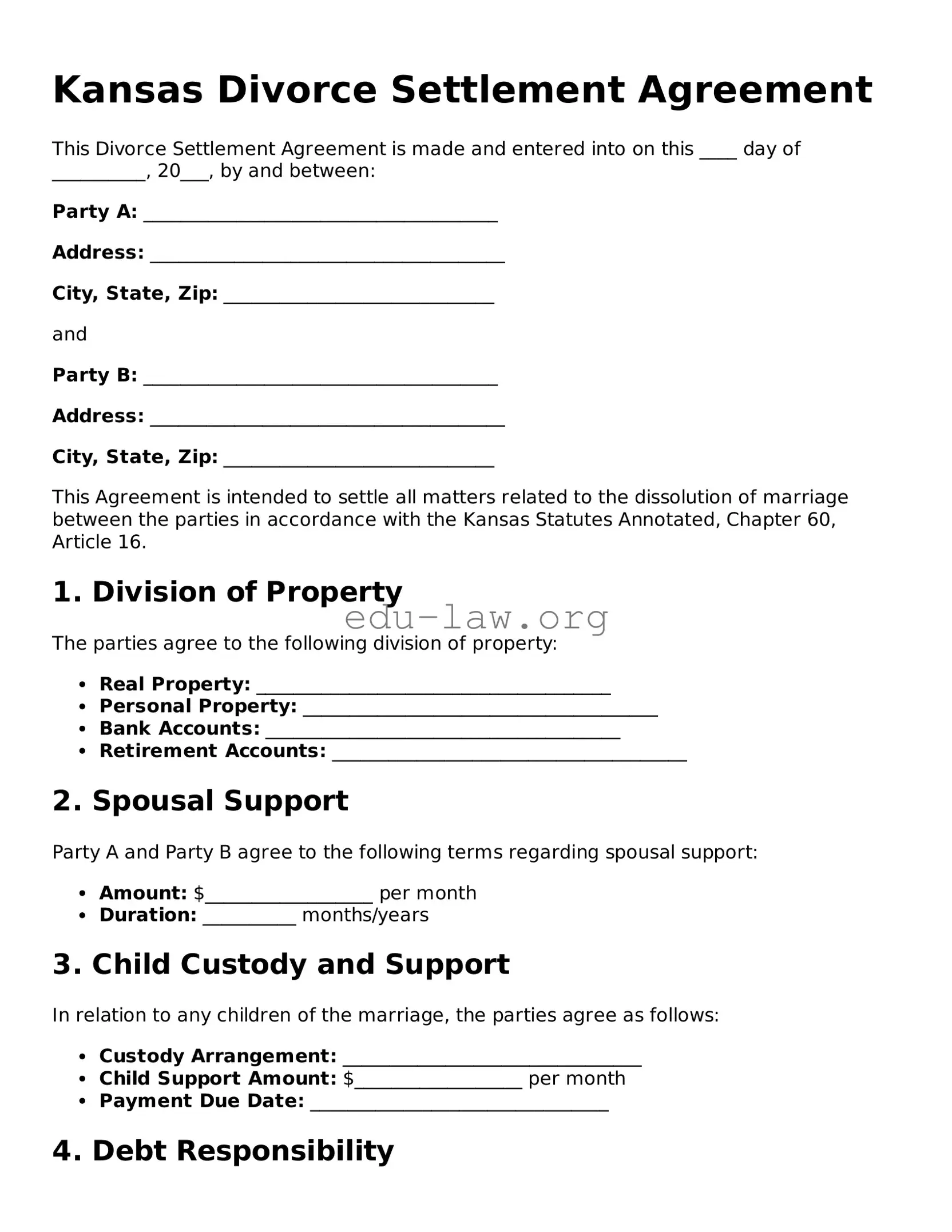
Kansas Divorce Settlement Agreement
This Divorce Settlement Agreement is made and entered into on this ____ day of __________, 20___, by and between:
Party A: ______________________________________
Address: ______________________________________
City, State, Zip: _____________________________
and
Party B: ______________________________________
Address: ______________________________________
City, State, Zip: _____________________________
This Agreement is intended to settle all matters related to the dissolution of marriage between the parties in accordance with the Kansas Statutes Annotated, Chapter 60, Article 16.
1. Division of Property
The parties agree to the following division of property:
2. Spousal Support
Party A and Party B agree to the following terms regarding spousal support:
3. Child Custody and Support
In relation to any children of the marriage, the parties agree as follows:
4. Debt Responsibility
The parties acknowledge the following debts and agree on their responsibility:
5. Miscellaneous Provisions
Other terms of this Agreement include:
IN WITNESS WHEREOF, the parties have executed this Divorce Settlement Agreement as of the date first above written.
Party A Signature: ____________________________ Date: ______________
Party B Signature: ____________________________ Date: ______________
Witness Signature: ____________________________ Date: ______________
| Fact Name | Description |
|---|---|
| Governing Law | The Kansas Divorce Settlement Agreement is governed by the Kansas Statutes Annotated (K.S.A.) 60-1601 et seq. |
| Purpose | This form outlines the terms of the divorce settlement between spouses, including asset division and support obligations. |
| Filing Requirement | The agreement must be filed with the court as part of the divorce proceedings to be enforceable. |
| Mutual Consent | Both parties must agree to the terms outlined in the settlement for it to be valid. |
| Child Custody and Support | If children are involved, the agreement must address custody arrangements and child support obligations. |
| Property Division | The form should clearly define how marital property and debts will be divided between the spouses. |
| Legal Representation | While not required, it is advisable for each party to seek legal advice before signing the agreement. |
| Modification | Changes to the agreement may be made if both parties consent and the modification is documented properly. |
| Finality | Once approved by the court, the settlement agreement becomes a legally binding order. |
After you have gathered all necessary information and documents, you are ready to complete the Kansas Divorce Settlement Agreement form. This form outlines the terms of your divorce settlement and should be filled out carefully to ensure clarity and mutual understanding.
Once you have completed the form, review it for accuracy. Both parties should keep a copy for their records. The next step is to file the agreement with the appropriate court, where it will be reviewed and approved as part of your divorce proceedings.
What is a Kansas Divorce Settlement Agreement?
A Kansas Divorce Settlement Agreement is a legal document that outlines the terms and conditions agreed upon by both spouses during a divorce. This agreement addresses various aspects of the divorce, including property division, child custody, visitation rights, and spousal support. By formalizing these agreements, the document helps to ensure that both parties are on the same page, reducing the likelihood of future disputes.
How do I create a Divorce Settlement Agreement in Kansas?
Creating a Divorce Settlement Agreement involves several steps. First, both parties should gather all relevant financial information, including assets, debts, and income. Next, discussions should take place to negotiate the terms of the agreement. It is often helpful to draft an outline of the key points, such as how property will be divided and arrangements for any children. Once both parties reach a consensus, the agreement should be written down clearly. It is advisable to consult with a legal professional to ensure that the document complies with Kansas laws and adequately protects both parties' interests.
Is a Divorce Settlement Agreement legally binding?
Yes, once both parties sign the Divorce Settlement Agreement, it becomes legally binding. This means that both spouses are obligated to follow the terms outlined in the document. If one party fails to comply with the agreement, the other party may seek enforcement through the court. It is important to understand that the agreement must be fair and reasonable; otherwise, a court may choose not to enforce it.
Can a Divorce Settlement Agreement be modified after it is signed?
Yes, a Divorce Settlement Agreement can be modified, but only under certain circumstances. If both parties agree to the changes, they can draft a new agreement or an amendment to the original document. However, if one party wishes to modify the agreement unilaterally, they may need to go to court to demonstrate a significant change in circumstances, such as a job loss or a change in the needs of the children. Courts generally prefer that both parties consent to modifications to avoid potential conflicts.
Incomplete Information: One common mistake is failing to fill out all required sections of the form. Every detail matters, so make sure to provide complete information about assets, debts, and personal details.
Not Disclosing All Assets: Some individuals overlook certain assets, like retirement accounts or hidden bank accounts. It’s crucial to disclose everything to avoid future disputes.
Ignoring State Guidelines: Kansas has specific rules regarding the division of property and custody arrangements. Ignoring these can lead to complications down the line.
Failing to Consider Tax Implications: Some people forget that dividing assets can have tax consequences. Understanding these implications can help in making informed decisions.
Not Addressing Child Support Properly: When children are involved, it’s essential to clearly outline child support arrangements. Vague language can lead to misunderstandings later.
Overlooking Spousal Support: If spousal support is applicable, it should be clearly defined in the agreement. Many forget to include this, leading to disputes after the divorce is finalized.
Not Seeking Legal Advice: Many individuals attempt to fill out the form without consulting a lawyer. While it’s possible to do it alone, professional guidance can prevent costly mistakes.
When navigating the divorce process in Kansas, several key documents accompany the Divorce Settlement Agreement. Each of these forms plays a vital role in ensuring that all aspects of the divorce are addressed properly. Below is a list of common documents you may encounter.
Understanding these documents can significantly ease the divorce process. Each plays a specific role in ensuring that all necessary legal matters are addressed, paving the way for a smoother transition to post-divorce life.
The Kansas Parenting Plan is a document that outlines the arrangements for child custody and visitation after a divorce. Similar to the Divorce Settlement Agreement, it addresses important aspects of family dynamics, such as where the children will live and how parents will share decision-making responsibilities. Both documents aim to provide clarity and structure, ensuring that the best interests of the children are prioritized while also addressing the needs of both parents.
The Kansas Child Support Worksheet is another related document. This form calculates the amount of financial support one parent must provide to the other for the care of their children. Like the Divorce Settlement Agreement, it requires detailed information about income, expenses, and other financial factors. Both documents work together to ensure that children are financially supported, fostering a cooperative approach to co-parenting post-divorce.
The Kansas Marital Settlement Agreement serves a similar purpose but focuses on the division of marital assets and debts. This document outlines how property will be divided between the spouses, much like the Divorce Settlement Agreement, which also addresses asset distribution. Both documents are essential for ensuring that each party understands their rights and responsibilities regarding shared property, helping to prevent future disputes.
The Kansas QDRO (Qualified Domestic Relations Order) is another important legal document that can accompany a Divorce Settlement Agreement. A QDRO is used to divide retirement accounts and pensions between spouses. Similar to the Divorce Settlement Agreement, it requires precise details about the financial assets involved. Both documents aim to ensure a fair distribution of assets, especially when it comes to long-term financial security for both parties.
The Kansas Affidavit of Financial Disclosure is a crucial document that provides a full picture of each party's financial situation during divorce proceedings. This form is similar to the Divorce Settlement Agreement in that it requires transparency regarding income, debts, and assets. Both documents play a vital role in ensuring that any agreements made are based on accurate and complete financial information, which helps facilitate fair negotiations.
Finally, the Kansas Petition for Divorce is the initial document filed to start the divorce process. While the Divorce Settlement Agreement is focused on the terms of the divorce, the Petition outlines the reasons for the divorce and the relief sought. Both documents are interconnected, as the Petition sets the stage for discussions that will ultimately lead to the creation of the Settlement Agreement, ensuring that all relevant issues are addressed throughout the divorce process.
When filling out the Kansas Divorce Settlement Agreement form, it is essential to approach the process with care and attention to detail. Below is a list of ten things to do and not do during this important task.
Things You Should Do:
Things You Shouldn't Do:
The Kansas Divorce Settlement Agreement form is often misunderstood. Below are some common misconceptions about this form, along with explanations to clarify them.
When completing the Kansas Divorce Settlement Agreement form, it's crucial to keep several key points in mind. This document outlines the terms of your divorce and can significantly impact your future. Here are important takeaways to consider:
By paying attention to these key points, you can navigate the divorce process more smoothly and protect your interests effectively.