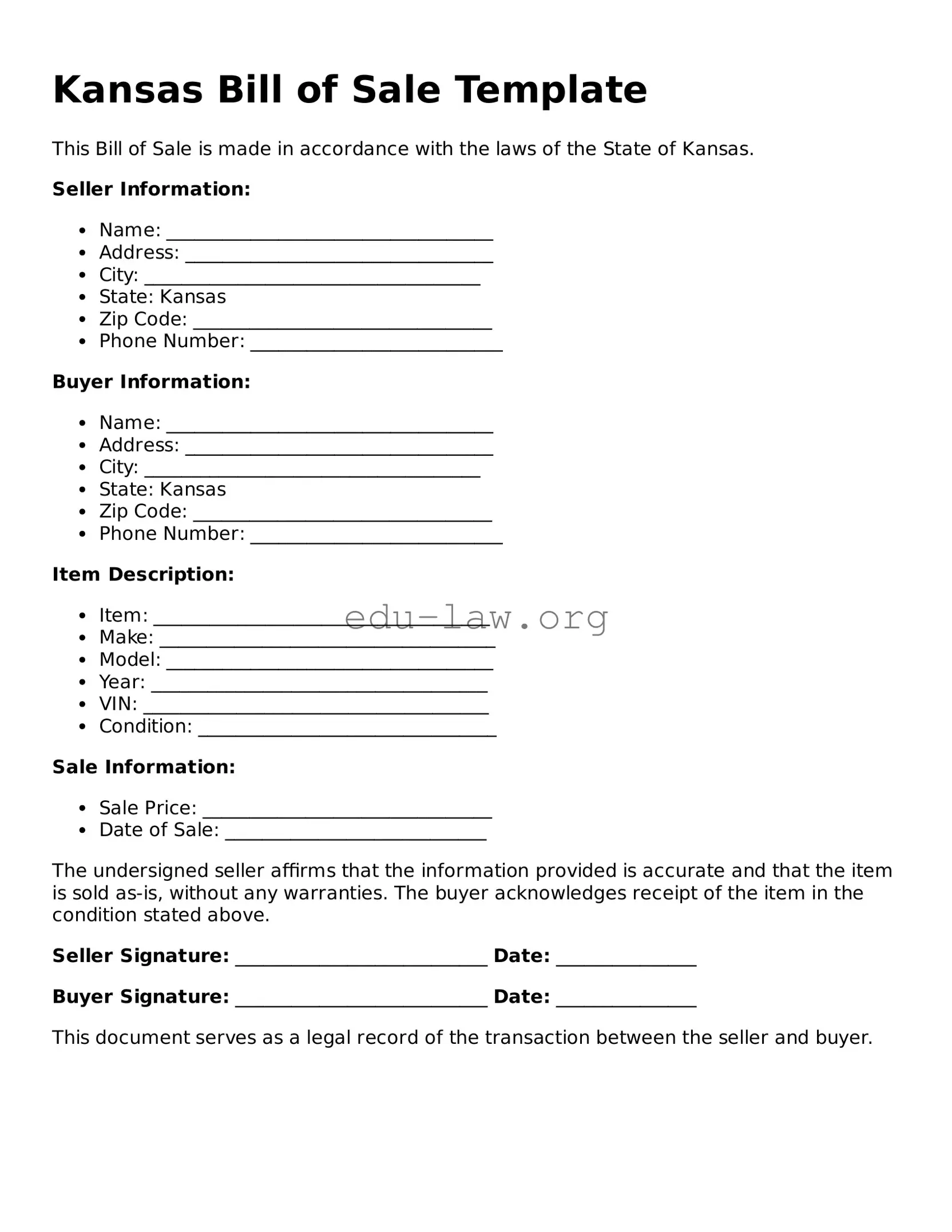
When engaging in the sale or transfer of personal property in Kansas, a Bill of Sale serves as a crucial document that outlines the transaction between the buyer and the seller. This form not only provides a clear record of the exchange but also protects the rights of both parties involved. Typically, a Kansas Bill of Sale includes essential details such as the names and addresses of the buyer and seller, a description of the item being sold, and the purchase price. Additionally, it may contain information regarding the condition of the item, any warranties or guarantees, and the date of the transaction. While the form is straightforward, its significance cannot be understated; it serves as proof of ownership and can be vital in resolving disputes should they arise in the future. Understanding the components and importance of a Bill of Sale can empower individuals to navigate their transactions with confidence and clarity.
Kansas Bill of Sale Template
This Bill of Sale is made in accordance with the laws of the State of Kansas.
Seller Information:
Buyer Information:
Item Description:
Sale Information:
The undersigned seller affirms that the information provided is accurate and that the item is sold as-is, without any warranties. The buyer acknowledges receipt of the item in the condition stated above.
Seller Signature: ___________________________ Date: _______________
Buyer Signature: ___________________________ Date: _______________
This document serves as a legal record of the transaction between the seller and buyer.
| Fact Name | Description |
|---|---|
| Purpose | The Kansas Bill of Sale form is used to document the sale of personal property, such as vehicles, furniture, or equipment. |
| Legal Requirement | While not legally required, a Bill of Sale provides proof of the transaction and protects both the buyer and seller. |
| Governing Laws | The form is governed by Kansas Statutes, specifically K.S.A. 84-2-201, which relates to the sale of goods. |
| Information Included | The form typically includes details such as the names of the buyer and seller, a description of the item sold, and the sale price. |
| Notarization | Notarization is not required for a Bill of Sale in Kansas, but it can add an extra layer of authenticity. |
| Transfer of Ownership | The Bill of Sale serves as a record of the transfer of ownership from the seller to the buyer. |
| Vehicle Sales | For vehicle sales, the Kansas Department of Revenue requires a Bill of Sale to complete the title transfer process. |
| Tax Implications | Sales tax may apply to the transaction, and both parties should be aware of their tax obligations. |
| Storage | It is advisable for both parties to keep a copy of the Bill of Sale for their records in case of future disputes. |
After obtaining the Kansas Bill of Sale form, you'll need to complete it accurately to ensure a smooth transaction. This form serves as a record of the sale between the buyer and the seller, capturing essential details about the item being sold.
Once completed, both parties should keep a copy of the Bill of Sale for their records. This document may be important for future reference, especially for ownership verification or tax purposes.
What is a Kansas Bill of Sale form?
A Kansas Bill of Sale form is a legal document used to transfer ownership of personal property from one party to another. This form serves as proof of the transaction and outlines the details of the sale, including the buyer, seller, item description, and sale price. It is commonly used for vehicles, boats, and other tangible goods.
Is a Bill of Sale required in Kansas?
While a Bill of Sale is not legally required for all transactions in Kansas, it is highly recommended. Having a Bill of Sale can provide protection for both the buyer and seller. It serves as evidence of the transaction and can help resolve disputes regarding ownership or payment in the future.
What information should be included in a Kansas Bill of Sale?
A Kansas Bill of Sale should include several key pieces of information. This includes the names and addresses of both the buyer and seller, a detailed description of the item being sold (including make, model, and VIN for vehicles), the sale price, and the date of the transaction. Both parties should sign the document to validate the agreement.
Can a Bill of Sale be used for vehicles in Kansas?
Yes, a Bill of Sale can be used for vehicles in Kansas. In fact, when transferring ownership of a vehicle, a Bill of Sale is often required in conjunction with the title transfer. It provides essential details about the sale and can help facilitate the registration process with the Kansas Department of Revenue.
Do I need to have the Bill of Sale notarized?
In Kansas, a Bill of Sale does not need to be notarized to be legally binding. However, having it notarized can add an extra layer of security and authenticity to the document. This can be particularly useful in cases of disputes or if the transaction involves a significant amount of money.
What if the item being sold has a lien on it?
If the item being sold has a lien, it is important to disclose this information in the Bill of Sale. The seller should ensure that the lien is paid off before the sale is completed. Failure to do so can lead to legal complications for the buyer, who may find themselves responsible for the lien after the purchase.
Where can I obtain a Kansas Bill of Sale form?
A Kansas Bill of Sale form can be obtained from various sources. Many legal websites offer downloadable templates that can be customized. Additionally, local government offices, such as the county clerk’s office, may provide official forms. It is important to ensure that the form meets all legal requirements for the specific type of transaction.
Failing to include all necessary information about the buyer and seller. It is essential to provide full names, addresses, and contact information for both parties. Omitting this information can lead to disputes or confusion in the future.
Not accurately describing the item being sold. A detailed description should include the make, model, year, and condition of the item. Without this information, the transaction may be challenged.
Leaving out the purchase price. It is important to clearly state the amount paid for the item. Failing to do so can create misunderstandings or legal issues later on.
Neglecting to include the date of the transaction. The date is crucial for record-keeping and can affect warranties or claims related to the sale.
Not signing the document. Both the buyer and seller must sign the Bill of Sale to validate the transaction. A lack of signatures can render the document ineffective.
Using incorrect or outdated forms. It is important to ensure that the correct version of the Kansas Bill of Sale form is used. Using an outdated form may lead to compliance issues.
When completing a transaction in Kansas, a Bill of Sale is often accompanied by several other important documents. These forms help ensure that the sale is clear and legally binding. Here are five documents that are commonly used alongside the Kansas Bill of Sale:
Having these documents ready can streamline the sale process and provide peace of mind for both the buyer and the seller. Ensure that all forms are completed accurately to avoid any issues in the future.
The Kansas Bill of Sale form is similar to a Vehicle Title Transfer form. Both documents are used to transfer ownership of a vehicle from one party to another. The Vehicle Title Transfer form provides essential information about the vehicle, such as its make, model, and VIN, while also requiring signatures from both the seller and the buyer. This ensures that the transaction is legally recognized and protects the rights of both parties involved.
Another document akin to the Kansas Bill of Sale is the Personal Property Bill of Sale. This form is specifically designed for the sale of personal items, such as furniture, electronics, or collectibles. Like the Kansas Bill of Sale, it includes details about the item being sold, the purchase price, and the parties involved. Both documents serve to validate the transaction and provide a record for future reference.
The Rental Agreement is also comparable to the Kansas Bill of Sale, though it serves a different purpose. While the Bill of Sale transfers ownership, a Rental Agreement outlines the terms under which one party rents property from another. It specifies details such as the rental period, payment terms, and responsibilities of both the landlord and tenant. Both documents require clear communication and agreement between the parties to avoid disputes.
The Lease Agreement shares similarities with the Kansas Bill of Sale in that both documents involve the transfer of rights related to property. A Lease Agreement allows one party to use property owned by another for a specified time in exchange for payment. While the Bill of Sale finalizes a sale, the Lease Agreement establishes ongoing terms for use, highlighting the importance of clarity in both transactions.
Lastly, the Warranty Deed is related to the Kansas Bill of Sale in that it involves the transfer of real estate ownership. A Warranty Deed provides a guarantee that the seller has the right to sell the property and that the property is free from any encumbrances. Both documents are critical in ensuring that ownership is legally transferred and that the buyer is protected from potential claims against the property.
When filling out the Kansas Bill of Sale form, attention to detail is crucial. Here are some important dos and don'ts to keep in mind:
The Kansas Bill of Sale form is an important document for transactions involving personal property. However, there are several misconceptions surrounding its use and requirements. Here are ten common misunderstandings:
Many people believe that a Bill of Sale is only necessary for selling cars. In reality, it can be used for any personal property transaction, including boats, furniture, and equipment.
This form serves as a legal record of the transaction. When properly completed, it can hold up in court if disputes arise.
While notarization can add an extra layer of security, it is not a requirement for a Bill of Sale in Kansas unless specified by the parties involved.
A Bill of Sale does not need to be filed with any government agency in Kansas. It is primarily for the buyer and seller's records.
Each Bill of Sale can be tailored to fit the specific transaction. Different types of property may require different information.
A verbal agreement is not sufficient. A written Bill of Sale provides clear evidence of the transaction.
Both the buyer and the seller should keep a copy of the Bill of Sale for their records.
A Bill of Sale can be used for both new and used items. It is relevant for any sale of personal property.
If a gift involves a transfer of ownership, a Bill of Sale can still be useful to document the transaction.
It is best to complete the Bill of Sale at the time of the transaction to ensure accuracy and clarity.
When completing the Kansas Bill of Sale form, it's essential to understand its purpose and requirements. Here are key takeaways to guide you through the process:
By following these guidelines, you can ensure a smooth and legally sound transaction when using the Kansas Bill of Sale form.