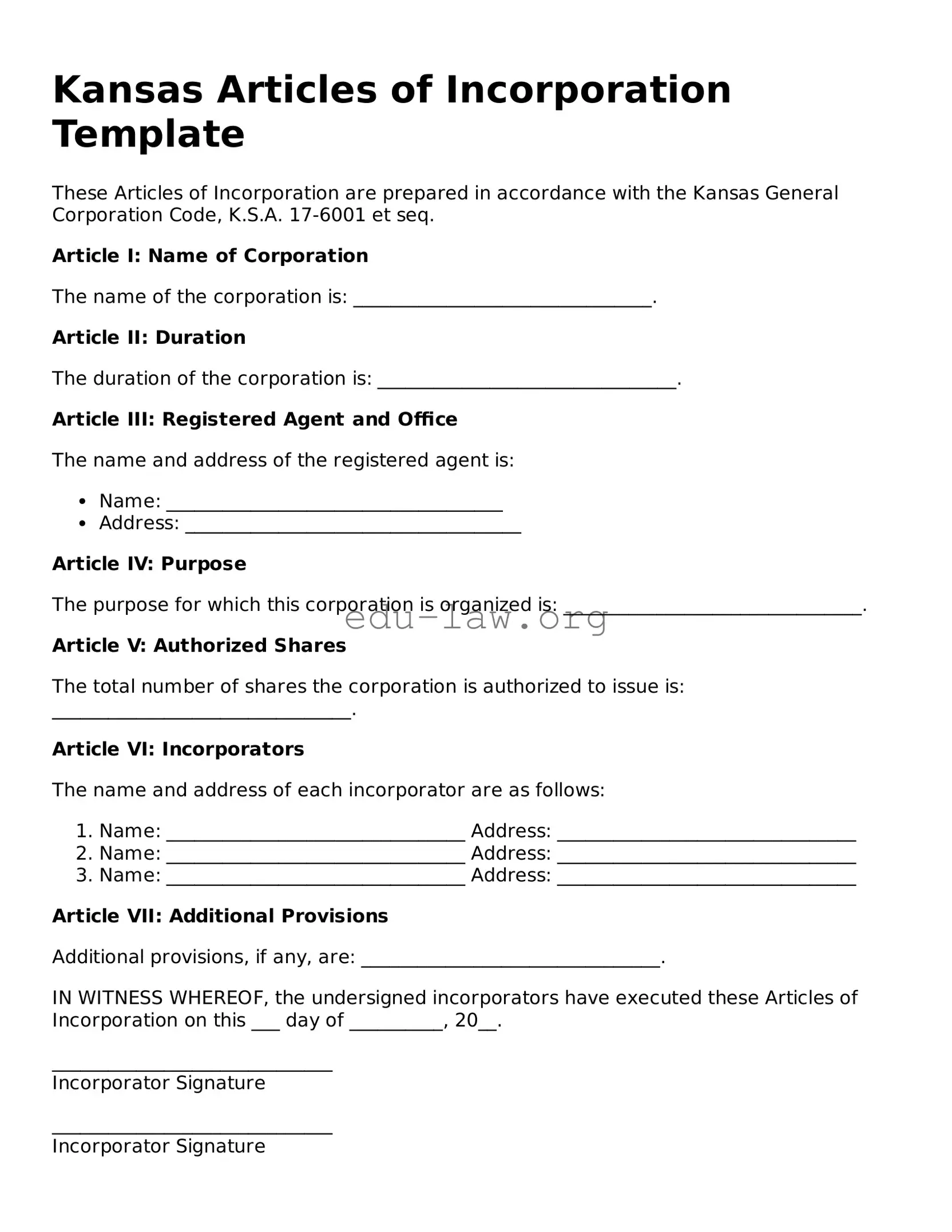
The Kansas Articles of Incorporation form is a critical document for anyone looking to establish a corporation in the state. This form serves as the foundation for your business, outlining essential details such as the corporation's name, its purpose, and the duration of its existence. It requires the identification of the registered agent, who will receive legal documents on behalf of the corporation, and mandates the listing of the initial board of directors. Additionally, the form allows for the specification of the corporation's stock structure, detailing the types and number of shares that can be issued. Completing this form accurately is vital, as it not only facilitates the legal recognition of your corporation but also ensures compliance with state regulations. Understanding these components will empower you to navigate the incorporation process with confidence and clarity.
Kansas Articles of Incorporation Template
These Articles of Incorporation are prepared in accordance with the Kansas General Corporation Code, K.S.A. 17-6001 et seq.
Article I: Name of Corporation
The name of the corporation is: ________________________________.
Article II: Duration
The duration of the corporation is: ________________________________.
Article III: Registered Agent and Office
The name and address of the registered agent is:
Article IV: Purpose
The purpose for which this corporation is organized is: ________________________________.
Article V: Authorized Shares
The total number of shares the corporation is authorized to issue is: ________________________________.
Article VI: Incorporators
The name and address of each incorporator are as follows:
Article VII: Additional Provisions
Additional provisions, if any, are: ________________________________.
IN WITNESS WHEREOF, the undersigned incorporators have executed these Articles of Incorporation on this ___ day of __________, 20__.
______________________________
Incorporator Signature
______________________________
Incorporator Signature
______________________________
Incorporator Signature
| Fact Name | Description |
|---|---|
| Purpose | The Kansas Articles of Incorporation form is used to officially create a corporation in the state of Kansas. |
| Governing Law | The form is governed by the Kansas General Corporation Code, specifically K.S.A. 17-6001 et seq. |
| Filing Requirements | To file the Articles of Incorporation, a minimum of one incorporator is required, and the form must include the corporation's name, address, and purpose. |
| Filing Fee | A filing fee is required when submitting the Articles of Incorporation, which varies depending on the type of corporation being formed. |
| Processing Time | The processing time for the Articles of Incorporation can vary, but it generally takes a few business days for the state to review and approve the application. |
Filling out the Kansas Articles of Incorporation form is an important step in establishing your business. Once you complete the form, you will submit it to the Kansas Secretary of State's office, where it will be processed. After that, you can focus on other essential aspects of your new venture.
What are the Kansas Articles of Incorporation?
The Kansas Articles of Incorporation is a legal document that establishes a corporation in the state of Kansas. This form provides essential information about your business, including its name, purpose, and the registered agent. By filing this document, you officially create a separate legal entity that can own property, enter contracts, and conduct business in its own name.
Who needs to file the Articles of Incorporation?
If you plan to start a corporation in Kansas, you must file the Articles of Incorporation. This applies to various types of corporations, including nonprofit organizations and for-profit businesses. If you want to limit your personal liability and establish a formal business structure, filing this document is essential.
What information is required in the Articles of Incorporation?
The form typically requires the corporation's name, the purpose of the corporation, the duration of its existence (if not perpetual), and the address of the registered office. You will also need to provide the name and address of the registered agent, who will receive legal documents on behalf of the corporation. Additionally, the names and addresses of the initial directors may be required.
How do I file the Articles of Incorporation in Kansas?
You can file the Articles of Incorporation online or by mail. If filing online, visit the Kansas Secretary of State's website, where you can complete the form electronically. For mail submissions, download the form, fill it out, and send it to the appropriate office along with the filing fee. Ensure that you check the current fee schedule, as fees may vary based on the type of corporation.
What happens after I file the Articles of Incorporation?
Once you submit the Articles of Incorporation, the state will review your application. If everything is in order, you will receive a certificate of incorporation, which officially recognizes your corporation. This certificate is important, as it allows you to conduct business legally in Kansas. Keep it in a safe place, as you may need it for banking, contracts, or other legal matters.
Can I amend the Articles of Incorporation after filing?
Yes, you can amend the Articles of Incorporation if there are changes to your corporation's structure or purpose. To do this, you must file an amendment form with the Kansas Secretary of State. This process typically involves providing the details of the changes and paying a filing fee. Keeping your Articles of Incorporation up to date is crucial for maintaining compliance with state laws.
Incorrect Business Name: One common mistake is choosing a name that is already in use. Before filing, check the Kansas Secretary of State's database to ensure your desired name is unique.
Missing Registered Agent Information: Every corporation must have a registered agent. Failing to provide accurate details about this person or business can delay your application.
Omitting Purpose Statement: The form requires a brief description of your corporation's purpose. Skipping this step or being too vague can lead to rejection.
Improper Number of Shares: When stating the number of shares, ensure it aligns with your business plan. Listing an incorrect number can cause confusion later on.
Inaccurate Incorporator Information: The incorporator's name and address must be correct. Double-check this information to avoid processing delays.
Neglecting to Sign the Form: A signature is required for the Articles of Incorporation to be valid. Forgetting to sign can result in your application being rejected.
When forming a corporation in Kansas, several documents and forms accompany the Kansas Articles of Incorporation. These additional documents serve various purposes, ensuring compliance with state laws and facilitating smooth operations for the new entity. Below is a list of commonly used forms and documents that are often required or recommended alongside the Articles of Incorporation.
Incorporating a business is a significant step, and understanding the necessary documents is crucial for a successful launch. Each of these forms plays a vital role in establishing a solid foundation for the corporation, promoting transparency and accountability as the business begins its journey.
The Articles of Organization is a document used for establishing a Limited Liability Company (LLC). Similar to the Articles of Incorporation, it serves as a foundational document that outlines the basic structure and purpose of the business. Both documents require information about the business name, registered agent, and the principal office address. However, while the Articles of Incorporation focus on corporations, the Articles of Organization cater specifically to LLCs, emphasizing the flexible management structure and limited liability features that LLCs provide.
The Certificate of Formation is another document closely related to the Articles of Incorporation. This document is often used interchangeably with the Articles of Incorporation in some states. It lays out the essential details required to legally form a corporation, such as the name, purpose, and duration of the business. While the terminology may differ, the function remains the same: to officially register a corporation with the state and establish its legal existence.
The Bylaws of a corporation serve as the internal rules governing the management and operation of the company. While the Articles of Incorporation provide a broad overview of the corporation's structure, the Bylaws dive deeper into the specific procedures for decision-making, the roles of officers, and the process for holding meetings. Together, these documents ensure that the corporation operates smoothly and in accordance with both state law and its own established guidelines.
The Operating Agreement is similar to the Bylaws but is specifically designed for LLCs. This document outlines the management structure and operational procedures of the LLC, including member responsibilities, profit distribution, and decision-making processes. While the Articles of Incorporation set up the legal framework, the Operating Agreement provides the detailed operational guidelines that members agree to follow.
The Partnership Agreement is a key document for partnerships, detailing the terms and conditions under which the partners will operate the business. Like the Articles of Incorporation, it defines the roles and responsibilities of each partner, profit-sharing arrangements, and procedures for resolving disputes. Both documents aim to provide clarity and structure, though the Partnership Agreement is tailored to the unique dynamics of partnerships rather than corporations.
The Certificate of Good Standing is a document that confirms a corporation's compliance with state regulations. While the Articles of Incorporation initiate the legal existence of a corporation, the Certificate of Good Standing serves as proof that the corporation is properly registered and has met all necessary requirements. This document is often required for various business transactions, such as applying for loans or entering contracts.
The Annual Report is a document that corporations must file periodically to update the state on their business activities. Similar to the Articles of Incorporation, it contains essential information about the corporation, including changes in management or business address. While the Articles of Incorporation establish the corporation's initial framework, the Annual Report ensures that the state has current information, reinforcing the corporation's ongoing compliance with state laws.
The Shareholder Agreement is a document that outlines the rights and obligations of the shareholders in a corporation. It complements the Articles of Incorporation by providing more detailed terms regarding share ownership, voting rights, and procedures for transferring shares. Both documents work together to protect the interests of shareholders and ensure the corporation operates in a fair and transparent manner.
The Business License is a document required by local or state governments to operate legally within a specific jurisdiction. While the Articles of Incorporation establish the corporation at the state level, the Business License is often necessary for compliance with local regulations. Both documents are essential for legal operation, but they serve different purposes: one for formation and the other for operational legitimacy.
When filling out the Kansas Articles of Incorporation form, it is important to follow specific guidelines to ensure accuracy and compliance. Here are nine things to consider:
When it comes to the Kansas Articles of Incorporation form, there are several misconceptions that can lead to confusion for those looking to establish a corporation. Understanding these misconceptions can help streamline the incorporation process and ensure compliance with state regulations.
Many believe that submitting the Articles of Incorporation is all that is required to form a corporation. However, additional steps, such as obtaining necessary licenses and permits, are also essential.
Some individuals think they can choose any name for their corporation. In reality, the name must be unique and not already in use by another registered entity in Kansas.
While it is possible to file at any time, it is advisable to consider the timing of your filing. Starting your business at the beginning of the fiscal year may offer certain advantages.
People often assume that the process is uniform across all corporation types. Different types, such as nonprofit or for-profit, may have unique requirements and forms.
Some believe that a registered agent is optional. In Kansas, however, every corporation must designate a registered agent to receive legal documents.
Filing the Articles of Incorporation is just the first step. Success depends on various factors, including market conditions, business planning, and management strategies.
Many think that modifications to the Articles can be made without consequence. While changes are possible, they often require formal amendments and may involve additional fees.
While it is true that the Articles are public, there may be limitations on how easily they can be accessed. Some information might require specific requests or fees to obtain.
When filling out and using the Kansas Articles of Incorporation form, consider the following key takeaways: