The Kansas Affidavit of Correction form serves as a vital tool for individuals seeking to amend errors in official documents. Whether it’s a mistake in a property deed, a marriage certificate, or any other legal filing, this form provides a straightforward way to rectify inaccuracies. By completing this affidavit, a person can assert that a mistake occurred and outline the necessary corrections. It’s essential to ensure that all information is accurate and clearly stated, as this document may need to be filed with the appropriate county office or court. The process typically involves gathering supporting evidence and signatures to validate the corrections being made. Understanding how to properly utilize this form can help prevent future complications and ensure that records reflect the correct information.
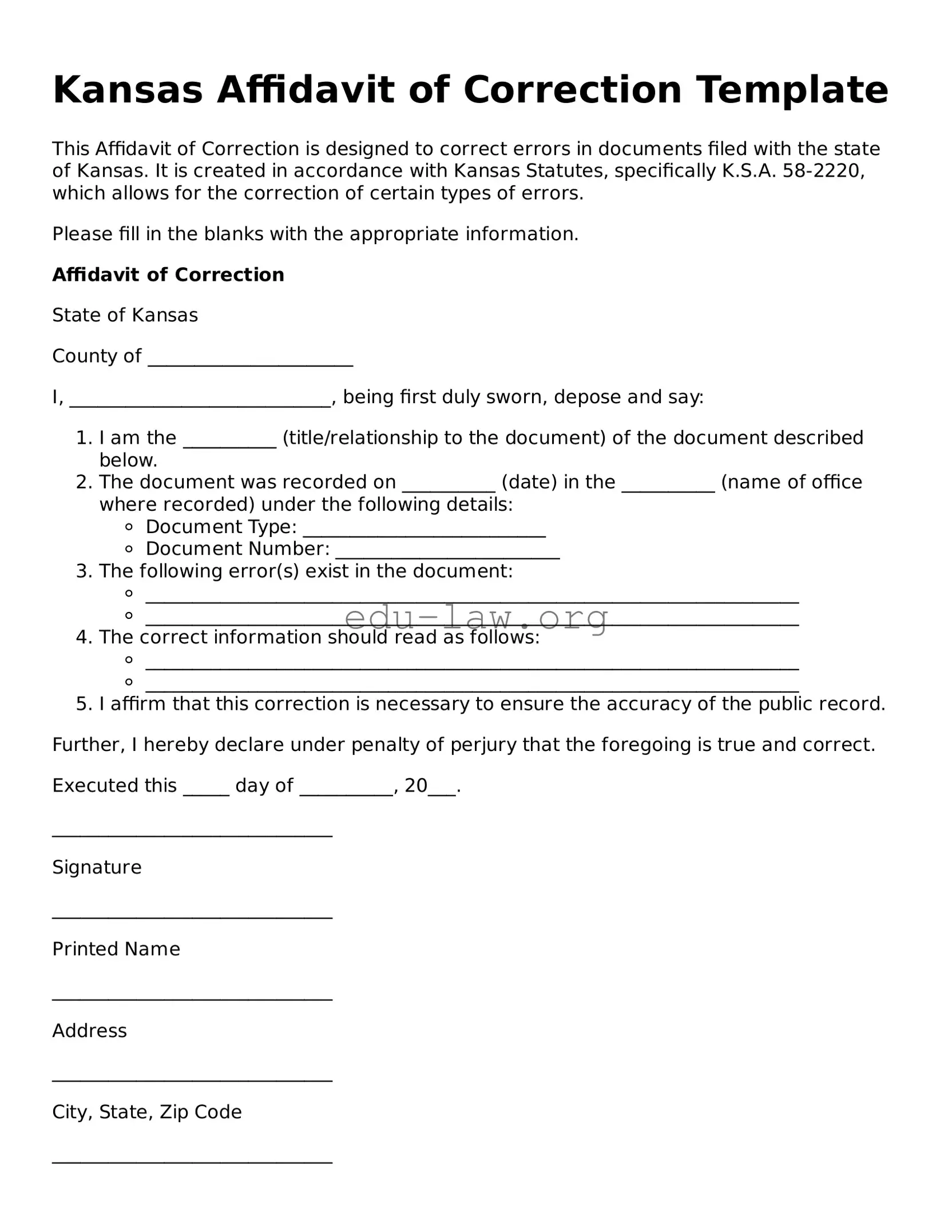
Kansas Affidavit of Correction Template
This Affidavit of Correction is designed to correct errors in documents filed with the state of Kansas. It is created in accordance with Kansas Statutes, specifically K.S.A. 58-2220, which allows for the correction of certain types of errors.
Please fill in the blanks with the appropriate information.
Affidavit of Correction
State of Kansas
County of ______________________
I, ____________________________, being first duly sworn, depose and say:
Further, I hereby declare under penalty of perjury that the foregoing is true and correct.
Executed this _____ day of __________, 20___.
______________________________
Signature
______________________________
Printed Name
______________________________
Address
______________________________
City, State, Zip Code
______________________________
Phone Number
Subscribed and sworn to before me this _____ day of __________, 20___.
______________________________
Notary Public
My commission expires: _____________
| Fact Name | Details |
|---|---|
| Purpose | The Kansas Affidavit of Correction is used to correct errors in recorded documents. |
| Governing Law | This form is governed by Kansas Statutes Annotated, Section 58-2220. |
| Eligibility | Any party involved in the original document can file the affidavit. |
| Filing Process | The completed affidavit must be filed with the appropriate county office where the original document was recorded. |
Once you have the Kansas Affidavit of Correction form, you’re ready to fill it out. This form is essential for making corrections to previously filed documents. Follow the steps below to ensure you complete it accurately.
After you’ve completed the form, make sure to submit it to the relevant authority. This could be a county clerk or another designated office. Keep a copy for your records, as this will be important for future reference.
What is the Kansas Affidavit of Correction form?
The Kansas Affidavit of Correction form is a legal document used to correct errors in public records. It serves to clarify or amend information that may have been inaccurately recorded, ensuring that the public record reflects the correct details. This can include errors in names, dates, or other important data associated with legal documents such as deeds or mortgages.
Who can file an Affidavit of Correction?
Any individual or entity that identifies an error in a public record can file an Affidavit of Correction. This includes property owners, legal representatives, or authorized agents. It is essential that the person filing the affidavit has a direct interest in the record being corrected.
How do I complete the Affidavit of Correction form?
To complete the Affidavit of Correction form, gather the necessary information about the record that needs correction. Fill out the form with accurate details, including the nature of the error and the correct information. Ensure that all signatures are obtained, and consider having the document notarized for added validity.
Where do I submit the Affidavit of Correction?
The completed Affidavit of Correction must be submitted to the appropriate county office where the original document is filed. This is typically the Register of Deeds or a similar office. Check with the specific county for any additional submission requirements or fees that may apply.
Is there a fee associated with filing the Affidavit of Correction?
Yes, there may be a fee for filing the Affidavit of Correction. The fee can vary by county, so it is advisable to contact the local office for the exact amount. Be prepared to pay this fee at the time of submission to ensure prompt processing of your request.
How long does it take for the correction to be processed?
The processing time for an Affidavit of Correction can vary depending on the county and the volume of submissions they are handling. Generally, it may take a few days to a few weeks. It is recommended to follow up with the county office if you do not receive confirmation of the correction within a reasonable timeframe.
What happens if my Affidavit of Correction is denied?
If your Affidavit of Correction is denied, you will receive a notice explaining the reasons for the denial. You may have the option to appeal the decision or correct any issues identified in your submission. It is important to address any concerns promptly to ensure that the correct information is eventually recorded.
Incomplete Information: Many individuals forget to fill in all required fields. Leaving any section blank can lead to delays in processing.
Incorrect Details: Double-checking the information is crucial. Mistakes in names, dates, or addresses can cause complications.
Signature Issues: Failing to sign the affidavit or using a signature that doesn't match official documents can result in rejection.
Not Notarizing: Some people overlook the requirement for notarization. An unsigned affidavit or one without a notary seal is not valid.
Missing Supporting Documents: Often, individuals forget to include necessary attachments. Missing documents can delay the correction process.
Wrong Filing Location: Submitting the affidavit to the wrong office can lead to confusion. Always confirm where to send your form.
Ignoring Instructions: Each affidavit comes with specific instructions. Not following them can lead to errors and rejections.
Failing to Keep Copies: After submission, it's wise to keep copies of the affidavit and any related documents. This can be helpful for future reference.
Not Following Up: After filing, some people forget to check the status of their affidavit. Following up ensures that everything is on track.
The Kansas Affidavit of Correction form is often used to amend or correct errors in legal documents. When filing this affidavit, individuals may also need to submit additional forms or documents to ensure compliance with legal requirements. Below is a list of other forms and documents frequently associated with the Kansas Affidavit of Correction.
Submitting the Kansas Affidavit of Correction along with these supporting documents can help streamline the correction process. It ensures that all necessary information is provided and that the corrections are legally recognized. Proper documentation is crucial for maintaining the integrity of legal records.
The Kansas Affidavit of Correction form shares similarities with the Affidavit of Identity. Both documents serve to clarify or rectify information that may have been inaccurately recorded. An Affidavit of Identity is typically used when an individual needs to affirm their identity, often in situations where identity theft or fraud is suspected. Just as the Affidavit of Correction seeks to amend a previously filed document, the Affidavit of Identity provides a formal declaration that can help resolve discrepancies regarding a person's identity, ensuring that records accurately reflect the true individual.
Another document akin to the Kansas Affidavit of Correction is the Declaration of Domicile. This declaration is used to establish a person's primary residence and can be important in legal matters such as taxation and voting. Similar to the Affidavit of Correction, it requires a sworn statement and is often filed with a government agency. Both documents aim to clarify legal standing and ensure that official records align with the individual's current circumstances.
The Certificate of Correction is also comparable to the Kansas Affidavit of Correction. This certificate is used to amend errors in official documents, such as corporate filings or property records. While the Affidavit of Correction is more personal in nature, both documents serve the purpose of correcting inaccuracies. They require a formal process, often involving notarization, to ensure that the corrections are legally recognized and enforceable.
The Affidavit of Support is another document that shares some characteristics with the Kansas Affidavit of Correction. This affidavit is commonly used in immigration processes to demonstrate that a sponsor has the financial means to support an applicant. Both documents involve a sworn statement and are intended to affirm certain truths. However, while the Affidavit of Support focuses on financial responsibility, the Kansas Affidavit of Correction centers on rectifying errors in public records.
In addition, the Quitclaim Deed is similar in function to the Kansas Affidavit of Correction, particularly when it comes to property ownership. A Quitclaim Deed is used to transfer interest in real estate without guaranteeing that the title is clear. When errors in property records arise, a Quitclaim Deed can help clarify ownership, much like how the Affidavit of Correction addresses inaccuracies in other types of records. Both documents require careful attention to detail to ensure that the corrections made are legally binding.
The Affidavit of Heirship also bears resemblance to the Kansas Affidavit of Correction. This document is used to establish the heirs of a deceased person, particularly when no formal will exists. Like the Affidavit of Correction, it involves a sworn statement and serves to clarify legal standing. Both documents are essential in ensuring that the correct information is recorded, whether it pertains to property ownership or the distribution of an estate.
Finally, the Warranty Deed can be compared to the Kansas Affidavit of Correction in the realm of property transactions. A Warranty Deed provides a guarantee that the grantor holds clear title to the property and has the right to sell it. When discrepancies arise regarding property ownership, the Kansas Affidavit of Correction can be used to amend those records. Both documents aim to provide clarity and assurance in legal transactions, ensuring that all parties involved have a clear understanding of ownership and rights.
When filling out the Kansas Affidavit of Correction form, it is important to follow specific guidelines to ensure accuracy and compliance. Here are five things to do and five things to avoid.
Things You Should Do:
Things You Shouldn't Do:
Understanding the Kansas Affidavit of Correction form is essential for those looking to correct errors in public records. However, several misconceptions can lead to confusion. Here are six common misunderstandings:
By clarifying these misconceptions, individuals can better navigate the process of correcting public records in Kansas.
When dealing with the Kansas Affidavit of Correction form, understanding the key aspects can help streamline the process. Here are some important takeaways:
By following these guidelines, individuals can effectively navigate the process of correcting errors in official documents in Kansas.