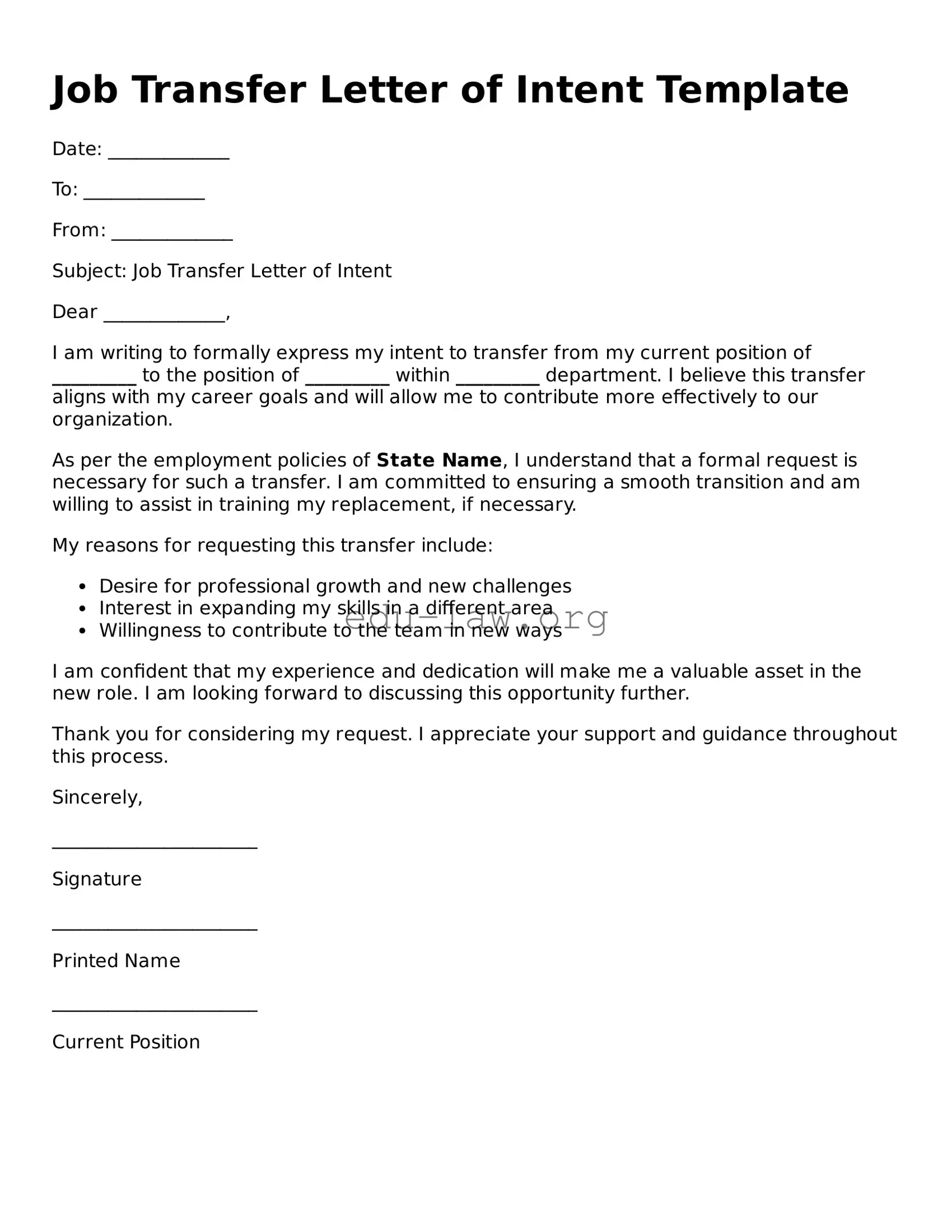
The Job Transfer Letter of Intent form serves as a crucial document for employees seeking to transition from one position to another within the same organization. This form outlines the employee's desire to transfer, providing essential details such as the current job title, the desired position, and the reasons for the transfer. It also allows the employee to express their qualifications and how they align with the new role. By clearly articulating the intent to transfer, employees can facilitate communication with their supervisors and human resources. Additionally, the form may include sections for management to provide feedback or approval, ensuring that all parties are informed and engaged in the process. Ultimately, this document helps streamline the internal transfer process, fostering a smoother transition for both employees and employers.
Job Transfer Letter of Intent Template
Date: _____________
To: _____________
From: _____________
Subject: Job Transfer Letter of Intent
Dear _____________,
I am writing to formally express my intent to transfer from my current position of _________ to the position of _________ within _________ department. I believe this transfer aligns with my career goals and will allow me to contribute more effectively to our organization.
As per the employment policies of State Name, I understand that a formal request is necessary for such a transfer. I am committed to ensuring a smooth transition and am willing to assist in training my replacement, if necessary.
My reasons for requesting this transfer include:
I am confident that my experience and dedication will make me a valuable asset in the new role. I am looking forward to discussing this opportunity further.
Thank you for considering my request. I appreciate your support and guidance throughout this process.
Sincerely,
______________________
Signature
______________________
Printed Name
______________________
Current Position
| Fact Name | Description |
|---|---|
| Purpose | The Job Transfer Letter of Intent form is used to express an employee's desire to transfer to a different position or location within the same organization. |
| Voluntary Submission | Employees typically submit this form voluntarily to indicate their interest in new opportunities within the company. |
| Format | The form can be a simple letter or a structured document, depending on the company's policies. |
| Content Requirements | It usually includes the employee's current position, the desired position, and reasons for the transfer. |
| Management Review | After submission, management will review the request and decide whether to approve or deny the transfer. |
| State-Specific Regulations | Some states may have specific employment laws affecting job transfers, such as anti-discrimination laws. |
| Governing Laws | In California, for instance, the Fair Employment and Housing Act governs employment practices related to transfers. |
| Confidentiality | Employers are generally expected to keep the contents of the transfer request confidential. |
| Impact on Employment Status | Submitting a transfer request does not guarantee a change in employment status or position. |
| Follow-Up | Employees should follow up with their manager or HR after submitting the form to discuss the next steps. |
After you have gathered all necessary information, you can proceed to fill out the Job Transfer Letter of Intent form. This form is essential for expressing your interest in a job transfer within the company. Follow these steps to complete it accurately.
Once you have completed the form, submit it to your supervisor or the HR department as per your company's policy. They will review your request and guide you on the next steps.
What is a Job Transfer Letter of Intent form?
The Job Transfer Letter of Intent form is a document that employees use to formally express their desire to transfer to a different position or department within the same organization. This form typically outlines the reasons for the transfer request, the desired position, and any relevant skills or experiences that support the request. It serves as a starting point for discussions between the employee and management regarding potential job changes.
Who should fill out the Job Transfer Letter of Intent form?
Any employee interested in changing their job role or department within the company should complete the Job Transfer Letter of Intent form. This includes individuals looking to advance their careers, change their work environment, or seek new challenges. It’s important for employees to ensure they meet any prerequisites for the new position before submitting the form.
What information is typically required on the form?
The form usually requires the employee's name, current position, and the position they wish to transfer to. Additionally, employees may need to provide a brief explanation of their reasons for the transfer, along with any skills, qualifications, or experiences that make them a suitable candidate for the new role. Some forms may also ask for the employee’s supervisor’s name and any relevant dates for the transfer.
How is the Job Transfer Letter of Intent form submitted?
What happens after I submit the Job Transfer Letter of Intent form?
Once the form is submitted, it will be reviewed by management or the HR department. They may schedule a meeting to discuss the request further, evaluate the employee’s qualifications, and consider the availability of the desired position. The employee will be informed of the decision, which may take some time depending on the company’s policies and the number of requests being processed.
When filling out a Job Transfer Letter of Intent form, people often make several common mistakes that can hinder their chances of a successful transfer. Here’s an expanded list of eight mistakes to avoid:
Many individuals use a generic template without tailoring it to their specific situation. Personalizing the letter shows genuine interest and effort.
Some applicants do not articulate why they want to transfer. A clear explanation helps the employer understand your motivation.
It’s crucial to highlight any experience or skills that relate to the new position. This information can strengthen your case for the transfer.
Sending the letter to the wrong individual can lead to confusion. Make sure to direct it to the appropriate manager or HR representative.
Each company has its own policies regarding transfers. Failing to follow these guidelines can result in delays or rejection.
Maintaining a professional tone is essential. Avoid slang or overly casual language to ensure your message is taken seriously.
Errors in spelling or grammar can create a negative impression. Always proofread your letter before submission to catch any mistakes.
After sending the letter, some individuals forget to follow up. A polite inquiry can demonstrate your continued interest in the transfer.
By avoiding these common mistakes, you can increase your chances of a successful job transfer. Take your time, be thoughtful, and approach the process with care.
A Job Transfer Letter of Intent is an important document that expresses an employee's desire to move to a different position within the organization. Alongside this form, several other documents may be necessary to facilitate the transfer process. Below is a list of related forms and documents that are commonly used in conjunction with the Job Transfer Letter of Intent.
In summary, these documents play a crucial role in the job transfer process. They help clarify expectations, evaluate qualifications, and ensure a smooth transition for both the employee and the organization. Having these forms ready can streamline the process and facilitate better communication among all parties involved.
The Job Transfer Letter of Intent form shares similarities with a resignation letter. Both documents serve as formal notices regarding an individual's employment status. A resignation letter communicates an employee's decision to leave their current position, while a transfer letter expresses the intent to move to a different role within the same organization. Each document requires clarity and professionalism, as they can significantly impact future employment relationships.
Another document akin to the Job Transfer Letter of Intent is the promotion request letter. This letter articulates an employee's desire to advance within the company. Like the transfer letter, it outlines the reasons for the request and highlights the individual’s qualifications. Both documents aim to persuade management to consider the employee’s aspirations and potential contributions to the organization.
The job application letter is also similar in purpose. While a job application letter seeks to secure a new position, the Job Transfer Letter of Intent focuses on internal movement. Both letters require a clear expression of interest and a demonstration of relevant skills. They often include a summary of the applicant’s qualifications and experiences that make them suitable for the desired position.
A letter of recommendation bears some resemblance as well. This document supports an employee's request for a transfer by highlighting their strengths and accomplishments. Both the transfer letter and a recommendation letter aim to provide context for the individual's capabilities and readiness for a new role, enhancing the chances of a successful transition.
The exit interview form, though often associated with leaving a job, parallels the transfer letter in its reflective nature. Both documents encourage individuals to articulate their experiences within the company. While the exit interview focuses on reasons for leaving, the transfer letter emphasizes the desire to remain with the organization in a different capacity, fostering a constructive dialogue about career development.
The employment verification letter is another document that shares a common thread with the Job Transfer Letter of Intent. This letter confirms an employee’s current position and duration of employment. When seeking a transfer, an employee may need to provide such verification to support their request. Both documents serve to affirm the individual’s standing within the company and can influence management’s decision-making process.
Additionally, the internal job posting is similar, as it outlines available positions within a company. Employees often refer to these postings when considering a transfer. The Job Transfer Letter of Intent directly addresses the intention to apply for one of these roles, while the internal job posting serves as the formal announcement of the opportunity. Both are integral to the internal mobility process.
Lastly, the employee performance review form relates closely to the Job Transfer Letter of Intent. This document evaluates an employee’s work performance and contributions. A strong performance review can bolster a transfer request by demonstrating the employee’s value to the organization. Both documents emphasize the importance of performance in career advancement and can significantly impact an employee’s prospects for internal movement.
When filling out the Job Transfer Letter of Intent form, it is essential to approach the task with care and attention to detail. Below is a list of things you should and shouldn't do to ensure your letter is effective and professional.
The Job Transfer Letter of Intent form is an important document for employees seeking to change positions within their organization. However, several misconceptions can lead to confusion about its purpose and use. Below is a list of common misunderstandings regarding this form.
Understanding these misconceptions can help employees navigate the Job Transfer Letter of Intent process more effectively. Awareness of the true nature of the form allows for better communication and expectations between employees and management.
Filling out a Job Transfer Letter of Intent form can be an important step in your career journey. Here are some key takeaways to keep in mind:
Taking these steps can help ensure that your Job Transfer Letter of Intent is effective and well-received.