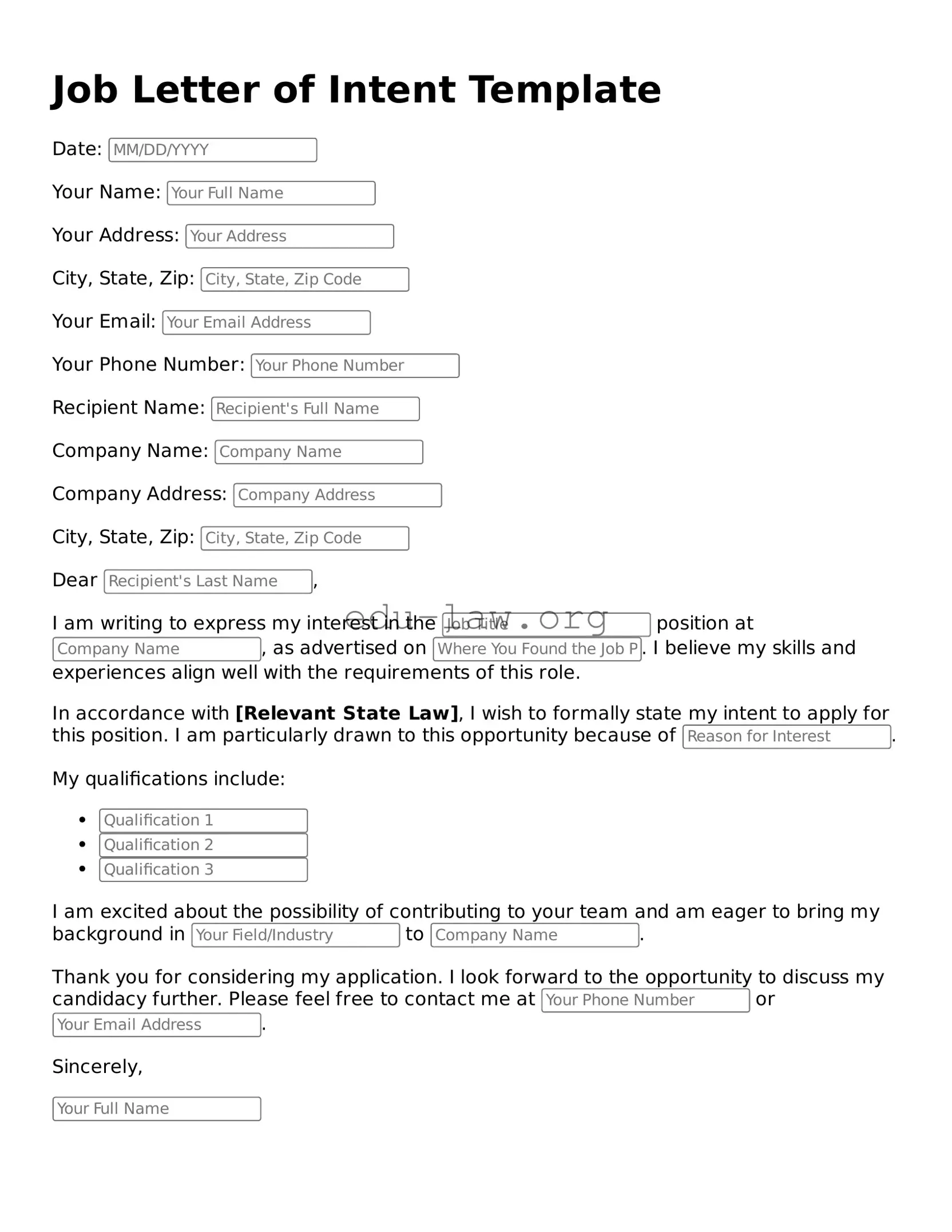
The Job Letter of Intent form serves as a crucial document for individuals seeking employment, providing a structured way to express interest in a specific position within an organization. This form typically includes essential components such as the applicant's contact information, the job title being pursued, and a brief overview of relevant qualifications and experiences. By outlining the applicant's motivations for applying and how they align with the company’s goals, the form helps create a compelling narrative that can capture the attention of hiring managers. Additionally, it often allows candidates to highlight their unique skills and contributions, setting them apart from other applicants. Understanding the key elements of this form can significantly enhance one’s chances of making a positive impression during the job application process.
Job Letter of Intent Template
Date:
Your Name:
Your Address:
City, State, Zip:
Your Email:
Your Phone Number:
Recipient Name:
Company Name:
Company Address:
City, State, Zip:
Dear ,
I am writing to express my interest in the position at , as advertised on . I believe my skills and experiences align well with the requirements of this role.
In accordance with [Relevant State Law], I wish to formally state my intent to apply for this position. I am particularly drawn to this opportunity because of .
My qualifications include:
I am excited about the possibility of contributing to your team and am eager to bring my background in to .
Thank you for considering my application. I look forward to the opportunity to discuss my candidacy further. Please feel free to contact me at or .
Sincerely,
| Fact Name | Description |
|---|---|
| Purpose | The Job Letter of Intent form expresses a candidate's interest in a specific job position and outlines their qualifications and intentions. |
| Format | This form typically includes sections for personal information, job details, and a brief statement of intent. |
| State-Specific Requirements | Some states may have specific requirements for the content or submission of the letter, often governed by employment laws. |
| Legal Considerations | While the letter is not a binding contract, it can influence hiring decisions and may be subject to employment discrimination laws. |
| Submission Process | The form is usually submitted alongside a resume and cover letter, either electronically or in hard copy, depending on the employer's preference. |
After obtaining the Job Letter of Intent form, you are ready to begin the process of filling it out. This form is essential for expressing your interest in a position and outlining your qualifications. Completing it accurately will help you make a strong impression on potential employers.
Once the form is completed, it is ready to be submitted as part of your job application. Be sure to follow any additional instructions provided by the employer regarding submission methods and deadlines.
What is a Job Letter of Intent?
A Job Letter of Intent is a document that expresses your interest in a specific job position. It outlines your qualifications, skills, and reasons for wanting to work for a particular organization. This letter serves as a way to introduce yourself to potential employers and highlight your enthusiasm for the role.
Why is a Job Letter of Intent important?
This letter plays a crucial role in the job application process. It allows you to make a personal connection with the employer, demonstrating your genuine interest in the position. A well-crafted letter can set you apart from other candidates and provide context for your resume.
How should I format my Job Letter of Intent?
Keep your letter professional and concise. Use a standard business letter format, including your contact information, the date, and the employer's contact information at the top. Aim for a clear and organized layout, using paragraphs to separate different points. A length of one page is typically sufficient.
What should I include in my Job Letter of Intent?
Your letter should include an introduction that states the position you are applying for, a body that highlights your relevant skills and experiences, and a conclusion that expresses your eagerness to discuss the opportunity further. Be sure to personalize it for the specific job and company.
Can I use a Job Letter of Intent for multiple job applications?
While you can use a template for your letter, it’s essential to customize each one for the specific job and employer. Tailoring your letter shows that you’ve done your research and are genuinely interested in the position, which can significantly improve your chances of getting an interview.
How do I address my Job Letter of Intent?
Whenever possible, address your letter to a specific person, such as the hiring manager or recruiter. If you can’t find a name, using a general greeting like "Dear Hiring Manager" is acceptable. Avoid using vague terms like "To Whom It May Concern," as it can come off as impersonal.
Should I mention salary expectations in my Job Letter of Intent?
Typically, it’s best to avoid discussing salary in your letter unless the job posting specifically requests that information. Focus on your qualifications and enthusiasm for the role. You can discuss salary during the interview or when you receive a job offer.
How can I make my Job Letter of Intent stand out?
To make your letter memorable, share specific examples of your achievements and how they relate to the job. Use a confident tone and express your passion for the industry and the company. A personal touch, such as mentioning a recent company initiative or project, can also make a positive impression.
What should I do after submitting my Job Letter of Intent?
After submitting your letter, follow up with the employer if you haven’t heard back within a week or two. A polite email or phone call can show your continued interest in the position. It’s a good way to keep your name fresh in the employer’s mind.
Failing to Address the Recipient Properly: Many people neglect to personalize their letter by not addressing it to a specific individual. Instead, they use generic salutations like "To Whom It May Concern." This can make the letter feel impersonal and may reduce its impact.
Not Clearly Stating the Purpose: Some applicants forget to clearly articulate the purpose of their letter. It's essential to state why you are writing and what position you are interested in. This clarity helps the reader understand your intentions right away.
Overlooking Required Information: Applicants often miss including vital information such as their contact details, the job title, or specific qualifications. Omitting these details can lead to confusion and might result in your application being overlooked.
Using Vague Language: Many letters contain vague statements that do not effectively communicate the applicant's skills or experiences. Instead of saying, "I have experience in marketing," it's better to specify the type of marketing and the results achieved.
Neglecting to Proofread: Spelling and grammatical errors can create a negative impression. It's crucial to review the letter carefully before submission. Errors can distract the reader and undermine your professionalism.
Failing to Express Enthusiasm: A lack of enthusiasm can be palpable in a letter. Applicants should convey genuine interest in the position and the organization. This passion can make a significant difference in how the letter is received.
The Job Letter of Intent form is an important document that expresses a candidate's interest in a specific position. However, there are several other forms and documents that are often used in conjunction with it to strengthen the application process. Below is a list of these documents, each serving a unique purpose.
These documents collectively enhance a candidate's application, providing a well-rounded view of their qualifications and intentions. Preparing them thoughtfully can make a significant difference in the job search process.
The Job Letter of Intent form shares similarities with a Cover Letter. Both documents serve as an introduction to potential employers, expressing interest in a position or opportunity. A Cover Letter typically accompanies a resume and highlights relevant skills and experiences tailored to the job. Like the Job Letter of Intent, it aims to persuade the reader to consider the applicant for a specific role. The tone in both documents is professional, and they often outline the applicant's motivations for seeking the position, making a compelling case for why they would be a good fit.
Another document akin to the Job Letter of Intent is the Statement of Purpose. While often used in academic settings, a Statement of Purpose outlines an individual's goals, motivations, and qualifications for a specific program or opportunity. Similar to the Job Letter of Intent, it provides a narrative that connects the applicant's past experiences to their future aspirations. Both documents require clarity and focus, as they aim to convey the applicant's vision and how they align with the organization's mission or objectives.
The Job Application is another document that resembles the Job Letter of Intent. A Job Application typically includes personal information, work history, and references. However, the Job Letter of Intent goes further by expressing the applicant's enthusiasm and intentions regarding the position. Both documents are essential in the hiring process, but the Job Letter of Intent adds a personal touch, allowing candidates to convey their passion and commitment to the role they seek.
Lastly, the Resume also bears a resemblance to the Job Letter of Intent. While a Resume lists qualifications, work experience, and skills in a concise format, the Job Letter of Intent provides a more narrative-driven approach. It allows the applicant to elaborate on their experiences and how they relate to the desired position. Together, these documents create a comprehensive picture of the candidate, with the Resume focusing on factual information and the Job Letter of Intent emphasizing personal motivation and fit for the role.
When filling out the Job Letter of Intent form, it's important to keep a few key points in mind. Here are some do's and don'ts to guide you:
Many people have misunderstandings about the Job Letter of Intent form. Here are ten common misconceptions, along with clarifications to help clear things up.
A Job Letter of Intent is not just a cover letter. While both serve to express interest in a position, a letter of intent often outlines your career goals and intentions more broadly.
This form can also be used for networking purposes or to express interest in future opportunities, not just for current job openings.
A concise letter is often more effective. Aim for clarity and focus rather than length.
A resume provides a summary of your qualifications, while a letter of intent allows you to convey your passion and goals. Both are important.
You can send this letter to anyone in the organization, including recruiters or networking contacts, who might help you find opportunities.
While it can enhance your application, it is not always a mandatory document. Check the specific requirements of the job you are applying for.
Each letter should be tailored to the specific position and organization. Personalization shows genuine interest.
Including salary expectations is not necessary in a letter of intent. Focus on your skills and interests instead.
Always proofread your letter. Errors can create a negative impression and undermine your professionalism.
Individuals at all levels, including executives, can benefit from submitting a Job Letter of Intent. It helps in expressing long-term career aspirations.
Filling out the Job Letter of Intent form is an important step in the job application process. Here are some key takeaways to keep in mind:
Using the Job Letter of Intent form effectively can enhance your chances of making a good impression. Take your time and present yourself well.